News
It's easy to believe young voters could back Trump at young conservative conference


People arrive before Republican presidential candidate former President Donald Trump speaks at the “People’s Convention” of Turning Point Action Saturday in Detroit.
Carlos Osorio/AP
hide caption
toggle caption
Carlos Osorio/AP
Sporting a “Pretty Girls Vote Republican” baseball cap and several buttons, including one reading “Gun Rights are Women’s Rights,” Lauren Kerby was surprised to be asked who she plans to vote for in the fall.
“Obviously Trump,” she said with a laugh. “I came here for a reason.”
Here is the ‘People’s Convention’, run by Turning Point Action, the advocacy wing of Turning Point USA, one of the largest national organizations focused on engaging students on conservative issues.
Turning Point – which rose out of concerns about free speech on college campuses, has grown into an unapologetically pro-Trump machine, focused on organizing for the former president ahead of the 2024 election.
It hosts events like these, attracting voters like Kerby and hundreds of others like her who want to party, young conservative style.
And this is certainly a Trump show. At the Huntington Place Convention Center in downtown Detroit, a bejeweled presidential seal with Trump’s face in the center rests on the hood of a gold-painted Mercedes-Benz. At a nearby booth among dozens, vendors are selling “America First” cowboy hats and shirts reading, “Voting Convicted Felon, 2024.”
The festivities this year come as Turning Point Action works to significantly expand its organizing presence in key swing states ahead of the general election, including Michigan, home to this year’s conference.
Just five months out, enthusiasm for Trump is high among younger attendees. NPR spoke with more than a dozen voters under 30, who remain committed to Trump, motivated by to vote for him largely because of his isolationist ideas and focus on the economy and immigration.
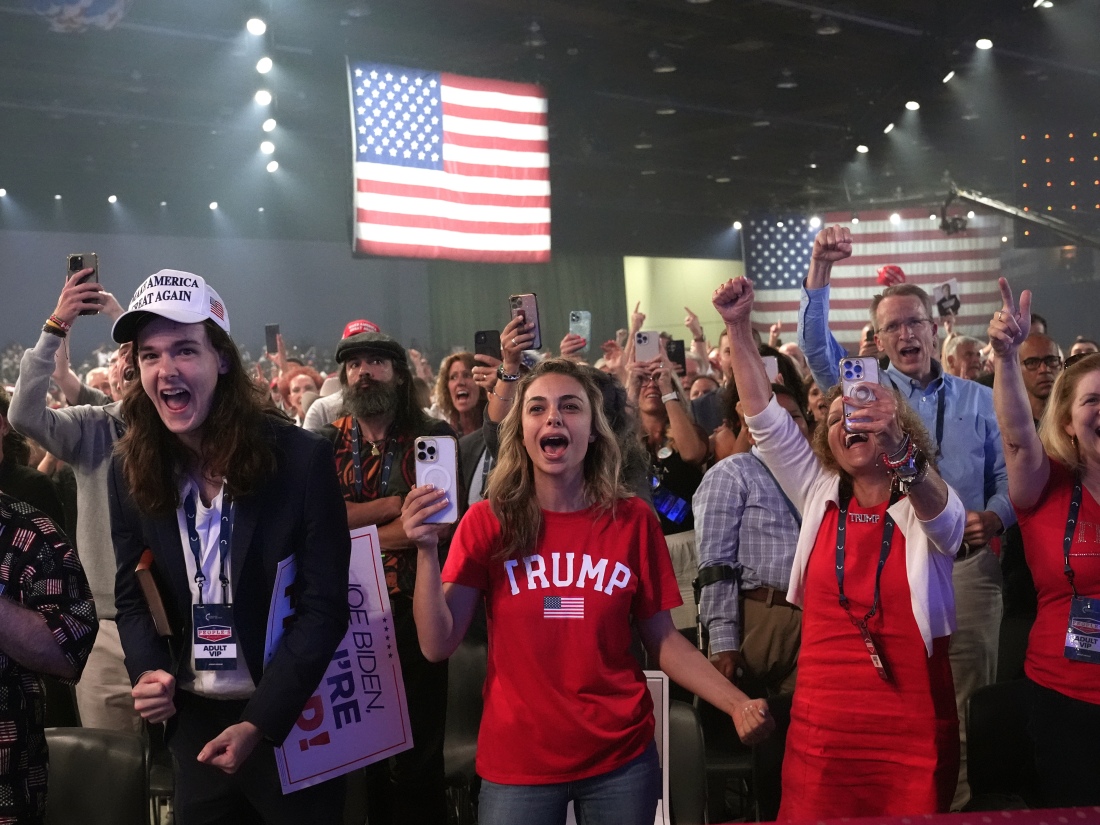
Supporters cheer as Republican presidential candidate former President Donald Trump speaks at the “People’s Convention” of Turning Point Action Saturday, June 15, 2024 in Detroit. (AP Photo/Carlos Osorio)
Carlos Osorio/AP
hide caption
toggle caption
Carlos Osorio/AP
Their unwavering support stands in contrast to sentiment of many younger Democratic voters, who remain unsure or unenthused about backing President Biden again.
Trump took the stage Saturday night as the event headliner. He ticked through his proposed second-term agenda and criticized Biden’s record, making little mention of the youth-focused nature of the event, outside of publicly thanking Turning Point founder and longtime supporter, Charlie Kirk, who is a millennial.
“[Kirk’s] got his army of young people,” Trump said. “These are young patriots. They don’t want to see… what’s been happening in our country.”
The former president’s remarks came after two days of speeches from conservative firebrands and high-profile Trump allies, including Republican National Committee co-chair and Trump’s daughter in law Lara Trump, former presidential candidate Vivek Ramaswamy, Rep. Matt Gaetz (R-Fla.) and Rep. Marjorie Taylor Greene (R-Ga.)
This year’s conference also comes just over two weeks after a New York jury found Trump guilty of criminal charges, a decision that could negatively impact his chances with younger voters. The latest Harvard youth poll, published in March, found a potential guilty verdict increased Biden’s lead by 10 percentage points among young Americans overall.
Much like their unwavering support in the election, though, voters at the event are unphased by his conviction. His mugshot is displayed on the posters and t-shirts of attendees.
To 20-year-old James Hart, the verdict has little effect.
“I don’t really think, at this point, anyone’s feelings changed. I think everyone knows who they’re going to vote for. We know Trump. Trust me – we know Joe Biden,” said Hart. “We know their policy. We know how they’re going to act. And I trust Trump.”
Where young conservatives stand
For Kerby from Berkeley, Mich., supporting Trump partially stems from his push for isolationism, including limiting U.S. aid to Ukraine in its war with Russia.
“He’s focused on what’s happening here,” she said, pointing instead to Trump’s focus on reducing illegal immigration.
“Not saying that other places don’t matter, but we should matter first,” Kerby’s friend, Elaina Luca, 21, added. “When you’re in a family, you make sure that your family is okay first.”
Luca is also backing Trump. As a mom with two young kids, she’s most concerned about rising prices.
“When I drive around and see a nice house, I like to look up how much it’s sold for,” she explained. “In today’s economy, it’s like, ‘Oh, wow, how did these people even afford that? …And it’s like, ‘Oh no, they bought it in 2012 for like $150,000 and now it’s worth like $1 million.”
“How am I supposed to get a house to raise my children to live in?” she wondered aloud, “I don’t want to pay for a house for the rest of my life.”
Turning Point’s 2024 strategy

Former President Donald Trump walks on to the stage to give the keynote address at Turning Point Action’s “The People’s Convention” on Saturday in Detroit, Michigan.
Bill Pugliano/Getty Images
hide caption
toggle caption
Bill Pugliano/Getty Images
While Turning Point’s non-profit side has held student conferences for nearly a decade, also sprinkled with appearances from Republican politicians and conservative media figures, this conference marks just the second for Turning Point Action.
The activist network has morphed into a more pronounced political force, planning to ramp up its organizing ground game ahead of the election.
“It’s night and day,” said Turning Point Action spokesman Andrew Kolvet. “Any activities we did, in 2022 for example, in the midterms, was like the Stone Age compared to the level of sophistication and just the resources that we’ve poured into this project to develop it.”

Kolvet is talking about the group’s “Chase the Vote” initiative, a get-out-to-vote campaign focused on reaching low-propensity voters in swing states that launched earlier this spring. Trump recently endorsed the program during a separate Turning Point event in Arizona, another pivotal state in 2024.
Turning Point hopes to raise $100 million to build up on the ground organizing staff and plans to work with the Trump campaign on canvassing – a notable change from past election cycles following new guidance from the Federal Election Commission.
Despite the roots of Turning Point, the program is not solely focused on young voters, though Kolvet said that will always be tied to Turning Point’s work.
Growing up under Trump, now it’s time to vote
Despite enthusiasm for Trump at Turning Point, Republicans face a steep challenge to bringing in more young voters. Voters under 30 have traditionally voted for Democrats andin 2020, Biden won the age group by a 24-point margin.
Plus – young voters tend to be aligned with Democrats on their key issues – notably on abortion access, addressing climate and curbing gun violence. And despite struggling in polling, Biden still maintains a lead with young voters overall in multiple youth polls.
But among some young conservatives, albeit a proportionally smaller group, Trump’s style of Republican politics – once fringe and now mainstream – is overwhelmingly what they want for their political future.

An attendee wears a “Team Trump” cowboy hat as people watch speakers during Turning Point’s “Peoples Convention” on Saturday in Detroit.
Jeff Kowalsky/AFP/Getty Images
hide caption
toggle caption
Jeff Kowalsky/AFP/Getty Images
“The pro-Trump, MAGA element definitely appeals more towards young conservatives and young Americans in general,” said 19-year-old Ohio student, Gabe Guidarini, a member of the College Republicans of America. “It actually addresses the problems that they face.”
He argued young people have trouble connecting to “old school Republican rhetoric” focused on cutting taxes and government spending, because they are not able to progress financially. And given the time period Gen Z has grown up during, Trump’s deviation from political norms is appealing, he explained.
James Hart agrees. Though the 20-year-old now lives in Tallahassee, he grew up in Detroit. “I was raised Democrat,” he said.
That is, until 2016, when his family flipped for Trump.
“His personality is what got my family to say. ‘Hey, you know, maybe the Democrats aren’t the greatest,’” he said. “Honesty is the best policy. And up here in the Midwest, we’re honest. We say it like it is. And Trump did that.”
Now, as Hart gets ready to vote for the first time, his mind is made up.
“I think most young people are going after Trump-like candidates,” he said. “We want the fire. We want the passion. We’re tired of the same old, same old. We want bold policy that actually is going to lead with results.”



News
Trump says proof of his allegations that vandals cut Reflecting Pool paint will be provided in court

Washington — President Trump on Monday said proof will be provided in court of his allegations that vandals “cut” a massive slit in the Lincoln Memorial Reflecting Pool, which he claims is the reason the paint is peeling on the recently renovated but algae-plagued project.
In an exchange with CBS News senior White House correspondent Ed O’Keefe, Mr. Trump insisted that vandals, rather than questionable craftsmanship, are responsible for the enduring problems following the $14.7 million sealant job. The president claimed vandals cut a 350-foot slit in the pool between the World War II Memorial and the Lincoln Memorial. Five people have been arrested for vandalism related to the Reflecting Pool, and five additional individuals were issued federal citations, according to the U.S. Park Police, although neither the company behind the project nor the U.S. Park Service has said a cut slit was responsible for the peeling.
Asked if he had proof, such as photos or video, that vandals used a knife to cut a massive slit in the pool, Mr. Trump responded: “Well, let’s put it this way, when you have a 350, I think it’s 350, not 250, when you have a 350-foot slit, from one end to the other, you think that’s proof? You think that’s proof?”
O’Keefe noted that reporters had been to the site and found no evidence of a slit.
“Well, you’d have to go see the Parks Department. They’ll show it to you, or see, see the secretary, but I saw it,” Mr. Trump said, likely referencing Interior Secretary Doug Burgum. “They cut it, they cut it very violently. The same thing with the floor, they cut it, and then they lifted it. They pulled it, and that’s what it is.”
After defending the project, the president said, “We also have pictures.”
O’Keefe asked the president for evidence of his claims.
“Yeah, at the right time you’ll see it,” Mr. Trump said. “You’ll see it in court. You’ll see it in court, but all you have to do is call the Parks Department, call the Department of Interior.”
The president also suggested someone may have placed fertilizer in the water to create the algae that teams have been attempting to clear.
“If you put fertilizer in the water, you get algae, but somebody said they might have put fertilizer, they did something to create the algae,” the president said, again without providing evidence for his claims.
CBS News has reached out to the National Park Service and the Department of the Interior. So far, there’s been no response.
Atlantic Industrial Coatings, which received a no-bid contract to install the sealant on the floor of the Reflecting Pool, told CBS News there are “some areas” that “require repairs.”
“These areas are a very small part of the massive 7-acre project, and do not indicate a failure of the liner,” the company said. “These repairs can not be made until the pool is drained. As soon as it’s feasible for the park, the pool will be drained and AIC will be back to make those needed repairs as part of the warranty.”

new video loaded: The Rise of Deadly Trucks and S.U.V.s
By Michael H. Keller, Danielle Ivory, Irineo Cabreros, Eli Murray, Gabriel Blanco and Joey Sendaydiego
June 22, 2026

Demonstrators hold a sign saying “PROTECT MINORITY VOTING RIGHTS” outside the U.S. Supreme Court in Washington, D.C., in 2025.
Jemal Countess/Getty Images for Legal Defense Fund
hide caption
toggle caption
Jemal Countess/Getty Images for Legal Defense Fund
By declining to take up a lower court ruling, the U.S. Supreme Court has dealt another blow to the Voting Rights Act.
The court announced Monday that it will not review an Arkansas-based lawsuit, leaving in place a 2025 appeals panel ruling that ends a long-used tool for protecting minority voters from discrimination under the landmark law in seven mainly Midwestern states.
That ruling found that in the states covered by the 8th U.S. Circuit Court of Appeals — Arkansas, Iowa, Minnesota, Missouri, Nebraska, North Dakota and South Dakota — private individuals and groups do not have the right to sue to enforce what’s known as Section 208 of the Voting Rights Act, which generally allows voters with a disability or inability to read or write to get help with voting from a person of their choice.
The Supreme Court’s move comes almost two months after its conservative supermajority issued a major ruling that further weakened the Voting Rights Act, setting off a groundswell in redistricting across the country.


In May, shortly after that undermining of Section 2 protections against racial discrimination in redistricting, the high court decided not to weigh in on what the legal world calls a “private right of action,” sending back to lower courts two cases brought by Black voters in Mississippi and Native American voters in North Dakota.
For decades, enforcement of these sections of the Voting Rights Act has mainly been driven by lawsuits by private individuals and groups.
But after conservative Justice Neil Gorsuch issued a single-paragraph opinion in 2021 questioning a private right of action, Republican officials in multiple states have raised a novel legal argument: Only the U.S. attorney general, they contend, has the right to bring lawsuits under these parts of the Voting Rights Act.
Such an interpretation of the law is likely to lead to a dramatic decline in voting rights lawsuits because of the Justice Department’s limited resources and shifting priorities under different presidential administrations.

The case that the justices decided not to take up was brought by the immigrant advocacy group Arkansas United, which has provided Spanish-language interpreters at polling sites to assist voters with limited English proficiency. The group challenged an Arkansas law that bans a person who is not a poll worker from helping more than six voters cast ballots. In 2022, a federal judge ruled that the state law violates Section 208 of the Voting Rights Act. But after GOP state officials appealed, an 8th Circuit panel found last year that private groups, like Arkansas United, do not have the right to bring this kind of lawsuit.
So far, the 8th Circuit — which also found that there is no private right of action under Section 2 — is the only federal appeals court to break with decades of precedent on this legal issue.
Edited by Benjamin Swasey
-

 Oregon2 minutes ago
Gray whale carcass washes ashore in Gearhart on Oregon coast
-
Pennsylvania5 minutes ago
From peace talks to Pennsylvania: Trump visiting Mack Truck facility
-
Rhode Island10 minutes ago
RI Lottery Powerball, Numbers Midday winning numbers for June 22, 2026
-
 South-Carolina17 minutes ago
What to know about a cold storage warehouse fire in Los Angeles
-
South Dakota20 minutes ago
SD Lottery Powerball, Lotto America winning numbers for June 22, 2026
-

 Tennessee32 minutes ago
Washington County, Tennessee commissioners hold workshop on senior tax freeze
-
 Texas35 minutes ago
Paxton, Trump adviser’s org win bid to block immigration rule
-

 Utah40 minutes ago
Inside Utah’s facial recognition system: How police use the technology

