Entertainment
'Bridgerton’ boss on Julie Andrews' fate, Polin's heir and Season 4

This article contains spoilers for Season 3 of Netflix’s “Bridgerton.”
The call from Shonda Rhimes came on a Saturday.
It was spring 2021 and Jess Brownell — a writer on “Bridgerton” who was living in London’s Notting Hill as filming got underway on the second season — was preparing some tapas from the local grocery store alongside her wife as they readied for guests. Brownell assumed something was wrong. Rhimes, the prolific producer behind Netflix’s smash hit, whose TV oeuvre includes hit series “Grey’s Anatomy” and “Scandal,” doesn’t often make work calls on the weekends.
“The first thing she said was, ‘What would you think about stepping into the showrunner role going forward?’” Brownell recalled. “It was very surreal.”
“Bridgerton” creator Chris Van Dusen, who had developed Julia Quinn’s bestselling historical romance novels for television and overseen the first two seasons, was set to depart ahead of the third installment. Brownell, who had been a writer on the series since its first season, didn’t let self-doubt crash that fateful phone call with Rhimes — instead, as she tells it, she was quick to say she was ready.
“And then panic came the next day,” she said.
Harnessing the momentum of a globally popular franchise, after all, is as high-stakes as maintaining the anonymity of the ton‘s gossip columnist, Lady Whistledown. “Bridgerton” was an instant success when it was released in 2020, aided by the passionate romance between Daphne Bridgerton (Phoebe Dynevor) and Simon Bassett, the Duke of Hastings (Regé-Jean Page). (According to viewership data released by Netflix, 82 million households watched the first season in its first month of release.) Its sophomore outing — focused on another Bridgerton offspring, Anthony (Jonathan Bailey), and his angsty relationship with Kate Sharma (Simone Ashley) — was also a triumph. And “Queen Charlotte,” the prequel spinoff that tells the monarch’s backstory as she falls in love with King George III, continued the insatiable fandom.
When word spread that Season 3 would chronicle the friends-to-lovers dynamic between Colin Bridgerton (Luke Newton) and Penelope Featherington (Nicola Coughlan) — a fan favorite to many of the books’ readers — the pressure was intense to rise to the occasion.
Still, Brownell knows all too well the value of a little drama.
Like Van Dusen, she is a veteran of Shondaland, Rhimes’ production company. Three months after graduating from USC’s film school, Brownell landed a job as a second assistant to Betsy Beers, Rhimes’ producing partner, following a stint in a pilot program for aspiring Hollywood assistants coordinated by the Writers Guild of America. She’s been at Shondaland since, working her way up on “Scandal,” starting as a researcher — “I was very, very unqualified for it, but I’m good at Google, so it worked out” — until she got the opportunity to write a couple of freelance scripts and eventually was hired on.
“‘Scandal’ was a really interesting experience,” she said, explaining that she loved the show but the subject matter wasn’t in her wheelhouse. “I remember sitting in the writers room, sometimes with people around me pitching ideas, not having as many ideas as everyone else, and just going, ‘Oh, maybe I’m not that good at this.’” It wasn’t until she arrived in the “Bridgerton” writers room, her first job after “Scandal” ended, that she realized, “‘Oh, I was in the wrong sandbox. Now I’m in my happy place.’”
In a recent video call from London, while taking a break from the “Bridgerton” writers room, Brownell talked about the debate with Rhimes over Colin’s virginity, Julie Andrews’ fate as narrator on the series and the visual changes coming to Season 4. This interview has been edited and condensed for clarity.
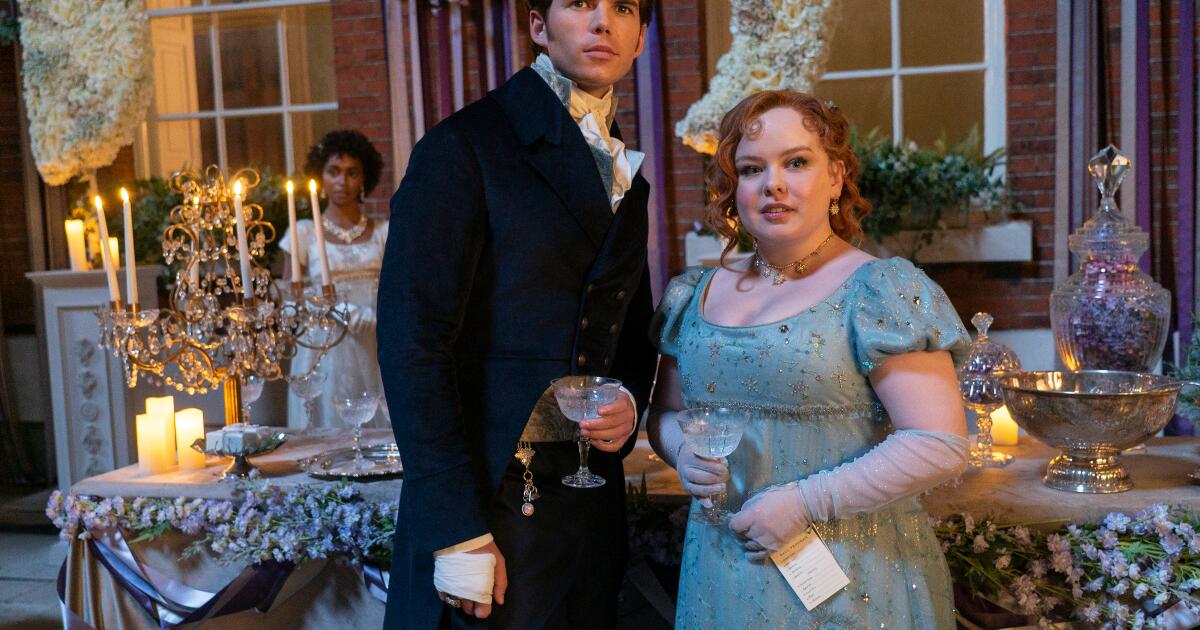
Luke Newton as Colin Bridgerton and Nicola Coughlan as Penelope Featherington in an episode from the third season of “Bridgerton.”
(Liam Daniel / Netflix)
The show has been an incredible success since it launched. How would you describe what it was like, taking over as showrunner?
The pressure was immense. I knew that if there was a drastic decline in the numbers or in the reception that I was the most obvious thing that changed, the thing to blame. It’s been a huge relief and really joyful to see people responding the way they have. I have been with the show from Season 1 and I am proud of my contributions to the show. That was the thing that I kept reminding myself: This isn’t my first time doing this. And I had an amazing writing staff who I really relied on.
The first half of the season generated a lot of chatter. Are you someone who reads comments and tweets?
I was really good the entire time we were writing and in production — I was nowhere near “Bridgerton” internet. But I have allowed myself to dip a little pinkie toe in since the [first half of the season] aired. I have a really sweet algorithm going on TikTok right now that’s basically just live carriage reactions. It’s the best thing ever. I spent three years working over Zoom, partly during the end of the pandemic, and to finally have it out there and to see people in their living rooms, reacting the way they are and going, “Oh my gosh, Pitbull!” — that was the coolest thing ever. The reaction to Pitbull has been a great surprise. That’s one of the few songs that I picked early on; it was in my showrunner’s cut. I was a little worried because I knew it was a slightly irregular choice, but the song just slaps so hard.
This was the first season of “Bridgerton” split into two parts. How did you feel about that decision?
We had actually already written and produced the entire season thinking it was going to all drop at once when Netflix approached us about splitting it. We did already have that midpoint with the carriage scene and so it worked pretty perfectly. I had concerns because I know, as a viewer, I’m someone who also wants to mainline TV shows that I love. But I was hopeful that it was going to be a good chance for people to pause and get to chat in their circles about the first half. What happens when you drop it all at once is that people are mostly just reacting to the end because that’s where usually all of the biggest “OMG” moments are. It’s been really gratifying as a writer to see people react to some of the earlier beats that we’re also really proud of.
Something that’s been tricky is people reacting before they’ve gotten to see the entire picture of what we’ve intended. I know there’s been some chatter about Colin being a whole other character. I’m like, “Yeah, that’s the point. Give us a minute!” I know that once people see the back half, they’re going to understand, but, of course, there are moments where I’ve felt frustrated with that.
I’m assuming the same release strategy will apply for next season. Is that shaping how you’re thinking about things?
I don’t know for sure that we’re going to be doing that, but it does seem to be something that Netflix wants to do. It seems to have helped the numbers. I would guess they would want to do it again. It doesn’t really change the way we approach story because we do always build to a major moment in the middle of the [season] that turns the action on its head.

Jess Brownell on taking over “Bridgerton”: “I knew that if there was a drastic decline in the numbers or in the reception that I was the most obvious thing that changed, the thing to blame, so it’s been a huge relief, and really joyful to see people responding the way they have.”
(Evelyn Freja / For The Times)
My TikTok algorithm likely looks a lot like yours — there’s no shortage of “Bridgerton” videos of declarations of love, like Anthony proclaiming to Kate: “You are the bane of my existence and the object of all my desires.” How did you and the writers want Colin or Penelope to express their love for each other?
After “I burn for you” became such a thing in Season 1, there was a moment in Season 2 where we got a little in our heads about trying to think what the moment was going to be, and it was not the one that we expected. We thought it was going to be “You vexed me.” And instead, obviously, it was Anthony’s wonderful line.
I’ve given up on trying to craft something for the sole purpose of it popping off. Also, if people have seen the entire season, they will know Colin is such a lover boy. He has so many different love confessions this season and so many big speeches about his adoration for his wife that it’s just impossible to predict which one is going to hit the hardest.
Unlike previous couples, Penelope and Colin have a backstory; there’s history there. How did that inform your approach?
It’s extra pressure because people love them so much. But it’s also a bonus that they’ve been established for two seasons, and that people have already invested in them. The challenge was making sense of everything we’ve already seen from them in Seasons 1 and 2, and building that into their arcs leading toward each other.
Of course, all writers on Season 1 have read all the [“Bridgerton”] books multiple times, but you have to take characters through some zigs and zags over the course of the season — especially with Colin, there was a lot of talk about how to reconcile the different actions we’ve seen from him, including proposing to Marina and saying he would have stayed with her even if she had told him about the baby. It’s not in the book for Colin’s character, but we were like, “Right, he’s got white knight syndrome.” He is a guy who wants everybody to like him. It’s very different from Anthony’s sense of duty and obligation. Colin’s need to be liked comes from a much more insecure place where he doesn’t really know what he has to offer, and doesn’t feel worthy.
The romance whirlwind that Penelope and Colin find themselves in is brief because Penelope’s secret — that she’s Lady Whistledown — sends things into a tailspin. What was the challenge of making so much fit in the eight episodes?
The Whistledown secret hanging over everything was a really helpful narrative device that we had this season, because it’s like Chekhov’s gun — you know that it’s going to go off at some point, and that provides the central tension in the back half of the season. Because we had that gun waiting to go off, we knew that we were going to be able to spend more time in the love bubble between Colin and Penelope in the back half. Whereas I think in previous seasons we had to build a ton of conflict directly between the main couple.
In the front half — I feel like Colin has been in love with Penelope all along. I think he’s just been too much of a dunderhead, as they would say in Regency times, to figure it out. It’s the way it is in the book. I do think that one kiss is really all that he needed to open up the door and go, “Oh, my God.” I understand that it is a little bit quick, but he’s known her forever.
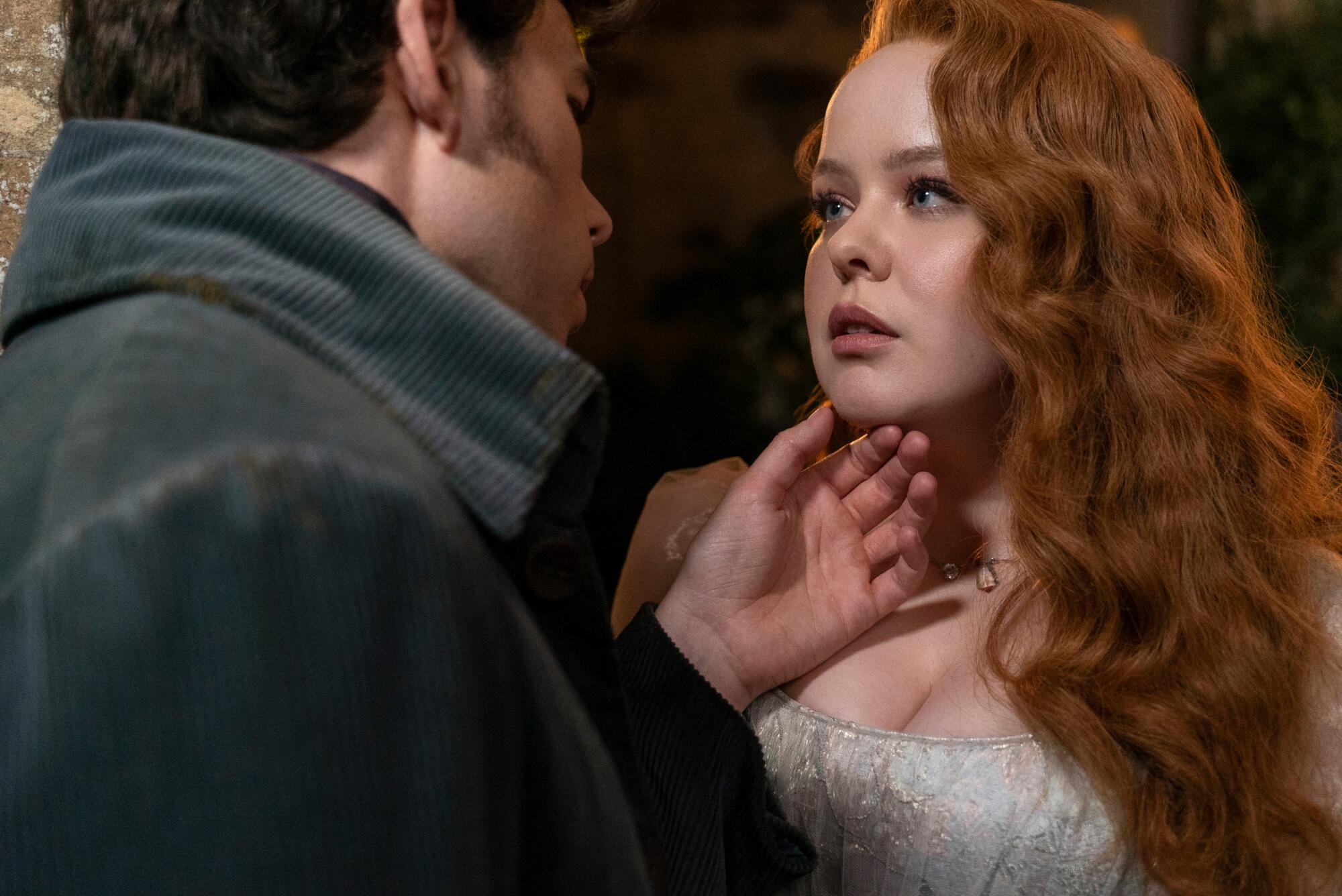
Colin Bridgerton (Luke Newton) and Penelope Featherington (Nicola Coughlan) in Season 3 of “Bridgerton.” Jess Brownell on their romance: “I wanted to get the dynamic right because there is such depth between those characters.”
(Liam Daniel / Netflix)
What was the most difficult scene or episode to execute? The carriage ride scene? The mirror scene?
The carriage scene and the mirror scene — those were just fun. We knew exactly what we wanted to do with those. I will say that the mirror scene, we really wanted to get right because it means a lot to me for the intimacy scenes to come from a storytelling place. I wanted to get the dynamic right because there is such depth between those characters and such a long-standing friendship that I wanted it to feel like a different kind of sex than we’ve seen. Finding those moments of laughter was really the key there.
Episodes 5 and 6 are always the hardest episodes to write in every season; that tends to be where the main drama has come to a peak, at the midpoint of the season. And then you’re waiting to get to the bigger stuff that is going to happen at the end of the season. Thankfully, the charades party with the ticking clock and Cressida deciding to come out as Whistledown provided us nice, new obstacles in the back half.
There’s an interesting thing that happens with this show, which is the tallying of intimate moments. Is that something you and the writers think about?
It feels like that maybe started happening after Season 2 had a different approach to intimacy than Season 1. I think people started getting very granular with the way they were talking about how “Bridgerton” does intimacy, But it’s so funny to me — I think of Season 2 as one of the sexiest seasons. This is a show, hopefully, for everyone, but I think when we’re talking about women and intimacy scenes, to me, the longing and the yearning and the pinkies grazing each other and the furtive looks from across a room — that is intimacy.
What is your approach to adaptation and assessing where you want to stay faithful to the book or when it’s appropriate to make tweaks for TV ?
Julia Quinn has been really lovely and understanding about some of the changes that we’ve made. A lot of romance novels, specifically, it’s a lot of internal monologue. But I think on television, you do have to find ways to externalize that. The charm-school plot, for example, and Colin being Penelope’s tutor, that is not in the book, but it’s really just a way of externalizing certain conversations they have about confidence and popularity. I really tried to honor the spirit of the book, the emotional journey of the book. In the writers room, on the first day, we talk about our favorite moments from the book that absolutely have to be there. Some of the scenes we’ve lost, it’s just been a calculation about figuring out how to weave in the ensemble stories — like the Whistledown hunt in the book comes from Lady Danbury, she’s the one who issues a reward. But we had been watching the queen hunt for Lady Whistledown for two seasons. … Sometimes it’s just a practical reason like that.

“Bridgerton” showrunner Jess Brownell on steamy moments: “This is a show, hopefully, for everyone, but I think when we’re talking about women and intimacy scenes, to me, the longing and the yearning and the pinkies grazing each other and the furtive looks from across a room — that is intimacy.”
(Evelyn Freja / For The Times)
In the book, Colin discovers that Penelope is Lady Whistledown before the carriage scene. Why change that?
When we were talking about it in the room, if you’re looking at Colin and Penelope as the leads of the season, that is the major dramatic moment between them. I’m really strict about structure. If you’re thinking about the season as a three-act structure, the way you would look at it with a movie, the end of Episode 6 is meant to be the low point or the end of Act Two in traditional storytelling structure. That’s the moment where you want to have the biggest fight or the biggest loss between your main couple. What could possibly be bigger than him finding out that she’s Whistledown and that she’s been lying to him this whole time? It also felt like if Colin finds out she’s Whistledown in the front half, it’s really all falling action from there. It would be difficult to keep the intrigue moving up and up to carry people through to Episode 8.
By the end of the season, the ton knows Penelope is Lady Whistledown and the narration changes to Penelope’s voice. Does this mean Julie Andrews is done as narrator?
It’s really a tough question because dramatically it would make sense to switch over to Nicola’s voice from now on because she’s owning her own voice. But it’s also freaking Julie Andrews. Her voice is so key to the feeling of the show. We’re playing around with it in Season 4. To be honest, we don’t know exactly what we’re going to do, but I think there’s a way to square that.
There is a friendship between Lady Danbury and Penelope that’s explored in the book that fans were interested in. We get a hint of it near the end.
I love the Lady Danbury friendship with Penelope in the book, it’s such a powerful one. But in the room, we talked a lot about the fact that Lady Danbury — she’s always been involved in other people’s stories. I think you run into somewhat problematic tropes with that, occasionally, when she’s there as an adult black woman, always helping the younger couples.
We wanted to center her own narrative, and build up her friendship with Violet, and show that her importance doesn’t rest squarely in her meddling in the lives of the young people, but that she can stand on her own two feet, story-wise. Now that we’ve built the friendship between Violet and Agatha so much, I’m excited about where we can go with it further in future seasons.
How do you see the storyline with Violet (Ruth Gemmell) and Lady Danbury’s brother Marcus (Daniel Francis) developing?
It’s a tricky trope to only have mothers act in service of their children. While we really want to honor the fact that her connection with Edmond is one for the ages, it felt appropriate for Violet to get to focus on herself a little bit in the same way we wanted to focus on Lady Danbury. Marcus Anderson is the exact right kind of character to help her very slowly dip her toes in the waters of dating. He’s very respectful, doesn’t look her directly in the eyes, knows that she needs to come to him and not the other way around. It’s a nice slow burn that that we’re going to take our time with going forward.
The season delves into the limitations of being a woman of that time and how it shapes some of their actions and behaviors —
Obviously “Bridgerton” has somewhat of a modernized feel to it, but I think the driving force of the show is still the gender roles that existed in the early 1800s and do still, to a certain extent, exist today, which is why I think people can relate to the stories. I’ll take Cressida, for example, and Lady Featherington this season. They are two characters who people have frequently talked about as villains. I was really interested this season in exploring the systemic factors that are going on. It misses the point entirely to villainize a woman in the Regency period because they were stripped of such little power and I think every action — it’s not to say that Cressida or Lady Featherington shouldn’t be held accountable for some of the things they’ve done, but there was a lot going on that was holding them back. And even if they still are playing as villains of a sort, at least now we understand why and we understand where they’re coming from.
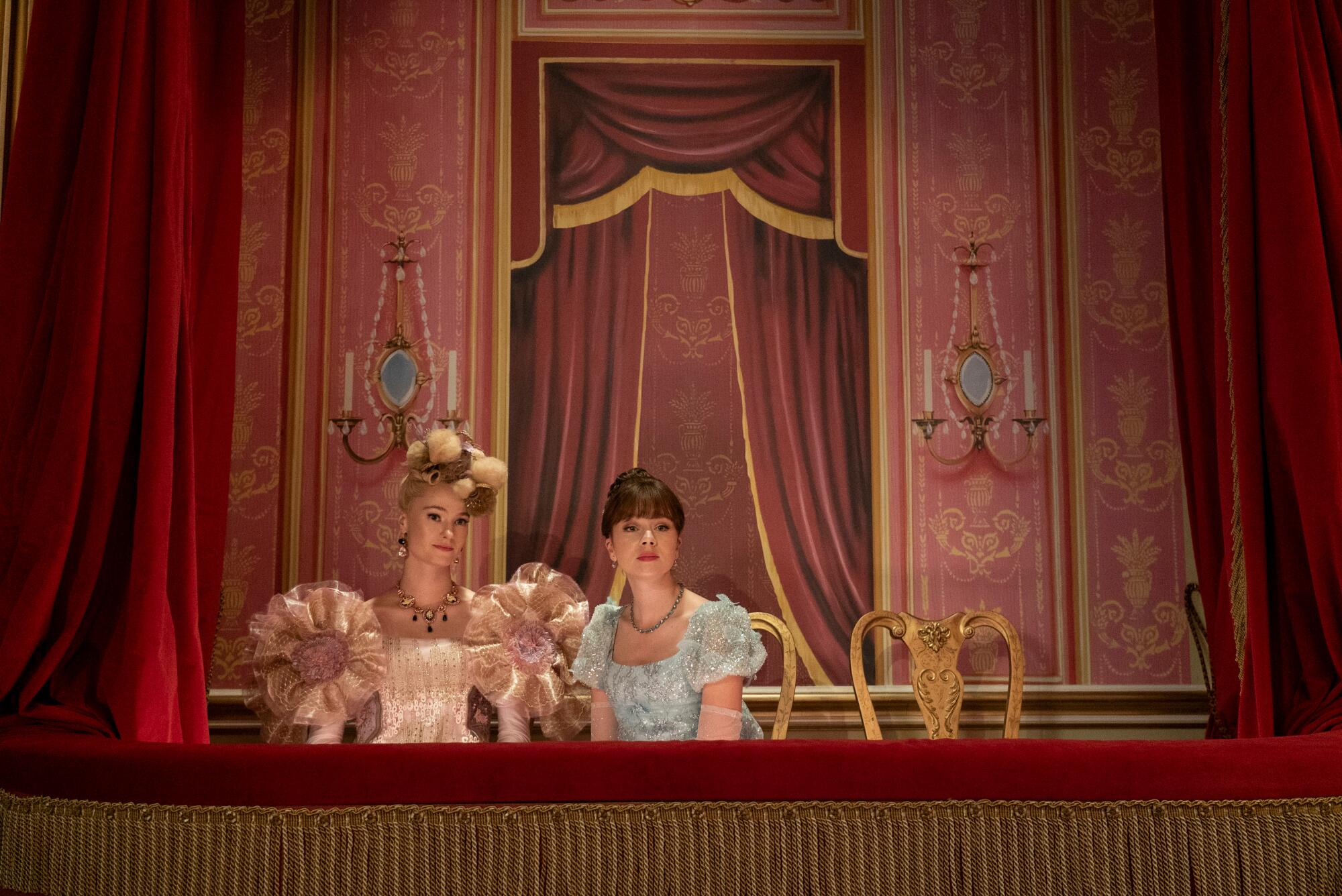
Cressida Cowper (Jessica Madsen) and Eloise Bridgerton (Claudia Jessie) in a scene from the show. “We’re not done with Cressida,” says “Bridgerton” showrunner Jess Brownell.
(Liam Daniel / Netflix)
We saw that in the end Cressida is sent off to live with her aunt — she appears in only two of the “Bridgerton” novels. Where does that character go from here?
We’re not done with Cressida, if I have my druthers. I have a storyline for her that I think gives a nice resolution to her journey. Initially, when we shot Cressida’s departure, we had it scripted that her mother, at the last minute, joins her in the carriage. She chooses her daughter, and it was really, really nice, but when I was talking about it with Shonda, we landed on the fact that we do want to do more with Cressida. If her mother had chosen her at the end, that’s an ending in a way. The fact that she hasn’t gotten her happy ending yet means that her story is not over.
Now I want to know if there was a Shonda note on Penelope and Colin.
That creative collaboration is so sacred. I will say Shonda and I debated Colin’s virginity. I was pro Colin being a virgin because it tracked with his character. In my mind, him coming back at the start of the season acting like he was this Regency F-boy was surely an act. But Shonda made a really good point, which was that if he is really trying to convince himself, he’s doing it [being a womanizer]. I think some of those scenes in the brothel, for example, which I know are very controversial, when Shonda and I were talking about it, these represent him trying to lean into this toxic masculinity and trying to prove to himself that he can be just like his older brothers. As you can see in the second [brothel scene], he can’t even convince himself for longer than a week or whatever that this is what he wants. I ultimately really agreed with her. She’s a genius at — I mean, she often gives notes that I know are going to be controversial, but they’re also going to be the thing that gets people excited about the storyline, and talking about it, and debating it. I’m glad that Shonda pushes me into a space where we’re making stronger creative choices.
The season ends with Penelope and Colin welcoming a son, a tweak from the book. What do you see for their future?
Colin and Penelope, in the book, initially had a daughter, and they named her after Lady Danbury, they named her Agatha. For us, because of the heir race, we felt like it was poetic justice for Penelope to be the one who pulls ahead of her two sisters who have dumped on her for so long. It made sense to give her the boy.
Just like with Anthony and Kate, Penelope and Colin will fall back. We’ll keep our focus on the main couple in Season 4, but I do think more than with other couples, there’s a bit more to tell because Penelope is Lady Whistledown. I’m really curious to see what it’s like for Penelope being a public gossip columnist, seeing whether she’s going to be able to be accountable in a way she hasn’t been in the past, if she’s going to use her pen for more righteous means going forward.
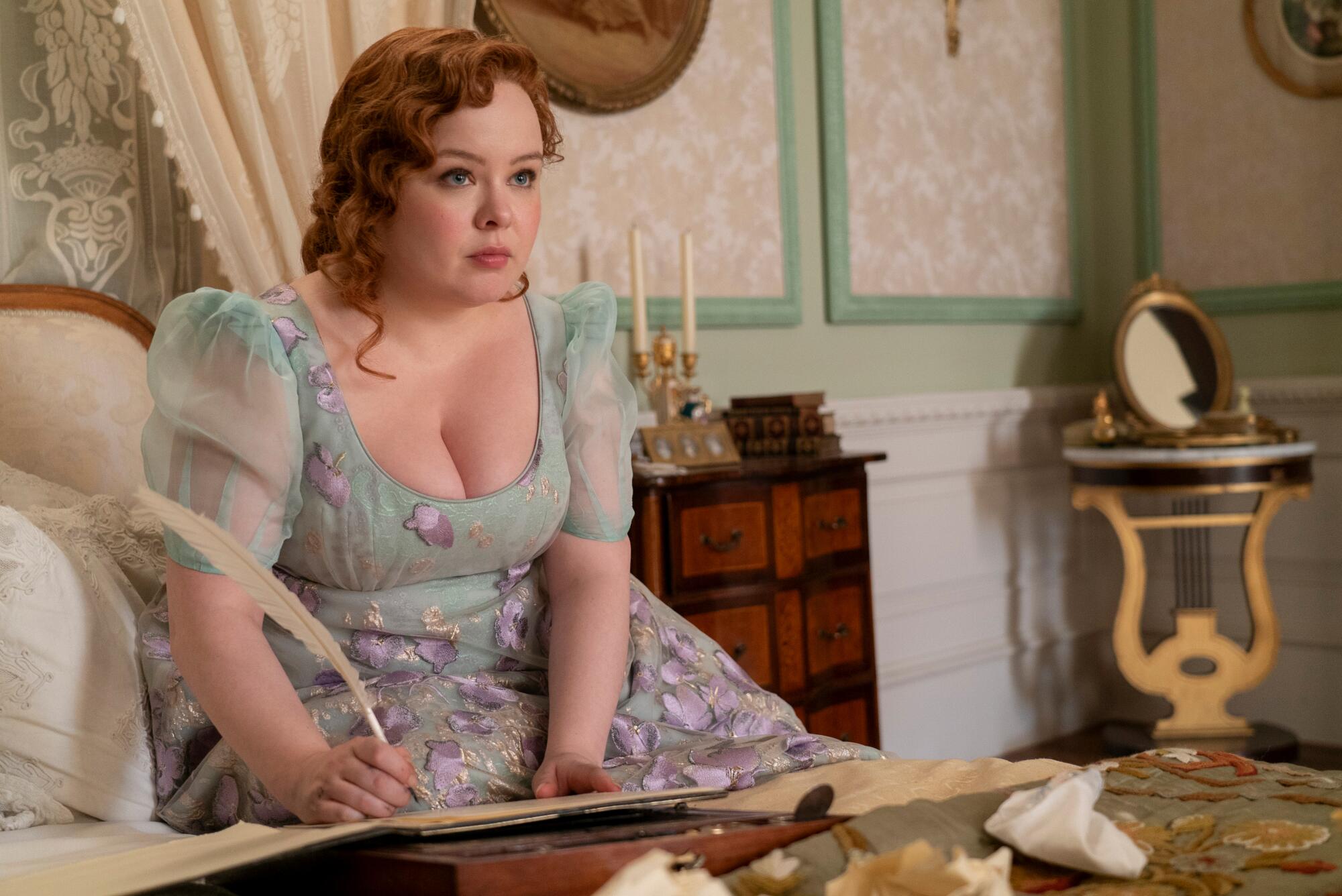
Now that Penelope Featherington’s (Nicola Coughlan) secret identity as Lady Whistledown has been revealed, “Bridgerton” showrunner Jess Brownwell says she’s “curious to see what it’s like for Penelope being a public gossip columnist.”
(Liam Daniel / Netflix)
This season explored a queer romance through Benedict Bridgerton (Luke Thompson). What are you setting up for next season?
Benedict’s fluidity is something we’ve been talking about from Season 1, which is why I think viewers have picked up on it. We wanted to do that storyline justice, and it felt like Season 3 was a good place to do that to make sense of some of the threads we’ve seen with him before. That storyline speaks in a bigger way to Benedict’s overall character arc, which has a lot to do with being someone who is learning how to exist between society and and being unconventional. Benedict [is] trying to figure out what his place is in the world and how to circumvent certain rules, which is something Tilley Arnold (Hannah New) is teaching him this season. I think we will continue telling the story of his fluidity going forward.
A character that caught people by surprise was John Stirling (Victor Alli ) and his relationship with Francesca Bridgerton (Hannah Dodd). You kept it under wraps.
The moment we cast Victor Alli, we knew he was going to be so beloved. He’s such an incredible actor, but we did want to sit on it just so that it could be a surprise when John Stirling shows up because book readers obviously know when they hear that name that he’s important to Francesca. Francesca and John are one of my favorite couples in the series. They have a kind of love that I would advise my girlfriends to seek. I think it feels really radical, or I hope it feels radical in a romance show, to focus on a love that is quiet and a love that is based on companionship and friendship and common interests and respect. I think there is also attraction there, but obviously, we are introducing Michaela at the end of the season, so there will be a second chapter for Francesca. But I want to emphasize that that doesn’t mean that we are disavowing what Fran and John have. I personally don’t believe in a hierarchy of love. I think there are lots of different ways to love and be loved.
Francesca is unlike the rest of the boisterous Bridgertons. John seemed to match her idiosyncrasies. Some fans felt it was a neurodivergent love story.
I actually think Fran and John’s relationship looks like so many more of the relationships I know than any of the romances on “Bridgerton.” We’re just not used to seeing that kind of relationship on television. I thought that the conversation around neurodivergence was really interesting and it was actually something we talked about in the room, but we didn’t necessarily set out to write a neurodivergent character with Francesca. As we were adapting her from the book, many of us thought maybe she is neurodivergent because she does share certain characteristics, and it’s just been beautiful to see people relating to that.
Is there a scene from this season that you’re excited fans finally get to see after sitting on it for so long?
It’s probably the the butterfly ball, as we called it internally. It has Penelope’s big monologue as she comes out as Lady Whistledown and then Philippa [Featherington, played by Harriet Cains] running across the ballroom shouting, “The bugs, Varley!” and then there are butterflies coming out. In Episode 6, when the Mondriches are throwing their first ball and they’re wanting to impress the Queen, in the writers room, we had come up with the idea of, “Oh, maybe they should do a butterfly release because that would surely titillate the queen.” Then one day I had this frying-pan-on-the-head cartoon moment of, “You, dodo. Butterflies! Hello, the Featheringtons. Like, hello, this is Penelope’s journey. She’s in a chrysalis. She’s a caterpillar, she’s becoming a butterfly.” Last minute, I had to tell our production designer, “You have to think of something else,” and she pitched that mechanical flower box so that we could save [the butterflies] for the final moment. I’m so glad and grateful to our crew for allowing me that last-minute change because it’s the perfect moment to underscore Penelope’s journey.
Let’s get into the music. How much of it is spitballing in the room, how much of it is being pitched by an artist’s team? And what led to the decision to feature the show’s first-ever original song?
Justin Camps, who is our music supervisor, gave me a playlist of maybe 100 or 200 orchestral versions of pop songs when we were starting production. We’re not really thinking about it when we’re writing. There are a few different ways [picking a song] happens. The process in postproduction is that an editor does a cut, then the director, then me and then Shonda. Then me, Shonda, Shondaland and Netflix give notes on the final cut.
Two songs in my cut that I was gunning for were Pitbull and a Demi Lovato song [“Confident”] in Episode 6 when Cressida has her big moment. I really tried to get [No Doubt’s] “Don’t Speak” in when Debling and Pen first have their dance, but it was just too melancholy, and [Billie Eilish’s] “Happier Than Ever” is actually perfect. Nicola suggested “Happier Than Ever.” A couple of the songs that the editors chose made it in there. Jack Murphy, our choreographer, does a choreographed dance with a set of dancers at every ball. Oftentimes, he would pick a song to choreograph a dance to and sometimes we would use the song that he picked. [Coldplay’s] “Yellow” being the song over the wedding was something that we all collaborated on and knew that the fans would love to see in that moment. It’s hitting that balance between something that’s not going to be so instantly recognizable that it’s going to take you out, but it has to be recognizable enough that after 10 seconds, you hit your knee, and you’re like, “Oh, it’s that one!”
With Tori Kelly, [behind this season’s “All I Want”] — that was the first time we’ve done an original song. I got the chance to see her perform the song live at the premiere in New York. I think it is such a beautiful song that speaks to so many themes of the seasons.
I know you’re a rom-com enthusiast. Were there films that you took inspiration from as you crafted this season?
I came of age in the ’90s and early 2000s. There’s a lot of nostalgia for movies from that period of time. The makeover moment for Penelope is, in some ways, an homage to “She’s All That” and Rachael Leigh Cook walking the stairwell. I had even, on one pass of my cut, put an orchestral version of “Kiss Me” in there, but it was just too on-the-nose. I’m really curious to see [the reaction] when the back half airs. There is a pretty obvious homage to a scene from “Notting Hill,” the Richard Curtis movie. The brownie scene. It’s one of the greatest scenes in modern rom-coms. There weren’t other really specific scenes, but I’ve been so influenced and informed by the banter in so many of the movies I grew up watching, whether it’s Nora Ephron or older classics. I just love good, awkward banter.
Is there anything you can tease about Season 4 that will make no sense now but will when it comes out?
I’ll tease this: You might be getting a different season from “Bridgerton.” We always live in this perpetual spring in “Bridgerton,” but we’re playing around with the idea of fall … for the first time. Some of that is about story and some of it is, honestly, just for practical reasons because we’re shooting in the fall. It’s still going to be just as lush and colorful, but just more in those warm fall colors instead of the pastels. There will still be some pastels, so it won’t look like a totally different show. I’ll give you that.


James Gunn isn’t exactly crushing it.
Named co-chairman and chief executive officer of the newly formed DC Studios in 2022, the “Guardians of the Galaxy” filmmaker wrote and directed the division of Warner Bros. Discovery’s largely disappointing “Superman,” released last year.
This week, DC Studios’ second big-screen affair, “Supergirl,” lands in theaters with similarly underwhelming results.
‘Superman’ review: James Gunn gets DCU off to rocky, overstuffed start
Starring Milly Alcock as the movie’s namesake Kryptonian heroine — who also goes by Kara Zor-El and is the cousin of David Corenswet’s Superman/Clark Kent/Kal-El — “Supergirl” isn’t distractingly zany the way its 2025 sister film was. Instead, it’s tonally boring, a chore of a movie chock full of thinly drawn characters and increasingly bombastic and violent.
To be clear, Gunn isn’t at the helm for “Supergirl.” Instead, it’s the typically dependable Craig Gillespie (“I, Tonya,” “Cruella”), working from a script by Ana Nogueira, making her less-than-impressive feature-writing debut.
This planet-hopping adventure in the new DC Universe isn’t a complete space wreck, however, thanks largely to the spunky performance by Aussie Alcock, best known for portraying the younger Rhaenyra Targaryen in the early episodes of HBO’s “House of the Dragon.”
When we catch up with Kara, she’s basically as we left her late in “Superman”: a super-sized mess. She’s out with her beloved, rambunctious dog, Krypto — the peppy and powerful pup having already been a major player in “Superman” — and enjoying a 23rd-birthday pub crawl among planets under a red sun. (Quick reminder: Supergirl, like Superman, draws her incredible powers from a yellow sun, like Earth’s, so she’s at least vaguely normal under a red sun and, importantly, can become intoxicated. The color of suns is a major factor throughout “Supergirl,” and it’s the movie’s most inventive narrative element.)
It is on such a world where a drunken Kara encounters 13-year-old Ruthye Marye Knoll of the Danastia Clan (Eve Ridley), whose family has just been brutally slain by the ruthless Krem of the Yellow Hills (Matthias Schoenaerts). Understandably, Ruthye wants revenge against Krem — leader of the Brigants, a band of male pirates and traffickers — and can think of little else.
She’s offering anyone who will help a sword made by her family of skilled weapons makers. The beyond-buzzed Kara isn’t interested, but she gets involved when a scumbag type tries to take the sword. She continues to do her best to fend off Ruthye’s subsequent pleas for assistance in her quest to kill Krem, but when the baddie — in the process of stealing her floating RV of a spaceship — shoots a charging Krypto with a poison dart, Kara has designs on punishing him, too. In fact, she needs to retrieve the specific antidote Krem carries with him to save her four-legged bud.
And so the gals are off to other worlds, initially traveling via the space equivalent of a beat-up Greyhound bus, on which they run into a trio of pillaging Sklarian Raiders. The sequence in which Kara retrieves stolen possessions and extracts information from them is as zany as “Supergirl” gets.
As their trek through the stars warps on, Kara and Ruthye encounter Lobo (Jason Momoa, seemingly leaving his Aquaman character back in the defunct DC Extended Universe), a rough-and-tumble, motorcycle-riding bounty hunter. They team up — sort of, eventually — but their alliance of convenience is one of the flick’s myriad plot threads that fail to tie into a sturdy knot.
The screenplay by Nogueira — an actor who’s penned a pair of plays — attempts to explore why Kara is so jaded by taking us back to her childhood in the Kryptonian city Argo, protected by her father’s tech after the planet’s demise. Of course, that protection proved to be temporary, or she wouldn’t have eventually been sent to Earth like her cousin before her. It’s lukewarm fare, with Kara eventually learning the familiar Spider-Man lesson — with great power comes great responsibility.
Gillespie adds a few nice touches from the director’s chair throughout the movie, but they’re too little to elevate the proceedings.
Again, Alcock — whose credits also include the recent Netflix limited series “Sirens” — does what she can with the material. It’s a demanding role, as she is on screen for most of the movie, and is spirited in it.
Unfortunately, the lesser-known Ridley — making her feature debut following a few television appearances — is given even less to work with. We never learn much about the one-note Ruthye beyond that her family was killed in her presence and that she is really upset about it.
If you’re expecting the always-lively Momoa to save the day, he brings his larger-than-life presence to Lobo, but the demon-like figure isn’t very interesting. A mix between Aquaman and his Khal Drogo from “Game of Thrones,” the longtime DC Comics character isn’t anything you wouldn’t expect here.

If there’s another bright spot in the cast, it’s Schoenaerts (“Rust and Bone,” “The Old Guard”), who brings a touch of nuance to the villainous Krem. You may have expected a bigger name to play the big bad in this second DC Universe big-screen effort, but some of the acting choices the Belgian makes keep things vaguely engaging when he’s within the frame.

Sadly, vaguely engaging is the best “Supergirl” can manage.
We’ll see if Gunn can turn things around, starting with the HBO series “Lanterns” in August and the horror-tinged film “Clayface” in October, before he returns to direct Corenswet, Alcock and the rest of the “Superman” gang in “Man of Tomorrow,” arriving a little more than a year from now.
We’re hoping for super results, but, at this point, it’s tough to say we’re expecting them.
‘Supergirl’
Where: Theaters.
When: June 26.
Rated: PG-13 for sequences of strong violence, action, language, and smoking.
Runtime: 1 hour, 48 minutes.
Stars (of four): 2.

Richard Montoya of Culture Clash doesn’t mince words when it comes to politics, current events or the state of mainstream Hollywood. But he does sugarcoat his technological limitations as a 67-year-old comic in the dreaded age of video calls with a punchy Chicano twist.
“I’m a low-tech Aztec,” he writes via email when requesting a Zoom link to our Monday interview.
Culture Clash — which includes members Montoya, Ric Salinas and Herbert Sigüenza — arrived on the scene as a guerrilla sketch theater group from the San Francisco Mission District in 1984. By that time, the Chicano movement had reached its peak, thanks to the United Farm Workers labor movement, as well as student activist organizations like Movimiento Estudiantil Chicano de Aztlán (MEChA), which advocated for Chicano unity, political empowerment and educational access.
Luis Valdez, founder of El Teatro Campesino — who began putting on social justice-oriented plays for the striking Delano farmworkers in 1965 — backed the slapstick satire troupe, considering the trio “the cutting edge of fresh, new Latino comic genius.”
Culture Clash stood out in a time when Chicanos became more vocal and visible — and its members challenged an entertainment industry that has historically lacked Latino representation. Between 1993 and 1996, Culture Clash hosted its own self-titled TV show on the syndicated Fox network. The show, which was filmed at the Mayan Theater in downtown Los Angeles, is widely considered the first Latino sketch comedy to air on American television.
Throughout the last four decades, Culture Clash has parodied nearly every prominent Latino figure in history, including Che Guevara, Frida Kahlo, Ritchie Valens, Rita Moreno, Edward James Olmos and others. Its members have mocked hard-shell cholos and gangsters, often by placing them in funny scenarios. For instance, take this clip, in which the trio take on cholo characters and reimagine what it would be like to surf on the Southern California shore.
But they’ve also taken on more serious topics in their classic “Chavez Ravine” play, which looks into one of the darkest chapters in L.A. history: the forceful removal and displacement of families, mostly Mexican, in the 1950s under eminent domain. Recently Montoya attended a live reading adapted by Somos El Teatro, led by Xolo Maridueña, Mariana da Silva and Angel Villalobos at Elysian Park.
“It gives us so much life that people are finding the issues of swindlers, whether it’s gentrification, the taking over of settlements,” says Montoya. “The generational trauma of losing your home in L.A. has never gone away.”
But not every Culture Clash joke or skit has been safe from criticism. Montoya still remembers how a conservative pundit chastised the group for using light humor to discuss the 1992 riots, when LAPD officers were acquitted for using excessive force in the arrest and beating of Rodney King.
“By looking at it and treating it as dynamite, exploding it and then by bringing some levity and a whole lot of seriousness to the Rodney King matter allows us a moment, a fraction of time to look at the issues a little bit differently,” says Montoya. “That laugh allows us a moment to examine it differently.”
On June 27, Culture Clash will return to Grand Performances, a free summer concert series at California Plaza in downtown L.A., with comedic sketches colored by political and social satire. The show, titled “American Payasos! Culture Clash’s End Times Cabaret” will be co-presented with De Los.
While their 40-year-plus legacy might merit a show reminiscent of old goofball skits — like their early 1989 show “The Mission” that poked fun at the problematic Spanish Franciscan missionary Junipero Serra — this will not be an “oldies but goodies show,” as Montoya put it. “We are highly pissed off about a lot of stuff right now.”
“ We’re thinking a lot about the Mexican American patriarchy, Cesar Chavez, Dolores Huerta and it’s time to address some of these things,” says Montoya. “ We want to look at the service workers of Los Angeles, the people that sell cotton candy in MacArthur Park, the people that sell ice cream in Echo Park and the people working the World Cup.”
For the veteran comic, son of the late Chicano poet Jose Montoya, it is also impossible to ignore the immigration enforcement raids that have rattled Los Angeles communities in recent years.
“This is a very strange moment for satirists,” says Montoya. “We have a responsibility to use those tools to say what’s going on in our city and country and provide these moments where we can do a little bit closer examination because the people in power aren’t telling us what’s going on.”
In the last five years, Montoya has fiddled around with digital media, creating sporadic videos featuring old clips of the troupe, as well as videos of Latino media, to connect with technologically diverse audiences of all ages. (One example is a video calling on people to get out the vote, that features clips of Speedy Gonzales and honors political figures like Huerta.)
Although Montoya believes Culture Clash is nearing the end of its career, there’s a question lingering inside his mind: What does a graceful exit look like for a group like Culture Clash, which has never been fully integrated into mainstream Hollywood and still left such a profound legacy in the world of Latino entertainment?
The answer to that might still be unknown, but like any Culture Clash project, it will likely be wickedly satirical and punchy. Says Montoya: “We’re ready to go out with a huge, loud bang that can say something against the power structure.”
Culture Clash will take center stage on June 27 at Grand Performances, in partnership with De Los. Also performing is the retro cumbia-quebradita musician É Arenas (bassist of Chicano Batman), the cumbia-fusion, luchador-masked cumbia group La Nueva Ola de Cumbia, as well as DJ Dali.

In the Hand of Dante, 2025.
Directed by Julian Schnabel.
Starring Oscar Isaac, Gal Gadot, Gerard Butler, John Malkovich, Louis Cancelmi, Sabrina Impacciatore, Benjamin Clementine, Martin Scorsese, Al Pacino, Franco Nero, Jason Momoa.
SYNOPSIS:
A handwritten manuscript of Dante Alighieri’s poem “The Divine Comedy” makes its way from a priest to a mob boss in New York City, where it is taken by Nick Tosches after he’s asked to verify its authenticity.

Outrageously ambitious with an absurd narrative that veers between slick scuzzy fun and philosophically snoozy, the key issue with co-writer/director Julian Schnabel’s excessively long In the Hand of Dante is that it’s more engaging as a dopey early 2000s crime thriller about mobsters employing the services of novelist Nick Tosches (also the writer of the novel the film is based on, inserting himself into it as a fictional character, here played by Oscar Isaac in the adaptation by Schnabel and Louise Kugelberg) and Dante Alighieri specialist to steal the recently unearthed original manuscript of his 14th-century masterwork The Divine Comedy from Italian priests than it does as its other side to that coin, a flashback story about the creation of that story complete with actors portraying secondary characters to eventually get at some points about reincarnation.
This means that the film mostly begins with Oscar Isaac entangled in a web of crime alongside slur-slinging, trigger-finger-happy Louie (in what might be the best performance of Gerard Butler’s career, despite the steep drop in quality in the second half), John Malkovich as a mob boss seeing nothing but dollar signs if they can get a hold of the original manuscript, authenticate it, and sell it on the black market, and even Al Pacino popping up for a scene and stealing it set during Nick’s childhood following a violent incident that is so bonkers readers might not believe it even if I typed it out here, to something close enough to a mess culminating in a confrontation between the excellent Oscar Isaac and the shudderingly bad Gal Gadot and Jason Momoa in important roles, the former a lover placed in danger to the mob by her proximity to Nick, and the latter a greedy killer in a relationship with literary historian Dr. Susanna Pulice (Sabrina Impacciatore).

Martin Scorsese also appears in the 14th-century section (for someone who loves to assert what real cinema is vs cinematic theme park rides, he has now appeared in 3 mediocre-to-terrible movies this year), offering sage-like advice to Dante (also Oscar Isaac) in a hilariously over-the-top beard piece. Much of this is a mental journey, but also has something to do with Pope Boniface VIII (also Gerard Butler) placing the Mark of Cain on Dante following a falling out, the writer’s inability to find inspiration in his current lover Gemma Donati (also Gal Gadot) compared to his first love Beatrice, executed in stark contrast from the much more accessible and palatable modern day crime story. A blunter way to put it is that any time the film shifts to these flashbacks, it’s quite boring and never finds a sense of rhythm, drive, or purpose.
Unquestionably, some of this is by design and baked into other elements of the presentation, which includes flashbacks only receiving color as a means of implying that they were more enriching days for artistic freedom and integrity, compared to the black-and-white 2000s material that further homes in on greed and only financial gain for a manuscript no one even knows how to price if it turns out to be authenticated. Expanding on that thought, there are certainly no qualms to be had with the striking cinematography from Roman Vasyanov.

The other encroaching thought here is that, for as carefully considered as the film looks and as captivating as about half the performances are (we truly do not need to talk anymore about Gal Gadot and Jason Momoa, neither of whom can deliver convincing accents without eliciting laughs), it’s not going anywhere interesting, especially once the mobsters exit the narrative. Technically, they are replaced by a hitman, although a lengthy amount of time is spent watching Nick fly around the world for different aspects of the identification process, sometimes involving technology that even he doesn’t understand and tunes out of. In the novel, there appears to be a greater emphasis on Nick’s inner thoughts about the current state of the art world and on finding flaws in classic works or restrictive prose, which is alluded to here but not interrogated enough to emerge as a compelling element. It’s enough to make one wonder what else was lost in translation from the book.
The filmmakers seem to think the romantic subplot will sustain intrigue for the second half, but it’s devoid of emotion and comes across as aimless in the 14th-century portion. At a certain point, one simply longs for a more focused movie about mobsters stealing recently discovered historic manuscripts for profit; it’s far more fun and amusing than the rest of the sluggish, artfully tedious In the Hand of Dante. No one here seems to realize that this should be a comedic crime caper, and it works that way until it takes itself far too seriously, with flashbacks that bore rather than provide insight or meaningful context.
Flickering Myth Rating – Film: ★ ★ / Movie: ★ ★ ★
Robert Kojder
https://www.youtube.com/watch?v=embed/playlist
-

 New Jersey2 minutes ago
Minnesota woman struck by worker while protesting outside of New Jersey ICE facility
-

 New Mexico5 minutes ago
Canyon Venado Fire near Clines Corners grows to 852 acres, I-40 reopened
-

 North Carolina17 minutes ago
Great horned owl kills 1 of NC Wildlife’s famous barn owlets: officials
-

 North Dakota20 minutes ago
NCAA Set to Change Unpopular Football Rule Just in Time for North Dakota State’s FBS Jump
-

 Ohio25 minutes ago
Ohio lawsuit alleges new NCAA rule unfairly denies high school Class of ’22 athletes a 5th season
-

 Oklahoma32 minutes ago
Fire Crews respond to commercial fire in SW Oklahoma City Wednesday afternoon
-

 Oregon35 minutes ago
Liu makes two! 2nd red panda joins Oregon Zoo family
-

 Pennsylvania40 minutes ago
Pa. measles cases jump, spread to Northumberland County

