Science
Ed Stone, JPL director and top scientist on Voyager mission, dies at 88

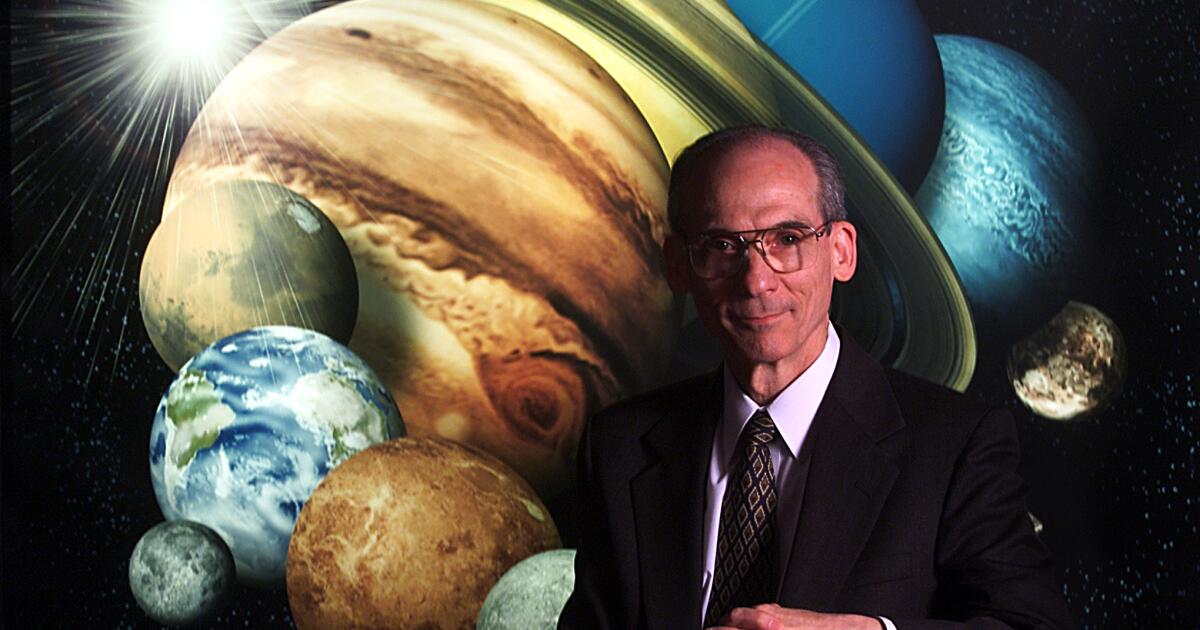
Ed Stone, the scientist who guided NASA’s breakthrough Voyager mission to the outer planets for 50 years and led the Jet Propulsion Laboratory when it landed its first rover on Mars, died Tuesday. He was 88.
A physicist who got in on the ground floor of space exploration, Stone played a leading role in NASA missions to Mars, Jupiter, Saturn, Uranus and Neptune. The discoveries made under his watch revolutionized scientists’ understanding of the solar system and fueled humanity’s ambition to explore distant worlds.
Carolyn Porco, who worked on imaging on JPL’s Voyager and Cassini missions, called Stone “a thoroughly lovely man” who was “as close to perfect as a project scientist could ever be.”
“When two science teams were in contention over some spacecraft resource, and Ed had to decide between the two, even the guy who lost went away thinking, ‘Well, if this is what Ed has decided, then it must be the right answer,’” Porco said by email Tuesday. “I feel blessed to have known Ed. And like many people today, I’m very sad to know he’s gone.”
Stone was a 36-year-old Caltech physics professor in 1972 when he was asked to serve as chief scientist for an audacious plan to send a pair of spacecraft to explore the solar system’s four giant planets for the first time.
It was the opportunity of a lifetime, but he wasn’t sure he wanted the gig.
“I hesitated because I was a fairly young professor at that point. I still had a lot of research I wanted to do,” he recalled 40 year later.
He took it anyway, and from the mission’s first encounter with Jupiter in 1979 to its final flyby of Neptune in 1989, Stone became the scientific face of the Voyager mission. He guided the science agenda and helped the public make sense of revolutionary images and data not just from Jupiter, Saturn, Uranus and Neptune, but from many of their fascinating moons.
Stone and his more than 200 science collaborators were the first to discover lightning on Jupiter and volcanoes on its moon Io. They spotted six never-before-seen moons around Saturn and found evidence of the largest ocean in the solar system on Jupiter’s moon Europa, as well as geysers on Neptune’s moon Triton.
“It seemed like everywhere we looked, as we encountered those planets and their moons, we were surprised,” Stone told the Los Angeles Times in 2011. “We were finding things we never imagined, gaining a clearer understanding of the environment Earth was part of. I can close my eyes and still remember every part of it.”
The Voyager 1 spacecraft became the first manmade object to reach interstellar space in 2012, and Voyager 2 followed suit in 2018.
Stone, pictured with a model of the Voyager spacecraft, said the discovery of volcanoes on Io was a highlight of the mission.
(NASA)
The twin probes continue to send weekly communications to Earth from interstellar space. Stone retired in 2022 on the mission’s 50th anniversary.
“A part of Ed lives on in the two Voyager spacecraft. The fingerprints of his dedication and keen leadership are woven into the Voyager mission,” said Linda Spilker, who joined the mission in 1977 and succeeded him as project scientist.
The Voyager mission was Stone’s crowning achievement, but hardly his only one.
He was a principal investigator on nine NASA missions and a co-investigator on five others, including several satellites designed to study cosmic rays, the solar wind and the Earth’s magnetic field.
He became director of the Jet Propulsion Laboratory in La Cañada Flintridge in 1991, a role he held for a decade.
It was an era of cost-cutting at NASA, but Stone still managed to launch Galileo’s five-year mission to Jupiter and send the Cassini spacecraft to Saturn. He was also at the agency’s helm when Mars Pathfinder delivered the Sojourner rover to the Red Planet. It marked the first time that humans had put a robotic rover on the surface of another planet.
Throughout his tenure at JPL, Stone continued to work and teach at Caltech, even teaching freshman physics during some of Voyager’s long cruise times between planets.
He also served as chairman of the board of the California Assn. for Research in Astronomy, which is responsible for building and operating the W.M. Keck Observatory and its two 10-meter telescopes on Mauna Kea, Hawaii.
Edward Carroll Stone Jr. was born in Iowa on Jan. 23, 1936, and grew up in Burlington, where his father ran a small construction business and his mother kept the company books.
The eldest of two brothers, Stone was attracted to science from a young age. Under his father’s watchful eye, he learned how to take apart and reassemble all varieties of technology, from radios to cars.
“I was always interested in learning about why something is this way and not that way,” Stone told an interviewer in 2018. “I wanted to understand and measure and observe.”
After studying physics at Burlington Junior College, he received his master’s and doctorate at the University of Chicago. Shortly after he began his graduate studies, news broke in 1957 that the former Soviet Union had launched Sputnik, the world’s first artificial satellite.
“Just like that, because of the Cold War and our need to match Sputnik, a whole new realm absolutely opened up,” he said.
Stone built a device for measuring the intensity of solar energetic particles above the atmosphere that hitched a ride to space aboard an Air Force satellite in 1961. Unfortunately the spacecraft’s transmitter didn’t work, so only a very limited quantity of data was returned to Earth. However, it was still enough to indicate that the intensity of the particles was lower than expected.
Despite the transmitter glitch, Stone said the project was thrilling. “We were taking the first steps in a whole new area of research and exploration,” he said. “We were right at the beginning.”
He joined the faculty at Caltech in 1964 and created more space experiments, this time for NASA.
Stone’s particular area of interest was cosmic rays — high-speed atomic nuclei that can originate from explosive events on the sun or from violent events beyond the solar system.
One of his cosmic-ray experiments was included among the 11 major Voyager experiments.

Ed Stone in 2011, about a year before Voyager 1 entered interstellar space.
(Al Seib / Los Angeles Times)
Colleagues praised Stone for his leadership of the Voyager science team.
“He was a great hero, a giant among men,” said Porco, adding that Stone was known to treat everyone — from top scientists to graduate students — with respect.
Voyager team scientist Thomas Donahue put it this way: “Over the years, Ed Stone has proved to be remarkably adept at keeping a bunch of prima donnas on track.”
Stone was elected to the National Academy of Sciences in 1984 and received the National Medal of Science from President George H.W. Bush in 1991 in recognition of his leadership of the Voyager mission. He won the Shaw Prize in Astronomy in 2019, an honor that comes with a $1.2-million award. In 2012 his hometown of Burlington, Iowa, named its new middle school after him.
“This is truly an honor because it comes from the community where my exploration journey began,” Stone told a local newspaper.
Decades after Voyager’s launch he was asked to select his favorite moment from the mission. He chose the discovery of volcanoes on Jupiter’s moon Io.
“Finding a moon that’s 100 times more active volcanically than the entire Earth, it’s really quite striking,” he said. “And this was typical of what Voyager was going to do on the rest of its journey through the outer solar system.
“Time after time, we found that nature was much more inventive than our models,” he said.
His wife, Alice, whom he met on a blind date at the University of Chicago and married in 1962, died in December. The couple are survived by their two daughters, Susan and Janet Stone, and two grandsons.



LOS ANGELES — All the water unleashed onto the warehouse fire in Boyle Heights — some of it 480 gallons at a time by helicopter — had to end up somewhere.
That somewhere is the Los Angeles River.
Los Angeles Fire Department crews ripped through 50-foot walls filled with foam insulation to get to the building’s steel skeleton and its storage racks.
Charred chunks of foam have been floating from the burn site, partially blocking storm drains. Now organizers from East Yard Communities for Environmental Justice are teaming up with scientists from UCLA and Columbia University to find out more about what’s in the runoff.
“The community here is really interested in knowing, ‘Are there any contaminants that are potentially making their way down to the L.A. River?’” said Yoshira “Yoshi” Ornelas Van Horne, UCLA assistant professor in environmental health sciences. “We really can’t answer that unless we actually have measures and samples analyzed.”
Water samples collected directly from the warehouse fire runoff have been shipped to Columbia‘s Multi-Element Trace Analysis Laboratory in New York, which has a spectrometer that can identify trace levels of elements. The lab also has relationships with researchers in Southern California.
2

1. Emmanuel Carrera Ruedas, left, and Casey Cooper prep containers to take water samples from the L.A. River. 2. Casey Cooper holds a water sample. (Christina House / Los Angeles Times)
The data will then come back to UCLA for analysis. For now, the scientists and community advocates only have the money to test for copper, lead and arsenic, Ornelas Van Horne said. Residents have expressed interest in testing for more contaminants.
As the water from the firefighting efforts trickles through the warehouse in rivulets, it forms a stream at the corner of S. Indiana and Noakes streets, that gushed into the storm drain. On a recent visit, the water traversed a smoky 10-foot canyon of charred foam and twisted wall panels on its way to the drain.
From there, the water flows to the L.A. River. Despite the fact that its concrete design is intended to whisk water out of the city as fast as possible, life stubbornly persists in the river and nearby. Recreational swimming is not permitted, yet anglers fishing for tilapia, largemouth bass and carp are a common sight along the rocky sides of the soft-bottom areas.
The L.A. River, and all it carries with it, meets the ocean in Long Beach.
The L.A. County Public Works Department said it has deployed three containment booms — floating barriers — on the L.A. River, and is continuing to monitor the water as it makes its way to the ocean.

Emmanuel Carrera Ruedas takes a water sample.
(Christina House / Los Angeles Times)
Before it gets there, the river passes through the Dominguez wetlands, where Public Works is removing some number of dead fish. The wetland has absorbed toxic runoff from a warehouse fire before, resulting in a fish die-off.
“For so long, the L.A. River has been used as a dumping ground for all kinds of chemicals,” said Emmanuel Carrera Ruedas, a community scientist and member of East Yard Communities for Environmental Justice.
Pollution has plagued the L.A. River, but it does have allies. In the 1980s, the Friends of the LA River pushed to address street runoff and trash that had made the water body infamous. Significant progress from advocacy and government initiatives improved water conditions, but these efforts have not been equally distributed.
Carrera said the samples represent “proof of what’s actually going on, and accountability, too, for the city, of not just what’s happening in our air, but what’s actually happening in our waterways.”
The first samples for the project were taken last Friday, the second day of the fire.
They were the first of 20 samples the research groups have agreed to test at no cost to see if any exceed regulatory standards and could pose a risk to people nearby.
The warehouse fire represents the latest environmental disaster for people in Boyle Heights and East L.A. Just four weeks ago, a telecommunications crew accidentally struck one of the many oil pipelines beneath the L.A. area, spilling 25,000 gallons of crude oil near Eastern and Cesar Chavez avenues — including into storm drains feeding to the L.A. River.
“I think it really is difficult to see disaster after disaster hit the communities here, with not a lot of talk about how we can move through these disasters together,” said Casey Cooper, a volunteer community scientist involved in the sampling. They were inspired, they said, by the response of neighbors, and how people were supporting one another.
Results from the laboratory analysis could be back to Ornelas Van Horne within a month.

The U.S. Environmental Protection Agency is ramping up its enforcement of illegal pesticides smuggled through the ports of Long Beach and Los Angeles, officials said during a visit to L.A. on Thursday.
Since President Trump began his second term in January 2025, EPA has blocked more than 2.4 million pounds of illegal pesticides from entering the country, said Lee Zeldin, the agency’s administrator. Much of it comes from China, but some comes from Mexico and, on the East Coast, from Africa.
“We’re very alarmed by any chemical that anyone would seek to bring into this country that our own government hasn’t had the opportunity to vet, to research to fully understand,” Zeldin said. “That’s why it’s so important that these products get stopped at the border.”
The announcement came just hours after the Supreme Court handed a major victory to the makers of the weedkiller Roundup, shielding it from thousands of lawsuits from states alleging the company failed to warn people the product could cause cancer.
Speaking from a U.S. Customs and Border Protection warehouse in Carson, Zeldin pointed to a white bottle with a yellow label reading “SNIPER” — an illegal pesticide product commonly imported from abroad and sold online — that was recently intercepted at the Port of L.A. complex. Sniper contains dichlorvos, or DDVP, a highly toxic insecticide that is not registered or approved for use in the U.S. It is known to cause neurological problems, convulsions and comas, with children particularly at risk.
Illegal pesticides are cause for concern in California, where they are often associated with illegal cannabis operations. Last year, Siskiyou County declared a local emergency in response to the “escalating threat” posed by illegal pesticides, often fumigants, in illicit cannabis operations.
“These chemicals, when burned, create thick, poisonous smoke that presents serious risks to public health, the environment, waterways, and first responder safety,” the county said.
A 2024 Los Angeles Times investigation found that contraband Chinese pesticides used on cannabis farms is a growing problem in the state.
Customs and Border Protection seized containers of an illegal pesticide from China that were packed with legitimate items.
(Myung J. Chun/Los Angeles Times)
Much of the illegal product comes through the ports of L.A. and Long Beach, which together handle more than 30% of the nation’s container traffic, officials said. EPA works closely with Border Patrol officials, who flag suspicious cargo containers at the port for further inspection.
CBP spokesman Jaime Ruiz said the agency is using artificial intelligence tools to help scan incoming cargo manifests for potentially illegal items. Thousands of containers are flagged for inspection each year, although that number also includes drugs, counterfeit goods and other contraband in addition to pesticides, he said. He could not immediately say what percentage were illegal pesticides.
Illegal pesticides have at times been found in California agriculture and the California Department of Pesticide Regulation has taken enforcement action against violators. The DPR operates one of the nation’s largest pesticide residue testing programs, analyzing some 3,500 produce samples each year from wholesale and retail stores and other outlets. The state produces about half of the nation’s fruits and vegetables.
Jeff Hall, assistant administrator of EPA’s Office of Enforcement and Compliance, said the issue should be bipartisan.
“We cannot allow foreign actors to profit by sending toxic and poisonous products into the United States and poisoning American communities,” he said. “This is a message that we should all be able to agree on, especially for pesticides.”
However, the agency’s visit to L.A. arrived at a fractured moment for U.S. pesticide regulation and for the Trump-aligned Make America Healthy Again movement.
On Thursday, the Supreme Court ruled 7-2 in favor of Bayer’s Monsanto, the maker of the powerful weedkiller Roundup, shielding it from thousands of state lawsuits that allege the company failed to warn people the product could cause cancer.
Roundup contains glyphosate, which was classified by the World Health Organization as “probably carcinogenic” in 2015. But the Supreme Court found that the company can’t be sued in state courts because federal agencies — including the EPA — have determined that it’s not likely to cause cancer in humans when used as directed. The EPA has repeatedly approved a label for the product without a cancer warning.
“When people are exposed to pesticides, they deserve honest warnings about the risks,” said Bill Jordan, former deputy director of EPA’s Office of Pesticide Programs, in a statement. “The Court’s decision leaves families, workers, and communities with fewer tools to protect themselves and to recover damages when they are injured by a pesticide.”

For the third year in a row, accidental drug-related overdose and poisoning deaths have dropped in Los Angeles County, a decline officials attribute to ongoing investments in prevention and harm reduction resources countywide.
There were 2,298 accidental drug overdose and poisoning deaths in 2025, down 6%, a relatively small drop from 2,438 the prior year but an overall substantial reduction from the all-time high of 3,220 deaths countywide in 2022, according to a recent report from the Los Angeles County Department of Public Health.
Drug overdoses continue to be the leading cause of accidental deaths countywide — surpassing the deaths due to vehicle crashes and firearms in 2017 combined — with methamphetamine and fentanyl most often involved in the overdoses.
The problem reached a historic high in 2022 when fentanyl surpassed methamphetamine as the most common drug listed as a cause of overdose deaths. At the time, the number of overdoses in general had increased across the board.
However, these accidental deaths have been on a downward trend, with a nearly 30% overall decrease in drug-related overdoses from 2022 to 2025. Fentanyl-related deaths dropped by 40% and methamphetamine-related deaths declined by 25% in that period.
Officials said in the report that the numbers are more modest compared with 2024, when accidental overdose deaths plunged overall by 22%, which they said “demonstrates sustained progress in the County’s efforts to address the overdose crisis.”
“Three consecutive years of fewer overdose deaths in LA County is proof that sustained investments in prevention, harm reduction, treatment, and recovery services saves lives,” Barbara Ferrer, director of the Los Angeles County Department of Public Health, said in a statement.
Ferrer credited the continued reduction to outreach workers and community partners who “are working every day to connect people to treatment, distribute lifesaving naloxone and meet people where they are without judgment.”
The department continues to invest in a coordinated spectrum of community-based overdose prevention efforts that include the Fentanyl Frontline — a multimedia campaign focused on the widespread distribution of naloxone — and ByLAforLA.org, a community-powered platform that connects residents to lifesaving services with an aim to reduce stigma.
The health department report also found:
- Los Angeles County overdose deaths declined across most age groups in 2025 but deaths among adults 65 and older increased by 14%.
- Although older adults accounted for only 11% of all overdose deaths, this increase contrasts with the broader downward trend observed across other age groups, according to the report.
- Those aged 40 to 64 remained the most affected group, accounting for 53% of overdose deaths last year.
- Communities with 30% of residents living below the federal poverty level had a higher rate of drug overdose deaths than areas with less than 10% of families living below the federal poverty level.
- By race, Black residents continued to experience the highest overdose death rates in 2025.
- By gender, a persistent disparity remains, with men accounting for most overdose deaths, nearly 1,800 compared with more than 500 deaths among women.
Nationwide, opioid overdose deaths have been on the decline since mid-2023, driven largely by decreases in fentanyl-related deaths, but the numbers remain above pre-pandemic levels, according to a recent report by KFF, a national health policy organization.
KFF said multiple policy actions have contributed to the decline, including efforts to expand access to treatment as well as overdose-reversal drugs and public awareness campaigns. At the federal level, there have been some efforts to mitigate the crisis including improving fentanyl detection at ports and borders.
“Despite progress, a range of more recent federal policy actions may affect future trends, including federal budget cuts, federal staffing reductions, and cuts to federal grants that support state and local programs; reduced Medicaid and Marketplace coverage; and a shift toward a more enforcement-focused approach, including the designation of illicit fentanyl as a ‘Weapon of Mass Destruction,’” according to the report.
Los Angeles County residents can access assistance for substance-use services 24 hours a day, seven days a week by calling (800) 854-7771, select Option 2 after the language prompt.
-

 Milwaukee, WI11 minutes ago
Brewers, Salvation Army pack hundreds of lunches for Milwaukee children through Feed the Kids program
-

 Atlanta, GA14 minutes ago
New Venues in Atlanta for Summer 2026 Meetings and Events
-

 Minneapolis, MN18 minutes ago
Minneapolis City Council member Aisha Chughtai taking mental health leave for a month
-

 Indianapolis, IN26 minutes ago
State police arrest man in connection with two Monument Circle attacks
-

 Pittsburg, PA29 minutes ago
Tech community to Shapiro and Pennsylvania legislators: Wait on data center rules
-
Augusta, GA34 minutes ago
Louise Franklin Sheehan Obituary Jun 26, 2026 – Platt’s Funeral Home
-
Washington, D.C41 minutes ago
DC will pay $50,000 to man detained while protesting guard patrol with ‘Star Wars’ song, record says
-

 Cleveland, OH44 minutes ago
Cleveland Browns Legend Set for Induction into Greater Cleveland Sports Hall of Fame


