West
For first time, researchers scale General Sherman, world's largest tree, in search of new threat to sequoias

- Researchers climbed General Sherman, the world’s largest tree, for the first time ever and gave it a clean bill of health.
- The researchers were looking for bark beetles, which have become more dangerous to giant sequoia trees in combination with extreme heat, drought and wildfires.
- In 2020 and 2021, record-setting wildfires killed as much as 20 percent of the world’s 75,000 mature sequoias.
High in the evergreen canopy of General Sherman, the world’s largest tree, researchers searched for evidence of an emerging threat to giant sequoias: bark beetles.
The climbers descended the towering 2,200-year-old tree with good news on Tuesday.
“The General Sherman tree is doing fine right now,” said Anthony Ambrose, executive director of the Ancient Forest Society, who led the expedition. “It seems to be a very healthy tree that’s able to fend off any beetle attack.”
GREEK SKIES TURN ORANGE AS DUST CLOUDS ROLL IN FROM SAHARA DESERT
It was the first time climbers had scaled the iconic 275-foot sequoia tree, which draws tourists from around the world to Sequoia National Park.
Giant sequoias, the Earth’s largest living things, have survived for thousands of years in California’s western Sierra Nevada range, the only place where the species is native.
But as the climate grows hotter and drier, giant sequoias previously thought to be almost indestructible are increasingly threatened by extreme heat, drought and wildfires.
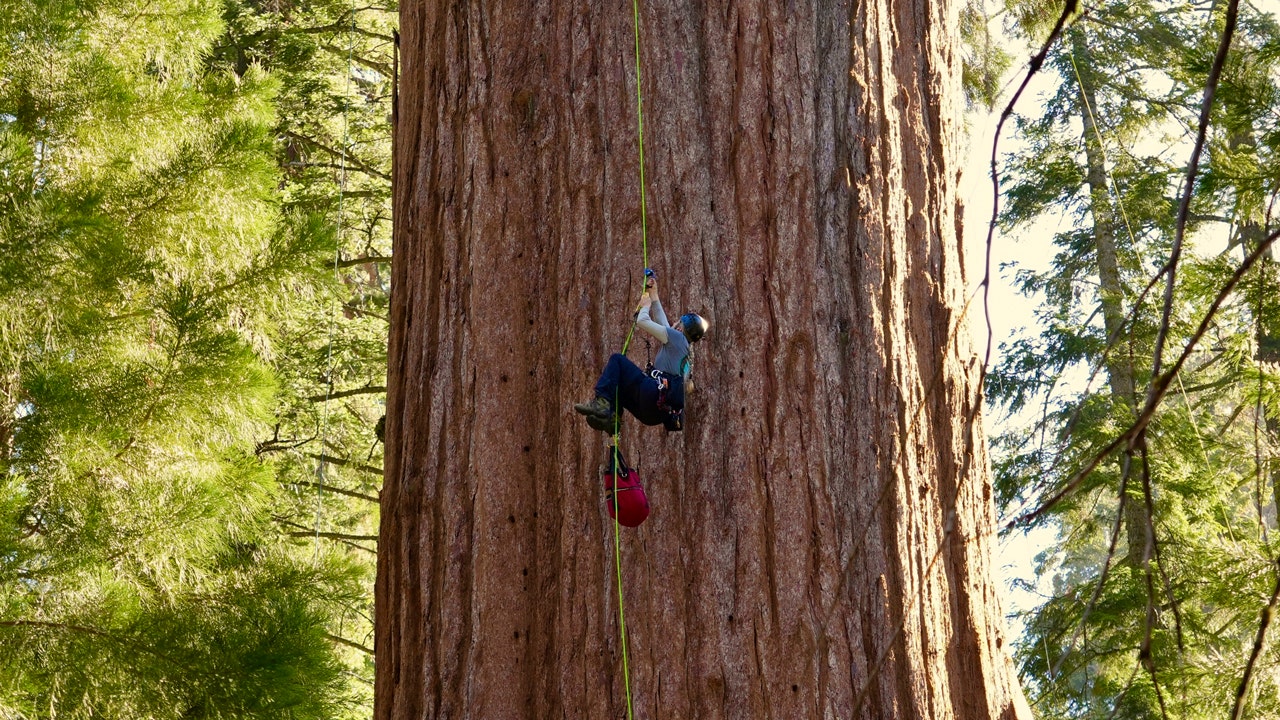
A researcher climbs General Sherman, the world’s largest tree, in Sequoia National Park, California, on May 21, 2024. The research team inspected the 275-foot tree for evidence of bark beetles, an emerging threat to giant sequoias. (AP Photo/Terry Chea)
In 2020 and 2021, record-setting wildfires killed as much as 20 percent of the world’s 75,000 mature sequoias, according to park officials.
“The most significant threat to giant sequoias is climate-driven wildfires,” said Ben Blom, director of stewardship and restoration at Save the Redwoods League. “But we certainly don’t want to be caught by surprise by a new threat, which is why we’re studying these beetles now.”
But researchers are growing more worried about bark beetles, which didn’t pose a serious threat in the past.
The beetles are native to California and have co-existed with sequoias for thousands of years. But only recently have they been able to kill the trees. Scientists say they recently discovered about 40 sequoia trees that have died from beetle infestations, mostly within the national parks.
“We’re documenting some trees that are actually dying from kind of a combination of drought and fire that have weakened them to a point where they’re not able to defend themselves from the beetle attack,” Ambrose said.
The beetles attack the trees from the canopy, boring into branches and working their way down the trunk. If left unchecked, the tiny beetles can kill a tree within six months.
That’s why park officials allowed Ambrose and his colleagues to climb General Sherman. They conducted the tree health inspection as journalists and visitors watched them pull themselves up ropes dangling from the canopy. They examined the branches and trunk, looking for the tiny holes that indicate beetle activity.
But it’s not possible to climb every sequoia tree to directly inspect the canopy in person. That’s why they’re also testing whether drones equipped with sensors and aided by satellite imagery can be used to monitor and detect beetle infestations on a larger scale within the forests.
Tuesday’s health inspection of General Sherman was organized by the Giant Sequoia Lands Coalition, a group of government agencies, Native tribes and environmental groups. They hope to establish a health monitoring program for the towering trees.
If they discover beetle infestations, officials say, they could try to combat the attacks by spraying water, removing branches or using chemical treatments.
Bark beetles have ravaged pine and fir forests throughout the Western United States in recent years, but they previously didn’t pose a threat to giant sequoias, which can live 3,000 years.
“They have really withstood insect attacks for a lot of years. So why now? Why are we seeing this change?” said Clay Jordan, superintendent for Sequoia and Kings Canyon National Parks. “There’s a lot that we need to learn in order to ensure good stewardship of these trees for a long time.”
Read the full article from Here


Oregon lawmakers have a new roadmap for tackling racism as a public health issue, and it’s packed with more than 100 recommendations for the 2027 legislative session.
According to KGW8, the Oregon Advocacy Commissions Office released the four-year report this week, built on input from more than 200 Oregonians of color and developed alongside the Oregon Health Authority. It digs into how Black, Indigenous, and other communities of color face unequal access to stable jobs, education, health care, and housing — the everyday conditions that shape locals’ lives.
“This is an opportunity for state government to earn trust with communities of color who have been historically excluded,” said executive director of the Oregon Advocacy Commissions Office, Jeff Selby, per the outlet. “The report process is a model for community engagement, as we all work together toward meaningful outcomes in community.”
State Rep. Travis Nelson said the findings have already shaped legislation, with several bills signed into law over the past two sessions covering topics like culturally specific health services and school staffing diversity. One concrete example: After residents flagged that Spanish-speaking applicants were passing the DMV’s written driving test at a rate of roughly 21%, versus 51% for English speakers, organizers connected the DMV with community groups to address the gap.
The report dates back to 2021, when Oregon lawmakers formally declared racism a public health crisis. “Racism in Oregon has left a legacy of trauma from one generation to the next, impacting Oregon tribes, Black and indigenous communities and people of color through a cumulative effect,” a section of the declaration reads.
A separate report from the Commonwealth Fund found Oregon has more severe racial and ethnic health disparities than its neighbors in the West, with Native American, Black, and Hispanic residents lagging behind white and Asian American residents on access, quality, and outcomes. Researchers warned that federal changes to Medicaid and the Affordable Care Act since 2025 could make those gaps worse, not better.
The Oregon Advocacy Commissions Office says the goal now is turning research into real policy before lawmakers reconvene — and building trust with communities that have historically been left out of the process.
The full report can be seen here.

The move gives the Aggies “instant credibility” on the recruiting trail, Bronco Mendenhall says.
(Francisco Kjolseth | The Salt Lake Tribune) The Old Main building at Utah State University in Logan on Monday, Nov. 17, 2025.

Mathematicians and statisticians from around the world descended onto Pullman to attend the regional conference of the International Biometric Society (IBS) in early June. Joining leading experts in data science and biometrics were several special guests: high school students from the Kalispel Tribe in northwestern Washington.
The eleven students from Cusick are participants in a collaborative tutoring program between the WSU Department of Mathematics and Statistics and the Camas Learning Center (CLC), an in-school and after-school program managed by the Kalispel Tribe. They were invited to the IBS conference by Regents Professor Jan Dasgupta, department chairperson and the current president of the IBS western North American region. Dasgupta saw an opportunity to share the Pullman academic experience with both leading researchers and the students tutored by her undergraduate students.
“The IBS conference includes an Access and Opportunity workshop focused on engaging local students, and we wanted them to experience WSU and see the possibilities that exist in STEM education and careers,” Dasgupta said.
Undergraduate students from the WSU “Future Teachers of Math” club typically tutor the high schoolers via one-on-one Zoom consultations, supported by CLC staff. The tutoring program has evolved since 2023, but the focus has always remained on student math preparation, for those learning and those teaching the subject. The partnership creates stronger pathways to both higher education and STEM opportunities for students in rural and tribal communities across Washington.
Integrating high school students into the IBS conference proceedings is not a new concept. In 2024, the annual conference’s Access and Opportunity Workshop invited community college students from the Denver area to network with attendees and participate in a data skills seminar. The next year, the workshop invited students from around Whistler, B.C. to the conference proceedings. This year, it was time for the students from Cusick.
Eleven students and four chaperones made the trip from Pend Oreille County to Pullman, where they stayed in Stimson Hall as an on-campus dormitory experience. While the students’ conference activities included hands-on experiences with biostatistics, data science, and biometry analysis, they were also treated to a campus facilities tour. Physics professor Guy Worthy provided a tour of the WSU Planetarium, and Squeak Meisel from the Department of Art led students on a tour of the art facilities and the Jordan Schnitzer Museum of Art at WSU. Other tour locations included the Veterinary Teaching Hospital and the University Recreation Center for some earned relaxation time in the pool.
Cross-discipline researchers also sat down for a panel discussion with the students, discussing their education, career, and life experiences. The speakers included Denise Dillard, director of the Institute for Research and Education to Advance Community Health (IREACH); Mikaela Nishida, PhD scholar in statistics from University of California, Irvine; and Courtney Meehan, Dean of the WSU College of Arts and Sciences.
“One of the most important things we can do as a university is help students see new possibilities for themselves,” said Dean Meehan. “Hosting international conferences like this on our campus creates powerful opportunities for students to interact with researchers and explore potential career paths firsthand. These connections can have a lasting impact long after they leave Pullman.”
-

 North Dakota3 minutes ago
North Dakota offers wellness grants to rural hosptials
-

 Ohio6 minutes ago
Assistant Ohio AG punched on Cincinnati street by man seeking money, police say
-
 Oklahoma11 minutes ago
10,000 texts per hour: How campaigns are reaching Oklahoma voters whether they like it or not
-
Oregon18 minutes ago
Oregon Says Racism Is a Health Crisis, Now It Has a To-Do List
-

 Pennsylvania21 minutes ago
Why are flags at half-staff today? Why they’ll stay lowered in PA
-

 Rhode Island26 minutes ago
Exclusive | Not everyone’s happy about Taylor Swift’s MSG wedding, as Rhode Island residents are left at altarÂ
-

 South-Carolina33 minutes ago
2 injured in South Carolina plane crash
-

 South Dakota36 minutes ago
South Dakota State Museum reopens three renovated rooms for America 250


