Lifestyle
Looking to vacation on the California coast? Marin County just made it harder


A stay in Brian Maggi’s house, per the Airbnb listing, is what coastal California dreams are made of.
“Bathed in natural sunlight,” it reads, you can “enjoy unobstructed panoramic views of the ocean and Point Reyes.” You can bring your dog. Walk to the sand. Savor “the perfect getaway” in the 1928 “BoHo surf shack.”
The little house in Dillon Beach, a remote town in western Marin County, is a second home for Maggi, a software designer who lives full time in Livermore, a hundred miles southeast.
He and his wife stay here a few weekends a month: Enough time to befriend neighbors and know the gossip, like who put in a new hot tub and who moved here to please a girlfriend despite hating the foggy weather.
“We’re not full-time residents,” Maggi said, “but we’re not absentee owners.”
“We’re really fortunate, and I get it,” Brian Maggi says of owning a second home in Dillon Beach. But he says cracking down on short-term rentals hasn’t made houses more affordable.
When Maggi is not using the house, he rents it on Airbnb for about $300 a night.
That’s a pretty common practice in Dillon Beach where, according to county estimates, a whopping 84% of the town’s 408 housing units are second homes and 31% are used as licensed short-term rentals.
Are those vacation rentals ruining California’s rugged little beach towns? Or are they opening up the coast to people who can’t afford to live there? Depends who you ask.
In Marin County, on the northern end of the San Francisco Bay, short-term rentals have become a lightning rod amid an affordable housing shortage in one of the most expensive — and beautiful — places in California.
This month, the Marin County Board of Supervisors approved a hard cap on the number of short-term rentals it will allow in unincorporated places, including the bucolic towns hugging iconic Highway 1 and the Point Reyes National Seashore.
The ordinance imposes a cap of 1,281 short-term rentals for unincorporated Marin County, where there were 923 licensed as of January.
The county has placed specific limits for 18 coastal communities, most of which will be allowed no more than the existing number of short-term rentals — while some will have to reduce their numbers. The exception is Dillon Beach, a historic vacation town where the short-term rental market will be allowed to significantly grow.
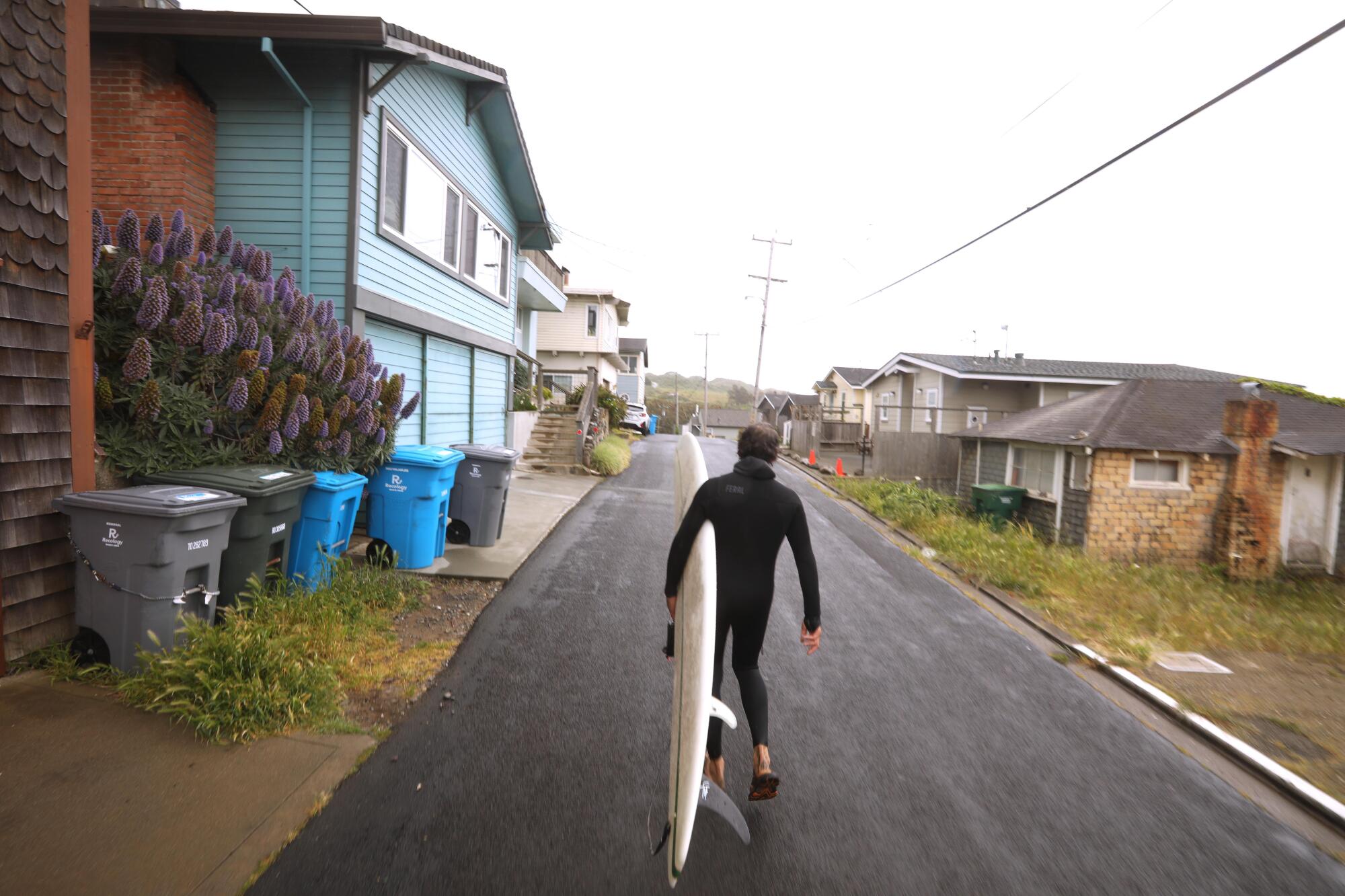
Dillon Beach homeowner Paul Martinez walks home after surfing. “Rent it responsibly,” Martinez says about owners renting out their houses when they are not in town.
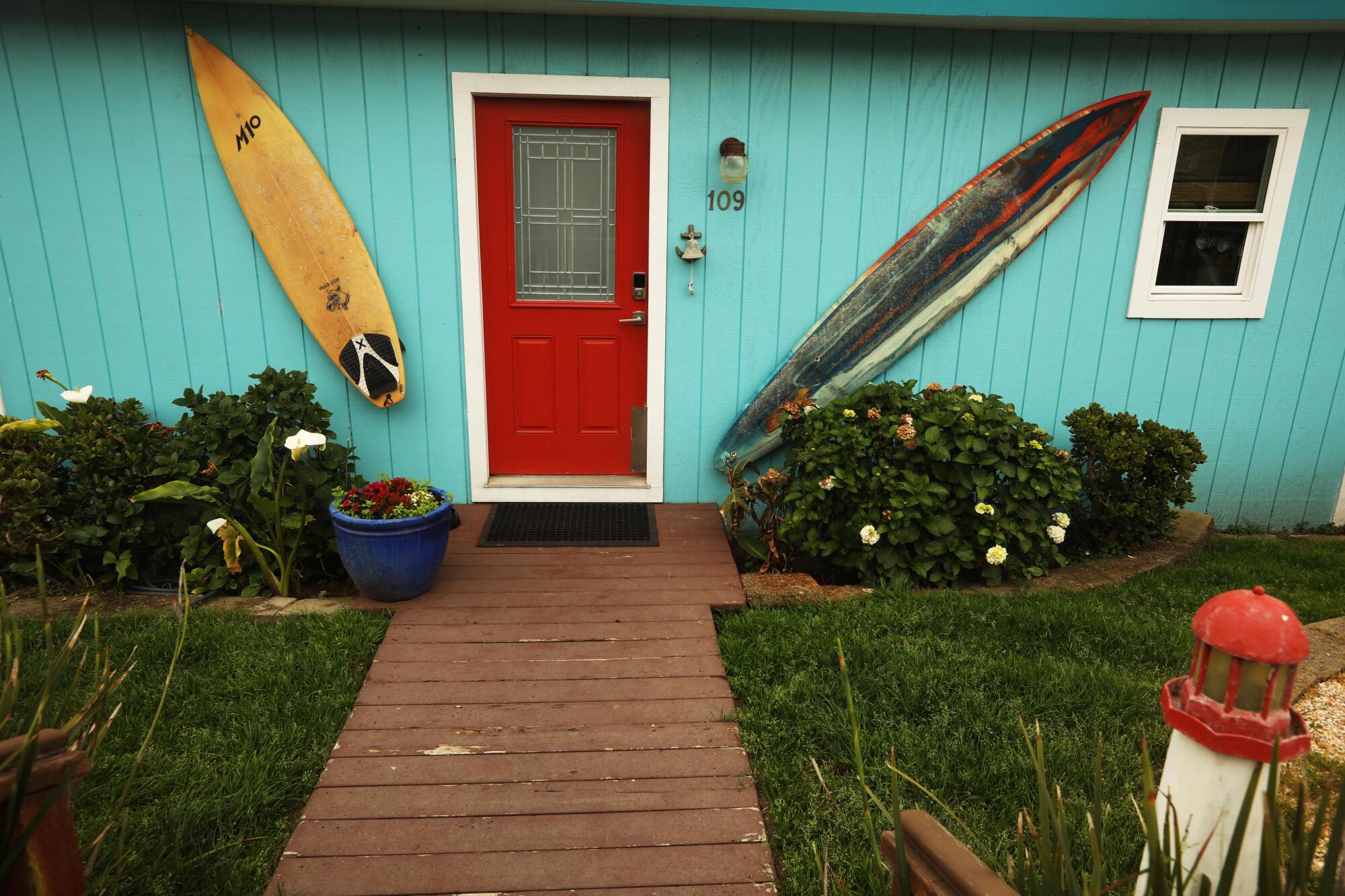
Mounted surfboards add to the charm of this colorful home in Dillon Beach.
In Point Reyes Station, population 383, there are 32 short-term rentals, according to the county. Under the new rules, 26 will be allowed. In Stinson Beach, the cap will allow the amount of rentals that currently exist: 192.
In Dillon Beach, vacation rentals will be allowed to grow 63%, from 125 to 204. The town has no school and the only businesses are a resort and its general store, which supervisors noted make for a different kind of community than many of the other towns dotting the Marin coastline.
County officials said they expect the number of existing short-term rentals to shrink through attrition. Current license holders will have to reapply and adhere to stricter regulations, which can include expensive septic upgrades. The new rules allow just one short-term rental property per operator, and licenses will not transfer to new owners if a property sells.
Debate over the issue has raised questions not just about limited housing in Marin, but also about whether Airbnbs have become a critical means of providing public beach access — a right enshrined in the California Coastal Act — in seaside towns with few hotel rooms.
“Please do not codify this anti-visitor, exclusionary behavior. Do not turn a region dense in coastal public recreational lands into an exclusionary playground that only the elite can access,” Inverness resident Rachel Dinno Taylor, founder of the West Marin Access Coalition, a citizens group that fought the measure, said in a speech last month before the California Coastal Commission.
The Coastal Commission regulates development in the Coastal Zone — which is generally the first 1,000 yards from the shoreline but extends a few miles inland in some areas — and increasingly is weighing in on local efforts to limit short-term rentals.

If it weren’t for vacationers — who fill the village with laughter and kids and wagons and dogs — Dillon Beach would be dead most days, residents say.
Since 1992, the Coastal Commission has considered at least 47 short-term rental ordinances. It has approved all but four, including Marin County’s new ordinance.
“Vacation rentals can provide important public access to the coast, especially where hotels are scarce. But without thoughtful guidelines, they can also have unintended impacts on local housing availability,” Kate Huckelbridge, executive director of the Coastal Commission, said in a statement to The Times. “We think Marin County achieved the right balance for their unique and world-famous coastline.”
The West Marin Access Coalition, many of whose members rent out their homes and so have a financial stake in the debate, argued the county did not have enough data to prove short-term rentals directly affect housing availability. Many residents rely upon income generated by their rentals to afford staying in their homes, Sean Callagy, a member of the coalition, said in an email.
The county’s new policy, he wrote, will “create hardships for low- and middle-income residents, worsen housing insecurity and deny visitors access to the coast.”

An aerial view of Stinson Beach in Marin County.
For years, high-demand destinations across California — including Los Angeles city and county, Palm Springs, Malibu, Ojai and San Francisco — have tried to rein in rental platforms such as Airbnb and Vrbo, citing the need to prevent housing from being converted into de facto hotel rooms .
In Marin County, the explosive growth in short-term rentals has been particularly divisive in smaller towns. There, the number of full-time residents is dwindling while millionaires’ second — and third — homes, many of which are used as seasonal rentals, sit empty much of the year.
That’s a cruel paradox when there are not enough affordable homes for people who work in those communities, proponents of the cap say.
In unincorporated Marin County, the median sales price of a single-family home rose 98% from 2013 to 2021, to $1.91 million, according to a countywide housing plan adopted last year.
“Housing affordability and housing supply were really the driving factor in why we’re addressing short-term rentals right now,” said Sarah Jones, director of the Marin County Community Development Agency. “There’s not housing being built. And the housing that’s available, people are just seeing that it’s more profitable and easier to use it as a short-term rental than to rent it out long term.”
Although Marin County has much open space, it has little room to expand housing. Roughly 85% of its land, including the Point Reyes National Seashore and the Golden Gate National Recreation Area, is public space or agricultural land protected from development.
Marin County Supervisor Dennis Rodoni, who represents the scenic West Marin towns where vacation rentals are most heavily concentrated, said they have transformed “tiny communities where even losing a few homes is a big deal.”
“Our volunteer fire departments are losing volunteers,” he said. “Our schoolteachers, we’re having a hard time locating them in the community; they have to commute long distances.”
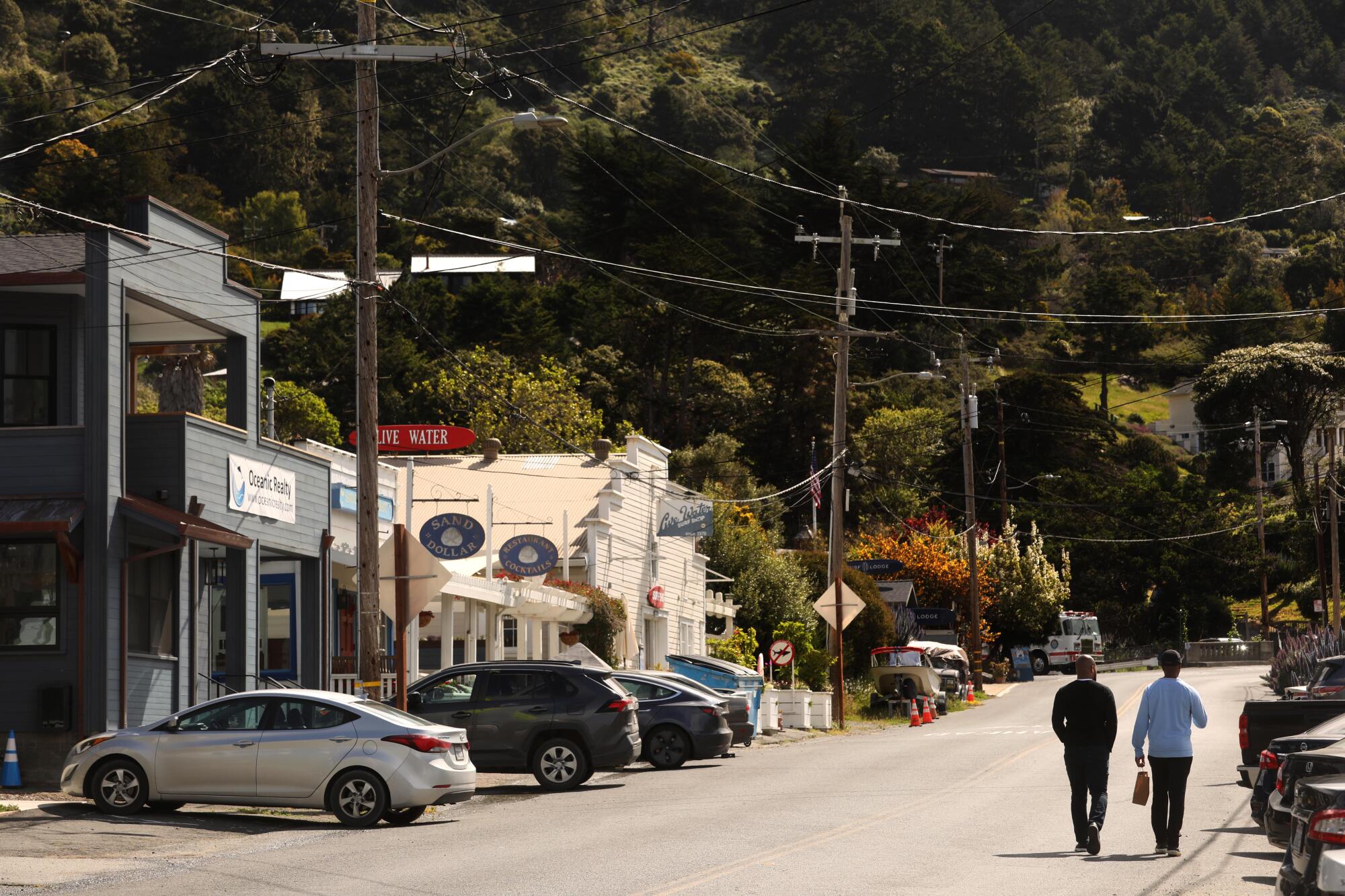
Visitors stroll through downtown Stinson Beach along Highway 1 in West Marin County.
The elementary school in Stinson Beach, he noted, is “having a hard time keeping its doors open” because so few children now live there. The town’s population, according to census data, plunged 38% from 2016 to 2022, to 371. In 2022, there were no children younger than 15.
According to county estimates, 27% of housing units in Stinson Beach are used as short-term rentals — many of which are in the gated neighborhood of Seadrift, a flood-prone sand spit.
The town has “become like Martha’s Vineyard on the West Coast,” said August Temer, co-owner of Breakers Cafe on Highway 1 in Stinson Beach. “It’s not people’s primary residence.”

August Temer, center, co-owner of Breakers Cafe in Stinson Beach, says as a business owner he likes Airbnbs and the tourists they bring. But it’s sad, he says, that his employees can’t afford to live in town.
Standing behind the outdoor bar on a windy afternoon last month, Temer, a 45-year-old who grew up in Stinson Beach, said that as a business owner he likes Airbnbs and the money-spending tourists they bring in. But it’s sad, he said, that none of his employees can afford to live in town and must commute — which makes it difficult to keep workers.
Mac Bonn, the general manager, said he drives 45 minutes “over the hill,” traversing a winding mountain road, to his home in Fairfax.

“We used to know this as very much a vibrant neighborhood,” says Bruce Bowser, seated with his wife, Marlie de Swart. “A lot if it’s thinned out. A lot of people are older and have passed or moved on.”
In nearby Bolinas, artist Marlie de Swart and husband Bruce Bowser welcomed the new rules, telling the Coastal Commission in a letter that their town “is being changed from a characteristic village to a vacation rental suburb.”
The county ordinance limits the number of short-term rentals in Bolinas to 54. There are now 63.
The septuagenarian couple bought their century-old house with picture windows and redwood ceilings in downtown Bolinas in 1992 for about $230,000. They were stunned when a nearby house recently sold for nearly $3 million after its owner died.
Bolinas is so famously opposed to outsiders that, for years, a vigilante band called the Bolinas Border Patrol cut down road signs on Highway 1 that pointed the way into town.
Alas, Google Maps directed tourists to Bolinas. And the Airbnbs kept them there.
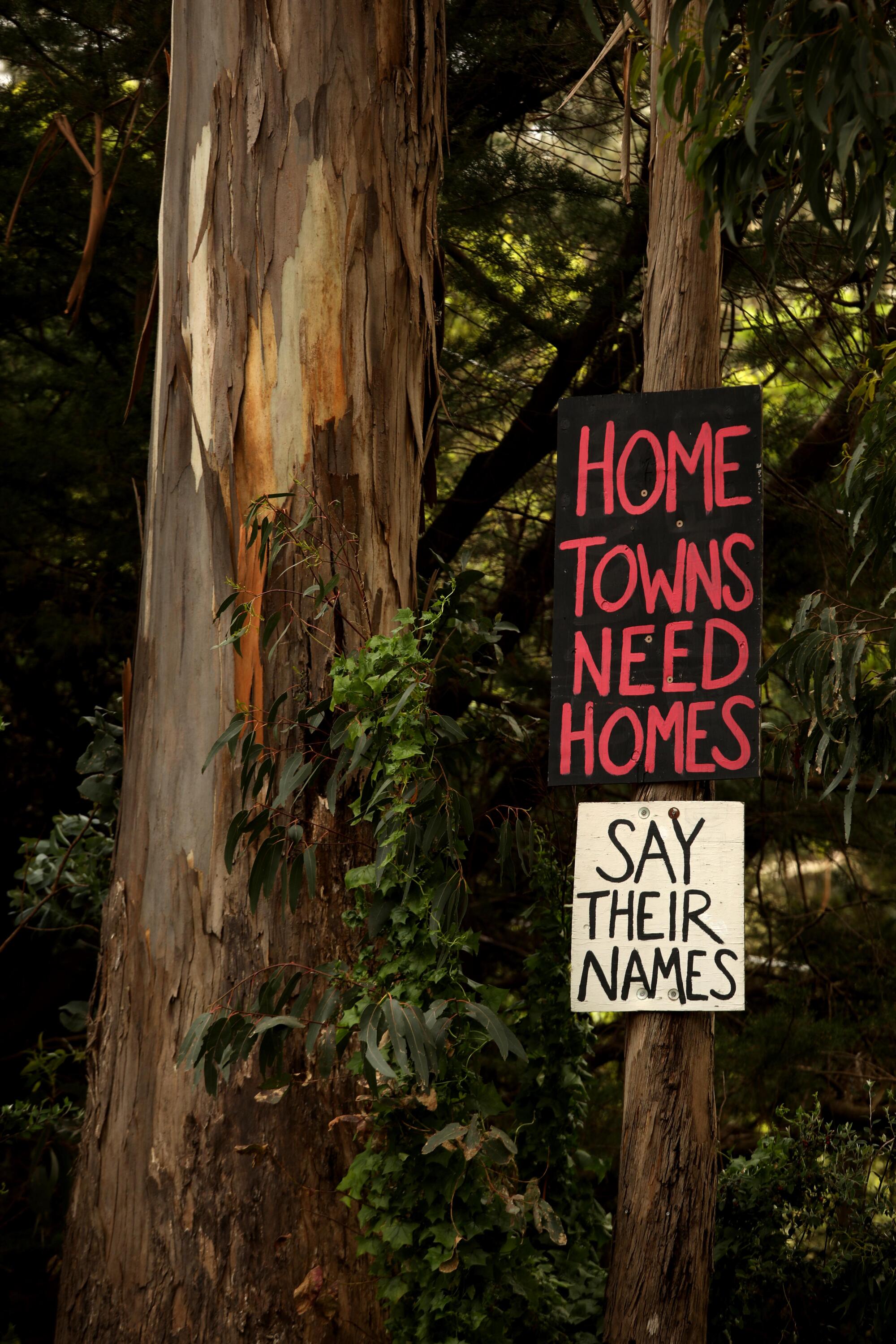
Bolinas residents say neighbors have been replaced by short-term guests and empty second homes, making the town feel more like a vacation rental suburb than a cozy hometown.
(Genaro Molina / Los Angeles Times)
During the summers, De Swart said, the town is overrun by visitors whose cars idle on narrow streets for more than an hour as they wait to park. Neighbors have been replaced by short-term guests and empty second homes.
“We used to know this as very much a vibrant neighborhood,” Bowser said. “A lot if it’s thinned out. A lot of people are older and have passed or moved on. We used to look out on this valley, and there were a lot of lights at night. Now, it’s mostly dark.”
Sitting on the couple’s living room table was a copy of the Point Reyes Light newspaper. On Page 11 was a classified ad that read: “In Search of Affordable Home,” placed by their friend, Tess Elliott, the newspaper’s publisher.
“We are the publishers of the Point Reyes Light and the assistant fire chief at the Inverness Fire Department,” the ad reads. “Please help us become permanent residents and continue to contribute to the place we love.”
Elliott, 44, said she and her husband have been running such ads for years. The mother of two young children, Elliott and her family live in an Inverness house that has been “rented to us at well below market rate” for the last decade by “a generous family.”
“It’s very fragile,” she said of life as a renter in Inverness, a town of 1,500 on the Tomales Bay with 93 registered short-term rentals. “People with kids, like us, can only take that so long. You want some stability. You want to invest in a property.”
Lately, she said, “we aren’t feeling very hopeful.”
Frank Leahy, a software engineer, bought his house a mile northwest of the newspaper office in 2020 and got a short-term rental license just before the county, in 2022, enacted a two-year moratorium on new operating licenses.
Leahy and his wife live full time in Inverness. But they travel a few weeks a year and list their house, with a bocce court out front, on Airbnb for $300 to $500 a night. Leahy said the county clamped down too broadly on short-term rental owners, conflating those who rent their homes full time and others who, like him, only rent a few weeks a year.
“I can name people who live up and down the street. If those were just rentals? It would be kind of weird,” he said. “I don’t have a problem with people wanting to rent out their home for a short amount of time.”
Leahy said short-term rentals are being scapegoated for the housing shortage in a place where it is prohibitively difficult to build.
About four years before they bought their home, he and his wife purchased an empty hillside lot nearby, planning to build a house. It took years to get all of the permits and to have the required bird, bat, geological and traffic surveys done. During that time, the cost to build rose by several hundred thousand dollars, he said. They gave up and sold the land.
On a chilly Wednesday morning last month, Dillon Beach was virtually silent — save for the plop-plop of sandals worn by a lone wetsuit-clad surfer walking home, and the tinkling of raindrops on Maggi’s windows.
With its gloomy weather, bad cell service and lack of jobs, Dillon Beach, on the south end of Bodega Bay, isn’t for everyone, Maggi said.
“A lot of the bugs in this place are its feature,” said Maggi, 54. “There’s no town. There’s no main drag. … This place has always been made of vacation homes. It’s not conducive to full-time living. It’s really far from everything.”
If it weren’t for vacationers — who fill the village with laughter and kids and wagons and dogs — the place would be dead most days, he said.
Maggi and his wife bought the house in 2020, when they and their adult children were going stir-crazy amid the pandemic. It was a financial stretch, but renting it out has helped. A gregarious Illinois native, Maggi joked that he had become a “California cliche” — a middle-aged guy with a beach house, a cool van, a border collie mix and a surfboard, even though he can’t surf well.
“We’re really fortunate, and I get it,” he said. But he finds it “kind of shameless” for the county to use the affordable housing crisis to justify cracking down on short-term rentals. The two-year ban on new licenses, he said, did not suddenly make houses cheap.
“You had this moratorium!” he said with a laugh. “How’s your affordable housing going?”



Rose Byrne poses at a 2025 press conference in Berlin for If I Had Legs I’d Kick You.
Andreas Rentz/Getty Images Europe
hide caption
toggle caption
Andreas Rentz/Getty Images Europe
Rose Byrne is one of the few actors to receive both an Oscar and a Tony nomination in the same year — the former for the film If I Had Legs I’d Kick You, and the latter for Fallen Angels on Broadway.
If I Had Legs was an intense indie film about a mother falling apart as she struggles to keep up with ever-increasing caregiving demands for her ill daughter. Byrne, who previously starred in blockbuster comedies like Neighbors and Bridesmaids, was praised for showing her range. Now, she’s returning to comedy in the revival of Noël Coward’s 1925 play about two wealthy women who find out a man they were each previously involved with is coming to town.

Kelli O’Hara, Mark Consuelos and Rose Byrne star in the Broadway revival of Fallen Angels.
Joan Marcus/Polk & Co.
hide caption
toggle caption
Joan Marcus/Polk & Co.
“I had long wanted to do a true comedic piece onstage, like it’s one of my dreams,” Byrne says of Fallen Angels. “We are trying to reach the back row, so physically, … I felt like I was screaming when I first got up [there], because we’re not wearing mics either.”
Byrne’s Fallen Angels character gets progressively drunk — and increasingly loud — throughout the play. She credits Coward’s “brilliant” writing and stage directions with guiding her performance.
“The language he used, the sort of linguistic gymnastics and the extraordinary vocabulary of Noël Coward is a delight,” she says. “I never tire of sitting backstage and I’m constantly rediscovering the words that he peppers throughout.”
Interview highlights
On her role in If I Had Legs I’d Kick You
Mary Bronstein wrote this incendiary screenplay and I just did not want to mess it up. It was such a creative opportunity. … We hit it off and had a real experience, one of those experiences in life that, creatively, has kind of changed me.
[The film] defies generalization or description, because it’s sort of like a fever dream, in a way. It has gallows humor in there. There’s horror tropes in the film, too. I think Mary Bronstein [who also directed the film] really broke the mold with the tone of the film, in many ways. She … tapped into the monster within and the fear of being a parent and the horror of being a parent, and some of the joy too, but obviously she’s in a really extraordinarily difficult situation, this woman. I still can’t believe the film got as far as it did, just because it was a small independent film.

If I Had Legs I’d Kick You was a small independent movie, says Byrne, “I still can’t believe the film got as far as it did.”
A24
hide caption
toggle caption
A24
On the constant beeping of medical equipment in the background of If I Had Legs
These noises get magnified and actually Mary Bronstein made those louder, just a bit, like the clock on the wall, the beeping of the machine, all those things were louder because they are in [the main character’s] point of view. And it is as a parent, those things become overstimulating. It’s relentless and, [Bronstein] wanted to capture that claustrophobia.
On why viewers don’t get to see the daughter or know what her illness is

The conceit of not seeing the daughter, and Mary has spoken to this many times, but [it’s] sort of a two-prong thing in that I don’t think Linda, my character, can see her daughter at this point. She’s so drowning and beginning this real descent into her mental health crisis. … Also for the audience to have that choice taken away to not see the daughter, you’re forced to reckon with the mother. Because as soon as you put a child on screen, your empathy, as it should, goes to the child. They’re so vulnerable, and immediately your concern will go to them, and so she takes that choice away from the viewer. So you are forced to be in the perspective of the mother.
On parenting after spending the day on set
Kids are so in-the-moment and grounding and — in the best way — they’re not particularly interested if you’ve had a hard day. But it’s so wonderful because you immediately snap into your role as mom, the greatest role, the most challenging, the most fun. And so for me, it’s church and state … leave it at work. I mean, obviously there were days when I was more exhausted or tired or [it’s] harder to let things go. But children are the great equalizer, as a parent.
On the thrill of filming the 2011 film Bridesmaids

We had such a fun time. It was a great group of actresses. I couldn’t believe I was there. … It’s already extraordinary to have that many scenes with just women. I’ve had that once since then when I did Mrs. America , [a] show for FX about the second wave of feminism. … But this was really, really special. And we had no idea that it would go on to become such a beloved movie and all of that. But the shooting of it was wonderful. It was an education in the brilliance of these comedic actresses and the performances. … It changed my life in so many ways. It really did. … The improv stuff, it’s just like a skillset that is still I marvel … they make it look effortless.
Therese Madden and Thea Chaloner produced and edited this interview for broadcast. Bridget Bentz, Molly Seavy-Nesper and Beth Novey adapted it for the web.


Anna Katherine Scanlon was having sushi in Marina Del Rey when she received an urgent text from her best friend.
“Just saw another place that was awful.”
Scanlon’s best friend, who was moving back to L.A. from Texas, had been apartment hunting for over a month and her moving deadline was creeping up.
In between bites of salmon nigiri, Scanlon began scrolling through apartment listings on her phone and came across a 1920s studio apartment in Los Feliz that she knew her best friend would swoon over.
“I sent it to her and was like ‘This is fabulous,’” she says. “I’m going to tour it immediately.”
Scanlon, an L.A.-based filmmaker who also works at a nonprofit, hopped into her car to see the rental, which had Art Deco tile, beautiful natural light, lots of storage and a stunning view of Griffith Observatory — a “rare find” for $1,900 in the sought-after neighborhood, Scanlon says. She sent a detailed video tour to her best friend, who applied instantly and signed the lease a few days later.
On the drive home, Scanlon, 33, had a light bulb moment: “What I love doing is something most people find totally overwhelming and exhausting,” she says. She could turn her knack for apartment hunting into something more.
So after finding apartments for several other friends (not to mention a dreamy 1927 storybook apartment in Echo Park for herself) and building a following on TikTok by posting apartment tours, Scanlon launched an apartment scouting business, LA Apartment Scout. She helps her busy clients find historic, characterful homes in L.A. within their budget.
She’s part of a rising group of apartment scouts — not licensed real estate agents, but savvy entrepreneurs who tour apartments, share videos on social media and, in some cases, work one-on-one with clients to find a place that fits their specific aesthetic and budget.
Unlike brokers — licensed professionals who act as intermediaries between landlords and tenants, commonly used in the apartment-hunting process in places like New York City, Boston and Austin, Texas, scouts operate outside the formal housing system. They aren’t connected to property owners and they don’t handle applications or negotiations. Instead, they act as digital lookouts who hunt for coveted vintage apartments that are otherwise hard to find without expertise.
The demand for apartment scouts highlights the pressures of L.A.’s competitive rental market, where vacancy is scarce and rental rates are among the highest in the country. According to Apartments.com, average rent for a one-bedroom apartment in L.A. was $2,182 as of May, which is 33% higher than the national average rent price of $1,642.
“To some extent, it reflects a dysfunctional housing market,” said Richard Kent Green, director of the USC Lusk Center for Real Estate. “It’s very hard for people to search and find what they’re looking for at the price they’re looking for, unlike many markets where it’s pretty straightforward.”
Apartment-scouting services tend to be especially appealing to younger Angelenos who feel priced out of homeownership, but still want spaces that reflect their personalities and tastes, rather than the increasingly common standard modern unit.
“There are tons of people who want to live in a home that reflects the character of the city, the beauty, glamour and drama, that is creatively inspiring or just cozy, unique, has character— not gray laminate floors,” Scanlon says.
Those seeking a scout might also be living out of town or simply too busy to endlessly search rental listing sites, Craigslist, Reddit and Facebook Marketplace, and then tour properties. One of Scanlon’s clients turned to her for help because they were finishing their PhD while getting ready for a new job at NASA.
Scanlon’s personalized services begin with a consultation call to understand the client’s needs, then she curates a list of apartments, tours the ones they love and provides videos of the space and the surrounding area. Scanlon says she works similarly to a local expert guide and relocation assistant. Since the apartment scout market is newer in Los Angeles, finding rates up front can be difficult (Scanlon did not wish to disclose her fees).
Indya Stewart, an interior designer and apartment scout, inside of a home.
(Gus Acord)
Indya Stewart, 24, of Hollywood is another L.A. apartment scout. In late April, the interior designer shared an eight-second TikTok with the words “hidden talent: finding chateau style apartments in L.A. for prices that feel illegal” and told people to contact her if they need help finding a place of their own.
“Omg pls put me on,” one person commented with an emoji crying face.
“Moving in the fall and I neeeeeed u,” another person said.
“Hmmm yes moving to LA in a month and can only live in a fairy castle sos,” commented another.
After receiving a flood of messages from people, she decided that instead of responding to each person individually, she would share her apartment picks on her interior design website. The list is free and is separated by region.
Unlike Scanlon, Stewart doesn’t tour apartments for people, rather she provides a curated list of vintage apartments for people to browse on their own.
“I spend so much of my free time looking for these places because I genuinely love the process,” says Stewart, who lives in a 1920s-style townhouse in Hollywood. “Sharing them just feels natural.”

Miesha Gantz of East Hollywood pivoted from dance to real esate.
(From Miesha Gantz)
While many apartment scouts do the work as an independent side gig, some like Miesha Gantz of East Hollywood are beginning to cross over into the formal real estate industry.
After stepping away from her professional dance career due to a massive pay cut, Gantz set out to find a more affordable apartment. Her criteria was specific: A 1920s or 1930s Spanish-style studio with oversize windows, lots of natural light, a fireplace, hardwood floors and character-rich tile work.
She began posting videos of her apartment-hunting journey on TikTok and before long people were asking her for help. Soon after, Gantz, who has a background in real estate, launched a membership-based website called the Hollywood Waitlist, where she posts listings of charming, vintage studios and one-bedroom apartments primarily based in Hollywood. She updates the website weekly with homes that are mostly under $2,500 per month. People can access the website for $6 for one week and $12 for one month.
As her social media and website gained traction, Gantz got connected with the Rental Girl, a boutique real estate brokerage based in L.A. and decided to reinstate her real estate license. She recently started working for the company’s concierge team, helping clients in a way that’s similar to her previous work as an apartment scout. However, the main difference is that she can now work directly with clients throughout the entire application process and help them secure the home.
Although finding the rental market is extremely competitive in L.A., these apartment scouts often foster a sense of community online. In TikTok comments, it’s common for people to offer tips from their own apartment-hunting experiences, sharing whether street parking is actually feasible in a particular neighborhood, if a building has a pest issue or if a listing agent was rude to them.
“When people know better, they do better,” says Gantz, who is also a filmmaker.
It’s worth noting that scams do exist in the world of rentals, so exercise caution when using social media. As demand for apartment scouts grows, Scanlon says she hopes others get involved, tackling different niches and neighborhoods.
“I don’t feel protective of it at all,” she says. “I’d love to see more people doing this.”

The Late Show with Stephen Colbert on Monday May 18, 2026.
Scott Kowalchyk/CBS Broadcasting Inc.
hide caption
toggle caption
Scott Kowalchyk/CBS Broadcasting Inc.
The Late Show With Stephen Colbert comes to an end this week amid a lot of changes in the business and the country. Some of the sources of tension include the economics of late night, the approaching merger of Paramount and Warner Brothers, and President Donald Trump’s constant criticism of late-night hosts. But for Colbert’s fans, it’s the end of a friendly, funny, candid show. So we’re talking about the legacy of Stephen Colbert in late night.
-
Indiana3 minutes ago
Bears reiterate Chicago stadium options are ‘exhausted,’ focused on suburban Illinois and Indiana
-

 Iowa9 minutes ago
Dozens of Iowa lawmakers ask federal regulators to reject transmission competition pause
-

 Kansas15 minutes ago
Former Kansas City PTA treasurer facing up to 30 years in prison for bank and wire fraud
-

 Kentucky21 minutes ago
KSP investigating fatal collision in Eastern Kentucky
-

 Louisiana27 minutes ago
I-10 crash in Baldwin County results in one fatality | WKRG.com
-

 Maine33 minutes ago
Hundreds of law enforcement officers travel to Bangor to honor fallen Maine Game Warden
-

 Maryland39 minutes ago
Maryland SHA to assess Fallston intersection where teen died in dirt bike crash
-

 Michigan45 minutes ago
Political expert weighs in on Mike Duggan’s withdrawal from Michigan gubernatorial race

