West
Suspect who fatally shot California UPS driver 10 times in truck was coworker, childhood friend: DA

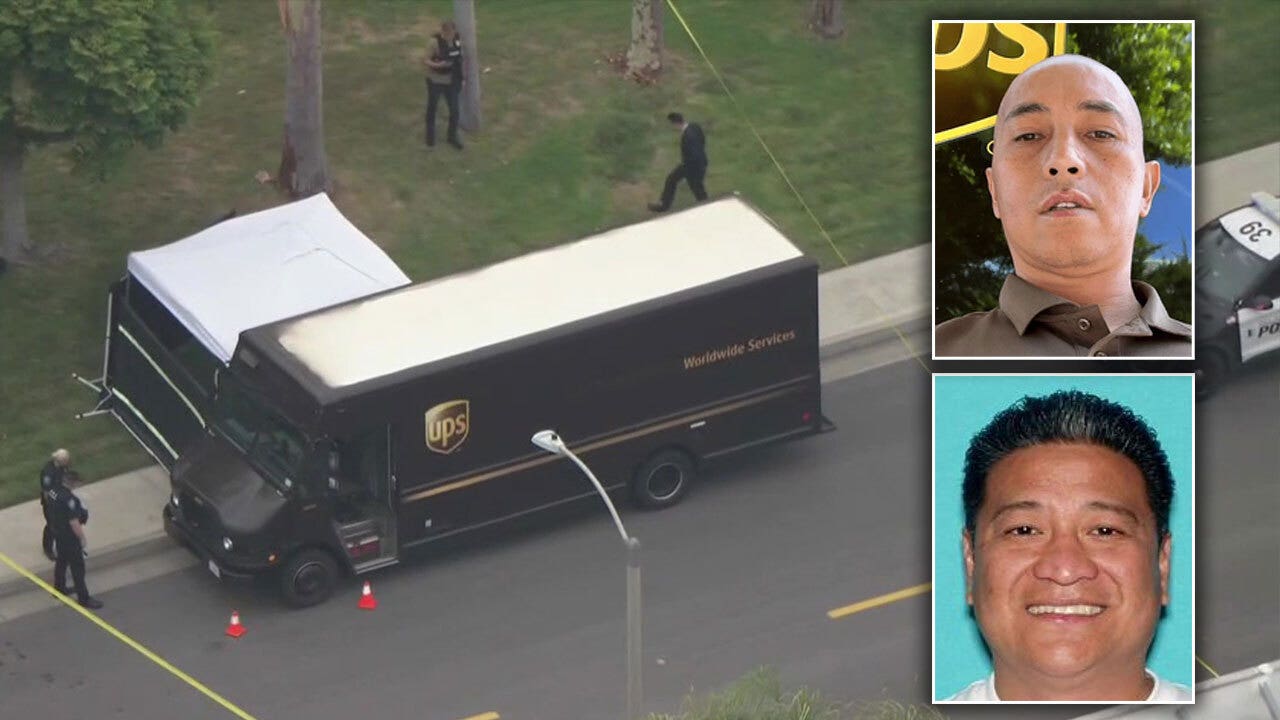
The suspect who shot a UPS driver in broad daylight in an ambush killing as the victim was on his delivery route in Southern California was a childhood friend of his and a coworker, prosecutors said.
Rhean Jalipa Fontanoza, 46, allegedly shot 50-year-old Expedito De Leon 10 times “in a matter of seconds as he sat seat belted in his delivery truck” on May 16, the Orange County District Attorney’s Office said Tuesday.
“He still had his UPS scanner in his hand and his seatbelt buckled when Fontanoza drove up next to De Leon’s delivery truck and shot [at] him 14 times in 19 seconds,” the DA’s office said.
Authorities said Fontanoza fired 14 shots and 10 hit De Leon.
USPS MAIL CARRIER SHOT AND KILLED ON THE JOB, POLICE OFFERING $250K REWARD FOR INFO
Rhean Jalipa Fontanoza (bottom), 46, allegedly shot and killed his coworker and childhood friend, Expedito De Leon (top), 50, as the victim was inside a UPS truck last week. (KTTV; Irvine Police Department)
Fontanoza, a UPS employee who was on disability leave, is charged with a special circumstances allegation of shooting from a vehicle and murder by lying in wait.
He allegedly went to great lengths to track down De Leon’s delivery route on the day of the killing. He allegedly stopped another UPS driver at around 12:30 that day and asked if it was the same delivery route used by De Leon.
The driver said De Leon was on a different route, prompting Fontanoza to go to the UPS substation in Aliso Viejo, where he was allegedly seen accessing a computer that shows driver routes and taking a picture with his phone.
“Just before 3 p.m., Fontanoza is accused of tracking De Leon down on his route and driving past him a new vehicle which De Leon wouldn’t recognize. De Leon then left his truck to make a delivery and returned to his truck, and buckled his seatbelt,” prosecutors said.
CALIFORNIA MAIL CARRIER FIGHTS BACK AFTER GETTING SUCKER PUNCHED, VIDEO SHOWS
A UPS driver was shot and killed in what police believe was a targeted attack on Thursday in Irvine, California. (FOX 11 LA livestream/Screenshot)
After the murder, Fontanoza fled the scene but was found by authorities in his vehicle later that afternoon, prosecutors said. He refused to get out of the car until tear gas and a police K-9 were deployed, authorities said.
Orange County District Attorney Todd Spitzer said De Leon “was just going about his day, doing his job with no idea his longtime friend was stalking him with every intent to kill him.”
“The depravity involved to plot and carry out a plan to execute someone you shared a lifetime of memories is not something anyone of us can wrap our heads around,” he added. “No life should have to end like this and it is a tragedy that should have never happened.”
The shooter accused of killing a UPS driver on Thursday in Irvine, California, barricaded himself inside his truck before police forced him out and arrested him. (FOX 11 LA livestream/Screenshot)
At the time of the killing, Fontanoza was scheduled to return to work on June 1 from disability leave.
Investigators have not determined a motive for the attack. Fontanoza is being held in the Orange County Jail with no bail. He is eligible for the death penalty, prosecutors said.
In a statement to Fox News Digital, UPS said it was “shocked and saddened by the latest developments in Irvine, CA. These are highly unusual circumstances and do not represent the culture of our company and the camaraderie among our employees around the world.”
“Our focus now is on supporting our people and their loved ones during this extremely difficult time. Since the investigation is ongoing, we defer any additional questions to the investigating authorities,” the company said.
Read the full article from Here



VIDEO: Floating central Montana’s Smith River
VIDEO: Floating central Montana’s Smith River
For the first time that I can recall, I found myself jealous of waterfowl.
And as vigilant as one must be in dodging rocks, they’re much easier to evade than raindrops.
Or hail, for that matter.
It had been nearly 20 years since I’d floated the Smith River, one of the premier locations for outdoor excursions in the state of Montana.
Despite its close proximity to Great Falls and the privilege of less stringent access, I hadn’t made the effort as an adult to enjoy the scenic journey practically in my backyard.
The trek was not easy, and by day’s end I was overcome with a lethargy almost two decades in the making.
However, as I’ve been reminded, a day’s effort was a small price to pay for enduring memories.
What and where is Montana’s Smith River?
The Smith River is a tributary of the Missouri River that spans 121 miles starting near White Sulphur Springs in Meagher County.
It flows between several mountain ranges to the mouth, where it dumps into the Missouri near Ulm, about 10 miles south of Great Falls.
The river was named after Robert Smith, the Secretary of the Navy under President Thomas Jefferson, by the Lewis and Clark Expedition. Meriwether Lewis dubbed it in an 1805 journal recording, “Smith’s River,” according to Montana State Library archives.
Located in historic Blackfeet territory, the area was eventually occupied by white settlers through various treaties between the tribe and the U.S. government.
The Act of Congress of 1874 moved the southern border of the Blackfeet territory 200 miles north, formally making settlement legal under U.S. law, according to educational materials from the Office of Public Instruction, although no compensation to the Blackfeet was given for the territory ceded.
Today, the Smith River Corridor — the 59-mile stretch of the river open to permitted floating in Smith River State Park — is managed by the Parks and Outdoor Recreation Division of Montana Fish, Wildlife and Parks in cooperation with the U.S. Forest Service.
Permitted floaters launch at Camp Baker, and the full journey to the Eden Bridge takes a minimum of three full days and two nights at approved camp sites, according to FWP.
A place for family
My dad, Mark Higgins, and his brothers frequented the Smith River area in their youth through a connection of their father, Alan “Lefty” Higgins.
My dad was able to purchase a cabin in the Castle Bar section of the Smith in the mid-1980s. It has now evolved into a family cabin, owned and curated by members of the extended family.
Some of my fondest memories come from times at the Smith, as family from California, Oregon and Washington all congregate at our place at various times each summer.
The Higgins cabin is one of the many things in my life that I am privileged to be a part of, and one that I strive to never take for granted.
The float begins at Camp Baker
The commute to Camp Baker is aesthetically identical to the one from Great Falls to the family cabin, moving along stretches of gravel backroads meandering through rolling hills and grasslands. The trip is scenic in its own way yet doesn’t give much of a hint of the views to come.
Unlike the usual gathering of cows from adjoining cattle ranches stopping to graze along the road, on this morning we were temporarily stopped by a small herd of elk making its way across — a sight I have only seen a handful of times in 30-some years.
The last time I floated the Smith was around the Fourth of July in 2007. My most vivid memory from the trip, aside from the scenery, was being inadvertently hit in the head by an oar and breaking the pair of knockoff Oakley sunglasses I’d bought on the street in New York on vacation.
As we set out from Camp Baker in our four-person raft and accompanying kayaker, I was reminded early and often how less-than-leisurely the float is, particularly in the conditions of the day.
On float day, the Smith was flowing at just over 160 cubic feet per second, according to the rangers at Camp Baker, which is a little over half of the “normal” flow of 300 cfs designated by FWP.
It seemed as soon as you’d evade one rock or shoot the gap between a pair, there was another right in your path.
I quickly became jealous of the ducks and geese we encountered frequently throughout, who navigated the river unconcerned with ducklings and goslings in tow, and whose instincts always seemed to point to the perfect “V” in the water’s flow.
Most rock encounters ended harmlessly with scrapes along the bottom of the raft or, at most, would stop us dead in our tracks. However, one passenger did take an involuntary dip as we collided sideways with a large rock, thankfully ending only in wet clothes and a soaked raincoat.
So went about the first half of our 21-mile, one-day float, as we attempted to dodge rocks through several bursts of heavy rain and another of hail.
Thankfully, as Mother Nature can humble you in one moment, it can also be quite generous.
If these walls could talk
Even if you were unencumbered by the task of navigating the river, it’d be impossible to take in the full picture of the Smith River Corridor, situated between the Big Belt Mountains to the west and Little Belt and Castle ranges to the east.
You see hillsides often greater than a 45-degree angle densely filled with tall skinny trees, with rock formations dug into and jutting out from the earth.
The cliff walls can reach over 100 feet high in places, each with its own distinct shape and pattern after millennia of erosion.
The cliff formations are almost as perfect as they are imperfect, as ornate as they are abstract, sometimes forming shelves, steps or ledges. Some of the bigger cliffs are commonly equated to cathedrals, almost as if chiseled in intricate and deliberate detail.
Each formation tells its own story, as if structures from an ancient civilization had been overcome by nature.
Past the Tenderfoot Creek — nearing the end of our day’s float — approaching the Castle Bar area is maybe the most beautiful stretch. The story goes that the area was named for the castle-like cliffs, with smaller rock formations on top resembling guards keeping a lookout from on high.
It’s easy to get caught up in your surroundings, falling into a dream state as you imagine the stories this landscape could tell.
The end of the journey
The flow of the river picked up significantly past the Tenderfoot, covering up most of the pesky rocks like those that had stymied the group early on.
The last five or six miles of the trip were far more serene as we took in the sights unencumbered and began to recognize the landmarks signaling our approach to Castle Bar.
There was a strong sense of accomplishment as the raft made its final landing on the shore of our destination, with the sun beginning to creep below the cliff line after a nearly 11-hour day on the water.
One participant declared this was their last float down the Smith, which seemed a reasonable decision as we wearily organized our gear on the riverbank.
After some rest, I hope that it wasn’t my last long float down the river that has come to mean so much to me and my family.
Maybe I’ll give it a go in another 20 years.
***
How can I float the Smith River?
Due to its popularity, the Smith is the only river in Montana to run on a permit system. Permits are granted through a lottery, and roughly 10% of those who enter receive permits — and only 10 % of those granted can go to out-of-state residents.
Applications for the lottery open on Jan. 1 and can be submitted to FWP until mid-February each year, with the lottery drawing occurring shortly after. Those who draw a permit are assigned a float day in the typical floating season from mid-April to mid-July, aside from one Super Permit winner, who is allowed to pick a day of their choosing.
Groups can consist of up to 15 people, and 9-10 groups per day set out from Camp Baker. The cost per floater is $25 for Montana residents 13 and older, $15 for children ages 6-12 and $60 for non-resident floaters over 13.
Groups are limited to four nights on the Smith and must camp at assigned campgrounds.
Those who don’t enter the lottery can also hire a private outfitter to float the river. There are seven outfitters who are approved by Montana State Parks and U.S. Forest Service to provide services on the Smith River.
For more information and FAQs on the float, visit fwp.mt.gov/stateparks/smith-river.

The U.S. Supreme Court ruled on Monday that states with laws that allow late-arriving mail ballots, including Nevada, can continue counting them in future elections.
In a 5-4 decision that had potential to affect November’s midterms, the high court upheld a Mississippi law that lets mail votes be counted up to five days after Election Day.
Nevada allows ballots postmarked on or before Election Day to be accepted for up to four days after the election. Mail returned without a legible postmark is accepted for up to three days.
“Nevada’s elections will not change — we will continue to run safe, secure and accessible elections this year without the interference and intimidation of the federal government,” said Nevada Secretary of State Francisco Aguilar in a statement.
The Supreme Court case originated in Mississippi, where the Republican National Committee, Mississippi Republican Party and the state’s Libertarian Party sued the state. Plaintiffs argued that the laws undermine trust and confidence in the election process. Their position centered around federal statutes that set a uniform Election Day.
President Donald Trump, who issued a 2025 executive order that called for an Election Day counting deadline, called the ruling a “tremendous loss” for voter rights.
In a statement, Gov. Joe Lombardo said he agreed with the court’s ruling and called for legislative changes in Nevada.
“Today’s ruling from the Supreme Court reaffirms my stance that states should determine how their own elections are conducted, but there is still a need to enhance transparency and security in Nevada’s elections,” the governor said in a statement. “I fully support the Voter ID ballot measure and will work to ensure our election laws reflect a simple, common-sense principle: Election Day should mean the end of voting, and ballots should be received by Election Day so the results are timely, secure, and trusted by the public.”
Nevada officials react
Attorney General Aaron Ford had signed Nevada onto a Supreme Court amicus brief in support of Mississippi, which argued that establishing an Election Day deadline could lead to a flood of litigation related to ballots that were cast on time but had delayed arrivals.
“Nevada’s elections are free, fair and safe, and Nevadans benefit from a range of choices in how to cast their vote — mail ballots included,” he said in a Monday statement. “Our state has made it clear that we believe our citizens deserve to cast their ballots in the way that is easiest for them, and today’s decision ensures that Nevadans who cast their mail ballot by Election Day will have their legal votes counted.”
Aguilar, Nevada’s chief election officer, earlier said that the state was preparing for the possibility that the high court would issue an opinion reversing the Nevada law. And, he said, recent elections had not seen a high volume of late-arriving ballots. In the 2024 general election, for example, under 10 had arrived by the fourth day after Election Day, he said in April.
Justices split vote
Justice Amy Coney Barrett and Chief Justice John Roberts, both conservatives, joined the three liberal justices in the majority ruling.
“When voting on different days in different states sparked allegations of fraud, Congress set a nationally uniform deadline for voting,” Barrett wrote in the majority opinion. “If varied deadlines for ballot receipt similarly call for a national solution, the American people must choose it through their elected representatives.”
She wrote that about 30 states accept at least some absentee ballots sent by Election Day to be counted afterward.
“Although the election-day statutes refer to a particular ‘day’ for the election, plaintiffs do not contend that everything must occur on that day,” Barrett said.
Justice Samuel Alito penned the dissenting opinion.
“If ballots received after Election Day are added to the set of ballots that dictate the election’s outcome, the electorate’s choice does not occur on election day, and the federal election-day statutes are violated,” he wrote.
Call for voter ID law renewed
After the ruling, Trump repeated his demand for senators to pass the Save America Act, a bill that would require voters to present a photo ID, proof of citizenship and outlaw most mail voting.
“There is no excuse for a politician, or otherwise, to be against the above three requirements. There is only one reason to oppose — CHEATING!,” Trump wrote on Truth Social. “The House of Representatives has approved this vital Act, THREE TIMES. The United States Senate seems unable to do so.”
The Repair the Vote PAC, which is leading a ballot initiative in Nevada to institute voter ID requirements, supports an Election Day deadline.
“This decision makes passing Question 7 even more important, as we must have verification that every ballot that is mailed in was sent in by a legally registered Nevada voter, regardless of when it was received,” said PAC Chairman David Gibbs in a statement, “but especially for those received after the polls have closed.”
Democratic senators Catherine Cortez Masto and Jacky Rosen celebrated the Supreme Court’s decision, adding that Nevada’s elections already are safe and secure.
“Today’s Supreme Court decision preserves that right so that Americans can continue to make their voices heard in the democratic process,” Cortez Masto wrote on X. “This administration will continue to lose in court as it tries to illegally control our elections.”
Added Rosen in her own post: “All eligible voters have a right to make their voice heard, and Trump won’t get away with his attacks on Americans’ voting rights.”
Contact Ricardo Torres-Cortez at rtorres@reviewjournal.com.

The David Woods abuse case and Iowa’s child welfare crisis
David Woods is serving 100-year prison sentence in connection with a case in which he adopted, then abused, boys from the Iowa foster care system.
New Mexico State Treasurer Laura Montoya reintroduced baby bonds to legislative teams at a recent conference.
During this conference, Montoya and her team explained what baby bonds would do, what they would mean for New Mexicans and asked for their thoughts and what she could change to help get it passed in the New Mexico Legislature.
Baby bonds are a way for parents to set children up for success later down the line, Montoya said. New Mexico would allocate around $7,000 to each newborn child as part of the bond proposal. The bond would grow over time, and the child would have access to it at age 18. Bonds could be used for a down payment for a car or to pay for parts of school that are not covered by the lottery or opportunity scholarships, buying or renovating a home, or starting a business all withing the state of New Mexico.
Montoya said the funds would not be used for random expenses.
“Now you might be saying, ‘when I was 18 and I would never give myself that money.’ You’re not getting the money directly. So, what happens is it all gets put into a pool of cash that is invested by the State Investment Council. They manage the money and then when you need it, let’s say you’re a student and NMSU gives us an invoice, you say ‘yes, I went to school and NMSU needs to be paid out,’” Montoya said. “Then it goes to the appropriate (agency), whether it’s EFA (Education Freedom Account) or whoever the Legislature designates, will then sign off the check and send it directly to NMSU. So, it’s their money but it isn’t their money.”
Montoya hypothesized on how a bond would benefit a young New Mexican.
“So, you consider an 18-year-old from a working-class family living in Rio Arriba (County), who dreams of attending a four-year college and eventually becoming a nurse. However, achieving this dream would have been difficult given her family’s working-class income. Having a Baby Bond has already made a difference. Research indicates that even small dollar savings accounts with money designated for school results in low-and middle-income children being more likely to enroll in college,” Montoya said.
Montoya said that statistics from the Treasurer’s Office, other state government agencies and pulled from public records to show what a baby bond could do for someone in a low income bracket.
“So, in Rio Arriba only 6% of adults have a degree beyond a bachelor’s degree. Only 7.5% of renters in Rio Arriba are able to afford median home price and baby bonds can contribute to significant decreases in student loan debt especially for women and people of color. You’ll see that same $7,000 she used $13,000 of it for nursing school when she was 18. Then, she still made another $23,000 and she used 30,000 for a home down payment. By the end of it she still had $150,000,” Montoya said.
The children who receive baby bonds would gain access to them only by taking a financial literacy course — or as Montoya calls it financial fitness course. This could be offered through state banks, but she said maybe later down the line it will be offered in kindergarten through grade 12.
“Financial fitness for me is something that I’m very passionate about because I grew up super humble and we didn’t have anyone to teach us what that looked like in having a savings account and investing and so many New Mexicans don’t. So, the one place we can learn this is in our schools, and we need to partner because a lot of our schools don’t have some of that expertise,” she said. “We need to partner with our banks; we need to partner with others that are doing the work already. We don’t need to reinvent the wheel. We just need to bring more people in to partner.”
Department Head and Professor at NMSU Harikuman Sankaran questioned whether the bonds could be used by students already relying on the New Mexico Legislative Lottery Scholarship and New Mexico Opportunity Scholarship. Deputy State Treasurer Ricky Serna said students had the option to access the funds regardless of scholarship awards.
“If I’m a student that says, ‘I live in Albuquerque and I’m going to UNM, I already don’t have to pay tuition and I have a scholarship and now I don’t have to pay for books and fees. Do I have to now wait until I buy a home to access my baby bond?’ Maybe it’s ‘No, I can tell UNM I have enough to put me to work in the school of arts and sciences or put me to work somewhere because I want to use some of my money now, right?’ I think that’s the idea,” Serna said.
Montoya said that this concern would be addressed later to not overcomplicate the bond proposal.
“But that’s something the Legislature can do in the future, too. I mean we have 18 years, so I don’t want to complicate it at this moment. I just want to keep it as simple as possible, but I understand (the concern) of what you’re saying on the long-term investment to have them buy in,” Montoya said.
Montoya said Baby Bonds have the potential to address some of the state’s largest issues – poverty, educational attainment and housing. As the bond recipient gets older it too can ease the burden of housing, retirement and reliance on public assistance.
Children born in New Mexico could access the investment between the ages 18 and 35 to build wealth.
Montoya asked the public to comment on the use of Baby Bonds, an issue the state Legislature will consider in the 2027 Legislative session.
Leighanne Muñoz is the business and development reporter for the Las Cruces Sun-News and is a fellow with the New Mexico Local News Fellowships and Internships Program, which places emerging journalists in newsrooms across New Mexico. Learn more at www.newmexicolocalnewsfellowships.org. Email her at lmunoz@gannett.com.
-

 Iowa50 seconds ago
11 beaches on Iowa DNR’s swimming not recommended list for July 4
-

 Kentucky11 minutes ago
Kentucky Wildcats News: Tyler Herro helped UK get Milan Momcilovic
-

 Louisiana16 minutes ago
Supreme Court rules in indictment against Louisiana attorney general
-

 Maine23 minutes ago
Magalloway Conservation Project in western Maine nearing completion
-
 Maryland26 minutes ago
Baltimore Gas and Electric seeks $8 monthly rate increase for Maryland customers
-

 Michigan31 minutes ago
Michigan lawmakers work through the night on ‘compromise’ budget
-

 Massachusetts38 minutes ago
Massachusetts city imposes curfew ahead of historic World Cup match
-
Minnesota41 minutes ago
Where to watch Minnesota Lynx vs New York Liberty on July 3: TV channel, start time and streaming

