Tuner, now playing in theaters throughout Israel, is an offbeat, interesting drama and crime caper, with some funny moments.
Entertainment
Review: Director Ken Loach's compassion remains a sturdy, reliable virtue in 'The Old Oak'

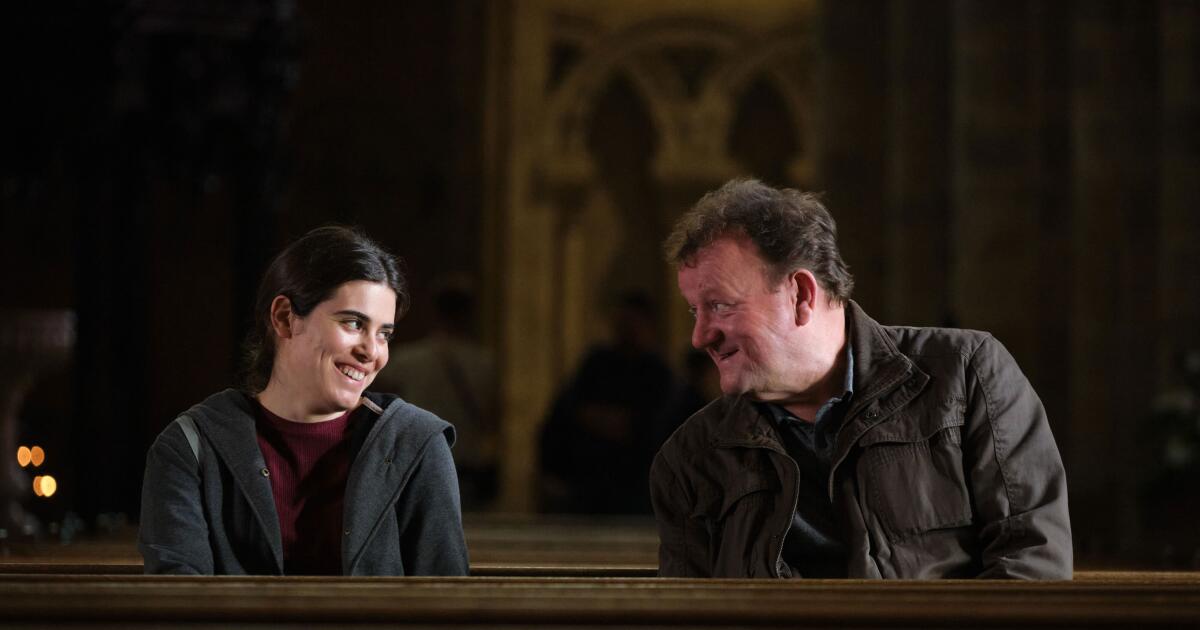
When it comes to the fiercely political British director Ken Loach’s latest film, “The Old Oak,” a bit of classic Hollywood promotional language comes to mind: Ken Loach is “The Old Oak.” Because seemingly forever, the sturdiest, tallest figure in the cinema of working-class struggle has been Loach, the man behind such raw, forthright classics as “Kes,” “Riff-Raff,” “The Wind That Shakes the Barley,” “I, Daniel Blake” and “Sorry We Missed You.”
If this is the final round for the 87-year-old filmmaker, he’s going out with a protest sign in one hand and a pint in the other. That’s because “The Old Oak,” written by longtime collaborator Paul Laverty and named for the last remaining pub in a downtrodden town in northeast England, shows Loach no less committed to the cause but also as faith-filled as he’s ever been.
It’s 2016 when we enter the story via black-and-white photographs of a busload of displaced Syrians, mostly mothers, children and the elderly, being dropped off in the mining town of Durham, the film’s audio dominated by locals loudly and bigotedly condemning their arrival. When the film itself starts (and cinematographer Robbie Ryan’s clean naturalism takes over), we learn that the refugee documenting everything is a young woman named Yara (Ebla Mari), whose first interaction is with a brutish man who violently grabs her camera and breaks it.
One of the aid helpers appalled at his townsfolk’s behavior is divorced, middle-aged pub owner TJ (an affecting Dave Turner), a lonely man with a good heart and a lot of hurt. He offers to help get Yara’s camera repaired and the unlikely pair strike up a friendship borne of mutual empathy for each other’s pain: her homeland and family brutalized by war; his once-thriving community battered by economic neglect and a poisoning fear. The latter is routinely manifested in the churlish Old Oak regulars for whom nostalgia-fueled resentment is no longer a condition to be changed but a disturbingly snug set of clothes; they view TJ’s kindness toward Yara (or anybody’s charity toward the Syrians) as a betrayal.
Dave Turner in the movie “The Old Oak.”
(Zeitgeist Films)
But on the walls of the threadbare pub’s long-shuttered backroom is photographic evidence — a reminder to TJ, an inspiring history for Yara — of the country’s 1984 miners’ strike, when an embattled people looked out for one another. Soon enough, TJ is spearheading a revitalization of the room so two struggling worlds can meet: communal dinners to feed both the refugees and a deprived town’s isolated youth. As things play out, however, Loach and Laverty are realistic enough in their tale of invigorating compassion to grasp that, as difficult as it is to find and nurture hope, just as essential is recognizing the danger lurking in festering grievance.
As vitally angry as Loach’s films can often be about the issues they’re addressing, the secret glue to his unvarnished, in-the-moment style has always been what camaraderie and care look like within any maelstrom of injustice and oppression. The authenticity of his casting, including his unwavering belief in newcomers, is flawless here, with Mari’s portrait of resilience sharing the frame wonderfully with Turner’s bearish, wounded air. And in a key role as a pub regular, Trevor Fox makes palpable the injury and distrust that can warp an honest reaction to a stranger’s struggles.
Loach is the rare movie agitator who can point to results. In 1966, his television film “Cathy Come Home” rattled the U.K. into acting on homelessness. We may be too inured these days to the unceasing drumbeat of immigration’s realities and disinformation to expect “The Old Oak,” as deeply emotional as it is, to have a similar impact. But we can still feel thankful for this beautifully indignant director’s career-long, never-wavering theme of solidarity, of seeing others’ problems as ours too, worth striking about and fighting against. It’s a righteous oeuvre with marvelously strong roots.
‘The Old Oak’
Not rated
In English with English subtitles (due to strong regional accents)
Running time: 1 hour, 53 minutes
Playing: In limited release.


By ABBIE BERNSTEIN / Staff Writer
Posted: June 26th, 2026 / 08:03 PM
SUPERGIRL movie poster | ©2026 Warner Bros./DC Studios
Rating: PG-13
Stars: Milly Adcock, David Corenswet, Eve Ridley, Matthias Schoenaerts, Diarmaid Murtagh, Jason Momoa, David Krumholtz, Emily Beecham
Writer: Ana Nogueira, based on characters created by Jerry Siegel & Joe Shuster
Director: Craig Gillespie
Distributor: Warner Bros./DC Studios
Release Date: June 26, 2026
The new SUPERGIRL doesn’t have that “Eureka! This is how you do this now” spark that galvanized its immediate franchise predecessor, last year’s SUPERMAN. Director Craig Gillespie and screenwriter Ana Nogueira, basing the film on characters created by DC Comics’ Jerry Siegel & Joe Shuster, probably wisely, aren’t going for that.
Instead, the SUPERGIRL makers are intent on providing a lively adventure, getting to the point quickly and letting the action unspool with unquestionably strong motivation, abetted by plenty of punch-ups, kicking and frequent explosions.
Supergirl, aka Kara Zor-El (Milly Adcock), is from the now-dead planet Krypton, just like her cousin Clark/Kal-El/Superman (David Corenswet). However, where Clark has chosen to remain on Earth, where the yellow sun gives him superpowers that allow to help Earth’s residents, Kara likes to party on planets that have a red sun, where she has no unusual abilities.
This is because Kara seems to have taken to heart a dictum from a different comic book universe – with great power comes great responsibility – and decided the inverse is true: with no power comes no responsibility.
We get insight into exactly why Kara is so duty-averse over the course of SUPERGIRL, and it’s probably not a spoiler to say that she re-examines some attitudes as events unfold.
Kara plans to celebrate her twenty-third birthday on a backwater red sun planet. The bar where Kara chooses to drink is entered by preteen Ruthye Knoll (Eve Ridley), whose family has been murdered by brigands, led by the horrendous Krem (Matthias Schoenaerts). Ruthye is out for revenge. Kara thinks Ruthye is a bit young and pure-hearted to be on a murderous quest.
Even on a planet with a red sun, though, Kara is still handy with fists and feet. Ruthye sees what Kara can do and concludes she is the ideal ally. Kara absolutely refuses to help. Then something occurs that credibly rouses Kara to do whatever it takes to achieve her aims, which sort of line up with Ruthye’s.
No explanation is needed for why Kara feels such urgency, which we easily share. Her concern for Ruthye is understandable and her connecting to larger purpose is shown rather than spoken.
Intriguingly, the aesthetics of SUPERGIRL are largely those of STAR WARS, with some MAD MAX and BLADE RUNNER thrown in. The filmmakers have a good time with all sorts of utterly nonhuman alien people and figuring out how to make interplanetary versions of familiar items like vending machines.
The pace is pleasingly brisk and the structure doesn’t require much exposition. When they hit a hard-to-answer question like why Kara is Supergirl while Clark is Superman, they acknowledge it and then get out from under without irritating anybody.
For anyone wondering about the veracity of the recording from Superman’s parents that appeared in SUPERMAN, a quick line of dialogue here confirms it (sorry, Jor-El supporters).
There is the expected amount of CGI involved, including a great motion-capture performance by Kara’s dog Krypto (modeled upon executive producer/SUPERMAN director James Gunn’s dog), but a lot of the stunts and makeup appear gratifyingly practical.
Adcock is fine in all of Kara’s moods, from wasted to resistant to determined, with a delightful reaction to feeling her body’s response to the yellow sun. Ridley is an appealing young hero, and Corenswet offers wholesome support. Schoenaerts lets Krem revel in his own soft-spoken vileness, and Jason Momoa enthusiastically portrays an intergalactic bounty hunter. David Krumholtz is affecting as Kara’s scientist father.
SUPERGIRL isn’t going to redefine superhero movies, but it’s a perfectly enjoyable example of the form.
Related: Movie Review: THE GET OUT
Related: Movie Review: CAMP
Related: Movie Review: LEVITICUS
Related: Movie Review: DISCLOSURE DAY
Related: Movie Review: KRAKEN
Related: Movie Review: FIND YOUR FRIENDS
Related: Movie Review: CHUM
Related: Movie Review: CAROLINA CAROLINE
Related: Movie Review: THE SUMMONING
Related: Movie Review: BACKROOMS
Related: Movie Review: SPEED DEMON
Related: Movie Review: PRESSURE
Related: Movie Review: PASSENGER
Related: Movie Review: I LOVE BOOSTERS
Related: TV Review: GREAT PERFORMANCES: STAGEBOUND
Related: Movie Review: OBSESSION
Related: Movie Review: LIFEHACK
Related: Movie Review: IS GOD IS
Related: Movie Review: AFFECTION
Related: Movie Review: ITCH!
Related: Movie Review: HOKUM
Related: Movie Review: ANIMAL FARM
Related: Movie Review: OVER YOUR DEAD BODY
Related: Movie Review: LEE CRONIN’S THE MUMMY
Related: Movie Review: HAPPY HALLOWEEN
Related: Movie Review: NORMAL
Related: Movie Review: FACES OF DEATH
Related: Movie Review: EXIT 8
Related: Movie Review: READY OR NOT 2: HERE I COME
Follow us on Twitter at ASSIGNMENT X
Like us on Facebook at ASSIGNMENT X
Article Source: Assignment X
Article: Movie Review: SUPERGIRL
Related
Related Posts:

In 2015, musician Roberto Carlos launched Boleros de Noche, an annual concert series held in Los Angeles that aimed at preserving and showcasing the Latin American bolero music genre.
This year, the event is celebrating its 10th anniversary with performances at the Ford on Aug. 1 by Puerto Rican singer and former Calle 13 member iLe and L.A.-based bolero trio Voz Bohemia
On Friday, the city of L.A. honored the series’ decade-long run and legacy of uplifting bolero music by declaring Aug.1 “Día del Bolero.”
Boleros are ballads noted for their slow tempo and romantic lyrics accompanied by a crooning vocal style. Though the genre originated in Cuba, it quickly gained popularity across Latin America, with each culture putting their own spin on it. In the early 20th century, the evolving sound of boleros was shaped by the Cuban group Trio Matamoros, Mexican composer Agustín Lara, Puerto Rican artist Rafael Hernández and Ecuadorian singer Julio Jaramillo.
The genre saw a resurgence in popularity in the 1980s and ‘90s when famed Mexican artists Juan Gabriel and Luis Miguel embraced the bolero sound. In recent years, the bolero movement has been modernized and electrified by artists such as Mon Laferte, Romeo Santos, Adrian Quesada and Kali Uchis. In the last five years, Quesada has released two bolero albums, “Boleros Psicodélicos” and “Boleros Psicodélicos II,” that mix the genre’s classic sounds with elements of psychedelic rock.
“Over the past decade, Boleros de Noche has presented numerous concerts featuring both local and international artists, has brought together thousands of people across the city to bask in the lush orchestration of this music,” said City Councilmember Nithya Raman, who presented Carlos with the honor. “For so many in the Latino community and beyond, this isn’t just music, it’s memory, it’s home, and perhaps most importantly, it’s heritage being carried forward.”
Raised in L.A. County by parents who immigrated from the Mexican state of Oaxaca, Carlos says he first fell in love with live performance and bolero music in his midteens, when he would frequent the now-defunct Teatro los Pinos in South Gate.
He yearned for that same level of comfort and awe at music and wanted to share that with a larger audience. The first iteration of Boleros de Noche took place in 2015 at an art gallery in Echo Park.
“Over the years, I have heard countless stories from audience members who tell me how this music reminds them of their parents, grandparents, first loves and family traditions,” Carlos said Friday at City Hall. “Ten years ago, bolero was rarely part of our city’s cultural conversation, and today bolero programming can be found across Los Angeles, and I’m honored that Boleros de Noche has been a driving force behind its growth.”
Boleros de Noche has sold out shows at the Ford over the last few years and has featured artists such as Gaby Moreno, Marisoul and the legendary trio Los Panchos. In 2025, the event made its debut at Chicago’s historic Symphony Center.
The bolero genre’s popularity and cultural significance has been spotlighted outside of L.A. in recent years as well.
On Dec. 5, 2023, UNESCO, the United Nation’s agency aimed at safeguarding social and cultural foundations, recognized the musical genre as an Intangible Cultural Heritage of Humanity.
As part of Friday’s ceremony, Carlos and his bolero group Los Rebeldes Románticos performed several tunes, including the Mexican bolero classic “Sabor a Mí.”
Last year, Carlos spoke with The Times about his ambitions for Boleros de Noche and the mentality that drives the event series.
“At Boleros de Noche, [I want] for us to speak in Spanish, to feel recognized, to do this music as a celebration for all these artists that unfortunately became background music for a lot of like weddings and quinceañeras,” he said. “How about if we celebrate them and give them recognition? How about if, through my events, I can take people back to the 1940s to my experience at Teatro los Pinos?”
Given recent attacks on Latinos on the local and national levels, Carlos said he hoped his events would create a safe and welcoming gathering place.
“It’s about bolero music. It’s about community. It’s about people. It’s about the musicians,” he said. “Many of the musicians were undocumented. They brought this music to L.A. through their hometowns.”
Movie Reviews
Film review: ‘Tuner’ mixes classical music, crime, and Dustin Hoffman | The Jerusalem Post

It co-stars Dustin Hoffman in a story of a young piano tuner, Niki (Leo Woodall), a former music prodigy with perfect pitch who suffers from hyperacusis, a condition that makes him extraordinarily sensitive to loud noises.
In a series of events that are a bit improbable but that seem quite credible while you’re watching, Niki discovers his finely tuned hearing gives him a great talent for safecracking, which brings him to the attention of a crime gang.
It features a clever, often surprising screenplay, co-written by its director, Daniel Roher (who won an Oscar for the documentary, Navalny) and Robert Ramsey. There are also wonderful performances from the cast, which also includes distinguished actress Tovah Feldshuh of Nobody Wants This and Fauda star Lior Raz.
The characters have a nice, funny raport
When Tuner opens, Niki is working in a piano-tuning business in New York with a former musician, Harry Horowitz (Hoffman).
The beefy, laconic, young man treats the garrulous, wisecracking Harry with respect, listening patiently to all his jokes and stories about the good old days when he worked with jazz greats.
These two have a nice rapport, as Niki drives Harry all over the New York area in an old van and eats in diners with him.
Niki does the work while Harry sits on a sofa, critiquing him.
The two stick out like sore thumbs in the many mansions where they work on spectacular pianos that haven’t been played in decades, for clients who ask them if they can also repair toilets and modems.
Harry, who never made much of a living despite his talent, has fallen on hard times, and he and his wife, Marla (Feldshuh), are barely scraping by. Niki is also broke.
Recognizing what a great musician Niki is, Harry tries to cajole him into playing again, but the younger man refuses, living an isolated life and trying not to draw attention to himself.
The three incidents that set the plot in motion
Harry has forgotten the combination to his safe and needs to open it. When Niki goes on YouTube to look at a video on how to do it, he discovers that his sensitive hearing makes him a genius at safecracking.
Harry becomes ill and, due to a mess with Medicare, suddenly falls into a huge debt; and Niki meets Ruthie (Havana Rose Liu), an extremely ambitious pianist and composing student, who is astounded by his perfect pitch.
Soon, Niki’s talent for safecracking draws the attention of Uri (Lior Raz), an Israeli who runs a bogus security company, where he uses his knowledge of his client’s homes and passwords to steal what he contends are minor trinkets, but which add up to big money for his gang, much like Jon Hamm’s character in the Apple TV series, Your Friends and Neighbors.
Raz hams it up as a character who fits the stereotype of the obnoxious Israeli in the US, and lords it over his supposedly bright accomplice, Yoni (Gil Frank), and his much dimmer nephew, Benny (Nissan Sakira).
Much of the comedy in the movie comes from Uri browbeating the two, and if you can understand the Hebrew, it’s even funnier than the subtitles.
Criticisms of Tuner
Niki’s romance with Ruthie, which develops quickly, feels a little convenient at times, though the screenplay paints a realistic picture of the competitive world of high-level music students. You know, for most of the movie, that eventually Niki will reveal to her that he was once a great pianist, and when it comes, it’s something of an anti-climax.
After Hoffman’s character gets sick, he disappears from the rest of the movie except for a couple of scenes, and that’s too bad. It’s great to see Hoffman having fun as Harry, and the scenes where he and Niki banter help humanize the younger man, making him more likable and less self-centered.
Woodall is one of the most in-demand young actors. He played a hunky love interest in both Bridget Jones: Mad About the Boy and the Netflix series Vladimir; he also appeared in the second season of The White Lotus.
He has a buff body and conventional leading-man good looks, and generally plays confident, happy-go-lucky guys, which means he is cast against type here.
Niki is the kind of role that might seem better suited for actors like Josh O’Connor, Jeremy Allen White, or Timothée Chalamet. Woodall has to work hard to convince us he is withdrawn and feels out of place in all the mansions where he tunes pianos, but his charm wins out, and soon, you come to accept him in the role.
Mixed music and mixed genres
The soundtrack features a mix of classical music and jazz, and it’s clear it was made by a director who appreciates both.
Tuner settles neatly into a mini-genre of movies that feature plot lines that combine piano-playing characters and crime, that include James Toback’s Fingers with Harvey Keitel, and Jacques Audiard’s remake of it, The Beat that My Heart Skipped with Romain Duris; Francois Truffaut’s Shoot the Piano Player with Charles Aznavour; and Eugenio Mira’s Grand Piano with Elijah Wood. It also recalls the spirit of Bob Rafelson’s Five Easy Pieces, which features Jack Nicholson in one of his best performances; here as a piano prodigy who has rejected his oppressive family and become an oil field worker.
Tuner shares some of the bleakness typical of 1970s films, like Fingers and Five Easy Pieces. At times, the movie moves jarringly between brooding, almost noir-like darkness and scenes with the chatty Harry or the bumbling gangsters.
It might have been a stronger film if Roher had gone in one direction instead of mixing genres, but it would likely have been less entertaining.
-

 San Diego, CA2 minutes ago
Your Produce Man – Great produce at the San Diego Farmers Market! 8am
-

 Milwaukee, WI4 minutes ago
See the corpse flower in bloom this weekend at the Domes
-

 Atlanta, GA10 minutes ago
How to watch DR Congo vs. Uzbekistan today: TV channel, streaming and kickoff time
-

 Minneapolis, MN17 minutes ago
North Minneapolis shooting injures 2 near Logan Avenue
-

 Indianapolis, IN19 minutes ago
Storm chance today, then turning hot and humid through midweek
-

 Pittsburg, PA25 minutes ago
Reunited! Penguins Get the Other Twin Ruck in Round 2
-

 Augusta, GA31 minutes ago
Richmond County elections board seeks dismissal of Myles election challenge
-
Washington, D.C34 minutes ago
Your access has been blocked – The Atlantic

