Entertainment
Review: Director Ken Loach's compassion remains a sturdy, reliable virtue in 'The Old Oak'

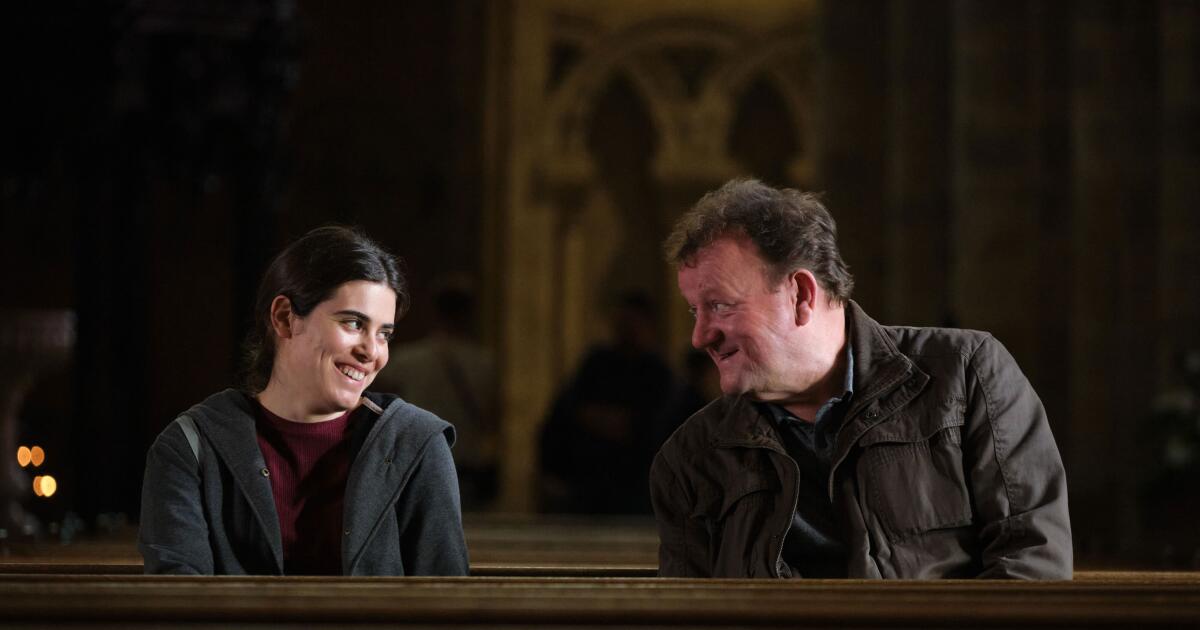
When it comes to the fiercely political British director Ken Loach’s latest film, “The Old Oak,” a bit of classic Hollywood promotional language comes to mind: Ken Loach is “The Old Oak.” Because seemingly forever, the sturdiest, tallest figure in the cinema of working-class struggle has been Loach, the man behind such raw, forthright classics as “Kes,” “Riff-Raff,” “The Wind That Shakes the Barley,” “I, Daniel Blake” and “Sorry We Missed You.”
If this is the final round for the 87-year-old filmmaker, he’s going out with a protest sign in one hand and a pint in the other. That’s because “The Old Oak,” written by longtime collaborator Paul Laverty and named for the last remaining pub in a downtrodden town in northeast England, shows Loach no less committed to the cause but also as faith-filled as he’s ever been.
It’s 2016 when we enter the story via black-and-white photographs of a busload of displaced Syrians, mostly mothers, children and the elderly, being dropped off in the mining town of Durham, the film’s audio dominated by locals loudly and bigotedly condemning their arrival. When the film itself starts (and cinematographer Robbie Ryan’s clean naturalism takes over), we learn that the refugee documenting everything is a young woman named Yara (Ebla Mari), whose first interaction is with a brutish man who violently grabs her camera and breaks it.
One of the aid helpers appalled at his townsfolk’s behavior is divorced, middle-aged pub owner TJ (an affecting Dave Turner), a lonely man with a good heart and a lot of hurt. He offers to help get Yara’s camera repaired and the unlikely pair strike up a friendship borne of mutual empathy for each other’s pain: her homeland and family brutalized by war; his once-thriving community battered by economic neglect and a poisoning fear. The latter is routinely manifested in the churlish Old Oak regulars for whom nostalgia-fueled resentment is no longer a condition to be changed but a disturbingly snug set of clothes; they view TJ’s kindness toward Yara (or anybody’s charity toward the Syrians) as a betrayal.
Dave Turner in the movie “The Old Oak.”
(Zeitgeist Films)
But on the walls of the threadbare pub’s long-shuttered backroom is photographic evidence — a reminder to TJ, an inspiring history for Yara — of the country’s 1984 miners’ strike, when an embattled people looked out for one another. Soon enough, TJ is spearheading a revitalization of the room so two struggling worlds can meet: communal dinners to feed both the refugees and a deprived town’s isolated youth. As things play out, however, Loach and Laverty are realistic enough in their tale of invigorating compassion to grasp that, as difficult as it is to find and nurture hope, just as essential is recognizing the danger lurking in festering grievance.
As vitally angry as Loach’s films can often be about the issues they’re addressing, the secret glue to his unvarnished, in-the-moment style has always been what camaraderie and care look like within any maelstrom of injustice and oppression. The authenticity of his casting, including his unwavering belief in newcomers, is flawless here, with Mari’s portrait of resilience sharing the frame wonderfully with Turner’s bearish, wounded air. And in a key role as a pub regular, Trevor Fox makes palpable the injury and distrust that can warp an honest reaction to a stranger’s struggles.
Loach is the rare movie agitator who can point to results. In 1966, his television film “Cathy Come Home” rattled the U.K. into acting on homelessness. We may be too inured these days to the unceasing drumbeat of immigration’s realities and disinformation to expect “The Old Oak,” as deeply emotional as it is, to have a similar impact. But we can still feel thankful for this beautifully indignant director’s career-long, never-wavering theme of solidarity, of seeing others’ problems as ours too, worth striking about and fighting against. It’s a righteous oeuvre with marvelously strong roots.
‘The Old Oak’
Not rated
In English with English subtitles (due to strong regional accents)
Running time: 1 hour, 53 minutes
Playing: In limited release.


Netflix stock plunged 9% on Friday morning to $67.74 a share, after the streamer’s second quarter earnings report renewed concerns among investors and analysts about the streamer’s future growth.
The Los Gatos-based company on Thursday narrowed its 2026 forecast to $51 billion to $51.4 billion from $50.7 billion to $51.7 billion, causing equity analysts to cut their estimates. The stock reached a new 52-week low on Friday and is down 49% from a year ago.
“This outlook likely reinforces investor concerns,” wrote analysts from Guggenheim Securities in a research note on Friday, which has a “buy” rating on the stock.
Netflix did not immediately respond to a request for comment on its declining stock price.
Investors have been skittish about the amount of time people spend on the streaming platform. Netflix’s share of TV viewing time in the U.S. has steadily declined in recent months as YouTube has gained market share, according to Nielsen data.
Investors are concerned that if people spend less time watching Netflix, it could cause people to cancel their subscriptions and make it more challenging for Netflix to raise prices in markets like the U.S.
Netflix said engagement is healthy on its platform and its programs continue to draw large audiences with popular shows like crime drama series “I Will Find You.”
Netflix said subscribers watched more than 97 billion hours on the streaming service in the first half of the year, up 2% from a year ago.
“We are increasingly concerned that younger generations are less interested in long form content as their time migrates to ‘free’ social media platforms,” wrote Jeffrey Wlodarczak, CEO of Pivotal Research Group in a report on Friday, who has a hold recommendation on Netflix stock. “We believe this will result in slower subscriber growth and attempts by the company to offset this via more aggressive price increases and investment in content.”
Netflix executives in a Thursday earnings presentation emphasized that measuring engagement at the company goes beyond hours spent watching the streaming service.
“There is not a linear relationship between view hours and revenue and profit because all hours are not created equal,” said Greg Peters, Netflix co-CEO on an earnings presentation on Thursday. “All hours don’t provide the same kind of value to the business.”
The streamer said it plans to allocate just over 5% of its content spend on live programming this year. Live content has been a key driver for subscriptions, accounting for six of the top 10 new member sign-up days over the last five years, the company said, even though it makes up roughly 1% of overall watch time this year.
The company is also diversifying the content it offers on its platform, adding live sports games and video podcasts, in addition its large library of TV shows and movies.
Netflix revenue rose 13% to $12.6 billion in the second quarter. Net income was $3.4 billion, up 9% from a year ago.
The company said its advertising business is on track to reach $3 billion in revenue this year, double the amount in 2025.

Sail we must, on Homer’s “wine dark sea” from Ithaca to Asia Minor and many points in between for the greatest story of them all, the tale of “a face, a fleet…of a war with Troy, of a man and a ‘trick’” and “Zeus’s Law, defied at mankind’s peril.
For his latest feat, Christopher Nolan takes us on the epic quest that is the cornerstone of Western literature and Western civilization, Homer’s saga of Odysseus, “hero of the Trojan War,” a trickster ready to wield his brain and his brawn in a titanic struggle not just to win that war, but the many tests that stand between himself and “home.”
And in Nolan’s telling, what makes “The Odyssey” timeless is the remorse of civilization’s unraveling, of the violence and pitiless greed that brings great epochs and empires to an end. Odysseus, played with equal parts cunning and gravitas by Matt Damon, spends his years “coming home” from The Trojan War filled with regret at what he’s seen, what he’s done and what’ he’s caused to come to pass.
His men and even he see himself as “punished” by the gods for his acts, playing god himself as he is forced to choose who lives and who dies. He pay for his hubris with more tests, more violence and more second guessing than we’ve ever seen in in a film or mini-series about him, the original “classic” hero of Western literature.
Nolan’s ancient epic is more historical and slightly grander than Wolfgang Peterson’s mythic star vehicle “Troy,” more touching than the riveting and brutally heroic “300,” and more tactile than either. We’re seeing real seas, realistic reconstructions of ancient armor, cities, galleys of war and a real dog — Argus — waiting for his master to return from decades of fighting and traveling.
Note to “Supergirl” and “Superboy” filmmakers and anybody else thinking “Let’s just digitally animate the damned dog.” Nobody cries when a digital dog dies.
If I’m honest, Nolan’s version of an oft-told tale had me from the moment I saw “the horse,” the “trick” of the tale-teller’s account of “clever” Odysseus. Troy really existed, and if there really was a “Trojan Horse,” I’ll bet it looked a lot like this — half-buried in the surf, a “Planet of the Apes” post-apocalyptic monument and tribute to the gods that had to be hauled, sans wheels, from the sand to the city whose blasphemous undoing it held hidden in its belly.
Nolan’s narrative opens with that “trick,” and tells the tale from three temporal perspectives — the war, as remembered, events back home in the Ithaca with the queen (Anne Hathaway) and son (Tom Holland) that King Odysseus left behind to fight, and the epic quest to return from that war as recalled by Odysseus in the company of his most alluring captor, Calypso (Charlize Theron).
The central conflict isn’t the war, or the murderously ruthless “suitors” for Queen Penelope, foremost among them the handsome and venomous Antinous (Robert Pattinson). It is between Odysseus and his superstitious men as he struggles with hardened warriors (Himesh Patel plays his stoic but questioning second in command) convinced their commanding officer has offended and re-offended the gods, especially Troy’s patron, Poseidon.
“You can’t live by omens and sacrifices,” Odysseus scoffs. But in this “time of apparent magic,” even our Ur-hero is given pause by Cyclops, the Sirens, the enchantress Circe (Samantha Morton) and the gigantic armored man-eaters that confront them, the Laestrygonians.
And even Odysseus has his Mount Olympus spirit guide. Zendaya plays the goddess Athena, who warns him “Your cleverness will get you into trouble.”
As indeed it does.
Damon’s “brand” as an actor has long been the intelligence he conveys in all but the silliest roles. That’s put to great use here as we see him plotting and planning this escape or that ambush. “The gods help those who help themselves,” he preaches. But his Odysseus also lets us see him second-guessing himself, a wearying and ageing man weighed down by the heartbreaking burdens of leadership.
Hathaway, in the role of the dutiful wife weaving and unraveling her tapestry while bullying suitors impose themselves on her household, shows us her own burdens. She said “Promise me you’ll come back.” And all she’s left with, decades later, is rising anger at the plight her long-absent and presumed-dead husband has placed her in. She is queen, but their overmatched son (Tom Holland) is too unsophisticated and physically weak to take the throne in the presence of entitled, murderous brutes.
Jon Bernthal brings a rough bluntness to the gruff Menelaus of Sparta, a hardnosed ruler dragged into war when Helen (Lupita Nyong’o) ran away from his brother Agamemnon (Benny Safdie) to Troy.
And John Leguizamo nimbly plays the loyal blind swineherd who tries to help Penelope and son Telemachus (Holland) cling to power as long as possible against long odds that his master, Odysseus, might return. Horror icon Mia Goth plays Penelope’s treacherous handmaiden.
Nolan’s “all-star cast” makes something of a statement in terms or the film’s intentions and modern messaging. The first character we see is played by the transgender actor Page, with a Black Helen of Troy and Black and Asian characters giving this ancient world the cosmopolitan flavor it most certainly had.
A running theme through all this is the breakdown of an old order, “Zeus’s Law” about piety, square dealing and how to treat strangers and guests and the rest of the human race, Trojans included. Nolan is talking about the “Dark Ages” to come, and the “Dark Ages” which have revisited us whenever the people lose their way and the violent and rapacious are empowered over us, often at our own doing.
Take a gander at insensate monster Cyclops and who he seems to resemble. Imagine him in a diaper if you have trouble making the connection.
This “Odyssey” is almost exactly what we’d expect from Nolan, a very good film not on a par with the unnerving novelty of “Inception,” lacking the poetry and stunning suspense of “Dunkirk” — just an epic yarn given epic treatment/
This is a filmmaker who has something to say to modern audiences, and a pretty good idea of how to say it within the context of a 3000 year old tale of “a face” that “launched” a “fleet” of “a thousand ships,” of “clever” Odysseus” and the gods and all-too-human men who bedeviled him every step of his guilt-ridden and bloody journey “home.”
Rating: R, graphic violence, nudity, profanity
Cast: Matt Damon, Anne Hathaway, Tom Holland, Lupita Nyong’o, Himesh Patel, Zendaya, Robert Pattinson, Elliot Page, John Leguizamo, Samantha Morton, James Remar, Ryan Hurst, Mia Goth, Jon Bernthal and Charlize Theron
Credits: Scripted and directed by Christopher Nolan, based on “The Odyssey” by Homer. A Universal release.
Running time: 2:52

Kris Jenner’s mom, Mary Jo “MJ” Shannon, has died.
Jenner announced the news of Shannon’s death Thursday in an Instagram tribute. She was 91.
“Today, we said goodbye to my beautiful Mommy MJ. … There are no words that could ever capture what she has meant to me or the heartbreak of having to say goodbye. My mom was the heart of our family.”
Jenner wrote that her mother, the matriarch of the Jenner-Kardashian clan, taught her everything that “truly matters.”
“To love your family fiercely, to be kind, to show up for the people you love, and to never take a single moment together for granted,” she wrote alongside a glamour shot of Shannon. “She taught us that family is everything. She showed us how to love unconditionally and how to find joy in the little moments. She showed me how to face life’s challenges with resilience and faith.”
Jenner concluded the post with an open letter to MJ:
“Mom, thank you for every sacrifice you made, every piece of wisdom you shared, and every moment you loved us so completely. I will miss our daily talks, your smile, your laughter… Our hearts are broken, but we find comfort knowing that love like yours never truly leaves us. Your love will live on in our family, in our traditions, in every moment we are together, and in every life you touched. When I look at my kids and my grandkids, I will forever see pieces of you in all of us. There is not a part of me that isn’t shaped by you. And if I have done anything right in this world, it’s because I spent my life trying to live in a way that would make you proud. Every memory, every moment, every blessing, it was all because of you, and I will forever thank God every single day for making you my mommy. My heart is broken into a million pieces… thank you for giving me the greatest childhood and oh what a beautiful blessed life… I love you forever Mommy. Thank you for giving us everything.”
Born Mary Jo Campbell on July 26, 1934, MJ married her high school sweetheart, whom she divorced two months later. Then in 1954, she wed Jenner’s dad, Robert “Bob” True Houghton. She gave birth to Jenner the following year and Jenner’s late sister, Karen Houghton, in 1958. After seven years of marriage, MJ and Bob called it quits and she married Harry Shannon, a businessman who helped raise Jenner and her sister in San Diego, where MJ ran a children’s clothing store.
Harry Shannon died in 2003.
MJ was featured on the famous clan’s E! reality series “Keeping Up With the Kardashians” and the follow-up Hulu series “The Kardashians” numerous times over the years. In a clip from the show, granddaughter Kim Kardashian detailed that her grandmother had survived colon cancer and breast cancer and, in her sunset years, struggled with sickness resulting from the cancer treatments.
In one clip from the show, MJ said she didn’t have an appetite without taking her “medication” first. Then she persuaded her daughter, Jenner, to have marijuana gummies with her. Together they lit some incense and munched on muffins and chips and guacamole.
In another clip, Jenner interviews MJ about her life, and during the sit-down, Jenner asks MJ, “What’s your biggest fear?”
MJ replies, “I try not to fear,” and then follows up asking Jenner what her biggest fear is.
Jenner starts to cry and says, “I don’t want to say it. I can’t believe I’m crying. … Just, losing someone.”
On Thursday, Kim Kardashian caught flak online when a post featuring the Skims mogul and her sister Khloe Kardashian swigging tequila from a boat on a lake published shortly after Jenner announced the news of MJ’s death.
“This post was scheduled a few days ago before we lost MJ, so its timing came right alongside her passing,” Kim wrote in the comment section of the post. “I’ve been by my mom and grandma’s side this past week, and my heart is completely with my family right now. We love and miss her so deeply, and in the days ahead, we’ll be focusing on celebrating her beautiful life.”
Kim followed up with a post celebrating her grandmother, writing, “My sweet Grandma MJ, my best friend, my gossip buddy, my forever twin … You taught all of us the importance of family, and those values are something we’ll carry with us forever!!!!! You were the woman who showed me what it meant to be a hardworking businesswoman. You gave me my very first job at your store in San Diego and taught me lessons about work ethic, strength, and confidence that I’ve carried with me ever since.
“You always believed in me, championed me, and were my safe place. You truly were the matriarch of our family, and your love is woven into all of us. I know you’re at peace now. Give Papa Harry, Aunt Karen, and my dad a hug for me. You will always be a part of me, I love you soooooo much and I will miss you forever and ever. … YOU ARE THE BEST OF US!!!”
Two weeks ago, Jenner’s bodyguard, Mason Haynes, who also worked as a close protection guard for other members of the Kardashian-Jenner family, died in a traffic accident. He was 52.
-

 Technology12 minutes ago
Apple’s plot to crush OpenAI
-

 World18 minutes ago
Leaked Iran report finds record public anger as regime focuses on holding power
-

 Politics24 minutes ago
White House dishes out new election security jab over Olive Garden’s pasta pass ID policy
-

 Health29 minutes ago
Doctors warn your ‘stomach bug’ may actually be a parasite that’s harder to detect
-

 Sports36 minutes ago
AEW star Kenny Omega blasts social media user over Charlie Kirk comment
-

 Technology42 minutes ago
New bank scam laws could stop suspicious payments
-
 Business48 minutes ago
Environmental groups press to halt Imperial Valley lithium venture
-
Entertainment54 minutes ago
Netflix stock plunges to 52-week low following mixed earnings report

