Business
Column: More than just a store, 99 Cents Only gave a fair shake to all who entered

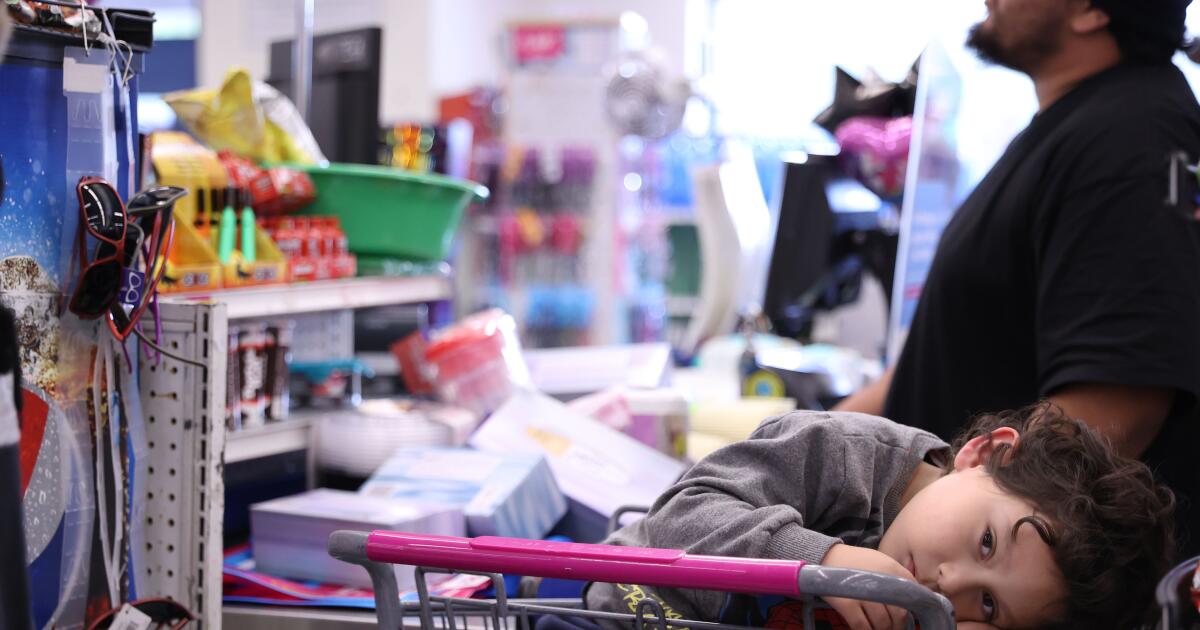
At 8:30 on Sunday morning, the parking lot at the 99 Cents Only store in Santa Ana was already beginning to fill. A few days earlier, the chain had announced it was closing all 371 of its stores in California, Nevada, Arizona and Texas.
This location off Main Street had seen better days. Unhoused people wandered near the trash bins. The walls and walkway leading to the front door were grimy. A massive window decal of fresh fruit near the entrance was peeling.
No one smiled while grabbing a shopping cart and walking in, even though all items were 10% off and signs screamed “Everything Must Go! Up to 30% Off.” Customers expressed their condolences to anyone with a name tag and vented to anyone who would listen.
“I blame [Gavin] Newsom,” said Rick Juarez, 53, referencing the California governor as he entered the store to stock up on batteries. He had shopped at this location for “at least” 20 years. “Too many taxes, too high the minimum wage. These companies just can’t compete, and so they have to close. And it’s poor people like us who end up suffering.”
Victor Barrios said he hopes the rumors of investors wanting to save the 99 Cents Only empire were true.
“This needs to stay open,” the 38-year-old delivery driver said. “I make OK money, and buying here helps me. But imagine if you’re on WIC? If you’re on Social Security? You need a place like this. Are people now supposed to go to Ralphs? Or Target? With what money?”
I can count on my hands the number of times I had previously shopped at 99 Cents Only, and maybe even on one hand — I’m more of a swap meet kind of guy. I’ve only gone with my wife, only to this location. But I had to visit out of respect — and sadness.
The 99 Cents Only Stores’ demise is another blow for the thrifters who make Southern California tick.
For generations, millions of us — immigrants, long-timers, working-class folks, or people who just want a good deal — have fueled an alternate economy far removed from fancy department and grocery stores. We patronize swap meets, Salvation Army stores, half-off warehouses and garage sales. Food comes from bartering with neighbors, or outlets like 99 Cents Only. My people inspired Carey McWilliams to half-jokingly call Los Angeles the “junkyard for a continent” in his 1946 masterpiece, “Southern California: An Island on the Land.”
Even today, as I make a good living and my wife runs her own restaurant, we live a penny-pinching life. A grocery splurge for us isn’t Whole Foods or Erewhon; it’s Trader Joe’s. I get my shirts and khakis at Marshalls or Ross Dress for Less, and guayaberas at the Anaheim Indoor Swap Meet or Olvera Street. The last time I spent more than $100 on an item of clothing was a black suit from Nordstrom for my mother’s funeral.
Those of us in this fellowship of frugality seek out bargains because we know that California’s booms inevitably end in bust. That’s what makes the imminent end of the 99 Cents Only empire — which started in Westchester in 1982 — so distressing.
Marta Lara, left, helps Anita Hernandez at a 99 Cents Only store in Los Angeles in 2008.
(Nick Ut / Associated Press)
Interim Chief Executive Mike Simoncic said in a statement that the chain was closing because of “significant and lasting challenges in the retail environment.”
Even though it was a multibillion-dollar company, 99 Cents Only operated under a premise straight from the Great Depression: a fair shake for everyone who entered. Here, the retiree shopped alongside the hipster, and the only colors that mattered were the bright blue and pink on the marquee of each store. The chain had locations in blue-collar towns such as Santa Ana and Colton, but also suburbs such as Alhambra and Santa Monica.
Yes, off-brands and remaindered products made up the bulk of offerings, but treasures awaited for those who regularly came. One day, you’d get a generic brand of sriracha, another time, regular Tapatío hot sauce at prices you last saw during your childhood. And who knew when you might encounter a small blowup doll of AC/DC frontman Angus Young, like I did on Sunday?
There was a camaraderie among fans that rivals such as Dollar Tree or Dollar General or even Walmart were never able to match. Founder Dave Gold was a SoCal business iconoclast on the level of In-N-Out founder Harry Snyder and cafeteria magnate Clifford Clifton, who made sure that the least among us could eat and shop like kings.
Nowadays, discount shopping is just an Amazon click away — a race to the bottom of inferior products and loneliness.
“I could buy toys for my younger kids, my older kids could get pens for school, and I could do groceries for all of us,” Altagracia Nuñez told me in Spanish as she perused the beauty aisle, where sticks of men’s and women’s deodorant looked like tumbled dominoes. “And the prices, of course.”
She stayed quiet, then offered a weak laugh. “Well, everything is more expensive nowadays, so I guess this had to end.”
Friends told me that their local 99 Cents Only stores were beginning to look as bereft as the pandemic days. But the Santa Ana branch I visited was well stocked. It was interesting to see what was available and what wasn’t.
The shelves that once held reusable containers were empty, but the Easter decorations hadn’t moved. There were no more bleach bottles by LA’s Totally Awesome, but the rest of the brand’s cleaning products were available. Milk was sold out, but stacks of bland El Comal corn and flour tortillas — already marked 50% off — were barely touched.
Everyone’s shopping cart seemed fuller than usual, and they all seemed to have at least one package of both toilet paper and cleaning towels. I didn’t need either, or anything, really. So I bought an array of canned goods from a bygone era — Hormel canned tamales, Armour potted meat, Libby’s chicken Vienna sausages and pork luncheon meat, whatever on Earth that is — to mark the end of another Southern California classic.
Shoppers exit the 99 Cents Only store in Huntington Beach
(Allen J. Schaben / Los Angeles Times)
The Frito-Lay and Takis displays near the checkout counter were picked clean, as was the Pepsi cooler. Cheery new jack swing tunes played on invisible speakers. Behind me, a man softly sang to himself “Se va, se va la 99” (“It’s going, the 99 is going”). In front of me, a woman announced in Spanish to no one in particular, “I think I’ll come back here another time.”
“We close June 3,” the cashier responded. “Come back.”
He let a beat pass. “Come here until we’re done.”


In the latest lawsuit against Paramount Skydance, a corporate shareholder has alleged corruption at the highest levels of the company, which is battling to complete its $111-billion takeover of rival Warner Bros. Discovery to create a new media behemoth.
Controlling shareholders Larry Ellison and his son David have presided over a firm that allegedly made “illegal promises and payments to secure regulatory approval,” for the Ellison family’s Paramount purchase last summer, according to the shareholder lawsuit filed this week in Delaware court.
Larry Ellison allegedly discussed with President Trump how Paramount’s pending Warner Bros. acquisition would result in a shake-up at CNN, states the lawsuit filed by Paramount shareholder Paul Robbins.
“The Ellisons [won] the bidding war for Warner Bros. by promising sweeping changes at CNN and other personal benefits to President Trump,” according to the 59-page complaint.
The case was brought on Robbins’ behalf by the nonprofit Public Integrity Project and the advocacy group Freedom of the Press Foundation, which has been critical of the Trump administration‘s policies toward the media.
The complaint noted that Netflix withdrew from the bidding in February — the same day Co-Chief Executive Ted Sarandos met at the White House with then-Atty. Gen. Pam Bondi and another top official.
The lawsuit suggests Netflix dropped out after recognizing the challenges of dealing with the Trump administration and that Trump always wanted to see the prize go to Paramount because of his close ties to the Ellison family, who have ushered in more favorable news coverage of Trump and the departure of late-night comedian Stephen Colbert.
Robbins does not appear to have firsthand accounts supporting his claims, which are based on public documents and media reports about dealings between the Ellisons and Trump. He has owned Paramount stock since 2021, but the lawsuit does not say how many shares he owns.
He could not be reached for comment.
Paramount, in a statement, pushed back against his claims, saying the “lawsuit recycles allegations that have already been reported and already addressed.”
“As we’ve said consistently: No commitments from either David or Larry Ellison have been made to any government body, state AG or federal agency regarding the future of CNN or any other news property, other than the goal to deliver truth-based journalism,” Paramount said.
It’s the third lawsuit lobbed at Paramount this week. On Monday, California Atty. Gen. Rob Bonta led a coalition of 12 Democratic state attorneys general that filed a federal antitrust lawsuit seeking to block the Paramount-Warner merger due to concerns about consolidation in movie distribution and cable channels.
The Writers Guild of America added another antitrust lawsuit against Paramount on Tuesday, alleging the massive merger would result in fewer jobs and lower pay for writers.
Many in Hollywood are opposed to the deal due to fears that another studio consolidation would bring more layoffs, programming cutbacks and a fragile business environment due to the heavy debt burden — nearly $80 billion — that Paramount would have to take on to buy Warner Bros.
The shareholder lawsuit noted that Paramount participated in a raucous event with UFC fighters on the White House lawn in June to celebrate Trump’s 80th birthday and the nation’s 250th anniversary. Paramount has UFC broadcast rights.
The event came two days after Trump’s Justice Department wrapped its regulatory review of Paramount’s Warner Bros. proposal, giving the merger a key green light.
Justice Department investigators reportedly did not have a chance to express potential antitrust concerns when high-level Justice Department officials closed the inquiry — a major win for Paramount and the Ellisons, the lawsuit states.
“There have been some line attorneys in the DOJ that have reviewed this [merger] and have some concerns,” New York Atty. Gen. Letitia James said Tuesday during a virtual town hall with opponents of the merger. “Their analysis of this particular case was ignored by the front office, if you will, at 1600 Pennsylvania Ave. [the White House] That’s the front office.”
Ellison’s Skydance Media emerged with its deal to buy Paramount two years ago. Previous controlling shareholder Shari Redstone was desperate for an exit and Trump was mounting his White House comeback by battling then-President Biden, then Vice President Kamala Harris.
Trump declined an invitation to appear on CBS’ “60 Minutes,” then under Redstone control. He became infuriated by an October 2024 interview with Harris on “60 Minutes.”
Trump filed a $10-billion lawsuit against CBS (he later upped it to $20 billion). After Trump won the election, he had considerable sway over Paramount because it needed his administration’s approval for the sale to the Ellisons.
Paramount agreed to pay Trump $16 million to end his “60 Minutes” lawsuit, allowing the sale to go forward. The Ellisons acquired Paramount in August, then set their sights on Warner Bros. Discovery, which owns CNN.
“The Ellisons proceeded to remake CBS in the President’s image, bought properties he enjoyed, and even hosted events to honor him,” the lawsuit said. “This helped the Ellisons, but it appears to have hurt Paramount and its media outlets.”
On Wednesday, Paramount said Ellison and other high-level executives had dealings with administration officials but “throughout … the review of the proposed acquisition of Paramount, Skydance has fully complied with all applicable laws, including our nation’s anti-bribery laws.”
In late April, David Ellison hosted an elaborate dinner in Washington to honor the “Trump White House,” according to invitations to the event, “even though President Trump continually insulted journalists at CBS and elsewhere,” the lawsuit said.
On Wednesday, during a confirmation hearing on Capitol Hill, Sen. Cory Booker (D-N.J.) blasted acting Atty. Gen. Todd Blanche for his attendance at the dinner while his agency was reviewing the Paramount deal.
Also on Wednesday, the nonprofit news site ProPublica reported Federal Communications Commission Chairman Brendan Carr has accepted $63,000 in free tickets from CBS in recent years — while Paramount mergers were pending.
Times staff writer Ben Wieder contributed to this report.

Grocery Outlet is opening new locations across California, rebuilding its network in the Golden State after closing stores early this year.
A new branch in Ontario Ranch is scheduled to open July 23, and more openings are planned for later this summer.
The location will be operated by independent owners Gloria and Jason Pineda. By the end of August, the discount grocery retailer plans to open stores in Ramona, San Francisco, Clovis and Petaluma as well.
The Emeryville, Calif.-based chain announced the closure of 36 stores in March, including nine California locations. The closures were an attempt to roll back an overexpansion in the wrong markets, resulting in a loss in 2025. Grocery Outlet did not announce which locations would be closed at the time, but they were listed for sublease by advisory firm Gordon Bros.
Among those listed was an Ontario location closer than seven miles from the soon-to-open site.
Five other Southern California locations were marked for closing in Azusa, Brawley, El Cajon, La Habra, Ontario and Poway. In Central California, the Kerman, Patterson and Ridgecrest stores were also listed for sublease. Outside of California, stores in Idaho, New Jersey, Maryland, Ohio and Pennsylvania also were listed.
In an earnings call in May, Grocery Outlet Chief Executive Jason Potter said the restructuring was helping boost the company’s profit.
“These closures are now complete and have improved fleet quality and will strengthen the earnings profile of the business over time,” he said.
Grocery Outlet was founded in San Francisco in 1946 as a discount grocery store chain selling overstock of limited-time or holiday food items. There are about 280 Grocery Outlet locations in California, accounting for more than half of its total store count.
Though Grocery Outlet has cultivated a dedicated consumer base on TikTok and other social media posts from grocery bargain hunters, it faces fierce competition from other budget grocery chains, including Aldi, which is set to open 180 stores in 2026. It also competes with Trader Joe’s, Walmart and Amazon, which have steadily gained customers.
Last year it was also hurt by the lapse in federal food assistance during the 43-day government shutdown.
In the wake of rising grocery prices and economic anxiety, some low-income customers who would once have shopped at budget grocery chains such as Grocery Outlet are turning to food banks instead. According to Los Angeles Regional Food Bank, 1.2 million people visit its food banks per month.
Grocery Outlet’s net sales rose 4% in the first quarter from a year earlier to $1.17 billion. It recorded a net loss of $180 million for the period.
It said it had closed locations as part of its optimization plan. It also underwent a store refresh program, changing products and is clustering locations to boost profit and customer traffic.
“Our value-oriented product offering continues to resonate with consumers. While we’re encouraged by the progress we’re beginning to see, we’re not satisfied with our current level of performance and are focused on the work we have in front of us,” Potter said on the earnings call.
Grocery Outlet shares have fallen more than 25% over the last 12 months. The Dow Jones industrial average has climbed more than 15% during the same period.

On July 9, the Trump administration delivered a gift to Cadiz Inc., a politically well-connected firm that has been trying for decades to win approval for a scheme to pump water out of the Mojave Desert and market it to water agencies across the Southland.
The administration approved the company’s application to convert an abandoned 220-mile oil and gas pipeline crossing the desert to carry water instead. Susan Kennedy, the chief executive of Cadiz, called the approval “a pivotal milestone” that would enable the project to move into its construction stage.
Here’s betting that Kennedy’s statement was somewhat premature. The project still faces significant opposition from environmentalists, local Indian tribes and the state of California. It has been declared ready to go — and declared dead, too — so often that it could serve as a character in a zombie movie or streaming series.
I haven’t seen anything to persuade me that there’s not going to be any environmental damage.
— Ileene Anderson, Center for Biological Diversity
Indeed, this is the second time that Trump has greenlighted this project. He did so during his first term, but his decision was overturned during the Biden administration; Trump’s most recent approval overturned that action — but there’s no promising that the next president, whoever that is, won’t overturn this one.
I’ve been covering the Cadiz project for nearly 25 years, starting in 2002; I take credit for helping to put the kibosh on a proposal for the Metropolitan Water District, which supplies water to 13 million Southern California residents, to partner with Cadiz.
In fact, there’s reason to wonder whether Cadiz itself still wants to do the project, even though in the past it described it as its potential corporate lifeblood.
Last year Cadiz reported that nearly 90% of its revenue stemmed from the sale of water filtration equipment manufactured by ATEC, a Hollister firm it acquired in 2022. That segment is its only profitable operation, though the $2.5 million in operating income the unit produced in 2025 was swamped by losses in its other operations — mostly the sale of fruits and vegetables grown on its desert tract — producing an overall loss of $25.6 million. The company has never reported a profit.
Kennedy told me this week that she now sees the water treatment business as “the future of our company — an enormous market opportunity.” She said “demand for filtration is skyrocketing,” with cleansed stormwater “the biggest source of new water supply.” Cadiz has doubled its manufacturing capacity for the equipment, and “we expect to double again.” The company has also signed an agreement to produce hydrogen at its desert site by installing a solar array for power.
Meanwhile, Cadiz is taking steps to hive off the infrastructure it has planned to use for its water project, mostly two unused pipelines, into a special purpose subsidiary. These entities are typically aimed at insulating the parent company from the risks and liabilities of a speculative investment.
In this case, Kennedy told me, the idea is to open the water project more broadly to outside investors.
In practice, that means that the pipelines Cadiz proposes to use to transport desert waters to urban, industrial and agricultural users would fall into the hands of private equity firms, which haven’t been known as a class for their devotion to the public interest. Cadiz would end up with a minority stake in the pipelines, Kennedy says.
Transporting water out of the desert faces so many headwinds that it may make more sense to divest the business and shift over into less controversial enterprises, like filtering poisonous minerals out of reclaimed stormwater and producing hydrogen.
It’s worth reacquainting ourselves with the company’s discreditable history. The Cadiz project was the brainchild of British-born Keith Brackpool, who had a checkered record as an investment promoter. As I wrote in 2002, he pleaded guilty in London in 1983 to criminal charges that included dealing in securities without a license.
Brackpool’s pitch was that by stockpiling water from the Colorado River under the Cadiz sands in years when a surplus was available and delivering it during droughts, the company could assuage the supply crisis confronting Southern California.
I wrote years ago that the project boasted “a sort of shimmering authenticity” — if one didn’t look too closely. Yes, the state faces a long-term water shortage. But the problem is that there’s no surplus water in the Colorado available for California. Cadiz has never made a conclusive case that it could withdraw as much water from its desert tract as it proposed without draining its underground aquifer to a dangerous level or causing its contamination with carcinogenic minerals.
After he started pitching the project in the mid-1990s it began to look as though the company’s principal asset was political juice. Former Rep. Tony Coelho, an important Democratic Party fundraiser, served on the Cadiz board. Cadiz and Brackpool were leading campaign contributors to former Gov. Gray Davis, who was thought to be the source of pressure on the Metropolitan Water District to make a deal with Cadiz. Brackpool hobnobbed with former Los Angeles Mayor Antonio Villaraigosa, who received campaign contributions from him and Cadiz. (Brackpool is no longer associated with Cadiz.)
Kennedy herself had been associated with Cadiz since before she became chief of staff to former Gov. Arnold Schwarzenegger in 2005. Before her appointment, and while she was serving on the state Public Utilities Commission, the firm paid her $120,000 in consulting fees. In 2009, Schwarzenegger endorsed the water scheme as “a path-breaking, new, sustainable groundwater conservation and storage project.”
For years, Cadiz shares traded as a sort of plaything for water investors hoping for a big score over the horizon — what craps players call “betting on the come.” In this case the bet is on the distant prospect that government approvals would eventually make the project real.
For these players, the investments tended to be cheap compared to the potential gains. The largest shareholder of Cadiz, with a 35% stake, is Netherlands-based Heerema International Services, a global industrial infrastructure company. Its holding is worth about $115 million at the current stock price — peanuts for a company that collects revenue of about $5 billion a year.
Then there’s Trump. In March 2017, his Interior Department reversed two Obama administration rulings that had blocked Cadiz’s ability to use a 43-mile pipeline to carry water from the desert to Southern California users. Biden’s Interior Department canceled those rulings. The July 9 action applies to a separate 220-mile pipeline.
In its recent ruling, the Interior Department’s Bureau of Land Management stated that the pipeline conversion would have “no significant impact … on the quality of the human environment” and therefore no environmental impact statement was even needed.
Environmental groups and other plaintiffs who have been fighting the project are “looking at all our options” for legal challenge, says Ileene Anderson, a senior scientist at the Center for Biological Diversity, a plaintiff in lawsuits challenging the project. “I haven’t seen anything to persuade me that there’s not going to be any environmental damage,” she says.
When I spoke with Kennedy in January 2024, a few weeks after she took over as Cadiz CEO, she acknowledged that the company’s name had become a “poison pill.” Her plan was to “change the company so people think about it differently.”
At that time, this amounted to refocusing its water supply program on serving users in San Bernardino County rather than urban users throughout Southern California. The idea was to counteract what she called a “political” claim that its goal was to drain the desert to “fill swimming pools in L.A.”
Kennedy didn’t mention ATEC then, but she talks about it today with unalloyed enthusiasm. Indeed, she asserted that the water filtration and hydrogen production businesses together could use as much of the company’s available water as it would pipe miles across the desert.
Kennedy is correct to maintain that government, which once built Hoover Dam, the Central Valley Project and Glen Canyon Dam as crucial pieces of our water infrastructure, “has gotten out of the business.”
But it’s wrong to say that it’s because government can’t afford such projects. Ceding them to private equity is a choice. Given Americans’ dependence on water as a life-giving commodity, do we really want to establish private firms as toll-takers on the water highway, permitted to charge what they wish to maximize their profits? Cadiz may be beating a path to that future, but it may not be a happy journey.
-

 Los Angeles, Ca45 minutes ago
Water main break floods West Hollywood streets, traps cars
-

 Detroit, MI1 hour ago
Detroit’s air quality early Thursday ranked as hazardous, worst in the world
-

 San Francisco, CA1 hour ago
‘It was a scene from the Titanic’: Fishermen recall rescuing passengers from sinking boat in SF Bay
-

 Dallas, TX1 hour ago
Big picture takeaways from the Dallas Mavericks first week at Summer League
-

 Miami, FL2 hours ago
“We’re going to be champions”. Argentina fans in Miami Beach celebrate team’s win against England
-

 Boston, MA2 hours ago
4 Red Sox Trade Targets to Solidify Boston’s Push for a Playoff Spot
-

 Denver, CO2 hours ago
RTD considers ending Denver’s 16th Street FreeRide shuttle due to budget issues
-

 Seattle, WA2 hours ago
Trump immediately fires the new court-appointed top prosecutor in Seattle | CNN Politics

