Lifestyle
'The American Society of Magical Negroes': You don't wanna join this club


Aren (Justice Smith) and Roger (David Alan Grier) in The American Society of Magical Negroes.
Focus Features
hide caption
toggle caption
Focus Features

Aren (Justice Smith) and Roger (David Alan Grier) in The American Society of Magical Negroes.
Focus Features
Lately, I’ve been musing on the concept of time and its relationship to Black art and identity. I keep bumping into this question: What time do we all think we’re living in right now?
In the year of someone’s lord 2024, a recent episode of Feud: Capote vs. The Swans conjured up James Baldwin – the same James Baldwin who once wrote, “I don’t like people who like me because I’m a Negro; neither do I like people who find in the same accident grounds for contempt” – as a Magical Negro to Truman Capote.
A straight-faced excavation of this old Hollywood trope, which has been on the wane for some time, is startling enough. But now there’s also Kobi Libii’s feature debut, The American Society of Magical Negroes, which attempts to skewer it. The comedy writer and performer imagines an underground network of Black mystics who dedicate their lives to placating white people for the safety of Black people everywhere. “White discomfort,” as one character opines, is the “nemesis” of Black existence.
If this all sounds like the premise for a classic Key & Peele sketch, you wouldn’t be too far off. The trouble is, as far as I can tell, no one involved with writing Key & Peele had anything to do with the Society of Magical Negroes.
The movie has at least two crucial factors working against it. For one, the Magical Negro trope isn’t anywhere near as pervasive in Hollywood as it was when Spike Lee coined the term more than two decades ago. So despite being set in the present day, Libii’s social commentary brings with it no new enlightenment on the dominant stereotypes Black people face now, despite a nearly two-hour runtime.
Second, it has no Black characters. To be clear, there are real Black performers playing these roles on screen. But one would think fully human, complexly written roles ought to exist in a movie where the goal is combatting multiple centuries’ worth of one-dimensional representation. Here, they decidedly do not.
The Illuminati, but make it respectable
In Society of Magical Negroes, Justice Smith plays Aren, a dull and depressing L.A. artist whose specialty is dull and depressing abstract yarn installations. His latest work is on display at an art show, but no one “gets” it. When a white collector mistakes him for the waitstaff, Aren obliges and gets the man a drink instead of trying to convince him to buy his art.
A member of the actual waitstaff has been observing him all night and introduces himself. It turns out he’s Roger (David Alan Grier), a jolly older man who’s arrived to recruit Aren into the American Society of Magical Negroes, a “firm” that views itself as a group of world-class superheroes. He leads him to their secret headquarters, tucked away behind a Black barbershop, with hallowed rooms and halls that resemble Hogwarts or the Clue mansion. The visual world-building in this regard is the film’s sole inspired choice.
Egotistical tech bro Jason (Drew Tarver) is Aren’s first “client.”
Focus Features
hide caption
toggle caption
Focus Features
Egotistical tech bro Jason (Drew Tarver) is Aren’s first “client.”
Focus Features
Each Society member is assigned a white “client” who’s experiencing some sort of crisis and is dangerously close to taking out their anxieties on innocent Black people. (A “white tears meter” assists in monitoring the threat level at any given moment.) The Magical Negro’s job is to befriend and counsel their client through all their issues until they get whatever it is they want. Aren’s first guinea pig is Jason (Drew Tarver), a disgruntled, egotistical tech bro at a software company called MeetBox, who’s angling for a promotion he almost certainly doesn’t deserve. Aren is hired at MeetBox and immediately gets to work practicing his skill of being a personality-less doormat, which has a great effect on clueless Jason.
Did I mention this is also a workplace rom-com? Sure, why not? Aren discovers one of his other new colleagues is Lizzie (An-Li Bogan), a woman with whom he had the gawkiest and most unsexy of meet-cutes at a coffee shop earlier in the day. Lizzie happens to be Jason’s “work-wife,” but he’s also into her, so that complicates Aren’s adherence to his Magical Negro responsibilities and tests his commitment to The Cause.
Maybe we’re all just Magical Negroes
So many disparate ideas and tones are being mashed up here, and none of them gel. Libii spends a ton of time obsessing over the details and internal rules of these proud, respectability politicians. Yet he also has a slippery grasp on the trope he seeks to interrogate. In this world, the Magical Negro is broadened out from its very specific real-world definition – Spike Lee was referring to movies with “magical, mystical” Black characters in films like The Legend of Bagger Vance and The Green Mile – to an all-encompassing label that includes any Black person who’s ever merely decided “Not today, Satan” and resisted the bait when dealing with racial microaggressions at work and Crispus Attucks.
Those muddled conflations would be less jarring if Aren were written as anything other than a convenient vessel for showcasing a convoluted premise. We know nothing about him besides that he’s a failed, self-loathing Rhode Island School of Design alum who’s so spineless he’ll awkwardly hold the door for a parade of oblivious exiting passersby before finally entering a coffee shop for himself. Before becoming a Magical Negro (I can’t believe this is an actual sentence I’m writing), he has no community to speak of – no friends, no real job, and no family, except a white mom he offhandedly mentions. (This is somehow both very illuminating and not at all illuminating at the same time.) Where did he grow up? How can Aren afford to be a struggling artist with a decent apartment in Los Angeles in this economy? Has Aren ever spent any time with Black people? (Magical Negroes don’t count.)
Lizzie (An-Li Bogan) and Aren (Justice Smith) have a tedious meet-cute at a coffee shop.
Tobin Yelland/Focus Features
hide caption
toggle caption
Tobin Yelland/Focus Features
Lizzie (An-Li Bogan) and Aren (Justice Smith) have a tedious meet-cute at a coffee shop.
Tobin Yelland/Focus Features
His character arc, if you wish to call it that, concludes with him superficially liberated. In the film’s climax, he gives a grandstanding speech that’s What It’s Like to Be Black 101, a far more grating version of Barbie‘s climactic Feminism 101 monologue. The moment is wholly unearned, and the epiphany lands with a thud because Aren didn’t really start from any place real to begin with. There’s nothing radical or daring about his journey to self-discovery, which hinges almost entirely on his romantic pining for Lizzie. In fact, Libii’s script doesn’t even try to engage with Black radicalism because if it did, The Society would have to come under far more rigorous scrutiny than the film is interested in pursuing. The Magical Negroes, so proud to have single-handedly “raised the Black life expectancy,” at least according to society head Dede (Nicole Byer), exist in a world where the likes of Harriet Tubman, Marcus Garvey, the Black Panthers, and Bree Newsome never existed. The movie’s finale seems content with that omission.
What time are we living in now?
Nicole Byer is Dede, head of the American Society of Magical Negroes.
Focus Features
hide caption
toggle caption
Focus Features
Nicole Byer is Dede, head of the American Society of Magical Negroes.
Focus Features
So: What time are we living in now? It depends on who you ask and where you look. Not unlike American Fiction, Society of Magical Negroes is convinced Black people on screen and in real life are, by and large, contending with the same stereotypes and barriers that we were 20 years ago. But that’s its own kind of retrograde nostalgia trap to fall into, the kind that can only be constructed by ignoring key parts of history and the present reality.
There are pressing issues like pay inequities and Black-created TV shows being canceled far too soon. But there’s also been so much exciting work being made by filmmakers on every level over the last decade – emerging voices like Nikyatu Jusu, Raven Jackson and Juel Taylor; newly-minted titans like Issa Rae and Jordan Peele; established vets like Gina Prince-Bythewood. They’ve told stories spanning a breadth of genres, sensibilities and character studies, the stuff their predecessors dreamed of. Amid this landscape, it’s hard not to view the Magical Negro as – thankfully – a relic.
Writing more than 25 years ago, bell hooks lamented how a dominant white supremacist environment forced too many Black artists to be hyperfocused on producing “resisting images,” thus overwhelming their creative and upsetting artistic integrity. At the time, she observed that Black filmmaking was still a “fertile frontier” because of the lack of radical images, but that she foresaw a “far distant future” where Blackness will be “overworked, overdone” just as whiteness has been. We’re a little bit closer to that future than we’ve ever been. But evidently, we’ve still got some ways to go.



Nephi Craig’s mother is White Mountain Apache and his father is Diné Navajo. He grew up on both reservations.
Ari Carter Craig/Penguin Random House
hide caption
toggle caption
Ari Carter Craig/Penguin Random House
Nephi Craig, the founder of the Native American Culinary Association, credits eating, cooking and teaching about Indigenous food with saving his life.
Craig became addicted to alcohol and drugs at an early age. After his first DUI, the judge gave him the option of three months’ probation if he agreed to get a job or go to college. That’s when he enrolled in cooking classes at Scottsdale Community College.
Craig says he initially felt like an “oddball” in the classes because he was unfamiliar with terms like “bistro” and “vichyssoise.” But he also credits the classes with igniting his interest in cooking — and teaching him more about Native foods, including the tomato.
“[When] I came across this info that [the tomato] was native to the Americas, it just brought this really big smile to my face,” Craig says. “As a Native American in Arizona, you don’t really see yourself represented in really anything, let alone cookbooks and culinary school curriculum. So that was a neat point of validation for me that grew into many other interests.”
Craig eventually landed a job at one of Phoenix’s top fine dining restaurants, a goal he’d been working towards for years. But after a period of sobriety, a relapse ultimately cost him the job. He wound up in jail, where he worked in the kitchen and learned to design meals with whatever food was on hand.
“I was bunched in with the other Native Americans. And in jail, we call ourselves ‘chiefs,’” he says. “Banding together to feed, I think it was 7,800 inmates a day, was really eye-opening. It showed me that I was not above or below any style of cooking.”
Over the years, Craig completed nine rehabs and ran away from five others. Now sober, he works as the nutritional recovery program coordinator at the White Mountain Apache tribe-owned Rainbow Treatment Center in Whiteriver, Ariz., which serves people recovering from substance abuse. In 2021, he opened Café Gozhóó, a restaurant on the reservation that’s a place for the community to eat and talk. His new memoir is Our Knives Will Save Us: Dispatches from a White Mountain Apache Chef.
Interview highlights

On the ubiquity of Native American food
For major American holidays like Thanksgiving, everyday staples like turkey, corn, squash and cranberries — those are all important Indigenous foods. And when people ask me what recipes or what ways do we prepare Native foods differently, or the question comes up, how come I haven’t heard of a Native American restaurant, or why are there no Native American cookbooks? I usually will say, “Well, you’ve been eating Native American foods and cuisine since as long as you can remember. It’s just that the stories are not told.”
All of American cuisine, every region in the United States is built on the landscapes or the ancestral terroir of Native American food and food traditions. So you can say Boston baked beans, barbecue in the American Southwest. … The hunting and fishing and agricultural bounty of the Northwest. All of these landscapes inform our diets as everyday Americans. So when we think about how we prepare different ingredients, I think it’s pretty straightforward and simple. We like to roast them, simmer them, turn them into pies just like everyone else sometimes. But Native foods have been there the whole time.
On why frybread isn’t Indigenous
It’s not an Indigenous food. It has this lasting legacy with us and when you study how foods were distributed once people were imprisoned, and foods that were distributed required a ration card, and you might get flour, some dried beef, maybe some rice and potatoes, maybe some coffee and sugar. Ration lists varied from place to place, but they were pretty much always going to contain flour and lard, and so frybread emerges, some say in the Southwest. And there’s big debates about where and who did it first, but if you look across all of Native America from Florida to New York to the Great Plains to the Midwest to the Pacific Northwest and the American Southwest, every tribe has frybread as a result of military food rations and that grows into these food traditions that are a part of our reality today. I teach it in a way that hopefully can promote responsibility and food choices, not to take it away, but to be aware.
On working at Mary Elaine’s, a high-end French restaurant in Phoenix
That place really built me up into a very strong, young chef. I was an entremetier on the meat station, which means I cook all the vegetables and do all the garnishes. And I became the saucier and the guy that cooks the meat on the meat station. And to be in Arizona, a very meat and potatoes state, it was the busiest station in that kitchen. And I realized how strong I was. And it was beautiful, best of everything. … So it really meant a lot to me. And when I lost that opportunity because of a relapse that crept in and took over, it was heartbreaking. I did not have the words to say it then, but it was a debilitating loss. That I took maybe five, 10, 15 years to process.
On selling his prized Japanese knives for alcohol
Addiction strips away everything slowly. It’s this terrible, terrible affliction that just causes you to devalue yourself and all of your belongings. … These knives were special because I had got them on a trip to Japan in 2007, where I prepared a seven-course tasting menu of Western Apache cooking and cuisine at the Imperial Hotel of Osaka. So I cherished these knives because they were like samurai swords. They were made by a knife maker whose ancestors made samurai swords and were samurai. And I brought them back to the States with me and I still have one of them with me, but I sold those other ones and it was terrible.
On experiencing sexual abuse as a kid
I included this part of my life not as the sole cause of addiction and dependency but a contributing factor. … I never told anyone about the sexual assault I encountered when I was 10 years old. I was just a little kid. My worldview was that it happened to me and it was my fault. My worldview is that no one’s going to believe me. So I just kept it in. And when I kept it, it festered and grew into this rage and anger and shame. And so when I talk about sexual abuse in my story, it’s not to point the finger at it, but I had to really take a long time to come to terms that I was a victim of that, and it doesn’t determine who I am.
On seeing a lot of alcohol addiction on Native reservations
As Indigenous people, we experience oppression differently. We experience being an American citizen differently. We experience capitalism, imperialism and colonialism differently. The systems that enable those three monsters were not designed and built by us. And as Native American peoples, we’ve inherited a legacy of historical trauma and colonial violence. So it’s not that we are different biologically, it’s that we have a different legacy in encounters with colonial violence in America. That’s what I feel is one of the root causes of this multi-dimensional monster that is addiction.
On why he has a Mormon name (Nephi)
All my life, I always encounter these really big, complicated web of American history and our lifelines as Native American people. So how my family encounters organized religion and the LDS Church is when they were small, my dad is out in the Navajo Nation, there were Mormon missionaries trying to convert people all over the Southwest and on the Navajo Nation, and the same thing in Whiteriver on the Apache rez. And so my parents were both placed on the placement program, which is where in the ’50s and ’60s and into the ’70s, young Native American kids were taken from their homes and placed in Mormon homes in Idaho, Utah, Nevada, Colorado, anywhere there was a high population of Mormon families. And my parents were essentially raised in the Mormon church in a Mormon community till they graduated high school. And that’s a big part of our life. And so when the three of us, me and my brothers come, into the picture, they decide to name me Nephi. … It’s a lot of complicated elements in how identity forms and for me that’s one dimension of how it contributes to substance use but also freeing myself from it, too.
Anna Bauman and Joel Wolfram produced and edited this interview for broadcast. Bridget Bentz, Molly Seavy-Nesper and Meghan Sullivan adapted it for the web.

A gold-colored item embossed with the word “President” sits on the Resolute desk in the Oval Office of the White House on Nov. 10, 2025.
Jacquelyn Martin/AP
hide caption
toggle caption
Jacquelyn Martin/AP
The New York Times journalist Jonathan Swan has spent the past 11 years covering President Trump through three political campaigns, his first, and now second, term in office and the ongoing war with Iran. Swan says aside from the COVID-19 pandemic, he can’t remember a time where Trump looked “as stuck as he looks right now.”
“It’s pretty clear he realizes that this war [with Iran] has not gone well, has not played out the way that Netanyahu pitched him or that Trump himself thought [it] would play out,” Swan says. “Trump is someone who is naturally given to hubris, but I think we saw a very extreme version of that with this war.”
Swan and his co-author Maggie Haberman spoke with more than 1,000 sources for their new book, Regime Change: Inside the Imperial Presidency of Donald Trump. The book paints a picture of an unrestrained president remaking the American government and its international relations in profound ways.

Swan notes that the president, who sat for an interview for the book, has been particularly fixated on becoming a “great man of history” during his second term. During one interview, Trump showed Swan and Haberman a document that compared him to notorious historical figures like Mao, Stalin, Hitler, Attila the Hun and Genghis Khan.
“[The list had] nothing to do with morality, all just about pure power projection. And Trump was relishing being in their company,” Swan says. “Maggie and I talked about it afterwards, and it really occurred to us that when you look at it through that lens, his second term makes a lot more sense.”
Swan says the president’s fixation on power is reflected in his decisions to go to war in Iran and implement regime change in Venezuela. But he also sees it manifested in Trump’s White House decor, which leans on what Swan calls the president’s “inner Louis XIV” style.
“He’s gilded almost every corner of the Oval Office,” Sway says. “The history of the Oval Office in the White House has been of modesty when it comes to design and decoration, reflecting the fact that America is a republic, not a monarchy. Trump has no use for that history.”
In a post on Truth Social, Trump referred to Regime Change as “mostly made up, Fake News, largely fiction, as have been most of the things [Haberman] has written about me for so many years.”
Interview highlights

On how Trump’s second term differs from his first
This term is unrecognizable from term one. And I still think a lot of people view [this] administration and government through the lens of the first term. It just couldn’t be more different. One of the ways in which it’s different is the team around him.
I remember in term one covering Trump, and you would have so many conversations with senior officials, including senior national security officials, and the overwhelming impression that you would receive from talking to these people was, A, they thought they were working for someone who was dangerous. And they saw their own roles as protecting the country and the world from the person that they were ostensibly working for. Those types of people don’t exist anymore in this administration. …
At a senior level, it’s really a group of people who believe in him, are loyal to him, in some cases went through the campaign with him. Many of them were radicalized on the campaign through the investigations and the efforts to prosecute Donald Trump. Many of them received some subpoenas themselves and viewed the stakes of the 2024 election as not so much about policy, but about staying out of prison.
So that’s the mindset of Trump and his inner circle. And it’s created a situation where there’s very little friction between a Donald Trump idea that might’ve just leapt straight from his internal monologue out of his mouth, with no filter, to an effort to make it actual American policy and execution.
On Trump’s meeting style
Meetings have no beginning, middle or end. There’s almost no delineation. And what often ends up happening is it’s essentially one meeting that just rolls throughout the afternoon with different people joining and leaving. And Trump [is] engaged or not engaged, people who have no business being in the meeting sometimes joining, whether it’s a pro wrestler, or a crypto investor, or foreign somebody from a golf monarchy, or a CEO. …
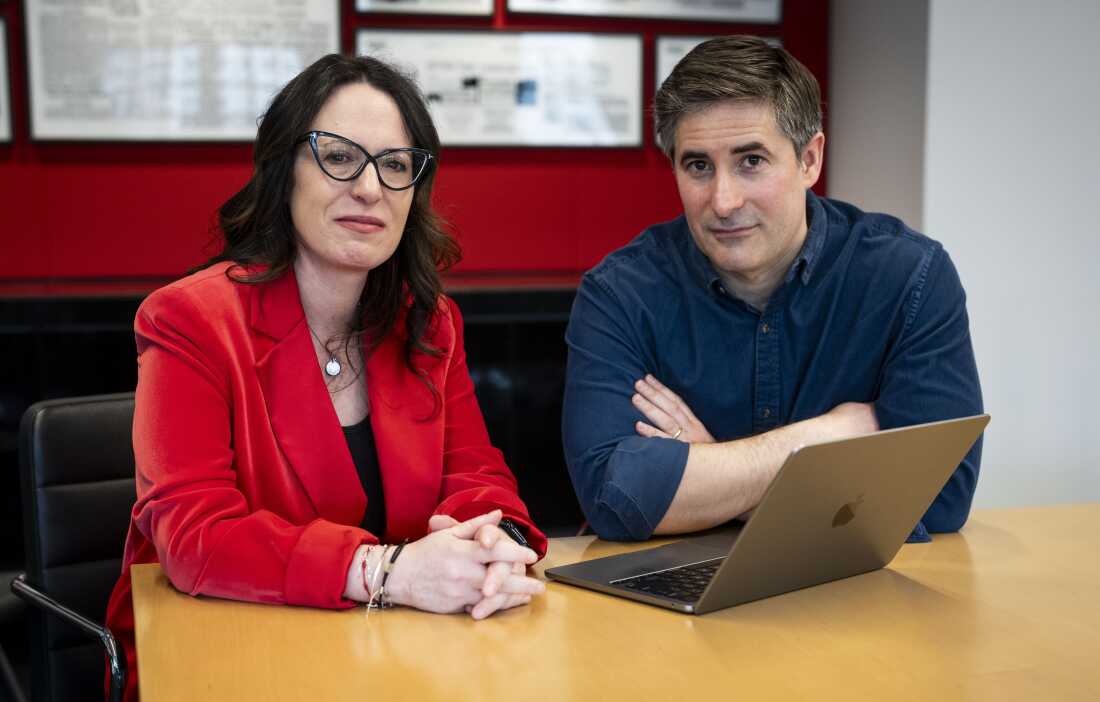
The New York Times journalists Maggie Haberman and Jonathan Swan are the authors of Regime Change: Inside the Imperial Presidency of Donald Trump.
Doug Mills/The New York Times
hide caption
toggle caption
Doug Mills/The New York Times
The conversations are non-linear. Trump will get fascinated about one thing that has nothing to do with the topic and that can derail a meeting. We have a scene in the book where he’s having a conversation, a very small meeting, which is highly classified about a defense program, and this guy comes in, just walks into the Oval, salt of the earth, kind of country looking guy, and he’s holding stone samples for the Rose Garden … and the two go off and sort of start conferring, looking out the window, talking about the paving and the stone and this and that, gets on the phone with another contractor. And before time’s up, the meeting’s ended, they haven’t actually resolved the issue they were going to resolve.
On the higher level of secrecy in Trump’s second term
When there are issues that Trump really cares about, or his team wants to keep secret, they can be incredibly secretive, to the point of great frustration across the government. And when it comes to the weightiest issues like the planning of going to war with Iran, we found that very, very senior people in the government were, A, completely cut out of the loop and, B, had no idea about what was being discussed in the Oval Office.
On Trump’s focus on decorating the White House

I traveled with President Trump to the Middle East, palace after palace. And it was really instructive to watch him with these Middle Eastern rulers in Saudi Arabia and Qatar and the United Emirates. He was just in a state of absolute pleasure, going from one palace to the next, admiring the marble, looking at most rarefied displays of state wealth on Earth. And that’s essentially what he’s trying to create at the White House. … He’s building this grand ballroom. He seemed to almost be competing with Melania as to who had had the better bedroom. They have separate bedrooms and he was taking objects that she had placed in the center hall of the residence and putting them in his bedroom.
YouTube
On the challenge of interviewing Trump
An interview with Trump requires an enormous amount of preparation if you want to hope to come out of it with any level of success. He’s a really difficult interview… He’s an overwhelming presence and you are confronted with a sort of tidal wave of words. Many of the words and the sentences are detached from reality or completely false. And you have to make judgments in real time about what you let go. You can’t fact-check everything. You just can’t. You can pick your moments.
I see my role in every interview as the representative of the people in that chair. You’re the one who’s lucky enough to be sitting in that chair interviewing the president of the United States. What would regular people want to know and want me to do in that situation? And I think that when you’re interviewing a president of the United States, you want to find the balance between letting them explain themselves and not cutting in every two seconds, but finding moments that are really important to puncture the bubble. Trump creates an unreality bubble. It’s the way he operates. … Tucker Carlson actually described it publicly as like being under a spell and I certainly wouldn’t ascribe a supernatural dimension to it, but I know what he’s getting at.
Thea Chaloner and Susan Nyakundi produced and edited this interview for broadcast. Bridget Bentz, Molly Seavy-Nesper and Meghan Sullivan adapted it for the web.

The real spectrum of housing insecurity
Annika McFarlane/Getty Images/Getty Images
hide caption
toggle caption
Annika McFarlane/Getty Images/Getty Images
Who counts as homeless in America?
If you ask the Department of Housing and Urban Development, around 750,000 people are homeless in America. If you ask the Department of Education, that number shoots up into the millions. What does this discrepancy tell us? And how do our cultural ideas about homelessness shape who we see as homeless, and who gets help? To find out, Brittany talks with Dr. Margot Kushel, Director at the UCSF Benioff Homelessness and Housing Initiative, and Dr. Molly Richard, assistant professor in the Department of Public Health at the University of Rhode Island’s College of Health Sciences.
Want more deep dives on cultural taboos? Check out these episodes:
The truth about men on the ‘down low’
Why can’t we be normal about polyamory?
Support Public Media. Join NPR Plus.
Follow Brittany on Instagram: @bmluse
For handpicked podcast recommendations every week, subscribe to NPR’s Pod Club newsletter at npr.org/podclub.
This episode was produced by Corey Antonio Rose. It was edited by Neena Pathak. We had engineering support from Josephine Nyounai. Our Supervising Producer is Cher Vincent. Our Executive Producer is Barton Girdwood. Our VP of Programming is Yolanda Sangweni.
-

 Florida4 minutes ago
‘Experimental explosion’ reported off Central Florida coast, experts say
-

 Georgia10 minutes ago
Everything From Georgia Tech LB Kyle Efford At ACC Media Days
-

 Hawaii16 minutes ago
New Honolulu police chief plans to launch drone program to help catch crime
-

 Idaho22 minutes ago
Boating, beaches, and mountain scenery: Escape to this bright blue Idaho reservoir
-
Illinois28 minutes ago
Illinois awards AD Josh Whitman a new contract worth more than $31 million over the next 10 years
-

 Indiana34 minutes ago
WATCH | Drone video captures Big Boy rolling through Northwest Indiana
-

 Iowa40 minutes ago
Jaylen Raynor Wisely Predicted To Be Starting Quarterback for Iowa State Football
-
Kansas46 minutes ago
Chiefs Name Burns & McDonnell as Owner’s Representative for New Practice Facility and Headquarters in Olathe


