West
Wyoming police sergeant shot, killed during attempt to serve trespass warning: 'Shocked and saddened'

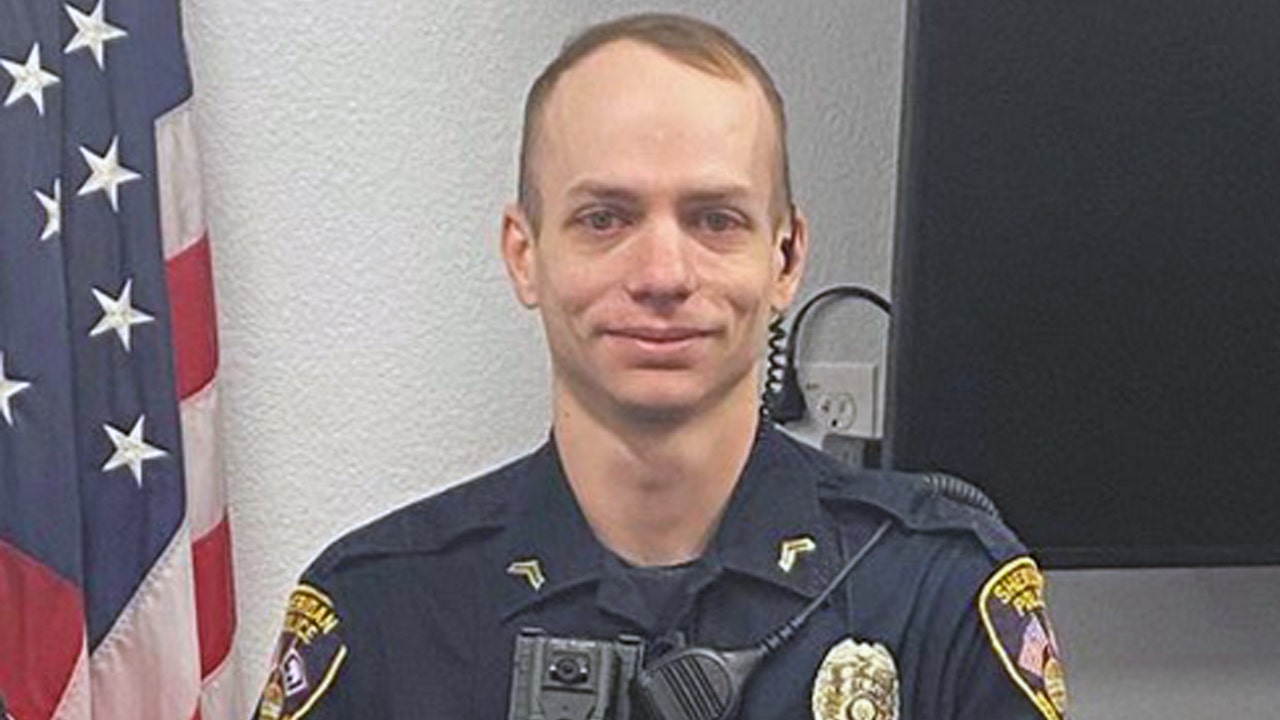
Law enforcement agencies in Wyoming are mourning the loss of a sergeant after he was shot and killed during an attempt to serve a trespass warning on Tuesday.
Sgt. Nevada Krinkee of the Sheridan Police Department died at the hospital Tuesday afternoon after he was shot while trying to serve a trespass warning to a man near the intersection of 5th Street and Val Vista Street in Sheridan, Chief Travis Koltiska announced.
Krinkee was sworn into the department on Oct. 11, 2017, according to the Sheridan WY Police and Fire Facebook page. He was also an Army veteran, local news outlets reported.
NEW MEXICO POLICE OFFICER DIES AFTER BEING STABBED BY A TRESPASSING SUSPECT
Sheridan police Sgt. Nevada Krinkee was shot and killed on Tuesday while attempting to serve a trespass warning to a man near the intersection of 5th Street and Val Vista Street. (Sheridan WY Police and Fire)
The man accused of killing Krinkee fled the scene, but was determined to be barricaded inside a residence in the area of 6th Street and N. Sheridan Avenue a short time later, Koltiska said.
The suspect has not yet been identified as of early Wednesday morning.
TENNESSEE DEPUTY KILLED DURING TRAFFIC STOP, ANOTHER INJURED; ‘ARMED AND DANGEROUS’ FELON AT LARGE
Sheridan police, the Sheridan County Sheriff’s Office and Wyoming Highway Patrol established a perimeter around the location and evacuated other residents in the area.
The Gillette Police Department’s tactical unit and crisis negotiators also responded to the scene and a standoff ensued, which remains active as of late Tuesday evening.
Sgt. Nevada Krinkee’s swearing in ceremony with the Sheridan Police Department took place on Oct. 11, 2017, according to the departrment’s Facebook page. (Sheridan WY Police and Fire)
“The entire department is shocked and saddened by this senseless act and appreciate all the thoughts and prayers from our community,” Koltiska said. “Please respect the privacy of our brother Nevada’s family through this trying time.”
Sheridan Mayor Richard Bridger issued a statement on Krinkee’s death Tuesday night, writing that the city is “deeply saddened by the tragic loss.”
“We are deeply saddened by the tragic loss of Police Sergeant Nevada Krinkee, who was killed in the line of duty while selflessly serving our community. His loss serves as a solemn and heartbreaking reminder of the risks our law enforcement officers face every day,” Bridger wrote. “Our thoughts and prayers are with Sergeant Krinkee’s family, loved ones, the Sheridan Police Department, and other first responders during this difficult time.”
He also asked that the community respect the privacy of Krinkee’s family and the first responders involved in the incident.
Read the full article from Here

Wyoming
‘Not just coloring tipis,’ experts debate quality of Indian education in Wyoming schools – WyoFile

RIVERTON—Nine years after the Wyoming Legislature passed the Indian Education for All Act, education experts say there is still more work to be done.
“I think it is a key priority across the state. Having grown up in Wyoming as a Native student in an off-reservation school, there was never a priority about learning about either tribe; and I still see that today,” Fremont County School District 21 Superintendent Deb Smith told the Wyoming Legislature’s Select Committee on Tribal Relations. “And I’m well into my 50s. So I think we need to push more.”
When the Legislature passed the Indian Education for All Act in 2017, lawmakers did not create an office of Indian education similar to the ones already in place in states such as Montana. Now, some experts and tribal members say they hope Wyoming will move in that direction in the future. But regardless of the particulars of future steps, reservation school leaders told lawmakers that the Indian Education for All Act needs more support and better integration into Wyoming schools.
“As a Native person, we shouldn’t always have to be the one advocating on behalf of our tribes,” Smith said. “People that are Wyomingites should know. They should be sharing that great history.”
Fremont County School District 14 Superintendent Blakke Bertram agreed.
“When there are questions on our state assessment that are geared towards Indian Ed. for All, then I’ll know that we’ve taken it serious,” Bertram told the tribal relations committee during its June meeting in Riverton. “I feel like I have yet to see that.”
The Legislature, he pointed out, recently passed new requirements for literacy education — and backed it up with grant funds and rulemaking. “So when we say something’s important, when we put support and money behind it, we’re saying it’s important. Have we really done that for Indian Ed. for All?”
Revisions underway
When she takes Lander fourth graders on their annual tour of the Wind River Reservation, Fremont County School District Native American Liaison Lisa McCart said one of the highlights is often the visit to Sacajawea’s grave. Having read “Naya Nuki,” the kids usually know who Sacajawea is — but seeing her grave, and hearing Fort Washakie Schools Librarian Robin Levin explain the history of disputes over her burial place, is special.
Fremont County School District 1 is not among the schools regularly invited to testify at tribal relations meetings. However, district representatives sat down with the Lander Journal in the days following the meeting.
As the Lander schools’ Native American liaison, McCart explained, her job involves keeping track of all of the district’s Native students and working with the district’s curriculum coordinator to coordinate learning and cultural experiences. McCart invites in tribal experts, organizes field trips, and works with extracurricular clubs in addition to helping Native students get to, stay in and feel supported at school.
Not every Wyoming school district has a significant population of Native American students, or a Native American liaison. Schools like those in Lander, which are close to the Wind River Reservation, have a bit of an advantage when it comes to integrating Indian education into their classrooms, the Lander district’s Curriculum Coordinator Deidre Meyer explained.

Scotty Ratliff, a member of the Wyoming Department of Education’s relatively new Native American Education Cabinet and a former legislator, said the Wyoming Department of Education could do more to provide districts with resources, teaching materials and curriculum to support the implementation of Indian Education for All statewide. Not every school in Wyoming, he pointed out, is close enough to the Wind River Reservation to have easy access to tribal experts.
The Indian Education for All Act requires that the state take another look at its social studies standards related to the act every nine years. Last updated in 2018, the state is currently in the process of putting together those new standards, the department’s Native American Liaison Rob Black told legislators.
Meyer worked in the Montana Office of Indian Education for years before moving to Lander and was at one point the principal of Fort Washakie Elementary School. She is among several Fremont County educators represented on the committee revising those standards.
Beyond her role as her district’s Native American liaison, McCart is also a member of the Wyoming Department of Education’s Native American Cabinet. In particular, she’s involved in an Essential Understandings subgroup that will be reviewing the updates to social studies standards currently underway to ensure they adequately incorporate tribal perspectives and Native American culture and history.
Learning language
Accessing Shoshone and Arapaho language classes also can be difficult for students, especially for those seeking successive years of Shoshone or Arapaho to qualify for the highest tier of Wyoming’s Hathaway Scholarship, Native American Education Director Roy Brown said. Brown works for Fremont County School District 25, which oversees Riverton schools. Part of the problem is a lack of qualified teachers, Brown and Fremont County School District 38 Superintendent David Holbert noted. Riverton has only ever offered one year of Arapaho language, Brown explained, which means that the district’s students wanting to take Arapaho can’t meet the high-tier Hathaway requirement of two successive years of a foreign language unless they actually take three years of foreign languages.
There are very few available and certified teachers of the Arapaho language, the group of superintendents explained — and even fewer for Shoshone.

McCart recalled that several years ago, Lander pursued its own attempts to bring Northern Arapaho and Shoshone language classes into the district. But, she said, her district found that there are very few people with the appropriate certifications to teach either language as part of a public school class. One of the ideas that she and Meyer have discussed is bringing in tribal elders or others who are fluent in Arapaho and Shoshone outside of a formal class setting, where they might not need to meet the same certification requirements as a teacher but can still help interested students start to learn.
‘[Not just] coloring tipis’
Bertram also challenged the implementation of the current standards for Indian Education for All, even in schools close to the reservation.
“My kids, they go to a neighboring school district, an off-reservation school district. I’ve seen the work that’s going toward Indian Ed. for All in that school district,” Bertram said. “It is not teaching my daughter, my son, about what Indian Ed. for All stands for and what it means to be a Northern Arapaho or Eastern Shoshone tribal member on our reservation.”
He continued: “We’re talking coloring tipis. That’s the kind of stuff we’re seeing on our off-reservation schools when it comes to Indian Ed. for All. And that’s a border school.”
If the district in question had called, Bertram’s district would likely be willing to work with them to share resources, he said.
“I appreciate his passion,” Lisa McCart said of Bertram’s remarks. However, she added, the superintendents at Fremont County school districts meet monthly, and she isn’t aware of any concerns along those lines having been raised at any of those meetings.
McCart and Meyer explained some of the ways Lander schools work to incorporate Indian Education for All into Lander’s curriculum, including reservation tours, cultural events, and the incorporation of Native American literature, history, and legal texts into classes from kindergarten through 12th grade.
For example, a few years ago McCart worked to bring musician and artist Gabriel Ayala, a member of the Yaqui tribe of Arizona, to Lander schools. Ayala worked with a variety of grade levels, McCart said, including teaching kids at Gannett Peak Elementary about the meanings of different symbols in Yaqui culture through an activity that involved the elementary students selecting symbols that would be meaningful to their family and drawing them on a tipi.
“If we weren’t confident in what we’re doing and trying to do in this district, we wouldn’t be vocal at the state level,” Meyer pointed out. “It’s not just coloring tipis.”
To characterize the district’s approach as such, McCart added, “is disrespectful for the [Native] families that choose to be in this district.”
McCart and Meyer noted that communication is key, and they hope Fremont County and Wyoming school districts can work together to ensure all Wyoming students receive an adequate education concerning tribal peoples and issues. If someone has concerns, they said, they both hope they will bring them to them directly so Lander can work to address those concerns.

June 27, 1776, was a momentous day for the Bay Area, California, and the world as 240 men, women, and children arrived mostly by foot from Mexico to what is now called San Francisco to set up camp and lay the groundwork for the future.
The “traveling village” is known as the Anza Expedition.
On Saturday, the 250th anniversary of the event was commemorated on Pershing Square at the Presidio of San Francisco in a two-hour ceremony.
The celebration opened with piercing fifes and thundering drums from the Young Patriots Fife & Drum Corps from Pleasanton, as a nod to America’s quincentennial.
But it was then followed up by a Spanish hymn, sung by musicians, dressed in 18th-century Spanish Colonial attire, including the garb of soldado, vaquero, pioneers, military, and indigenous peoples. The song is known as “Alabado” and it was sung by the ancestors as they made their long journey to the Bay.
A proclamation on a scroll was then read with gusto by local actor Dane Andrew, who was portraying the Spanish trailblazer Lt. Colonel Juan Bautista de Anza.
The message was loud and clear: When it comes to history in the Bay Area, Spain swings a big sword.
“People don’t realize in California our early Spanish history. While on the East Coast was becoming a brand-new U.S.A. was a small part. Actually, Spain owned a large part of the West Coast,” remarked Andrew.
The Anza Expedition established the first reliable overland route from Mexico to what was then known as Alta California, claiming San Francisco Bay for the Spanish Crown.
In 1776, the expedition’s leaders established both the Presidio as well as Mission San Francisco de Asis, which is known today as Mission Dolores.
In the crowd, the direct descendants of those who traveled the long, arduous route, including 98-year-old Eddie Grijalva of Vallejo. He was accompanied by his wife Lydia and her son Jeff.
“What an honor to be here and to remember my ancestor,” exclaimed Grijalva.
The event was coordinated by the nonprofit Los Californianos. The nonprofit represents the direct descendants of those who were part of the Anza Expedition. Its documented purpose includes efforts “to preserve the heritage of early Hispanic Californians in Alta California, to conduct research on genealogy, and to provide an accurate and authentic interpretation of Alta California’s history”
Carol Eber represents the group and is the co-chair of the event. She told us the group is thrilled to celebrate its heritage along with the quincentennial of the United States.
“We have a celebration on the East Coast. We wanted to have the 250th celebration on the West Coast as well as recognizing history was made on both coasts,” noted Eber.
During the ceremony, the crowd recited the Pledge of Allegiance and heard from Superintendent David A. Smith, who is with the Golden Gate National Recreation Area.
There were also presentations from the Daughters of the American Revolution and a group called “Our American Patriots”. The keynote speech was delivered by Professor Damian Bacich. He focused on San Francisco’s Spanish-American Legacy.
Also on hand for the festivities, the Consul General of Mexico Marco Mena. Mena told CBS News Bay Area that this was his first visit to Presidio and found it beautiful. He was pleased to be invited.
“The Anza expedition is very related to Mexico, especially to the states of Sonora and Sinaloa,” Mena explained.
As the Presidio ceremony was underway, a mass was said at Mission Dolores. The event concluded with a Roll Call, which was the reading of the names who those who walked on the route in 1776.
Descendants, including Grijalva, placed a flower in a memorial wreath as children were asked to blow bubbles for expedition members named without descendants.
Afterwards, participants went on docent-led tours of the Presidio’s Heritage Gallery and also were invited to tour the site of the Spanish Presidio Chapel.

The Denver Broncos have undergone a uniform overhaul, beginning in 2024. The Broncos rolled out the Mile High Collection ahead of the 2024 season, which included three different uniform combinations, plus the ’77 Throwbacks.
In 2024, Broncos fans were also treated to a Midnight Navy jersey/pants combination with the white ‘D’ helmet on Monday Night Football against the Cleveland Browns. On top of that, the Broncos rocked their White Out look, which included the Summit White jersey/pants combination and their standard Bronco logo on a white helmet, against the Kansas City Chiefs on Christmas Day last season.
The Broncos are keeping things fresh, and it’s going to be fun to see the different jersey combinations the team rolls out each week this coming season. Fans are obviously partial to the designs, but where do the Broncos’ uniform combinations rank among their NFL peers?
Sports Illustrated‘s Mike Kadlick ranked all 32 NFL teams’ uniform combinations, with the Broncos checking in at No. 10.
“Known as the ‘Mile High’ collection, the Broncos’ new uniforms debuted ahead of the 2024 season, and they remain awesome. Jam-packed with nods to Denver and the surrounding area, their jerseys feature a sleeve cap with a mountain peak and subtle triangles along the sides to represent Colorado’s summit markers. Their helmets, meanwhile, don a bumper that reads “5280”—a reference to Denver’s elevation above sea level. Rounded out with an all-blue alternate kit and a classic throwback look that incorporates the team’s D helmet logo, the Broncos nailed their recent redesign,” Kadlick wrote.
Attention to Detail
It’s not No. 1, but at least the Broncos are in the top 10. As Kadlick noted, Denver’s attention to detail in the new uniform designs is second to none.
Kadlick had the Los Angeles Chargers ranked No. 1, which, I’ve got to admit, kind of surprised me. I’ve never been that impressed by the Chargers’ designs, but to each their own, I suppose.
The Chiefs ranked No. 11, with the Las Vegas Raiders at No. 14, for whatever it’s worth. Beauty is always in the eye of the beholder, but Kadlick had a few questionable uniform designs ranked ahead of the Broncos, I must say.
Besides the Chargers at the top, Kadlick had the Cincinnati Bengals (No. 5), Tampa Bay Buccaneers (No. 6), Washington Commanders (No. 8), and Miami Dolphins (No. 9) ranked above the Broncos. I’ll hear you out on the classic look of the Dallas Cowboys and San Francisco 49ers (with slight modern twists), as well as the cool options the Baltimore Ravens and Houston Texans are rolling out nowadays, but the Chargers are meh, the Bengals and Bucs are downright ugly, and the Commanders are just plain.
No big deal, though. Posts like this make for timely offseason fodder as we await the return of football. The Broncos just finished up their offseason training program, and we’re now firmly in the NFL summer.
The cleats will hit the grass again at Broncos Park Powered by CommonSpirit on July 28, when the veterans report for training camp. From there, the whirlwind of the 2026 season will begin in earnest.
Let’s hope the product on the field looks as good as the Broncos’ Mile High Collection uniforms. The Broncos have produced two double-digit-win seasons since the Walton-Penner ownership group rolled out the new uniform designs, so there is a precedent in place.
Sign up for our free Denver Broncos On SI newsletter, and get breaking Broncos news delivered to your inbox daily!
 Add us as a preferred source on Google
Follow
-
 West Virginia4 minutes ago
Across West Virginia, public schools are closing. Communities are feeling the loss.
-

 Wisconsin6 minutes ago
What did prized Wisconsin commit Baboucarr Ann average in 2025-26?
-

 Wyoming14 minutes ago
‘Not just coloring tipis,’ experts debate quality of Indian education in Wyoming schools – WyoFile
-

 Crypto21 minutes ago
Japanese Yen Sinks to 162.27, Its Weakest Since 1986, Reviving Intervention Bets
-

 Finance24 minutes ago
World Bank drops climate finance target amid US pressure
-

 Fitness29 minutes ago
Fitness Point: The Small Weekly Investment That Could Transform Your Health – KT PRESS
-

 Movie Reviews39 minutes ago
Movie Review – Minions & Monsters (2026)
-
World51 minutes ago
Pope issues last-ditch appeal, begs breakaway traditionalist group to back off bishop consecrations


