Politics
Column: How the Vietnam War, political protests and a mimeograph machine birthed today's Iowa caucuses

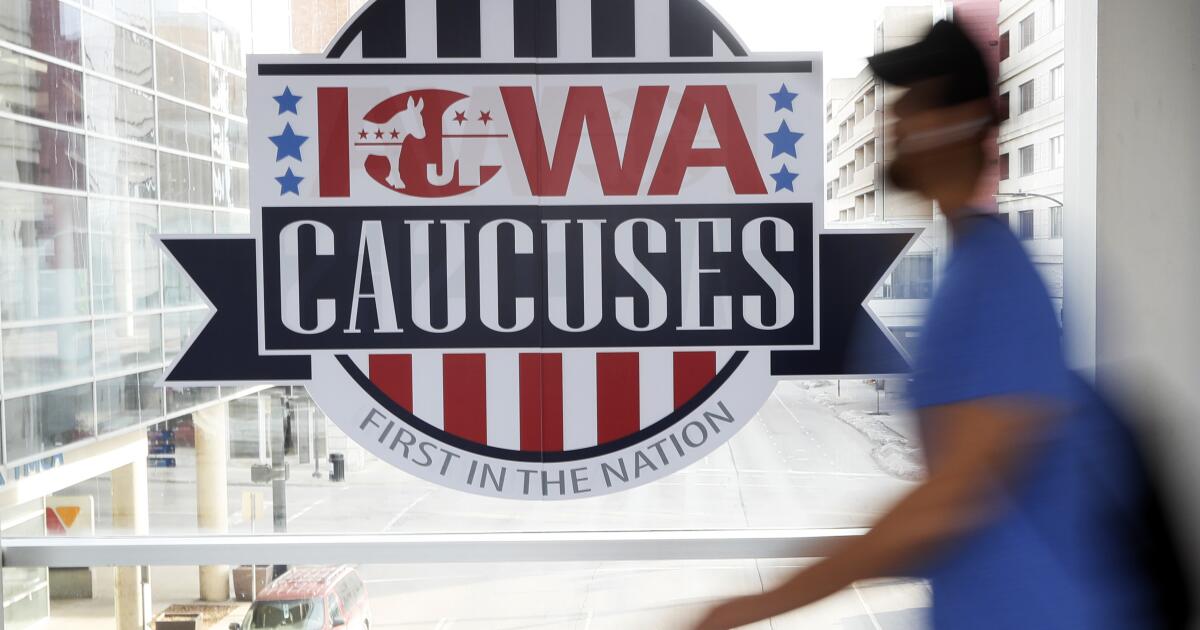
When Iowa’s brave and hardy Republicans venture Monday night into the arctic cold to cast the first presidential ballots of 2024, Richard Bender will be watching with special interest and a twinge of regret.
Bender, 78, has been called the godfather of the Iowa caucuses, in recognition of his role more than 50 years ago in creating one of the most closely watched and idiosyncratic events in American politics.
He was a young Iowa Democratic Party staffer at the time, an ardent foe of the Vietnam War and an architect seeking to build bridges between the party’s old guard and anti-establishment wings.
Today, Bender is retired from a career on Capitol Hill, living in the suburbs of Washington, D.C., and sorry to see his party shun Iowa — at President Biden’s behest — in favor of later contests in South Carolina and Nevada.
“It was good for my state,” Bender said of the caucuses that both major parties relied on for decades to begin choosing their presidential nominees. “I think we really did have an impact on national politics. I suspect Jimmy Carter and [Barack] Obama” — who used strong Iowa showings to launch themselves to the White House — “would agree with me on that.”
“And frankly, I had a personal pride in it,” Bender said. “So I wasn’t very happy to see it go by the wayside.”
As Bender is the first to attest, no one imagined the caucuses would turn into today’s internationally watched spectacle and crucial early test of political strength. Their timing, as the first event on the presidential calendar, began as pure coincidence.
Iowa had long chosen its delegates in a series of gatherings beginning at the precinct level — those are the caucuses being held Monday night — and concluding at a statewide convention. But those meetings, typically held in the spring, were largely the province of party bosses and political insiders who anointed their chosen candidates.
After the maelstrom of the 1968 Democratic National Convention, when party chiefs picked the presidential nominee and blood ran in the streets of Chicago, there was a strong push to overhaul the process and give voters more say.
In Iowa, the party was headed by Clif Larson, who’d backed Eugene McCarthy’s 1968 antiwar candidacy. He tasked Bender with leading an effort to devise a new, more open system for choosing the state’s presidential delegates.
Among the changes were the elimination of the winner-take-all rule, allowing candidates to receive a portion of delegates based on their grassroots support, and a requirement for public notification before each step of the nominating process.
The party’s straitened circumstances led to Iowa’s serendipitous place at the head of the political calendar.
Democrats were essentially broke ahead of the 1972 campaign and dependent on an old mimeograph machine. Counting back from the state convention on May 20, and allowing for printing and mailing materials out before each of four rounds, the party came up with Jan. 24 for the initial, precinct-level balloting — making it the first vote in the country.
Thus was born an institution.
A modest contingent of national political reporters showed up in Iowa to chronicle that first January caucus. Four years later, interest exploded when Carter, a little-known former Georgia governor, surged from nowhere and outpolled a field of Democratic heavyweights to catalyze his underdog campaign.
(Carter actually finished second in the caucuses, behind “uncommitted,” but his 28% showing exceeded expectations, which has become the measure of success.)
By 1976, Republicans were on board with the early vote, and for years Iowa and its rituals — kaffeeklatsches, state fairs, pandering to farmers and agricultural interests — were an indelible part of presidential politics.
Mindful of their privileged role, “Iowans really started to care and feel responsible,” said Bender, in a corned-beef-thick accent he retains from his native New York. (He moved to Iowa in 1967 to study biochemistry at Iowa State.)
“They became a very sophisticated, careful electorate,” Bender said. “Knowledgeable. Thoughtful.”
Richard Bender has been called the godfather of the Iowa caucuses.
(Courtesy of Richard Bender)
But as Iowa’s clout grew, so did resentment.
Politicians in big states like California griped about Iowa’s outsized influence. Others complained the state was too white and too rural, making Iowa unrepresentative of the country at large and the Democratic Party in particular.
When Iowa Democrats bungled the 2020 caucuses — taking days to declare a winner — it provided all the more reason to strip the state of its prime spot. (It also didn’t help that Biden, who was twice a candidate in Iowa, never finished better than fourth in the caucuses.)
This year, Democrats have officially bypassed both Iowa and New Hampshire, which has long hosted the nation’s first primary and also been criticized as too white and rural. The party will begin awarding it delegates Feb. 3 in South Carolina.
Republicans have had their own Iowa foul-ups.
On caucus night in 2012, Mitt Romney was declared the winner by a mere 8 votes. The state GOP then backed off that call, and more than a week later announced that former Pennsylvania Sen. Rick Santorum had, in fact, finished first. By then the campaign had long since moved on.
Even so, with no incumbent dictating the 2024 presidential calendar, Republicans kept Iowa first.
Watching from afar, Bender acknowledged that the caucuses are considerably removed from their humble origin. Thousands of journalists now descend on the state to chronicle its presidential campaigns, which have turned into multiyear extravaganzas fueling a multimillion-dollar industry.
The time has seemingly passed when a candidate can win Carter-style by slogging from small town to small town, bunking with local families and spending years meeting voters a handful at a time.
Trump, who made a splash in 2015 giving kiddie rides on his helicopter, has shown up relatively few times this election cycle — and is still the heavy favorite to win.
“He was an extreme example of what’s been happening for a long time,” Bender said, as TV, radio and, more recently, social media have come to matter more than the one-on-one campaigning that gave the caucuses their intimacy and charm.
Still, Bender holds out hope — optimistically? naively? — that once Biden departs, Iowa may regain its prominence in Democratic politics.
It remains a place where voters can approach most presidential hopefuls and get a question or two across. “And I think that’s really useful,” Bender said, “as opposed to [candidates] creating five 30-second ads to represent what they are.”
It’s also still relatively easy and inexpensive to campaign across Iowa, where plenty of people are willing to give a political unknown a careful listen.
“It’d be the Jimmy Carter situation,” Bender said, envisioning a Democratic caucus renaissance.
He built it. He hopes his party will come, again.


NEWYou can now listen to Fox News articles!
It hasn’t been a great last few days for Marxist political influencer Hasan Piker.
First, as Fox News Digital reported exclusively last week, the Treasury Department’s Office of Foreign Asset Control (OFAC) sent Piker an administrative subpoena seeking financial, logistical and communications records related to his March trip to Cuba as part of an investigation into whether he violated U.S. sanctions laws against doing business with the communist regime running the island nation.
Then last night, during protests outside an Immigration and Customs Enforcement facility in Newark, N.J., hecklers confronted Piker, calling him a “f—ing fraud, ” “fake-a– grifter” and “dog abuser,” telling him, “Go back to the desktop.” (Piker has denied allegations he trained his dog, Kaya, with a shock collar.)
Now, Piker told his loyal following on the gaming platform Twitch that British authorities denied his Electronic Travel Authorization, or ETA, preventing him from traveling to the United Kingdom for a series of scheduled appearances, including events at SXSW London and the Oxford Union. Approved U.S. travelers to the UK can enter the country with a simple Electronic Travel Authorization, which is easier to get then a formal visa.
“I’ve been banned from the UK,” Piker told viewers. “I’ve been to the UK on numerous occasions, and all of the things they’re complaining about now are things I’ve said before.”
He went on to say, “It’s f—ing ridiculous.”
HASAN PIKER DEFENDS PRO-COMMUNIST, ANTI-ICE SINGHAM NETWORK ACTIVISTS AS ‘WONDERFUL PEOPLE’
Hasan Piker speaks with an interviewer during a protest in New Jersey. (Michael Dorgan/Fox News Digital)
Although Fox News Digital could not confirm Piker’s claim, such a move by the UK would be significant because it would mark a potential red line that a Western government has drawn regarding the importation of extremist ideas and ideological movements that officials believe may contribute to social unrest, extremism or political violence.
At the tail end of a long livestream, Piker said he was denied entry for alleged antisemitism, which he denied, and then proceeded to lash out at Jewish organizations that he said had campaigned against his visit, claiming they wielded excessive influence over British policy.
“Israel advocacy organizations have unbelievable amounts of power over what even the United Kingdom has to say and do,” Piker said. “If you’re an avowed anti-Zionist, your travel will be restricted.”
Piker accused the UK government of bowing to pressure from pro-Israel advocacy groups and described the decision as evidence of a growing crackdown on political dissent across Western democracies.
The comments came weeks after several British Jewish organizations publicly urged the government to block Piker’s entry into the country, citing remarks they described as antisemitic and supportive of extremist groups. Piker has said he believed the U.S. deserved the 9/11 attack as “backlash” for its foreign policy decisions. The Jewish Leadership Council and Community Security Trust argued that Piker’s presence in Britain would not be “conducive to the public good,” pointing to his comments about Hamas, Hezbollah, Zionism and Orthodox Jews.
Labour MP David Taylor also called on the Home Office to revoke Piker’s visa ahead of scheduled appearances at SXSW London, arguing that his rhetoric had contributed to concerns within Britain’s Jewish community.
Punctuating his commentary about the UK decision with deep sighs, cursing and rage at suggestions from his followers, Piker repeatedly rejected accusations of antisemitism, saying criticism of Israel was being conflated with hatred of Jews. He said the decision reflected a broader trend in which governments are suppressing anti-Israel voices.
“This is straight-up fascism,” Piker said. “Being critical of Israel while combating antisemitism is not a good enough reason to bar someone entry into the country.”
HOW A RHODES SCHOLAR WITH TIES TO CUBA’S PRESIDENT ORGANIZED THE CONVOY THAT BROUGHT HASAN PIKER TO HAVANA
(left) Cuba’s President Miguel Diaz-Canel raises his fist next to Progressive International’s general coordinator David Adler during an event at the Cuban Institute for Friendship with the Peoples in Havana on March 21, 2026. (right) Hasan Piker joins a convoy to Cuba in March 2026. (Ernesto Mastrascusa/AFP and CodePink via Storyful)
The streamer said he had planned a week-long trip that included appearances alongside former Greek finance minister Yanis Varoufakis, a live podcast recording and an event at Oxford Union.
Varoufakis is the co-founder of the 501(c)(3) nonprofit group, Progressive International, which Piker credits with getting him to Cuba for a March aid convoy that may have violated U.S. laws. A Fox News Digital investigation chronicled how Progressive International and its co-founder David Adler have allegedly been a critical part of a foreign influence operation by the Communist Party of Cuba. Progressive International and Adler didn’t respond to a request for comment.
The U.K. government didn’t respond to a request for comment. However, in recent weeks, Home Secretary Shabana Mahmood, a critic of Israeli policies, recently revoked the travel authorization of Piker’s uncle, Cenk Uygur, founder of “The Young Turks,” after concluding his presence would not be “conducive to the public good.”
During the livestream, Piker warned that the alleged UK decision could set a precedent for other Western countries, including Australia and Canada, potentially restricting his future travel.
HASAN PIKER NAMES PRO-CCP TYCOON SINGHAM AS FINANCIER OF ‘POLITICAL MOVEMENTS’ DESPITE NONPROFIT VENEER
Hasan Piker and Jodie Evans and Neville Roy Singham (Getty Images)
“I genuinely did not think this would happen,” he said. “We’re moving into a very different timeline.”
Piker said he and his team were exploring whether he could apply for a standard visa despite the denial of the Electronic Travel Authorization, though he acknowledged it was a long shot.
Piker’s case intersects with a broader inquiry into the influence of transnational activist networks operating in the United States. During a livestream this week, Piker said that the Treasury Department’s investigation into his Cuba trip may ultimately be focused on Neville Roy Singham, an American Marxist businessman living in Shanghai who has funded a network of nonprofit organizations and activist groups that have drawn scrutiny from lawmakers and administration officials.
Among the organizations funded by Singham is CodePink, which also received a Treasury Department administrative subpoena related to its participation in the March convoy to Cuba, as well as groups such as the Party for Socialism and Liberation and the ANSWER Coalition. All three organizations openly identify with socialist or communist political traditions and have been prominent organizers of anti-Israel demonstrations across the United States since the Oct. 7, 2023, attacks by Hamas against Israel.
Critics argue that some of those demonstrations have created hostile environments for Jews in the UK, U.S., and elsewhere, including the use of slogans such as “From the river to the sea,” which calls for the elimination of Israel.
Trump administration officials are investigating the groups tied to Singham as a transnational network advancing anti-American, pro-Chinese Communist Party and anti-Western narratives while exploiting political and social divisions inside the U.S.
Lawmakers, Treasury officials and national security analysts have increasingly examined whether such networks are helping to amplify polarization, social discord, and hostility toward democratic institutions. Meanwhile, last night at the ICE protest, Piker defended the groups as led by “wonderful” people.
The debate has been particularly acute in Europe, where governments have grappled with alliances between far-left activists and Islamist organizations that have joined forces around anti-Israel activism and antisemitism. Critics argue that some of these coalitions have fomented rhetoric and violence hostile to Jews, leading to rising antisemitism in the UK, much like in the U.S.
For his part, Piker ended his podcast defiant, angry and seemingly deflated for the moment, repeating again, “Bro, they banned me from the UK,” and then finally closing the podcast, saying, “I’m done for the day.”
CLICK HERE TO DOWNLOAD THE FOX NEWS APP
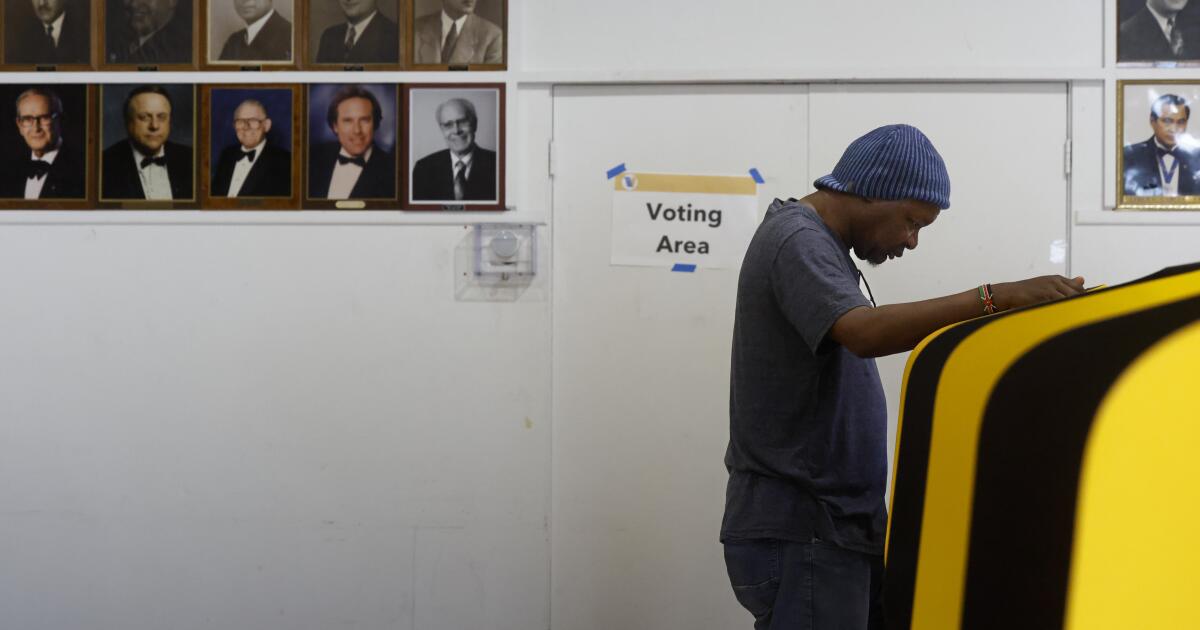
Yes, voting centers will be open across Los Angeles this week. And no, you don’t have to cast your ballot by mail.
With days left before the June 2 primary, President Trump made a round of misleading claims about the electoral process, this time falsely suggesting that the city was holding elections only by mail.
Trump’s comments came Saturday during an appearance on Fox News when he was asked by host Lara Trump — the president’s daughter-in-law — about his predictions for the upcoming primary.
“You know, they don’t have voting booths; everything’s by mail,” Trump responded. “I don’t think a Republican can win in California unless you pass the Save America Act — then they’re gonna have to show proof of citizenship, they’re going to have to get rid of mail-in voting.”
The L.A. County registrar-recorder moved to set the record straight in a tweet posted Sunday morning that read “MISINFORMATION ALERT.”
Noting that in-person voting was in fact allowed, the agency announced that it had 646 vote centers across the county — each with multiple voting booths. The centers will be open from 10 a.m. to 7 p.m. on Monday and Tuesday, the agency said in the posting, while tagging Fox News and the White House.
A map of polling locations featured on the agency’s website shows that there are dozens of voter centers available countywide. Mobile vote centers also were made available at various sites in the county. Mobile voting runs for the 10 days before election day and will not be available on June 2, according to the county registrar-recorder.
As of Friday morning, 333,000 mail-in votes had been cast in the June 2 primary for Los Angeles mayor, city attorney, city controller and eight of the 15 City Council seats. This was up from 321,000 at the same time in 2022, according to registrar-recorder.
Registered voters already should have received a ballot in the mail. Those who choose to vote in person can take their mail-in ballot to a vote center and ask to vote in person instead. Residents who haven’t yet registered to vote can still do so by requesting a conditional voter registration application at any voter center and filling out their ballot as they normally would.
Recent polling suggests that, ahead of Tuesday’s primary, incumbent Los Angeles Mayor Karen Bass has what pollsters deem a statistically insignificant lead in her bid for reelection as the city’s top executive. Bass is locked in a tight race with councilmember and former ally Nithya Raman and Spencer Pratt.
Trump has signaled his support for Pratt but hasn’t formally endorsed the former reality TV star and registered Republican. Former Trump advisor Steve Bannon said the president hadn’t done so out of the fear it would hurt Pratt’s chances in Democrat-dominant Los Angeles.
In 2020, during the outbreak of the COVID-19 pandemic, Gov. Gavin Newsom took the unprecedented step of issuing a statewide order for voting by mail for that year’s election in what he described as a necessary step to limit the virus’ spread.
A handful of rural counties had no in-person voting locations that March.
In 1979, the state eliminated the need for an excuse to receive an absentee ballot, and an option to choose permanent absentee voting was created in 2002. In the decades since, Californians have embraced the flexibility that voting away from a polling place offers. In nearly every statewide election since 2008, the majority of votes have not been cast at a traditional polling place.
Fourteen more counties — including Orange, Sacramento and Santa Clara — have adopted the state Voter’s Choice Act, an optional state law that requires them to mail every voter a ballot and to replace traditional neighborhood polling places with multipurpose vote centers. Those in-person locations offer multiple election services for up to 10 days before election day.
Los Angeles, the 15th county to adopt the new state law, was initially given special permission by the Legislature to implement it without mailing every voter a ballot.
Trump has for years repeated baseless claims that the 2020 election was stolen and that undocumented immigrants were swaying elections by voting illegally.
In light of these claims, Trump and some Republicans have pushed for new restrictions on voters. A federal proposal known as the Save America Act — which would require Americans to prove they are U.S. citizens before they register to vote and to show identification at the polls, among other things — cleared the U.S. House but stalled out in the Senate.
In November, California voters will weigh in on a similarly contentious ballot measure pushed by Republicans that would require all voters in future elections to show identification every time they vote in person or provide a special PIN when submitting mail-in ballots.
Under current state law, Californians are required to provide identification when registering to vote and must swear under penalty of perjury, a felony, that they are eligible to vote and are U.S. citizens. They are not required to show or provide identification when casting a ballot in person or by mail.
If passed, the California ballot measure would require voters to present government-issued identification, such as a state driver’s license, every time they vote. Voters mailing ballots would be required to write a four-digit number, essentially a PIN, on their ballot envelopes matching the one generated when they registered to vote.
Critics of California’s voter ID initiative, including many legal scholars, say the ballot measure addresses a problem that does not exist.
In May, a federal judge handed Trump a victory by declining to halt the president’s executive order creating a federal list of eligible voters and then directed the U.S. Postal Service to deliver mail ballots only to those on the list. Observers say the decision opens the door for potential sweeping changes in how American elections are run shortly before this year’s midterm elections.
The Associated Press contributed to this report.

NEWYou can now listen to Fox News articles!
An Arizona school board member is facing calls to resign after appearing to make a Nazi salute during a contentious public meeting before later comparing the board president to a dictator and saying, “All I could think of tonight was Hitler.”
Video from a May 26 Deer Valley Unified School District Governing Board meeting appears to show board member Kimberly Fisher raising her right arm and saying, “Heil, heil” during a dispute with board President Paul Carver Jr.
The exchange occurred near the end of the meeting during a disagreement over scheduling a community study session related to district boundary discussions.
According to video of the meeting, Fisher objected to holding the session during the afternoon, arguing that community members would have difficulty attending.
NJ COUNCILWOMAN CONDEMNS ‘IGNORANCE’ OF COMPARING ICE AGENTS TO NAZIS DURING HEATED MEETING
A still image from a Deer Valley Unified School District board meeting shows board member Kimberly Fisher during a contentious exchange with board President Paul Carver Jr. over meeting procedures. (DVUSD)
“The whole point of having a study session with our community is that we can get their input and they can hear our discussions,” Fisher said during the meeting.
Carver later said he moved to adjourn the meeting because the discussion involved an item that was not on the posted agenda and could have raised concerns under Arizona’s Open Meeting Law.
“The reason for calling for the adjournment was simply that, as the question turned into discussion concerning an item that was not on the agenda, the board was moving into an area that could have been considered a violation of Arizona’s Open Meeting Law,” Carver said in a Facebook video posted after the meeting.
BYRON DONALDS REBUKES ‘SQUAD’ MEMBER OVER ‘FASCIST’ SLUR: ‘DO I LOOK LIKE A MEMBER OF THE THIRD REICH?’
Carver said Fisher made the gesture and comment after the motion to adjourn.
“The point behind this post is that there’s a lot of noise being made that she may have been justified in making that statement because she felt like I was being a dictator,” Carver said. “I was simply following the rules of the state of Arizona.”
He added that “it is never okay to make those gestures and make that statement with those gestures in any environment.”
MARYLAND TEACHER FACES CALLS FOR RESIGNATION OVER CONTROVERSIAL CHARLIE KIRK MEME
The incident prompted condemnation from district officials, who said Fisher was acting independently and did not represent the views of the district.
“The District does not condone, support, or endorse gestures or language associated with hate, discrimination, intimidation or violence in any form,” Deer Valley Unified School District said in a statement. “Such actions do not reflect the mission or vision of Deer Valley Unified School District.”
Kim Fisher took to Facebook hours after the board meeting to explain her side of the story. (Facebook/@kim.fisher.233417)
The district added that Fisher’s “views and actions do not reflect and should not be attributed to other board members, staff, other members of the school community or the District.”
TENNESSEE SCHOOL BOARD MEMBER CENSURED AFTER CALLING STUDENT ‘HOT’ AT MEETING
The Deer Valley Educators Association also condemned Fisher’s conduct and called for her resignation.
“DVEA was horrified and disgusted to see DVUSD Governing Board Member Kimberly Fisher deliver a Nazi salute during the Tuesday, May 26, 2026, board meeting,” association president Kelley Fisher said in a statement.
“Any leader who uses a Nazi salute during a School Board meeting is unfit for public service. There is no justification for this behavior. Kimberly Fisher should resign before she does more harm to our students and the community at large.”
WOMAN DISROBES AT CALIFORNIA SCHOOL BOARD MEETING IN PROTEST OF LOCKER ROOM POLICIES
Hours after the meeting, Fisher posted a Facebook livestream in which she doubled down on her criticism of Carver, repeatedly describing his leadership as dictatorial.
“We have been living or operating under virtually a dictatorship for a long time,” Fisher said.
She also accused Carver of acting like “a dictator” and urged voters not to support him in future elections.
DEMOCRATIC CONGRESSMAN HURLS PROFANITY-LACED MESSAGE AT STEPHEN MILLER
Near the end of the livestream, Fisher appeared to connect her thinking during the meeting to historical dictators.
“What was it? Pol Pot, you know, was the most egregious dictator I’ve heard of,” Fisher said. “All I could think of tonight was Hitler.”
Fisher did not directly address the gesture or comment from the meeting during the livestream.
VIRGINIA SCHOOL BOARD MEMBER SUED FOR ALLEGEDLY EMBEZZLING $175K FOR STRIP CLUBS, VACATIONS, CAMPAIGN EXPENSES
In a separate video posted to social media, Carver said community members had asked why the board was not taking action against Fisher. He argued Arizona law limits the ability of school boards to discipline elected members.
Deer Valley Unified School District Governing Board President Paul Carver Jr. addresses community questions in a Facebook video after a May 26 board meeting during which board member Kimberly Fisher appeared to make a Nazi salute and say “heil, heil.” (Facebook/@paul.carver.264650)
“I need the community to understand that in the state of Arizona, the school district and the board do not have the ability to discipline board members,” Carver said.
Carver called Fisher’s behavior “rampant and repetitive” and said her actions were “totally unacceptable and unprofessional.”
CLICK HERE TO DOWNLOAD THE FOX NEWS APP
Deer Valley Unified School District serves more than 33,000 students across northern Maricopa County, including communities in north Phoenix, Glendale, Peoria, Cave Creek and New River, according to the district.
Fox News Digital reached out to Fisher for comment.
-
 Lifestyle5 minutes ago
Trump floats MAGA rally instead of concert after musicians drop out of Freedom 250
-

 Technology17 minutes ago
AMD’s new pitch: our old tech is so good you should just keep using it
-

 World20 minutes ago
Hezbollah’s ‘game changing’ night-hunting weapon punches through Israel’s defenses: expert
-

 Politics25 minutes ago
Hasan Piker says UK has barred him, trashes ‘unbelievable…power’ of pro-Israel groups
-

 Health32 minutes ago
Quitting smoking could offer a major benefit beyond heart and lung health, study finds
-

 Sports35 minutes ago
Roman Reigns domesticates Jacob Fatu to retain World Heavyweight Championship at WWE Clash in Italy
-

 Technology40 minutes ago
QR code email scam targets employee reviews
-
 Business47 minutes ago
Move over, Grogu. Internet culture soars as ‘Backrooms’ and ‘Obsession’ top the box office

