Wyoming
230 Million-Year-Old Fossil From Wyoming Challenges Dinosaur Origin Theories


Though paleontologists have been discussing the origin and spread of dinosaurs for decades, the widely accepted theory was that they emerged in the southern part of the ancient continent of Pangea over 200 million years ago, and only spread northward millions of years later. A new study dramatically changes the conversation.
University of Wisconsin–Madison (UW–Madison) paleontologists announced the discovery of a new dinosaur that challenges the conventional theory about the dinosaurs’ origin and spread. The location and age of the newly-described fossils suggest that dinosaurs prowled the northern regions of Pangea millions of years earlier than previously hypothesized. The findings were detailed in a January 8 study published in the Zoological Journal of the Linnean Society.
“We’re kind of filling in some of this story, and we’re showing that the ideas that we’ve held for so long — ideas that were supported by the fragmented evidence that we had — weren’t quite right,” Dave Lovelace of the University of Wisconsin Geology Museum, who co-led the study, said in a UW–Madison statement. “We now have this piece of evidence that shows dinosaurs were here in the northern hemisphere much earlier than we thought.”
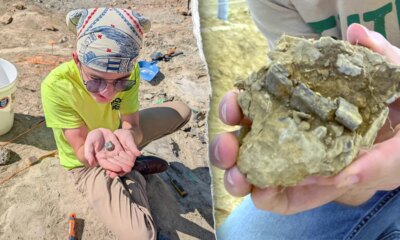
The paleontologists uncovered the theory-defying fossils in present-day Wyoming in 2013. Due to Earth’s shifting tectonic plates, this region was located near the equator over 200 million years ago on Laurasia, the northern half of Pangea (the southern half was called Gondwana). While the remains were fragmented, the paleontologists were able to attribute the fossils to a new dinosaur species they named Ahvaytum bahndooiveche, which was likely an early sauropod relative. Ahvaytum, however, looked very different from the iconic long-necked herbivores.
“It was basically the size of a chicken but with a really long tail,” said Lovelace. “We think of dinosaurs as these giant behemoths, but they didn’t start out that way.” The adult specimen was just over a foot tall (30.5 centimeters) and about three feet long (91.4 cm).
Perhaps most shockingly, however, is the age of the fossil. Lovelace and his colleagues used radioisotopic dating (a method for determining the age of materials by measuring radioactive decay) to determine that the rock layers where they’d found the Ahvaytum fossils—and thus roughly the remains themselves—were about 230 million years old. This makes Ahvaytum the oldest known Laurasian dinosaur, and about equivalent in age to the earliest known Gondwanan dinosaurs, according to the study. Dinosaurs first emerged during the Triassic period, around 230 million years ago. This era, which lasted from about 252 to 201 million years ago, saw the rise of the earliest dinos, before they became dominant in the Jurassic period.
“We have, with these fossils, the oldest equatorial dinosaur in the world — it’s also North America’s oldest dinosaur,” Lovelace added. The fact that the oldest known Laurasian dinosaur is about as old as the earliest known Gondwanan dinosaurs consequently challenges the theory that dinosaurs originated in the south of the ancient continent and only spread north millions of years later.
The site of the discovery is within the ancestral lands of the Eastern Shoshone Tribe. As a result, the researchers partnered with tribal members throughout their work, and included Eastern Shoshone elders and middle school students in choosing the new dinosaur’s name. Ahvaytum bahndooiveche roughly translates to “long ago dinosaur” in the Eastern Shoshone language.
The region also yielded additional finds. The team identified an early dinosaur-like footprint in older rock layers, meaning that dinosaurs or dinosaur-related creatures were calling Laurasia home even before Ahvaytum. The paleontologists also uncovered the fossil of a newly described amphibian, which was also named in the Eastern Shoshone language.
In challenging long-standing theories about how dinosaurs spread across Pangea, the discovery of the chicken-sized Ahvaytum ultimately paints a clearer picture of the creatures that walked the Earth—and where—millions of years before us.





RAPID CITY, S.D. (KOTA) – Wyoming officials are reminding travelers to be prepared for high winds this summer, especially those driving or towing recreational vehicles.
The Wyoming Department of State Parks and Cultural Resources and the Wyoming Department of Transportation are encouraging outdoor enthusiasts to plan ahead and stay informed about weather conditions before hitting the road. Officials said highways such as Interstate 25, Interstate 80 and U.S. 287 frequently experience strong wind gusts that can create dangerous driving conditions for high-profile vehicles.
Vehicles most vulnerable during high-wind events include motorhomes, fifth-wheel and bumper-pull trailers, toy haulers, rooftop tent vehicles and passenger vehicles towing campers, boats or utility trailers.
Wyoming transportation officials may impose travel restrictions or temporarily close roads to certain vehicles during severe wind events.
Travelers are encouraged to check road conditions at wyoroad.info or by calling 511 before departing and to build flexibility into their travel plans. Officials also recommend securing external gear and understanding how wind conditions may impact their specific vehicle setup.
See a spelling or grammatical error in our story? Please click here to report it.
Do you have a photo or video of a breaking news story? Send it to us here with a brief description.
Copyright 2026 KOTA. All rights reserved.

Wyoming hospitals will soon get their funding from the 5-year Rural Health Transformation Program, but for now they’ve been told to focus on the first year only.
Recently all hospital leaders met the Director of the Wyoming State Department of Health, to get more details of the $10-billion that the state will receive from the program, between Federal Fiscal Years 2026 and 2030, which starts on the first day of October each year.
Funds will be distributed by the Center for Medicare and Medicaid Services (CMS).
According to Sheridan Memorial Hospital President and CEO Mike McCafferty, part of a proposal from the state to the CMS was rejected.
“In their original submission to CMS, they allowed for a concept called the perpetuity fund, which would put funds away for a longer period of time than the 5 years allocated within the Rural Health Transformation Fund guidance and apparently CMS didn’t like that concept.”
McCafferty adds the new plan for the first federal fiscal year is that the state will focus on the first $205-million of the funding, which must be allocated to Wyoming hospitals by the end of October 2026 and used by the end of October 2027.
The other 4 years are to be announced.
The WY Department of Health will start receiving proposals from hospitals as early as next month.
Sheridan Memorial Hospital is currently working on its proposal.
-
 Politics6 minutes ago
Trump’s quiet crackdown: Fewer ICE raids, harsher rules push immigrants to leave
-
 Sports14 minutes ago
Shohei Ohtani held out of starting lineup a day after leaving game with knee inflammation
-

 World24 minutes ago
Pope leaves Spain on plane offered by king after technical glitch
-

 Los Angeles, Ca2 hours ago
MLB to screen Hollywood classic at drive-ins nationwide
-

 Detroit, MI2 hours ago
Detroit at Le Mans: Cadillac favorite, Ford poised for 2027
-

 San Francisco, CA3 hours ago
Hudson Pacific lands SF’s biggest office lease in nearly a decade
-

 Dallas, TX3 hours ago
NFL Brazil tickets are available: Shop Cowboys vs. Ravens NFL Brazil tickets now
-

 Miami, FL3 hours ago
North Miami man accused of stabbing victim 7 times

