Science
A New Dinosaur Museum Rises From a Hole in the Ground in New Jersey


Ten years ago, this was just a big hole in the ground behind a Lowe’s home improvement store in southern New Jersey, an unlikely place to find what might be one of the world’s most important fossil sites.
But 66 million years ago, tantalizingly close in time to when the dinosaurs went extinct, a multitude of sea creatures died here — a “mass death assemblage” — and sank to the bottom of what was then a shallow sea.
Because of its prehistoric past as a possible mass extinction gravesite, the hole that was once a quarry has become the Edelman Fossil Park & Museum.
Built in Mantua, N.J., about 20 miles from Philadelphia, the museum welcomed its first paying customers this past weekend. For Kenneth Lacovara, a professor of paleontology and geology at nearby Rowan University and the museum’s executive director, it is the culmination of a decade of work.
“We’re doing so much here that I think has never been done in any museum,” said Dr. Lacovara, best known in paleontology for the discovery of Dreadnoughtus, one of the largest dinosaurs ever.
The fossils come with a hard-to-miss message from Dr. Lacovara, one that makes direct connections between the mass extinction 66 million years ago and today’s rapidly changing climate, which is putting many species in danger of dying out.
The museum’s motto is “Discover the past, protect the future.”
“That’s really the thrust of this place,” Dr. Lacovara said. “We need to act, and we need to act now, and every day of inaction or worse, every day that we go backwards, is a burden that we are placing on future generations.”
For decades, the Inversand Company had scooped from the quarry a dark greenish sand called marl, used for the treatment of water and soil. Tightened environmental regulations turned the site into a money loser, and Inversand looked to close it.
Mantua had hoped that a developer would turn the pit into more suburban homes and shopping. But the Great Recession stalled those plans, and the quarry remained a hole in the ground.
The mining of marl had exposed prehistoric sediments that extend throughout this part of South Jersey, but are typically inconveniently buried more than 40 feet underground.
Dr. Lacovara, then at Drexel University in Philadelphia, had started visiting the site, which included a fossil-laden layer that appeared to coincide with the mass extinction 66 million years ago. Fossils of anything that died that day are scant within the extinction layer, because the conditions needed to preserve bones are rare.
“This is something that I personally and lots of other paleontologists have been looking for all around the world,” said Dr. Lacovara, adding that he had sought such a layer in southern Patagonia, the foothills of the Himalayas and elsewhere.
“And I found it behind the Lowe’s in New Jersey,” he said.
More than 100,000 fossils representing 100 species have been carefully excavated from the quarry and cataloged.
Until the pandemic, the site opened once a year to the public for a community fossil dig, allowing people to collect fossils from sediments above the mass extinction layer.
Rowan University bought the site in 2015 for just under $2 million and lured Dr. Lacovara, who had graduated from the school when it was known as Glassboro State College, to join its faculty as the dean of the new School of Earth and Environment. Rowan also bought into Dr. Lacovara’s vision of building a museum.
“This is going to be a place to motivate young minds to become scientists,” Ali Houshmand, the president of Rowan, said in remarks at the start of the media tour.
Jean and Ric Edelman, founders of a financial advisory firm and also graduates of Glassboro State, contributed $25 million of the $75 million Rowan needed to build it.
“We immediately recognized that this had the potential to be a world-class destination,” Mr. Edelman said.
There is plenty of what one would expect to find in a dinosaur museum, which overlooks the fossil site in the former quarry. Near the ticket kiosks are skeletons of creatures that lived along the east coast of North America during the Cretaceous period. A mosasaur, a ferocious marine reptile, hangs from the ceiling, and a Dryptosaurus, a relative of T. rex, poses menacingly.
The museum highlights how some of the earliest dinosaur discoveries were made in New Jersey. The first nearly complete dinosaur skeleton — a duck-billed hadrosaur — was dug up in a quarry in Haddonfield in 1858. Dryptosaurus was the first tyrannosaur to be discovered, in 1866, just a mile from the museum.
Visitors walk a winding path through three galleries in the museum.
In the first gallery, an introductory movie provides perspective on just how mind-bogglingly old our planet is.
If the 4.5-billion-year history of Earth were a 1,000-page book, the entire 10,000 years of human civilization would be covered by just the last word on the last page. That sense of “deep time” is meant to set up visitors for an understanding of how unnaturally quickly Earth’s climate is changing now.
Life-size re-creations of dinosaurs, big and not so big, fill the gallery. In the warmth of the late Cretaceous, sea levels were much higher and North America was a series of islands. In one, a big, angry plant-eater known as Astrodon stomps a juvenile meat-eater, Acrocanthosaurus, to death.
“We want to show the gritty underbelly of the dinosaur world,” Dr. Lacovara said.
The next gallery highlights the marine creatures that lived in the seas here, including sea turtles, sharks and saber-toothed salmon. This part of New Jersey was about 70 feet underwater and 15 to 30 miles offshore. “In this gallery, everything you see here is something that was found on the property,” Dr. Lacovara said.
That includes the fearsome mosasaurs.
“I would say it’s a statistical near certainty that at some point in time, a mosasaur of this size was at that exact location,” Dr. Lacovara said, pointing to a re-creation of the creature.
Visitors then enter the Hall of Extinction and Hope. It shows the devastation that enveloped Earth after an asteroid struck the Gulf of Mexico off the Yucatán Peninsula, the fifth mass extinction in the planet’s history.
Then it turns to the present, which many other scientists describe as the sixth extinction as species struggle to adapt to the changes humans have made to the planet, including the destruction of habitats and global warming spurred by the rise in greenhouse gases released from the burning of fossil fuels.
One interactive exhibit shows the sharp rise in global temperatures over the past few centuries and allows a visitor to compare that curve with possible natural causes like sunspots, volcanic eruptions and cyclical changes in Earth’s orbit.
“None of those things explain the temperature variation,” Dr. Lacovara said.
But the simultaneous rise of temperature and greenhouse gases are “almost an exact correlation,” he said. “So at that point, you can draw your own conclusions.”
He said he wanted people to learn by examining the data themselves. “Not everybody is going to connect the dots,” Dr. Lacovara said, “but if they’re inclined to, our job is to help.”
At the last station, kiosks offer visitors information about how they can take action to offset climate change. “Because hope without action is really despair,” Dr. Lacovara said. “You’re all set up to make a positive change in the world before you walk out the doors of the museum.”
How might this message play in a time when President Trump calls climate change a hoax and his administration is dismantling projects and research aiming to move away from fossil fuels?
“I guess we’ll see when the museum opens,” said Kelly Stoetzel, the managing director who oversees the day-to-day running of the museum. It expects to draw 200,000 visitors a year.
She said she was interested in hearing the reactions of visitors who are skeptical that the planet is undergoing rapid changes.
“When they come in and they learn the science, can they be convinced to consider something different?” Ms. Stoetzel said. “Maybe.”
For Dr. Lacovara, the message is simple. “You can’t love what you don’t know,” he said. “And we’re hoping to make people fall in love with this amazing planet that we have so that they take action to protect it.”
The museum’s learn-by-doing ethos will allow visitors to become paleontologists for a day. For an extra fee, from May through October, visitors will be able to dig through the quarry sands for fossils that they can take home.
The museum also includes fun flourishes. Take the elevator between its two floors, and you’ll hear a snippet of popular singers of the 1950s and 1960s like Dean Martin, whose given name was Dino. Thus, “dino lounge” music.
At the entrance is the pronouncement, “This facility is smoke-free, weapons-free and asteroid free (for the last 66 million years).”
Dr. Lacovara is also proud of the glass used for the exterior windows, because it keeps modern-day dinosaurs — birds — from fatally flying into them.
“What I really love about it is, it relies on evolutionary principles,” Dr. Lacovara said.
The eyes of the first vertebrate animals, predating both mammals and dinosaurs, possessed four color receptors — for red, blue, green and ultraviolet light.
Birds, which are dinosaurs that survived the mass extinction, still have ultraviolet receptors in their eyes. They see images of spider webs that are imprinted on the museum’s glass, and they safely fly away.
“If you come up and you catch just the right angle, you can kind of see it,” Dr. Lacovara said.
Mammals, however, lost the ability to see ultraviolet light, because when they arose more than 200 million years ago, they were small creatures that scurried about at night — better not to be seen and eaten by the dinosaurs. There is not a lot of ultraviolet light at night, and in mammals, the gene that encodes that receptor in the eye was co-opted by the olfactory system.
As a result, mammals tend to have a good sense of taste and smell but cannot see ultraviolet light.
“To us mammals, this looks like clear glass,” Dr. Lacovara said. “And I know this because the forklift truck driver who drove through one of these panes was a mammal.”
With the museum now open, Dr. Lacovara hopes to turn his attention toward proving that the mass death assemblage in the quarry pit indeed consists of animals killed in the planet-wide cataclysm that followed the asteroid strike.
That has been hard to settle, however, because creatures burrowing in the sea bottom churned up the sediments. As a result, the marker of the extinction — a layer containing substantial amounts of iridium, an element concentrated in asteroids and comets — is fuzzy.
“It’s almost like looking through a shower door at something,” Dr. Lacovara said.
He said he had all the data he needed, but work on the museum had not left him time to finish writing the papers.
“This has been all-consuming,” Dr. Lacovara said.



Video released by Chinese state media shows a state-owned aerospace company launching a rocket and recovering part of it on Friday. The successful launch of a reusable rocket was a major step for China toward challenging SpaceX’s satellite internet dominance.
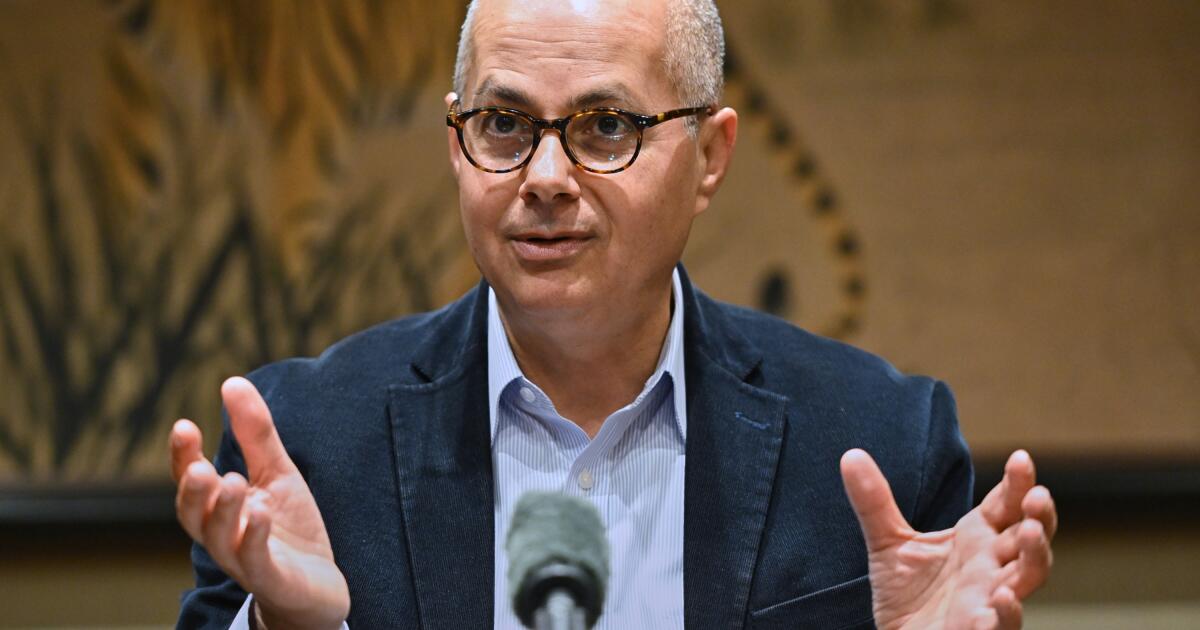
Nobel Prize recipient Omar Yaghi is leaving his role at UC Berkeley to lead the development of a new artificial intelligence institute at Tsinghua University in Beijing, the Chinese university announced.
Yaghi will head the AI Chemistry and Materials Research Institute at Tsinghua, where he was appointed an honorary professor in 2022. Known as AIMATRY (AI × Materials × Chemistry), the new center will focus on material design and synthesis through artificial intelligence, according to a statement from the university.
In 2025, Yaghi shared the Nobel Prize in chemistry with Susumu Kitagawa of Kyoto University and Richard Robson of the University of Melbourne for their development of metal-organic frameworks, a type of super-porous material in which metal ions and carbon-based molecules combine to form crystals with exceptionally large surface areas.
The material has the potential to combat climate change by capturing and storing carbon or other pollutants, and by extracting water from the atmosphere in water-scarce areas. Upon awarding the prize, a member of the Nobel committee likened the technology’s ability to store enormous amounts of stuff in seemingly compact spaces to Hermione Granger’s enchanted handbag in the Harry Potter series.
Yaghi’s Irvine-based company, Atoco, has said it will start taking orders later this year for its technology that harvests water from the air.
A representative for Yaghi said he was not yet available to respond to questions.
China is one of several countries that has been actively recruiting scientists from the U.S., where the Trump administration has slashed science funding, suspended research grants, fired science advisors and tightened immigration restrictions.
“For many, many years, our funding was very competitive; if you worked hard and you were doing good research, you would get funding,” Yaghi said of the U.S. in an interview with Scientific American earlier this year. “The current state is not so encouraging because of the cutting back on grants and support of science by the very agencies that many university researchers rely on.”
Yaghi was born in Jordan to Palestinian refugees, and immigrated to the U.S. when he was 15 to study.
“We’ve learned over and over in human civilization that scholars can move across borders,” Yaghi told the New York Times last year. “This is how knowledge spread and how vast regions of the world lifted themselves out of poverty.”
Science
Trump administration seeks to limit federal funding that doesn’t ‘advance’ presidential policies

A new rule proposed by the White House Office of Management and Budget would fundamentally overhaul the way federal grants are awarded and overseen — a sweeping change that one scientific society said “would all but end the use of scientific merit in the selection of grants and programs across the government.”
Proposed in late May, the rule would give political appointees unprecedented control over federal grants for research, education and infrastructure, and specifies that government funds can only be spent on projects “aligned with administration policies and priorities,” according to a copy of the proposed rule.
The rule would also restrict research topics, limit U.S. scientists’ ability to collaborate with colleagues in other countries and make it easier for the government to suspend or cancel grants at any time.
The changes are intended to improve “transparency, accountability, and oversight for Federal awards” while “ensuring that American tax dollars are not wasted or misused,” according to the White House office.
But critics say that if the rule is implemented, the final sign-off for grants will no longer be in the hands of subject-matter experts within individual agencies, but in those of political appointees.
“This touches all parts of American life,” said Dr. Eric Rafla-Yuan, a psychiatrist who practices at the Veterans Administration and San Diego County’s psychiatric hospital.
“Control of how all of the federal grants and programs are funded will fall under a small group of highly partisan individuals who would have very few limits on how they spend these billions of taxpayer dollars,” said Rafla-Yuan, who also chairs the Committee to Protect Public Mental Health advocacy group. “This touches everyone’s life, even if they don’t realize it.”
OMB published the proposed rule May 29, opening a 45-day comment period that closes July 13.
Opposition to the proposed rule has mobilized multiple sectors of society. Professional groups representing cancer researchers, civil engineers, county governments, medical schools, housing agencies, city and municipal governments, nonprofits and others have publicly expressed concerns about potential consequences.
By midday Thursday, the Federal Register logged nearly 100,000 comments about the proposal, many of them expressing concern.
“I understand the need for oversight, fiscal responsibility, and accountability. That is not the issue,” wrote Jack Feldman, a neuroscientist who holds the David Geffen School of Medicine Chair in Neuroscience at UCLA. “The issue is whether scientific research is to be judged by scientific merit, or whether it can be approved, denied, or terminated according to broad political criteria that may change from one administration to the next.”
Crucially, the rule converts policies governing federal grants from “guidance” into binding regulations that all agencies would be required to follow. It would give political appointees power to override federal agencies’ merit-based reviews and mandate that a political appointee review decisions to ensure that all awards “demonstrably advance the President’s policy priorities.”
The elevation of political appointees in what were previously merit-based decisions has alarmed many scientists.
“The proposed rule changes would all but end the use of scientific merit in the selection of grants and programs across the government,” read a statement from the Planetary Society, a nonprofit dedicated to space research.
Researchers and science groups have also expressed concern about a section of the rule prohibiting the promotion of “theories of disparate-impact liability” — a legal concept that refers to policies that appear neutral but cause disproportionate harm to certain groups.
The section’s vague language and many loopholes could have a chilling effect on any research that studies the effects of a disease, policy or public health intervention on any specific group of people, Rafla-Yuan said.
As an example, he said, “if there’s a specific age range that is at higher risk for suicide, and we want to figure out, well, what’s going on with people that are aged 14 to 19 … we can’t do that under the wording in this rule.”
New restrictions on collaborations with scientists in other countries would hinder opportunities for U.S. researchers and limit innovation, said Joanne Padrón Carney, chief government relations officer for the American Assn. for the Advancement of Science.
“Science is a global enterprise. Especially in biomedical and public health fields, diseases don’t care about borders or government policies,” she said.
California’s congressional delegation sent a letter Wednesday asking OMB to rescind the proposal, outlining concerns about its impact on scientific innovation, U.S. competitiveness and the fiscal stability of local governments, many of which rely on federal grants for local services.
The proposed rule grants the federal government broad powers to suspend or cancel grants for any reason, introducing “unprecedented unpredictability into local governance,” the lawmakers wrote, “leaving vital infrastructure projects unfinished and abandoning vulnerable populations who rely on these services.”
Republican Sen. Susan Collins has also asked the White House to withdraw certain parts of the letter and extend the public comment period, saying the proposed rule as written would “harm small and rural communities, undermine scientific and biomedical research, and conflict with Congress’ control over the federal funding process.”
-

 Detroit, MI18 minutes ago
Around 400 pairs of shoes intended for charity giveaway stolen from Detroit nonprofit, organization says
-

 San Francisco, CA30 minutes ago
How to watch San Francisco Giants vs. Colorado Rockies
-

 Dallas, TX36 minutes ago
3 unanswered questions before training camp: Dallas Cowboys edition
-

 Miami, FL42 minutes ago
“Love & Hip Hop: Atlanta” star Tommie Lee among 6 arrested during World Cup match in Miami, sheriff says
-

 Boston, MA48 minutes ago
‘More than just a cyclist’: Hundreds mourn Boston transit planner killed while biking – The Boston Globe
-

 Denver, CO54 minutes ago
Nuggets sign former Denver West basketball player Alpha Diallo out of EuroLeague
-

 Seattle, WA60 minutes ago
Portland aims to top Seattle’s 405 e-bikes with 2-mile Guinness record ride and party
-

 San Diego, CA1 hour ago
Top-ranked Jannik Sinner beats Alexander Zverev to win Wimbledon again

