West
Utah mom in upscale ski community killed husband to fund romance and lavish lifestyle, DA says

NEWYou can now listen to Fox News articles!
Text messages about marriage, money and a “fresh start” took center stage in the murder trial of Utah author Kouri Richins, as prosecutors laid out what they say was her plan to move on from her husband and profit from his death.
Richins, 35, is charged with aggravated murder, attempted aggravated murder and multiple financial crimes in the March 3, 2022, death of her husband, Eric Richins. Prosecutors allege she poisoned him with a fentanyl-laced Moscow mule so she could collect life insurance money and begin a new life with her boyfriend. She has pleaded not guilty.
During opening statements, Summit County Deputy Attorney Brad Bloodworth read aloud a series of text messages he said were exchanged between Richins and a man identified in court as her boyfriend.
In one message sent the day before Eric’s death, Richins allegedly wrote: “If I was divorced right now and asked you to marry me tomorrow, you would?”
Internet searches recovered from the phone of Kouri Richins, a Utah mother accused of fatally poisoning her husband, are displayed on a screen during her murder trial at the Summit County Courthouse in Park City, Utah, Monday, Feb. 23, 2026. (Spenser Heaps/AP Photo, Pool)
Weeks earlier, prosecutors said she sent another message: “If he could just go away, and you could just be there, life would be so perfect.”
Jurors also heard that 16 days after Eric’s death, Richins allegedly sent her boyfriend a link to a Caribbean resort and wrote, “Are we there yet?” About a month after the death, prosecutors said she texted him, “I think I want you to be my husband one day.”
Bloodworth argued the messages reveal Richins’ desire to start over and pointed to what he described as mounting financial pressure.
According to prosecutors, Richins was facing substantial debt and believed she would inherit millions from Eric’s estate if he died. Bloodworth told jurors a prenuptial agreement would have limited what she received in the event of a divorce.
CHILDREN’S BOOK AUTHOR KOURI RICHINS SAYS SCANDAL AND NOTORIETY POISONED HER MURDER TRIAL
Body camera video is displayed on a screen during the murder trial of Kouri Richins at the Summit County Courthouse, in Park City, Utah, Monday, Feb. 23, 2026. (Spenser Heaps/AP Photo, Pool)
“Kouri Richins murdered Eric for his money and to get a fresh start at life,” Bloodworth said in court.
Prosecutors also highlighted phone activity from the early morning hours of March 4, 2022.
Bloodworth told jurors Richins first accessed her phone at 3:06 a.m. but did not call 911 until 3:21 a.m.
The state further referenced internet searches conducted after Eric’s death, including: “Can cops uncover deleted messages iPhone?”
Jurors were also told that three money-themed memes — including one that read “I’m rich!” — were accessed on Richins’ phone the morning Eric died.
Prosecutors allege the killing was tied to life insurance proceeds.
HOUSEKEEPER EXPECTED TO PLAY KEY ROLE IN TRIAL OF WIFE ACCUSED OF HUSBAND’S MURDER IN WEALTHY SKI TOWN
Defense attorney Kathy Nester shows the jury an image of a pill bottle while delivering her opening statement in Kouri Richins’ murder trial, Monday, Feb. 23, 2026. (Spenser Heaps/AP Photo, Pool)
Court documents state Richins purchased multiple life insurance policies totaling nearly $2 million and later changed the beneficiary designation to herself without Eric Richins’ authorization. Authorities say Eric discovered the change and switched the beneficiary back to his business partner.
Investigators also allege Richins intended to use insurance money to complete and flip a roughly $2 million Wasatch County mansion, an investment Eric’s family has said he did not approve of.
Defense attorney Kathryn Nester told jurors Eric struggled with chronic pain and substance use and died from an accidental overdose. In pretrial filings, Richins’ legal team has argued that a key prosecution witness changed their story and that the evidence against her is largely circumstantial.
“No family ever wants to believe that behind closed doors someone you loved is using drugs,” Nester said during opening statements.
The defense played Richins’ 911 call in court, in which she can be heard crying and telling a dispatcher her husband was not breathing.
“Those are the sounds of a wife becoming a widow,” Nester told jurors.
The third day of testimony ended unexpectedly after roughly an hour on the stand from the state’s lead crime scene technician.
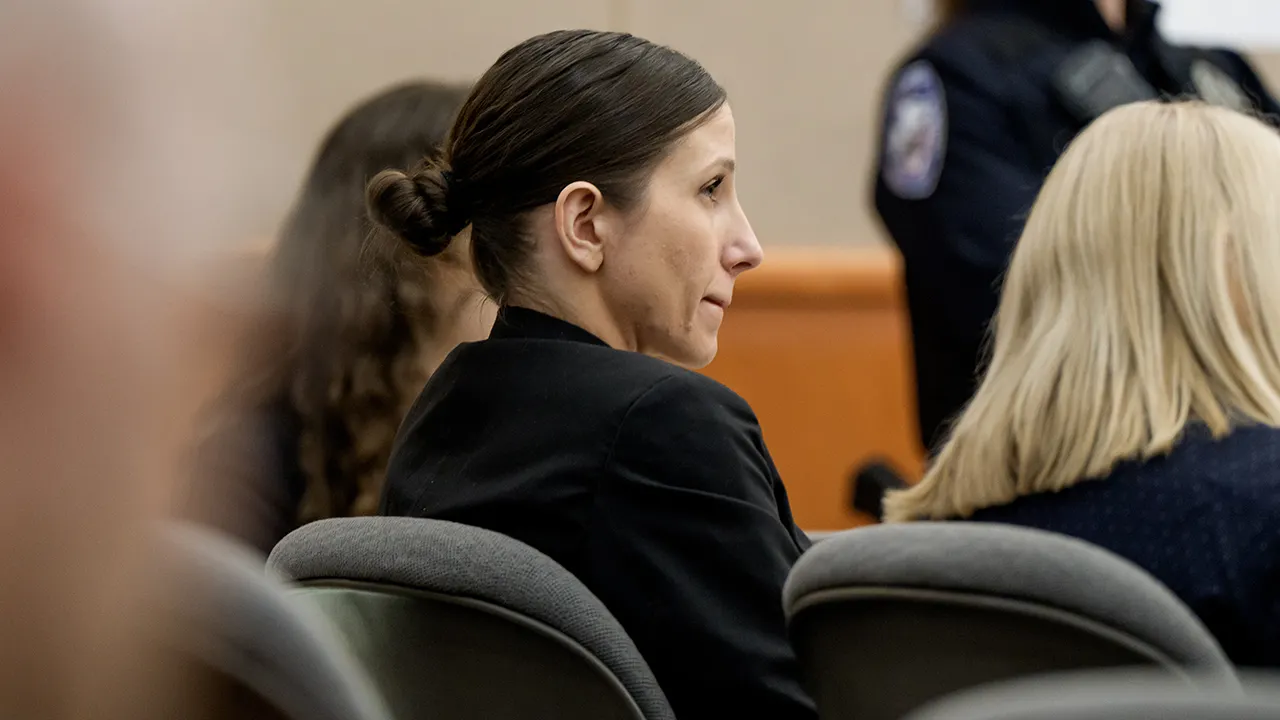
Kouri Richins looks on during her murder trial at the Summit County Courthouse, Monday, Feb. 23, 2026. (Spenser Heaps/AP Photo, Pool)
LIKE WHAT YOU’RE READING? FIND MORE ON THE TRUE CRIME HUB
Chelsea Gipson, the CSI technician who processed the Richins home, faced cross-examination focused on the evidence she collected, including prescription medications removed from the scene and whether she observed alcohol or THC gummies inside the residence. Gipson acknowledged the hydrocodone bottle recovered from the home was not tested for fentanyl and testified that no drug paraphernalia was found.
SIGN UP TO GET TRUE CRIME NEWSLETTER
Defense attorneys also questioned how certain areas were documented, noting that no photographs were taken of the kitchen, sink or closet during the initial processing of the scene.
FOLLOW THE FOX TRUE CRIME TEAM ON X
Kathy Nester walks back to her seat during the trial at the Summit County Courthouse, Monday, Feb. 23, 2026. (Spenser Heaps/AP Photo, Pool)
Judge Richard Mrazik called a recess around 9:30 a.m., citing a scheduling conflict. When court resumed shortly after 10:30 a.m., he dismissed jurors for the day, referencing “unforeseen emergency circumstances unrelated to the case.”
On Thursday, Kouri Richins’ housekeeper testified that she bought pain pills for her after repeated requests in early 2022. Carmen Lauber said Richins asked in early February 2022 for pain meds for an “investor,” took the pills and deleted their texts, and later left $1,000 at her Midway home for Lauber to pick up for another purchase.
Lauber also said she helped Kouri Richins obtain increasingly stronger drugs. She said she first sought out strong painkillers through a friend after Kouri Richins allegedly said her “investor” wanted something stronger, calling it the “Michael Jackson stuff.”
Lauber’s testimony followed a state toxicologist’s testimony acknowledging that Eric Richins could have taken fentanyl before having a drink, potentially undercutting prosecutors’ claim that Kouri Richins laced his Moscow mule.
Richins was arrested in May 2023. The case later drew national attention after she published a children’s book about grief following her husband’s death.
CLICK HERE TO DOWNLOAD THE FOX NEWS APP
The trial is expected to continue for several more weeks.
The Associated Press contributed to this report.
Stepheny Price covers crime, including missing persons, homicides and migrant crime. Send story tips to stepheny.price@fox.com.
Related Article

Read the full article from Here



Not only the Utah that we are today, but the Utah that we can choose to become.
(Rick Egan | The Salt Lake Tribune) Gabriel Meneses makes one of the limited edition flags for the United States 250th anniversary at Colonial Flag in Sandy on Monday, June 1, 2026.

Jazz Chisholm Jr. hit a two-run homer in the ninth inning to lift the New York Yankees over the Washington Nationals 5-3 on Friday night.
WASHINGTON (AP) — Jazz Chisholm Jr. hit a two-run homer in the ninth inning to lift the New York Yankees over the Washington Nationals 5-3 on Friday night.
The Yankees and Nationals rank 1-2 in the major leagues in home runs, and all but one run in this game came via the long ball. Ben Rice hit his 29th of the season for the Yankees, and Jasson Domínguez and Austin Wells also went deep for New York.
Keibert Ruiz and James Wood homered on consecutive pitches in the seventh to give Washington a 3-2 lead, but in the ninth, the Nationals brought in left-hander Matt Krook — who had allowed 22 earned runs in 12 2/3 big league innings dating to 2023. Krook (0-1) yielded a one-out single by Domínguez, and Chisholm followed with his 13th homer.
Wells added a solo shot off Justin Lawrence to make it 5-3.
David Bednar (3-3) won in relief, working the final two innings. The Yankees remained four games behind first-place Tampa Bay in the AL East.
Rice homered in the first off Carson Palmquist, but the New York designated hitter fouled a pitch off his right leg in the fifth and was shaken up. He was able to stay in the game.
By that time, Domínguez had given the Yankees a 2-1 lead with a homer off Zack Littell (8-6) in the fourth.
The game was delayed two hours at the start, and a wet field might have prevented Washington from tying it in the sixth. New York starter Ryan Weathers allowed a one-out double to CJ Abrams. Then Jacob Young followed with a single. Abrams looked likely to score, but he slipped rounding third and had to stay there.
Fernando Cruz then replaced Weathers and struck out the next two hitters to strand both runners.
New York’s Paul Goldschmidt singled in the first to snap an 0-for-34 drought, and he also reached on an infield hit in the sixth.
Amed Rosario of the Yankees struck out in all three of his plate appearances and made two errors at third base before being lifted for a pinch-hitter.
Up next
Cam Schlittler (9-5) was scheduled to start for New York on Saturday against Miles Mikolas (3-7) of the Nationals.
___
AP MLB: https://apnews.com/hub/mlb
Copyright
© 2026 The Associated Press. All rights reserved. This material may not be published, broadcast, written or redistributed.
Wyoming
Residents celebrate Wyoming Statehood Day by revealing their favorite thing about the Cowboy State

-

 South Dakota2 minutes ago
South Dakota GFP Commission Holds July Meeting
-

 Tennessee5 minutes ago
Forward Chris Washington Talks First Month With Tennessee Basketball | Rocky Top Insider
-

 Texas10 minutes ago
Texas Man Finds Hidden GPS Tracker in His New Truck: “They Didn’t Want Me To Find This”
-

 Utah17 minutes ago
Voices: America at 250 could use a little more Utah
-
Vermont20 minutes ago
VT Lottery Mega Millions, Gimme 5 results for July 10, 2026
-

 Virginia25 minutes ago
Vice President JD Vance eyes estate in Virginia
-

 Washington32 minutes ago
Chisholm’s homer keys 3-run 9th as the Yankees rally past Washington 5-3 – WTOP News
-

 Wisconsin35 minutes ago
Quiotepec en Wisconsin brings Oaxacan basketball fever to the Midwest

