West
Trump DHS turns tables on liberal media narrative over father’s arrest in deep blue city

NEWYou can now listen to Fox News articles!
The Trump Department of Homeland Security flipped the script on a liberal California media outlet that reported immigration agents “drove off” with a U.S. citizen detainee’s toddler in the backseat of a vehicle.
The Los Angeles Times reported that while carrying out an immigration enforcement operation at a Home Depot in the Cypress Park neighborhood, Border Patrol officials detained a 32-year-old U.S. citizen named Dennis Quinonez, who had a 1-year-old child in the backseat of his car.
The outlet reported that “after two agents climbed into his car — along with their weapons — they drove off with the child as onlookers protested.”
The article noted that a DHS spokesperson said Quinonez “allegedly ‘exited his vehicle wielding a hammer and threw rocks at law enforcement while he had a child in his car.’”
ILLEGAL IMMIGRANTS ARRESTED AFTER RAMMING BORDER PATROL IN CHICAGO AMID VIOLENT CLASH WITH PROTESTERS
Demonstrators gather outside Dodger Stadium to protest the presence of ICE and Border Patrol agents ahead of a game between the Los Angeles Dodgers and San Diego Padres. (Zin Chiang/picture alliance via Getty Images)
The outlet also noted that the spokesperson said Quinonez “was arrested for assault, and, during his arrest, a pistol was found in his car that is reported stolen out of the state of New York,” adding he “has an active warrant for property damage.”
Quinonez was charged with unlawful possession of a gun and ammunition by a person previously convicted of domestic violence, the outlet reported.
Despite this, the outlet quoted an immigration activist who said, “The fact that they were getting into that car, heavily armed, with masks on their face, they put that toddler in extreme danger.”
The activist said, “It should shock everyone’s conscience that we have masked armed men behaving like that with a U.S. citizen father and a toddler who were just going to run an errand at Home Depot on a random Tuesday.”
Deeper in the outlet’s coverage of the incident, it reported that the “agents decided to drive Quinonez and his daughter separately to another location, where agents determined that the handgun was loaded with five rounds of ammunition.”
DHS CALLS OUT NBC AFFILIATE FOR HIDING ILLEGAL IMMIGRANT CRIME HISTORY IN ARREST STORY
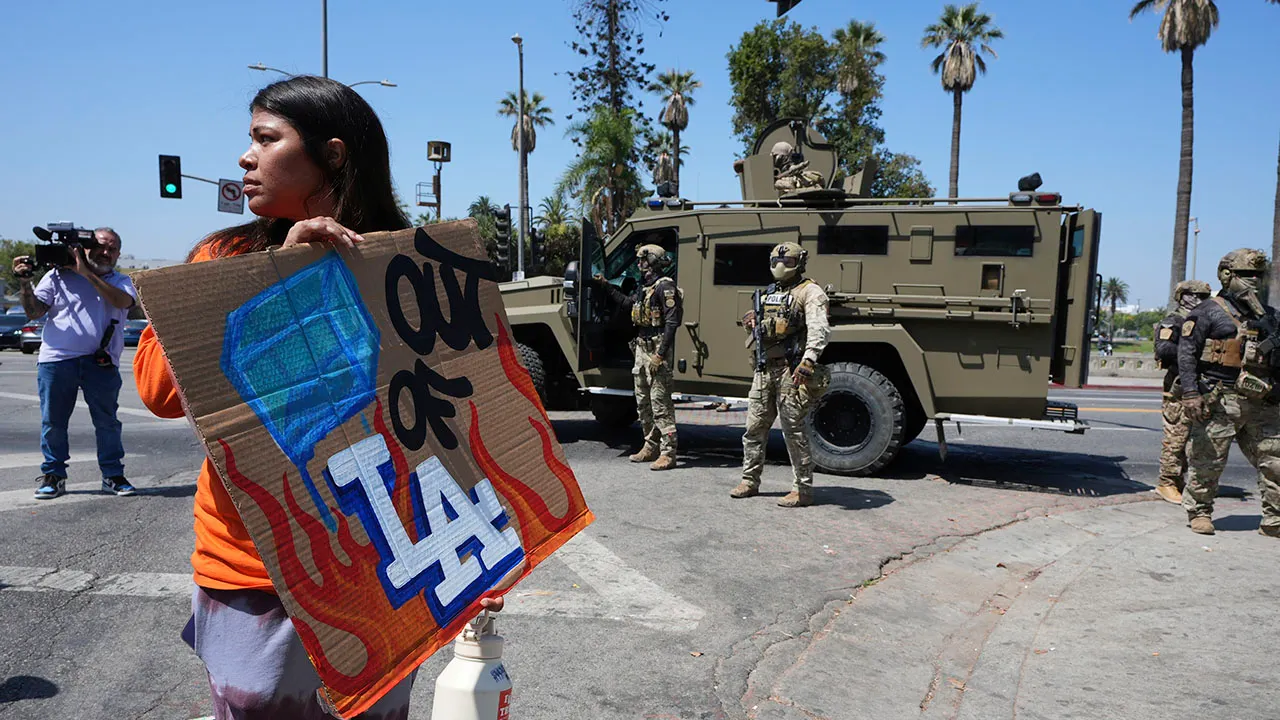
A person holds a sign in front of federal agents at MacArthur Park July 7, 2025, in Los Angeles. (AP Photo/Damian Dovarganes)
An LA Times reporter took to X to post about the incident, writing, “During a Border Patrol operation outside a Cypress Park Home Depot yesterday, agents detained a U.S. citizen they accused of assault. The agents drove off with his one-year-old daughter in the backseat. She’s since been reunited with her family.”
The reporter added that “Maria Avalos, the child’s grandmother, said the agents ‘shouldn’t have driven off’ with her granddaughter.”
“When they got into the car, taking my granddaughter, I said, ‘Why are they taking her, are they really ICE, are they kidnapping her or what?’” the woman reportedly said.
This post prompted a sharp reply from DHS Assistant Secretary Tricia McLaughlin.
“Oh ffs sake, Brittny. This U.S. citizen left his own child unattended in a car and proceeded to attack law enforcement as the[y] were conducting an operation—he exited his car wielding a hammer and threw rocks at law enforcement as he abandoned his child,” she wrote.
MAN STRUCK, KILLED ON FREEWAY WHILE FLEEING IMMIGRATION AGENTS DURING HOME DEPOT RAID
ICE and Border Patrol agents march through Los Angeles. (Carlin Stiehl/Getty Images)
McLaughlin added that, given the facts that Quinonez was arrested for assault, a pistol was found in his car during the arrest, the car was reported stolen out of New York and he had an active warrant for property damage, “law enforcement rightly looked over the child until they were in the safe custody of a guardian.”
CLICK HERE TO DOWNLOAD THE FOX NEWS APP
In response, a spokesperson for the LA Times told Fox News Digital, “We stand by this story. All the information that DHS cited is prominently reported in the story.”
Read the full article from Here



A man was being sought as the suspect in a double shooting in Bay Point that left one person dead and another injured early Friday morning.
The Contra Costa County Sheriff’s Office said deputies were dispatched at about 1:30 a.m. to an unknown problem on Olivia Lane, just east of Alves Lane and south of Delta de Anza Regional Trail, which later was reported to be “shots fired.”
While arriving at the scene, deputies were flagged down by several people who were injured at the location, the Sheriff’s Office said. Deputies found one person who was unresponsive and he was taken to a hospital. The victim was later pronounced dead at the hospital, the office said.
A second person was taken to the hospital; the victim’s condition was not disclosed. The victim who died has not yet been identified.
Sheriff’s detectives identified the suspect as 35-year-old Avery Alexander Gibbs, described by the Sheriff’s Office as a transient. Gibbs was still at large as of Friday afternoon
The Sheriff’s Office said Gibbs should not be approached, and anyone seeing him should call 9-1-1. People with information on the shooting were asked to contact Sheriff’s Office investigators at (925) 313-2600 dispatcher at (925) 646-2441.
Denver, CO
Nations Cup in Colorado another showcase for Denver’s bid to host the 2031 Rugby World Cup

Think of Saturday’s rugby match at Dick’s Sporting Goods Park as a very physical audition.
The Nations Cup showdown between the USA Men’s Eagles and Portugal on the Fourth of July is another chance for Denver — long an epicenter for American growth in the sport — to showcase itself as a host city for the 2031 World Cup.
“We had that great moment at Dick’s last year where we qualified for the World Cup (by beating Samoa in the Pacific Nations Cup),” said national team captain Jason Damm. “Any opportunity to get out here, sort of in the middle of the country, feels like a connection point for the nation. It’s a good way to kick off this Nations Cup.”
Damm’s professional rugby roots are in Colorado. The Georgia native played for a team in Vail and for the Glendale Raptors, a now-defunct Major League Rugby franchise. Damm thinks Denver would be a “great fit” for hosting the 2031 Men’s and 2033 Women’s Rugby World Cups, the first time the tournaments will be held in the U.S.
“We have a lot of guys now, and I’ve had the pleasure of playing with a lot of guys who went through that American Raptors program that was here for such a long time and really wanted to look after the development of some transition players (from other sports),” Damm said. “There’s just so much great rugby out here and good competitions.”
In addition to the legacy of the Glendale/American Raptors as well as burgeoning club and youth scenes, Denver is home to “Rugbytown USA,” the city of Glendale, which boasts the first rugby-specific stadium in the U.S. at Infinity Park. That’s where Colorado’s pro women’s team, the Denver Onyx, plays. The Onyx are the reigning champions of Women’s Elite Rugby.
And the college scene is solid, too, including strong performances by local women’s squads at this spring’s sevens Collegiate Rugby Championship, where CSU and CU placed in the Division I-AA tournament, Colorado Mesa was the Division II national champion and Mines was the Division III national champion.
All of that background makes Saturday another important milestone for rugby in Colorado. The Eagles have two locals in their player pool in prop Kaleb Geiger (Castle View High School) and lock Sam Golla (Denver East High School), but both players are coming off surgery and are not on the Nations Cup roster.
Golla, the No. 1 overall pick in the 2022 MLR Draft and the league’s 2023 rookie of the year, sees Saturday as another chance for Colorado to prove its support of the sport amid World Rugby’s ongoing selection process for the 2031 World Cup.
“I see myself playing in the 2027 World Cup (once healthy again), and also in 2031,” Golla said. “It’s not often that your home country gets to host a World Cup, let alone you get to play in it. And then on top of that, potentially having a game in my home state in the World Cup representing my country, that would be amazing. Only one can dream of all the stars aligning in that perfect figure.”
In March 2025, the Denver Sports Commission hosted delegates from World Rugby as part of its ongoing, separate bids to host the 2031 Men’s and 2033 Women’s Rugby World Cups. While the bid for the women’s tournament is further off, the bid for the men’s tournament — one of the world’s largest sporting events — is heating up.
Last fall, World Rugby announced that 27 total cities entered the application phase. At the end of this year, World Rugby will reveal the formal candidates, and the host cities and venues will be announced following the Rugby World Cup in the fall of 2027. Eight to 10 cities are expected to be named hosts, according to Denver Sports Commission executive director Matthew Payne.

“We’ll continue to work with World Rugby on portions of the bid as they request them,” Payne said. “And so we’ll continue to give them information during this applicant phase with the whole goal of getting into the candidate phase.”
The 2023 men’s Rugby World Cup in France generated $1.95 billion in total spending, according to the Denver Sports Commission. Should Denver be named a host city, Empower Field will host matches due to its capacity, while Dick’s Sporting Goods Park and Infinity Park will serve as training venues.
The USA Men’s Eagles, which did not qualify for the 2023 Rugby World Cup, have much to prove in the year-plus leading into the sport’s biggest stage next year in Australia. The Eagles, who have never advanced past the pool stage of the tournament, are a combined 2-21 over their last six World Cup appearances. In Japan in 2019, the Eagles went 0-4 with a minus-104 scoring margin.
So beating Portugal in the 7 p.m. match on America’s semiquincentennial, and then notching wins over Zimbabwe (July 11 in Charlotte, N.C.) and Spain (July 18 in Cary, N.C.), would be a good start. None of the other three nations are rugby powerhouses, as they’ve combined for only five World Cup appearances.

The Nations Cup, which also features Tonga versus Zimbabwe on Saturday at 4:15 p.m. at Dick’s Sporting Goods Park, will conclude with three additional rounds in November.
“We want to be able to compete at a Tier 1 level (which consists of the world powers, while the U.S. is Tier 2) around our set piece,” Eagles head coach Scott Lawrence said. “We feel like we have the players and the athletes to do that. We want to have a defense that stays in the fight with discipline and is physical.
“If we think about the game on Saturday and we back up from it, we’ve got to keep the end in mind, which is the World Cup. So it’s really around a new intensity, a new approach to the way that we’re building into that World Cup. And we think of Portugal as a first step along the way.”
Want more sports news? Sign up for the Sports Omelette to get all our analysis on Denver’s teams.

U.S. men’s national team coach Mauricio Pochettino will throw the first pitch before Friday night’s Major League Baseball game between the Seattle Mariners and Toronto Blue Jays, which the team was invited to attend.
Pochettino played catch with a few of his players before Friday’s practice at Husky Soccer Stadium. The U.S. plays Belgium in the World Cup round of 16 on Monday at Seattle Stadium.
Pochettino has also joined tens of thousands of fans in singing John Denver’s “Take Me Home, Country Roads” after the USA wins. The 54-year-old coach, who was born in Argentina and lives in Spain, has fully embraced the American experience this summer.
U.S. forward Folarin Balogun, who was born in the New York City borough of Brooklyn to Nigerian parents but raised in London, marveled at the opportunities he, his teammates and the coaching staff have been afforded.
“I think that sort of stuff can only happen in America. So, I’m very, very proud,” Balogun said. “This is a unique experience for me, being in the World Cup in your home nation. And, I think you’re seeing, we’ve been able to be so focused, but, at the same time have so many things we can do to distract ourselves and to take our mind off the high-pressure environment. This evening will be another opportunity to do that.”
Reporting by the Associated Press.
-

 San Francisco, CA4 minutes ago
1 dead, 1 injured in Bay Point shooting; suspect sought
-

 Dallas, TX7 minutes ago
Viral video shows Egypt coach, team director in Dallas police confrontation
-

 Miami, FL7 minutes ago
Fourth of July celebrations planned across South Florida for America’s 250th birthday
-

 Boston, MA19 minutes ago
‘Forever grateful for all we accomplished together’: Jayson Tatum speaks out about Jaylen Brown trade – Boston News, Weather, Sports | WHDH 7News
-

 Denver, CO22 minutes ago
Nations Cup in Colorado another showcase for Denver’s bid to host the 2031 Rugby World Cup
-

 Seattle, WA27 minutes ago
USA Coach Mauricio Pochettino To Throw Out First Pitch At Seattle Mariners Game
-

 San Diego, CA34 minutes ago
California to institute Bruce Lee Day, a first for a Chinese American in the state’s history
-

 Milwaukee, WI37 minutes ago
Bucks waive Pete Nance

