West
Suspect in plot to kill famous rapper leaves jail

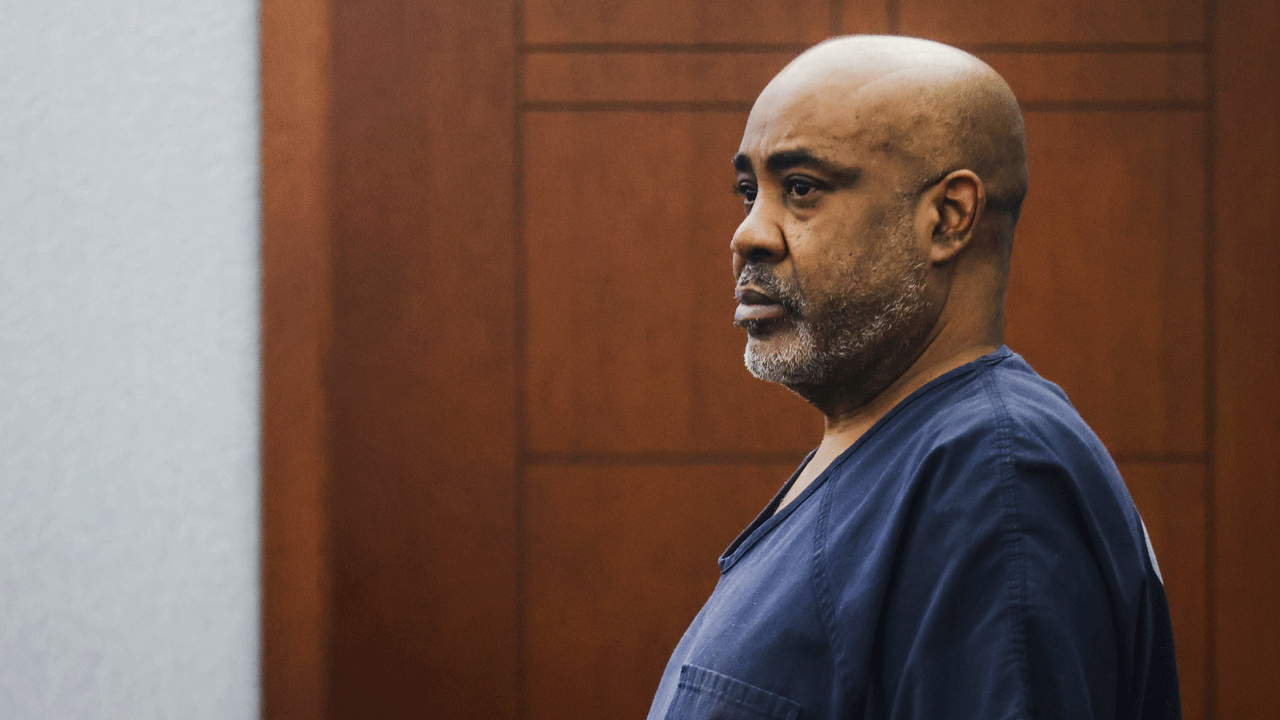
LAS VEGAS (AP) — A Nevada judge set bail Tuesday at $750,000 for a former Los Angeles-area gang leader charged with orchestrating the killing of hip-hop legend Tupac Shakur in 1996, saying he can serve house arrest with electronic monitoring ahead of trial on a murder charge.
Court-appointed attorneys for Duane “Keffe D” Davis told The Associated Press after the judge’s decision that they believe Davis can post that amount. They had asked for bail of not more than $100,000 and noted for the judge that the demands of preparing a defense based on two decades of evidence may require a postponement of the current June trial date.
MAN INDICTED IN TUPAC SHAKUR’S 1996 MURDER
Clark County District Attorney Steve Wolfson told reporters that he expects Clark County District Judge Carli Kierny will hold a “source hearing” to determine whether money posted for bail is legally obtained. The judge did not set a new trial date but called for a status check Feb. 20.
Prosecutors Binu Palal and Marc DiGiacomo argued Tuesday that Davis has never left gang life, that his 15 years of admissions about his role in Shakur’s killing show he is guilty of murder, and that a jailhouse phone call in October suggested he poses a threat to witnesses.
“There is one constant,” Palal told the judge. “Mr. Davis has consistently admitted to being architect of the murder.”
DiGiacomo called Davis “a very, very high danger to the community.”
The judge, in her ruling, acknowledged that Davis “made a living talking about his past life as a leader of the South Side Crips,” a street gang in his hometown of Compton, California, “and also the killing of Mr. Shakur in graphic detail.”
Arroyo and co-counsel Charles Cano argued that police and prosecutors could have arrested Davis 15 years ago but didn’t, and that the prosecutors were wrong with their interpretation of the jail telephone call and a list of names provided to Davis’ family. The defense lawyers said it is Davis and his family who are at risk.
Arroyo and Cano said their 60-year-old client is in poor health after battling cancer, which is in remission, and said he would not flee to avoid trial.
They also downplayed evidence against Davis as the product of tales told by witnesses with gang backgrounds that make them not credible, and noted the prosecution lacks evidence, including the gun and the car involved in the September 1996 drive-by shooting that killed Shakur.
Arroyo focused Tuesday on what he called “the obvious question” dating to 2008 and 2009 — when Davis talked with police in Los Angeles and Las Vegas. He went on to write a 2019 tell-all memoir and began giving interviews on social media in which he described his role as gang leader and “shot-caller” in Shakur’s death.
“If his guilt is so overwhelming, what’s been happening for 15 years?” Arroyo asked in court Tuesday. “Why did we wait 15 years to make the arrest?”
Davis was arrested Sept. 29 outside his home in suburban Henderson, which Las Vegas police had searched in mid-July. He pleaded not guilty in November to first-degree murder and has been jailed without bail at the Clark County Detention Center in Las Vegas, where detainees’ phone calls are routinely recorded. If convicted at trial, he could spend the rest of his life in prison.
Arroyo argued Tuesday that his client’s accounts in “the YouTube world” accentuated violence to attract viewers and make money.
“Conflict sells,” Arroyo said. “They get on these interviews, they puff out their chest. They’re trying to get clicks.”
Prosecutors say Davis’ own words are strong evidence that he is responsible for the crime, even if he didn’t pull the trigger. DiGiacomo said other people who have described Davis’ role in other media interviews, and to police, corroborate his accounts.
Davis is the only person still alive who was in the car from which shots were fired, mortally wounding Shakur and wounding rap mogul Marion “Suge” Knight. Knight is serving 28 years in a California prison for an unrelated fatal shooting in the Los Angeles area in 2015.
Davis’ attorneys noted that Knight is an eyewitness to the Shakur shooting but did not testify before the grand jury that indicted their client.
Davis maintains he was given immunity from prosecution in 2008 by an FBI and Los Angeles police task force investigating the killings of Shakur in Las Vegas and rival rapper Christopher Wallace, known as The Notorious B.I.G. or Biggie Smalls, six months later in Los Angeles.
DiGiacomo and Palal say any immunity agreement was limited. Last week, they submitted to the court an audio recording of a December 2008 task force interview during which they said Davis was told that what he said in the room would not be used against him, but that if he talked to other people he could be in legal jeopardy.
Davis’ attorneys responded with a reference to the publication 12 years ago of a book written by former Los Angeles police Detective Greg Kading, who attended those interviews.
“Duane is not worried,” the attorneys said, “because his alleged involvement in the death of Shakur has been out in the public since … 2011.”
Read the full article from Here



SAN FRANCISCO – Even as votes continue to be counted in California’s gubernatorial primary, one candidate spent part of Wednesday campaigning in the Bay Area.
Hilton looks ahead to November
Some were surprised to see Republican gubernatorial candidate Steve Hilton in San Francisco. With the primary election behind him, Hilton visited Osmanthus Dim Sum Lounge to meet with voters and begin laying the groundwork for a potential fall campaign.
Hilton acknowledged that ballots are still being counted and criticized the pace of the process, saying results should be available more quickly. Still, he expressed confidence that he will finish among the top two candidates and advance to the November election.
“This is my plan to grow my support,” Hilton said, gesturing to supporters gathered inside the restaurant. “To be out with the people of California desperate for change.”
Former Health and Human Services Secretary Xavier Becerra, another leading candidate, also projected confidence on election night.
“I take nothing for granted. There are lots of ballots to be counted; it appears we are on track to advance to November,” Becerra said.
Voters voice concerns
What they’re saying:
Among those attending Hilton’s event was Nelson Lum, a former San Francisco police officer who said he wanted to hear the candidate’s views on crime.
“It’s not an endorsement of anybody at this point,” Lum said. “I’m certainly not going to exclude anyone because I want to hear their views.”
Meina Young, with the Business and Housing Network, said she attended to discuss issues she sees as burdensome regulations in the rental housing market.
“I want to make our voices heard, and I feel that Steve has been very good,” Young said. “This is our second time meeting with him.”
Small protest outside event
Outside the restaurant, a small group of protesters gathered after noticing signage for the event. They said they are concerned San Francisco is becoming more welcoming to Republican candidates.
“We’re here today because we know San Francisco is a Democratic, progressive city,” said Romalyn Schmaltz. “We’re not going to just let a Republican come here and fundraise in our neighborhood without saying something.”
Counting continues
What’s next:
Ballots are still being counted statewide. More than 23 million ballots were mailed to California’s registered voters for the primary election.
The extended counting process often fuels accusations of irregularities. Election officials and supporters of the system, however, say the process takes time to ensure every eligible ballot is counted accurately.


On this day 52 years ago, the Pacific Northwest’s upper-left city of Seattle was granted an NFL Franchise. NFL Commissioner Pete Rozelle announced the news that they would join the league as an expansion franchise in 1976 and would be the league’s 28th, alongside the Tampa Bay Buccaneers. The name “Seahawks” was chosen from a survey with over 20,365 entries. This tweet from @HawkMania shows an article from the now-online and former print local newspaper, the Seattle Post-Intelligencer. They were known for the big globe with an eagle on top that resided on top of their building in downtown Seattle, and as it says on their front page here, a staple in the community since 1863.
The article mentions Seattle drafting Archie Griffin as a possibility, who was the two-time Heisman Trophy winner for Ohio State and the massive hotshot prospect back then. It mentions the Nordstrom family, represented by Lloyd Nordstrom, as the majority owners, and Herman Sarkowsky as the chief operating officer. Sarkowsky says he thinks the team will pick high in 1976 before they play their inaugural season, and they did, taking defensive tackle Steve Niehaus 2nd overall (Griffin ended up going 24th to the Cincinnati Bengals). Ironically, the article mentions the Portland TrailBlazers as well and their ability to draft Bill Walton early on, the NBA franchise which the Seahawks’ most prominent owner Paul Allen also owned.
It’s great to look back on the history of the franchise, and the sport overall. In 2026, it’s one of the few institutions that preserves memories well enough to stay in touch with its roots. Seattle and the Seahawks have grown up together as an American sports city and franchise, and 52 years ago today was one of their most important turning points.
-

 Health3 minutes ago
People taking common sleep drug may not realize they’re too impaired to drive, study finds
-

 Sports5 minutes ago
Seth Jarvis scores overtime game-winner as Hurricanes storm back from 2-0 deficit to even Stanley Cup Final
-

 Technology11 minutes ago
Are humanoid robots now coming for retail jobs?
-
 Business18 minutes ago
Value of Huntington Beach defense tech startup balloons to $1.8 billion
-
 Entertainment20 minutes ago
Jesse Ridgway speaks out on death threats after ending pregnancy due to Down syndrome
-

 Lifestyle25 minutes ago
Inside the Push Towards Footwear Manufacturing in Portugal
-
 Politics33 minutes ago
Commentary: No, Mr. Hilton, our elections are not ‘a joke.’ It’s time for you to stand up to Trump
-
 Sports48 minutes ago
High school baseball and softball: Regional scores and schedule

