- Sen. Mike Lee said Utah bill that requires proof of citizenship to vote is an example of the state leading the way.
- A review by the Utah Lieutenant Governor’s Office has so far found one confirmed noncitizen on Utah voter rolls.
- Lt. Gov. Deidre Henderson said these efforts must be careful not to accidentally kick citizens off of the voter rolls.
Utah
Utah leading nation to prevent noncitizens from voting, Sen. Lee says


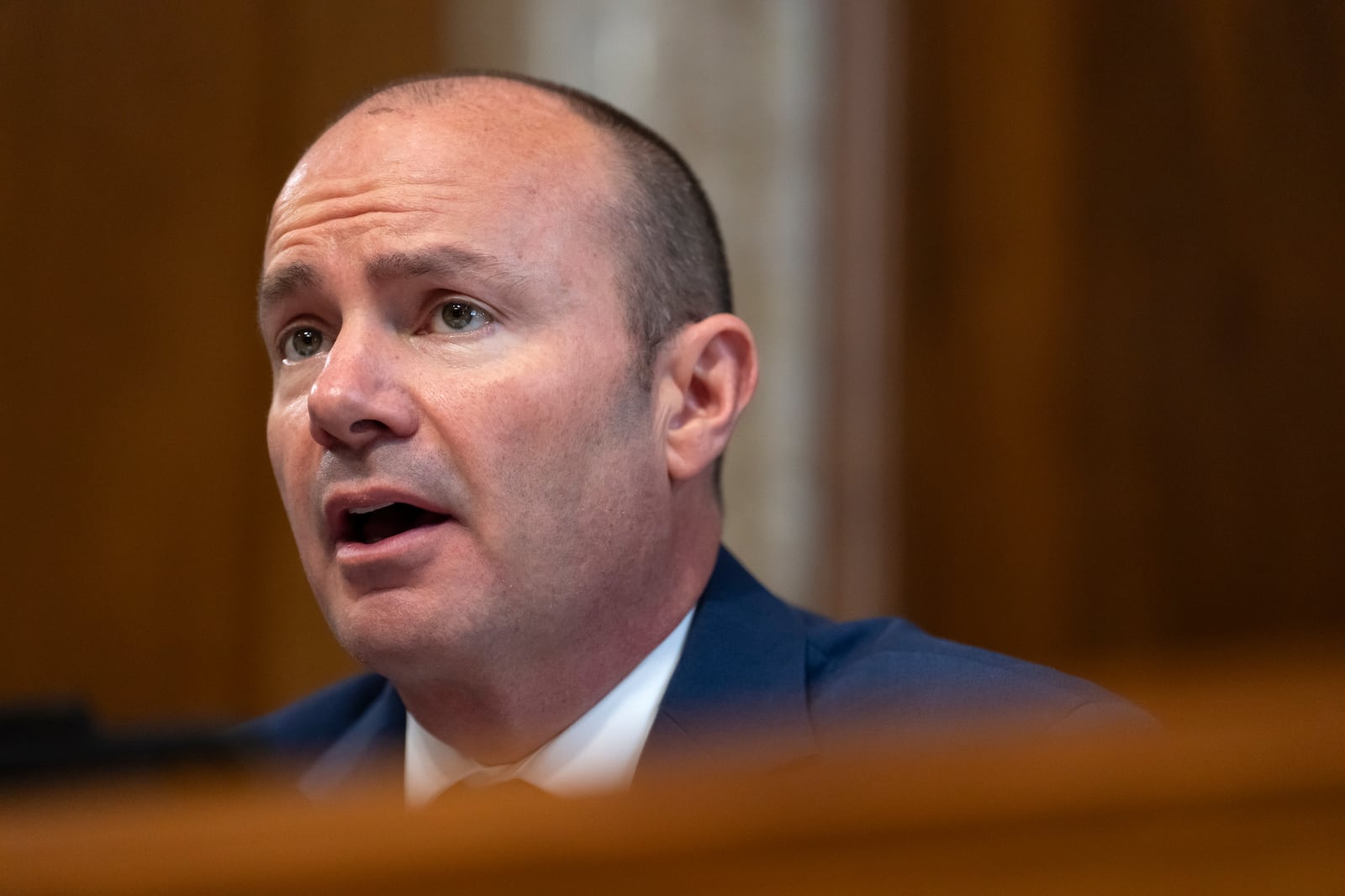
U.S. Sen. Mike Lee said Utah is an example to follow for its efforts to verify voter citizenship as the senator comes closer to passing his voter ID law in Congress.
More than a year after it was first introduced, Lee’s Safeguard American Voter Eligibility Act appears to be gaining traction as Republicans seek to make good on President Donald Trump’s campaign promises.
Meanwhile, Utah GOP legislators are backing a bill, HB209, that would create a process for county clerks to verify documentary proof of U.S. citizenship during voter registration, in line with the Utah Constitution.
“While we fight to pass the SAVE Act in the Senate, state-level citizenship requirements for voting and registration will be a vital tool to secure American elections and ensure citizen-only voting,” Lee said. “As ever, Utah leads the way.”
The Utah legislation would mirror that in a handful of Republican-leaning states that empower clerks to independently determine whether a registered voter is not a citizen and to bar participation in state elections.
As Lee, in Washington, D.C., and lawmakers in Utah clamp down on loopholes that may allow for noncitizens to vote, Utah’s chief election officer is also concluding an unprecedented citizenship review of Utah’s voter rolls.
What has the citizenship review found?
On Friday, the Utah Lieutenant Governor’s Office, which oversees elections in the state, provided an update on its review of noncitizens who are registered to vote.
After analyzing over 2 million records, election officials have so far identified just one noncitizen who was actively registered on voter rolls, but who never voted.
The individual checked the “noncitizen” box on the voter registration form but was still registered by the county clerk in a “clerical error” likely committed out of “some sort of confusion,” Lt. Gov. Deidre Henderson said.
Before the review began in April, the office identified four noncitizens who registered online to vote. The four were removed from voter rolls and are under investigation. It is unclear whether they voted, according to Henderson.
After confirming the citizenship of more than 99.9% of Utah voters, Henderson’s team is still working through roughly 7,000 records that could not be verified by using state drivers license information or federal databases.
Meanwhile, the office has updated the online voter registration process to prevent noncitizens from completing an application and Henderson is collaborating on HB209 to clarify when clerks can request proof of citizenship.
A problem of federal data?
One of Henderson’s takeaways from the comprehensive citizenship review, which she believes is the first in Utah history, is that federal databases are not a foolproof way to identify noncitizens on voter rolls, she said.
“There is no centralized federal database with a list of U.S. citizens,” Henderson told the Deseret News. “The states need to do further checks to find out. The federal government does not have good data.”
More than 95% of the 2,069,640 voters registered in August could be immediately confirmed as citizens by the Lieutenant Governor’s Office when comparing the state’s voter database with Driver License Division records.
The office then entered a memorandum of understanding with the Department of Homeland Security to use its SAVE program — which compiles Social Security, change of address and death records to determine welfare eligibility.
The program confirmed the citizenship of all but 8,836 of the remaining registered voters. But the database cannot “confirm noncitizenship,” Henderson said. So the Lieutenant Governor’s Office has begun manually inspecting each of the records.
The office found that 77% of the 2,119 active voters born outside the U.S. were citizens. On Jan. 13, the office asked the final 486 actively registered voters who could not be confirmed as citizens to complete a new registration form before Feb. 1.
The office will also inspect the roughly 6,700 records of inactive voters and those with incomplete information who said they were born within the U.S. The review will be published “as soon as we can track down as many of these voters as possible,” Henderson said.
Utah brings Sen. Lee’s SAVE Act to the state level
HB209 outlines what steps clerks can take if they cannot confirm citizenship, according to Henderson, who pointed out that, due to an election law passed last year, all Utah voters will soon be required to have state ID.

HB209, which is sponsored by Rep. Cory Maloy, R-Lehi, sailed through its first committee hearing on Wednesday with the blessing of House Speaker Mike Schultz, and the endorsement of the state’s top election administrators.
The bill would create a “bifurcated ballot system,” similar to that used for military service members in the state, that would provide voters a federal-only ballot if they refuse to provide documentary proof of U.S. citizenship.
If a registered voter has not provided proof of citizenship — with a drivers license, birth certificate, passport, tribal card or naturalization document — then clerks are instructed to notify the individual they cannot vote in state elections.
Schultz, R-Hooper, and Senate President Stuart Adams, R-Layton, both called the bill “common sense” this week, with Adams predicting on Friday that the desire to prevent noncitizens from voting is “probably unanimous up here.”
Over in the U.S. House, GOP leaders have signaled that Lee’s SAVE Act is a priority. The bill would amend the National Voter Registration Act to allow states to require REAL ID identification in order to vote in federal elections.
In addition to adding penalties for knowingly registering a noncitizen, the bill would provide alternate ways of proving citizenship to ensure citizens aren’t prevented from voting if they do not have certain forms of identification.
Any federal reform must actually accomplish “the intended goal,” Henderson said. In 2022, she was removed from voter rolls when her county clerk interpreted her birth on a foreign military base to mean she was not a U.S. citizen.
“We have worked in our state to balance accessibility and security,” Henderson said. “We want to make sure that only eligible voters are registered. We also want to make sure that we don’t erroneously kick off the voter rolls any eligible voters.”



It’s on nights like these that I’m reminded of the ravine that divides the NBA from all other levels of basketball. This Summer League tilt was sloppy on both sides, and not many fringe players earned an NBA contract tonight, by the looks of it.
This matchup has always been about the number-one pick AJ Dybantsa and the number-two pick Darryn Peterson. Rivals since high school, these two are in an eternal struggle for the designation of being “number-one”. They wanted to be the best in their high school class. They wanted to be the first off the board in the NBA Draft. Rest assured, these two will be battling for Rookie of the Year honors by the season’s end.
Advertisement
Both stars were fully aware of the magnitude of this game, and both wanted to be the first to strike in the Thomas and Mack Center.
Dybantsa took his first touch all the way to the basket and forced up an off-kilter shot that missed everything.
Peterson took the ball the other way and forced up a top-of-the-key three-pointer that missed badly.
Dybantsa quickly picked up the slack, flipping an under-and-around lay-in and following that up with a good leading bounce pass through traffic to find a cutting teammate.
From there, the 1-2 combo settled in and let the game flow around them.
For the first time in a Utah Jazz uniform, Darryn Peterson walked among mortal men as a commoner. He had a very slow start in his Las Vegas debut, opening the night 0-for-3 from the floor and even whiffing on his first all-or-nothing foul shot. His steps were hurried, and he stood unstable before his first trip to the bench. Not quite so infallible outside of the mountain air in Salt Lake City.
Advertisement
AJ claimed the first quarter, dicing up the defense with fadeaways, dribble chains, and this vicious, inhumane slam that will dominate your social media feed for the next day or so.
Washington set the tone for some — should we say physical — defense out on the perimeter, and the officials gave the Wizards liberty to reside in Peterson’s chest for the majority of the game. The number-two pick couldn’t get himself into a rhythm as he’d step out of bounds, dribble off his foot, and sputter under the heat of the Wizards’ aggressive double-team scheme.
They were incredibly handsy from end to end, frustrating Jazz ball handlers as the whistles piled up at the other end.
Advertisement
AJ Dybantsa lives at the foul stripe — that’s his superpower — and he has since his days at BYU, where he led the nation in foul shots taken per game. Perfectly within his idiom, Dybantsa was 6-of-7 from the foul stripe — keeping in mind the experimental do-or-die free throw rule. Considering how much more physical the Wizards played at the defensive end, it’s a mystery how the Wizards managed to reside in the comfort of the bonus for the entire first half.
Neither player was efficient from the floor, but Dybantsa won the first half of this marquee matchup.
Dybantsa finished the first half with 19 points on 4-of-12 shooting.
Peterson lagged behind with 11 points on 3-of-9 shooting and a pair of dimes.
The lead shrank to single digits, and what appeared to be a blowout in the first half — Washington led by as much as 20 — rapidly drew tighter in the second half. It had become a two-possession game before the clock hit 0:00 in the third quarter.
Advertisement
Both stars lived up to the bill in this one, clearly displaying their individual talents despite their efficiency not leaping off the box score.
Peterson’s tendency to cough up possession has to get straightened out. He’ll be a target for his whole career, so learning to handle and exploit on-ball pressure will be critical to maximize his effectiveness and keep his teammates involved.
Cody Williams stole the show a bit for the Jazz, despite a rocky opening to the night. Though he struggled to stop Dybantsa on the defensive end, he notched 16 points on great efficiency (6-11, 2-3 3PT) plus 5 rebounds. He’s not a ball-handler, despite the Jazz’s wishes, but thrived on a newly added stepback mid-range jumper tonight.
Dybantsa had a strong night, finishing with 27 points on 7-for-18 shooting, 7 rebounds, and 2 steals.
Advertisement
The Wizards ultimately won this game behind the strength of their NBA guys, Tre Johnson and Will Reily, who combined for 41 to pair with Dybantsa’s 27. They also strongly benefited from Jamir Watkins, Darryn Peterson’s assignment fouling a grand total of 9 times (not a typo).
Peterson likewise fouled 9 times in this one, an ugly blemish on what was an unsteady night for the rookie. He finished with 24 points on 6-18 shooting and 2-7 from three-point land (thanks to a bank-shot heave at the final horn). Dybantsa will be crowned the winner of this head-to-head with Peterson thanks to better highlights and the team win, but neither player dominated, despite what X will likely tell you.
Washington defeats Utah with a final score of 92-88.
Calvin Barrett is the Associate Editor for SLC Dunk. Originally from Springville, Utah, he currently lives in Japan and has covered the NBA and college athletics since 2024.

LAS VEGAS (KSNV) — The man arrested for murder in the 2006 death of his wife at a Utah national park left behind a suicide note in his Las Vegas jail cell, according to a police report.
Las Vegas Metropolitan Police released a public report on the death of David Vander Meer, 49, who was in custody on an out-of-state warrant.
The Washington County District Attorney’s Office said in an affidavit that Vander Meer, a former youth pastor, was a suspect in the death of his then-wife, 28-year-old Bernadette Vander Meer, 20 years ago.
Bernadette fell to her death at Angels Landing in Zion National Park. Prosecutors said in their affidavit that they received new information implicating David, alleing that he began having a close relationship with a young girl when she was 14 and he was her youth pastor.
A fugitive task force took Vander Meer into custody in Summerlin, according to an arrest report, and he was booked into Clark County Detention Center on June 22.
In the report on his death, LVMPD said a corrections officer was conducting visual checks at about 9:30 p.m. June 24 when he noticed Vander Meer lying face down on the ground and unresponsive.
Several sections are redacted, but police wrote that the officer performed chest compressions until medical personnel arrived. Vander Meer was taken to UMC, where he was pronounced dead just after 2:36 a.m. June 25.
Investigators wrote that because of “the nature of his case,” Vander Meer was placed into protective custody. He was seen sitting upright and awake at 9 p.m., and he had no known medical conditions. He also did not mention being suicidal during a mental health screening.
Inside the cell, police wrote that Vander Meer “left a hand written suicide letter and a hand written will in his cell which has been photographed and impounded.” The following paragraph of the report was redacted, and no further details on Vander Meer’s death were disclosed.
The Clark County Coroner’s Office has not yet released its official rulings on his cause and manner of death.
Bernadette’s parents, Richard and Laura Gudenkauf, told News 3 they long suspected Vander Meer played a role in her death.
“Because of the girlfriend,” said Laura. “I found insurance policies months later that he had, lots of them.”

It has been a long time since the Jazz last played a meaningful game I desperately wanted them to win, and it is unhealthy how excited I am for this matchup. After a solid three games in the SLC Summer League, the Jazz head south to Las Vegas, and as hot as the desert sun is sure to be outside, on the court, the Thursday night primetime game featuring the top two picks in the draft will be much hotter.
How to Watch the Las Vegas Summer League?
Who: Utah Jazz vs Washington Wizards
When: Thursday, July 9, 2026 | 7:00 MT
Where: Thomas & Mack Center, Las Vegas, NV
How to watch: ESPN, Jazz+
Darryn Peterson and AJ Dybantsa
Summer league games do not matter in the record books, but this game is a statement-making opportunity for both AJ Dybantsa and Darryn Peterson. Given the historical nature of this draft class, especially at the top, there is some real juice to this game that is atypical of most Summer League games. AJ has the chance to silence the noise that has swelled after Darryn’s remarkable performances in the SLC Summer League. Meanwhile, Darryn has the chance to ratchet up the noise and take the NBA world by storm with another solid performance against the Wizards. Can you imagine the narratives if Darryn were to come out and dominate AJ as he has through high school and college? In the words of the great Charles Barkley, I have two words for you… Darryn Peterson, AJ Dybantsa, must-see TV.
Ace Bailey looked really impressive in his 2.5 quarters of play in Salt Lake before missing games with back spasms. It is unknown whether or not he will be ready to go for the Vegas opener, but if he is available, he will probably be the one checking AJ Dybantsa on defense. His combination of length and athleticism could not only make things difficult for AJ on the defensive end but also expose his lackadaisical defense on the offensive end. If Ace is able to go, he will be looking to show the Jazz and the NBA that he is ready to take a leap in year two.
Which Jazz Big Man Will Stand Out?
Which big man will step up this game? In Game 1, we saw a lot of Kylor Kelley, who was a little less than impressive. Against Memphis, Jaxon Kohler, the Utah native, showed up and showed out against Cam Boozer. In game three, although the number of NBA-level players was few and far between, Jonas Aidoo stole the show with his rebounding and ability to play his role. Will we see one of those same three guys seize their opportunity, or will another guy like Micah Handlogten or Eric Dixon steal the show? We saw how vital a big that can roll and catch passes is for Darryn Peterson as a lead guard, playmaking-wise. It will be interesting to see who steps up to the plate to relieve pressure when he is blitzed and double-teamed.
SIDE NOTE: Adam Silver is LAME
No one should ASPIRE to be as boring as Adam Silver. After much excitement was made about Keyonte George making his unofficial coaching debut on Thursday night, according to Sarah Todd, the league has nixed that excitement and won’t allow Keyonte to be coaching on the sideline because who knows why…? I guess they were worried about the Jazz circumventing the salary cap to pay Keyonte or something. Anyways, I guess Will Hardy’s coaching TREE will have to wait for more branches to grow. Adam Silver remains evil in my book.
-

 Arizona41 seconds ago
Arizona tackling heat mitigation, could their efforts translate to Nevada
-

 California6 minutes ago
California bill would let insurers monitor driving data for discounts
-

 Arkansas8 minutes ago
ROBERT STEINBUCH: DEI deja vu | Northwest Arkansas Democrat-Gazette
-

 Colorado16 minutes ago
Colorado reports 90 cases of Cyclospora this year: Here’s what health officials want you to know
-

 Connecticut23 minutes ago
Marian Katz Obituary
-

 Delaware26 minutes ago
DE health officials ‘on pins and needles’ after measles cases in PA
-

 Florida31 minutes ago
Florida man accused of driving drunk, causing head-on crash and seriously injuring 2
-

 Georgia38 minutes ago
Georgia cops’ alleged misuse of Flock license plate tracking data fuels privacy concerns

