West
Sea lion numbers surge at popular California pier, reaching 15-year high

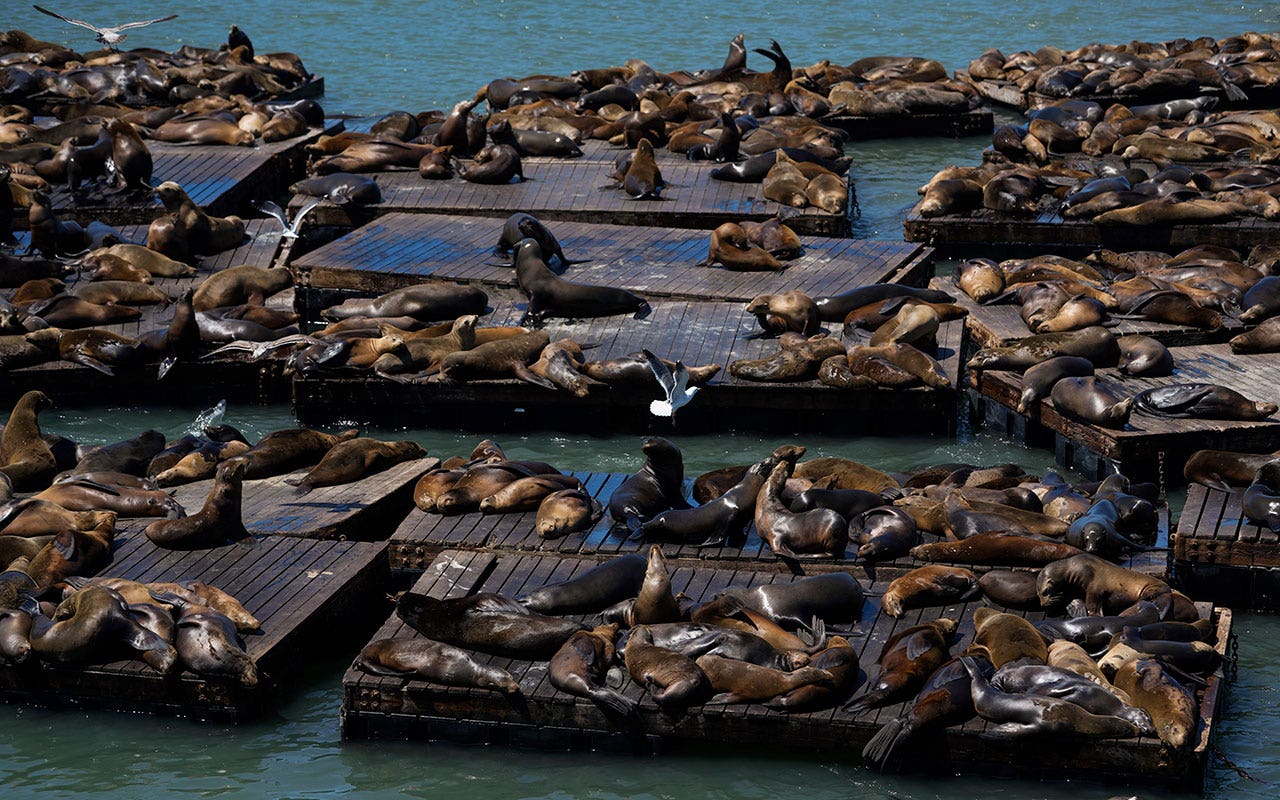
- San Francisco’s Fisherman’s Wharf district is experiencing a surge in sea lions, with more than 1,000 counted this week.
- The sea lions have remained a tourist attraction since appearing at Pier 39 after a 1989 earthquake.
- Harbormaster Sheila Chandor attributes the sea lion influx to the abundant food, suggesting they are preparing for mating season.
They’re lounging, biting each other and generally making a ruckus in numbers not seen in more than a decade. And don’t even think about stealing their anchovies.
San Francisco’s famed Fisherman’s Wharf district is seeing a surge in sea lions.
First appearing at Pier 39 after the 1989 earthquake, the sea lions have become a well known tourist attraction. The number of sea lions — marine mammals that make loud barking calls and can weight up to a half-ton — crashing at the pier fluctuates over the seasons. On most days more than a hundred can be seen.
CALIFORNIA SEA LIONS CHARGE TOWARD STARTLED BEACHGOERS, EMPTYING BUSY COVE
But this week, Pier 39 harbormaster Sheila Chandor has counted more than 1,000 sea lions, and that’s the most seen there in 15 years. A huge school of anchovies — a favored food of the pinnipeds — brought them there, Chandor said.
Sea lions are seen on rafts along Pier 39, on May 2, 2024, in San Francisco. (AP Photo/Godofredo A. Vásquez)
“It’s all about the seafood. It’s all about the food,” Chandor said. “A very good way to put it is they are fueling up for the mating season. It’s spring. They are ready to rock and roll down in the Channel Islands, and we’re a nice pit stop with some great seafood.”
The spike in sea lions is indeed only expected to be temporary. But the barges the sea lions lounge on are designed to hold significant weight, and officials admit this current surge is testing their limits.
Biologists said the number of anchovies in the bay that seems to have attracted extra sea lions this spring is especially high. Chandor said the schooling fish were off the Farallon Islands.
Meanwhile, shops and businesses in the area were hoping the sea lion surge would also result in a tourist shopping spree, attracting more visitors to the area. Sea lion lovers have been flocking to the pier to catch a glimpse of the huge, noisy herd.
“I’ve never seen that many sea lions in one place. I heard about this place, and we came here a few minutes ago, and it’s awesome to see them,” said Theresa Simbeck, a visitor from Germany. “It’s very loud, of course, but it’s really nice to see all of them. And it’s funny to watch them fight and relax in the sun.”
Big numbers of sea lions have come to their pier in past years, and some 1,700 have previously arrived, Chandor said. It’s usually 300 to 400 in winter and up to 700 in spring, Chandor said.
Read the full article from Here


NEWYou can now listen to Fox News articles!
The Supreme Court on Monday cleared the way for California schools to notify parents if their children want to change their gender identity without approval from the student amid a challenge against the Golden State’s ban on so-called forced outing of transgender students.
The court granted an emergency appeal from a conservative legal group, the Thomas More Society, blocking, at least for now, a state law that prohibited automatic parental notification requirements if students change their gender expression or pronouns at school.
The Thomas More Society praised the decision as “the most significant parental rights ruling in a generation.” Two sets of Catholic parents represented by the legal group argued that the state law, signed by Gov. Gavin Newsom in 2024, caused schools to mislead them and secretly facilitate the students’ gender transitions.
Two sets of Catholic parents argued that the state law, signed into law by Gov. Gavin Newsom in 2024, caused schools to mislead them and secretly facilitate the students’ gender transitions. (Sean Rayford/Getty Images)
But California contended that students have the right to privacy about their gender expression, particularly if they fear rejection from their families who may not support their decision to adopt a new gender identity. The state also said school policies and state law sought to balance student privacy with parental rights.
Last year, state education officials told school districts that the state’s policy “does not mandate nondisclosure.” Newsom’s office also previously said that “parents continue to have full, guaranteed access to their student’s education records as required by federal law.”
The Supreme Court sided with the parents on Monday and reinstated a lower-court order blocking the law and school policies while the case continues.
“The parents who assert a free exercise claim have sincere religious beliefs about sex and gender, and they feel a religious obligation to raise their children in accordance with those beliefs. California’s policies violate those beliefs,” the majority wrote in an unsigned order, adding that state policies also burden the free exercise of religion.
The Thomas More Society praised the decision as “the most significant parental rights ruling in a generation.” (AP Photo/Julia Demaree Nikhinson, File)
Conservative Justices Samuel Alito and Clarence Thomas also said they would have gone a step further and granted the teachers’ appeal to lift restrictions for them. The three liberal justices dissented, saying the case is still working its way through lower courts and there was no need to take action now.
“If nothing else, this Court owes it to a sovereign State to avoid throwing over its policies in a slapdash way, if the Court can provide normal procedures. And throwing over a State’s policy is what the Court does today,” Justice Elena Kagan wrote.
A federal judge ruled in December 2025 that schools cannot prevent teachers from sharing information about a student’s gender identity with their parents, but an appeals court blocked that ruling last month, leading the plaintiffs to ask the nation’s highest court to step in.
TRUMP ADMIN FINDS CALIFORNIA BAN ON NOTIFYING PARENTS OF GENDER TRANSITIONS VIOLATED FEDERAL LAW
The Supreme Court sided with the parents and reinstated a lower-court order blocking the law and school policies while the case continues. (OLIVIER DOULIERY/AFP via Getty Images)
CLICK HERE TO DOWNLOAD THE FOX NEWS APP
The high court has been weighing whether to hear arguments in cases out of other states such as Massachusetts and Florida filed by parents who say schools facilitated gender transitions without notifying them.
The U.S. Department of Education also announced last month that the California law violates federal law. The findings of the federal investigation could put at risk the nearly $8 billion in education funding the federal government gives the state each year if state officials do not work with the Trump administration to resolve the violations.
The Trump administration is also pursuing legal action against California and threatening to withhold funding over a policy allowing biological males to compete in girls’ sports.
The Associated Press contributed to this report.
Related Article

Read the full article from Here

It’s 10 a.m. sharp, and Abby Kurtz gets her first assignment of the day. She’s received a time, a location in San Francisco and a target.
Her weapon of choice: an iPhone.
“Being a social agent is really the coolest thing ever,” she said.
Kurtz is a content creator working through an app called Social Agent, part of an expanding gig economy where more and more workers are trading stability for flexibility. Work that once required connections, planning, and a big budget can now be booked with a tap —extending the on-demand model from rides and meals to storytelling itself.
Just make a request, and someone like Kurtz can arrive within 30 minutes, camera-ready.
“What I look for when I’m shooting events is very crisp and clean content,” she said.
Her mission this time took her to Sutro Nursery, a nonprofit dedicated to growing native plants and that is hoping to grow its volunteer base, too. Board member Maryann Rainey said booking a Social Agent is a lot cheaper than hiring someone to do their social media full-time.
“I know I can’t do it myself, and I was certainly hoping that these young people would know how to do a good film,” Rainey said.
A typical job runs about $200, with same-day delivery. Agents earn around $50 an hour, plus tips. And if clients already have footage, they can upload it and have it turned into a finished piece.
The service is currently available in New York, Los Angeles, and Miami, with a slower rollout now underway in other cities.
Lisa Jammal, the company’s CEO, said the idea is simple: Let someone else do the shooting.
“We all are missing those beautiful moments because we’re always behind the phone,” she said.
As for Kurtz, after the shoot, she headed straight to a nearby coffee shop, where the clock started ticking. She had just over an hour to shape her raw material into a polished final cut.
“I think I’m going to give this reel a really peaceful, calming feel, but also informative and inviting,” she said.


Meta’s AI glasses reportedly send sensitive footage to human reviewers in Kenya

Iran continues firing missiles, drones at neighboring states, with multiple interceptions reported

Paxton vows he’s ‘staying in this race’ even if Trump backs Cornyn in Texas GOP clash

Do collagen supplements really improve skin? Major review reveals the truth

Law firm fighting for women’s sports in SCOTUS battle comments on ruling possibly impacting SJSU trans lawsuit

Florida High School Football Rankings: Top 25 teams – Oct. 21

Cleary's 21 help Le Moyne down Central Connecticut State 69-64 in OT

How old is Bo Nix? What to know about Oregon quarterback ahead of 2024 NFL Draft

99th annual Pony Swim held in Virginia

Indiana Members Credit Union announced as new anchor tenant at Bottleworks District
Paxton vows he’s ‘staying in this race’ even if Trump backs Cornyn in Texas GOP clash

Which Kurdish groups is the US rallying to fight Iran?

Man accused of plot to assassinate Trump testifies Iran pressured him, says Biden and Haley were other possible targets

DHS defends McLaughlin against allegations husband’s company profited millions from ad contracts: ‘Baseless’

Fareed Zakaria’s takes on Trump and the collapse of nuclear stability
-

 World1 week ago
Exclusive: DeepSeek withholds latest AI model from US chipmakers including Nvidia, sources say
-

 Massachusetts1 week ago
Mother and daughter injured in Taunton house explosion
-

 Wisconsin3 days ago
Setting sail on iceboats across a frozen lake in Wisconsin
-

 Maryland4 days ago
AM showers Sunday in Maryland
-

 Florida4 days ago
Florida man rescued after being stuck in shoulder-deep mud for days
-

 Denver, CO1 week ago
10 acres charred, 5 injured in Thornton grass fire, evacuation orders lifted
-

 Massachusetts2 days ago
Massachusetts man awaits word from family in Iran after attacks
-

 Oregon6 days ago
2026 OSAA Oregon Wrestling State Championship Results And Brackets – FloWrestling