West
San Jose State trans volleyball player gets 250th kill of season as team faces safety and competition concerns

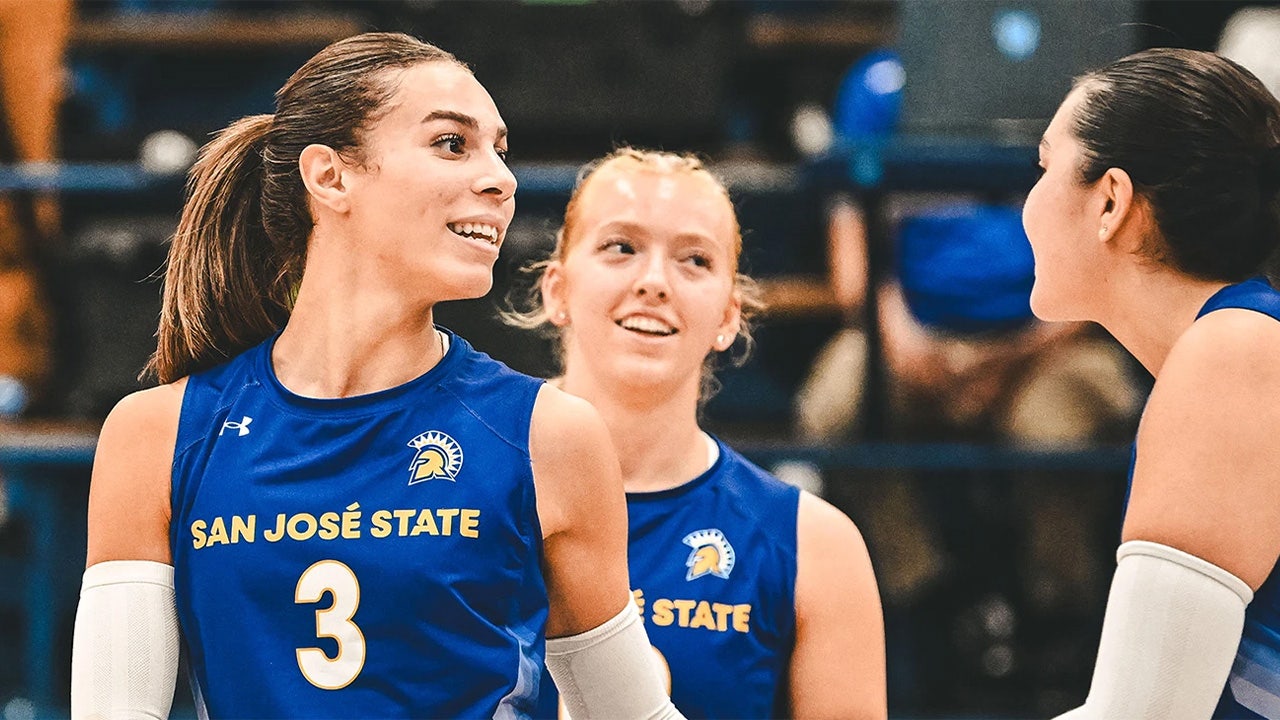
San Jose State’s women’s volleyball team lost 3-1 to San Diego State on Saturday amid an ongoing national controversy surrounding a trans athlete on the team.
Redshirt senior Blaire Fleming led the game in kills with 15, raising an individual season total to 252. It is the second 250+ kill season of Fleming’s career. Fleming previously recorded a staggering 311 kills in a debut season at San Jose State in 2022, after transferring from Coastal Carolina.
Fleming went into Saturday’s game with the third-best kills-per-serve percentage in the entire Mountain West conference with 3.76, but still well behind the conference’s leader in Colorado State’s Malaya Jones.
Fleming has racked up these numbers despite the fact that a total of seven of San Jose State’s matches have been forfeited amid the ongoing controversy. And yet, anchored by Fleming’s production, the entire team is third in the conference in kills-per-serve average and first in hitting percentage across the Mountain West.
But it is Fleming’s teammate Brooke Slusser who is anchoring the team’s top hitting percentage ranking. Slusser leads the team and is currently fourth in the entire conference with a .377 hitting percentage.
Slusser is also currently engaged in a lawsuit against the NCAA over Fleming’s presence on the team. Slusser has alleged that the university hid Fleming’s biological sex from her and teammates over the last two years since their arrival at San Jose State. Slusser also alleges that Fleming’s spikes traveled at 80 miles per hour during practice.
“Brooke estimates that Fleming’s spikes were traveling upward of 80 mph, which was faster than she had ever seen a woman hit a volleyball,” Slusser’s complaint read. “The girls were doing everything they could to dodge Fleming’s spikes but still could not fully protect themselves.”
Fleming previously set a single-game record at John Champe High School with 30 kills in a match and a single-season record of 266 kills for the school’s girls’ volleyball team.
Footage from the athlete’s Hudl page of the school-record 30-kill match in September 2019 shows how hard and fast Fleming’s spikes came down at the high school level against girl opponents.
President Trump even went out of his way to comment about footage of one of Fleming’s plays in which the player spiked a ball at San Diego State player Keira Herron in a match earlier this season.
“I saw the slam, it was a slam. I never saw a ball hit so hard,” Trump said during a Fox News town hall. “But other people, even in volleyball, they’ve been permanently — I mean, they’ve been really hurt badly. Women playing men.”
In another match against New Mexico on October 18, one of Fleming’s spikes knocked an opposing player to the ground.
The National Collegiate Athletics Association (NCAA) requires transgender women to submit documentation including testosterone levels before a decision is made on their eligibility to play. San José State has said the program is in full compliance with NCAA rules, in a statement to Fox News Digital.
Still, Fleming’s participation has brought about questions over legality at the state level and whether female athletes should share the same court and locker rooms.
Five programs have already forfeited their games against San Jose State this season, with Southern Utah, Boise State, Utah State, Wyoming and Nevada all declining to face the Spartans. Boise State and Wyoming forfeited two matches each, taking multiple loss to avoid competition against Fleming.
Questions have arisen over the potential conflict that could erupt when San Jose State competes in the Mountain West tournament at the end of November. It’s possible the Spartans would get paired up to play a team that has already forfeited against them in the regular season in that tournament.
INSIDE SAN JOSE STATE’S POLICE BATTLE TO PROTECT WOMEN’S ATHLETES THREATENED BY A TRANSGENDER CULTURE WAR
Slusser told Fox News Digital in an exclusive interview that she and her teammates are in limbo about what a potential postseason run might look like as they navigate a demoralized locker room.
“We’re just mostly wondering, are teams even gonna play us, period if we go there? Because of just everything that’s happened this season,” Slusser said. “It seems like every few days it looks like It’ll be a fine day and everything’s normal and then something else happens. So I truly do think everyone’s just kind of taking things day by day and taking the punches as they come.”
Slusser and her teammates are reeling from the recent suspension of assistant coach Melissa Batie-Smoose, who was put on leave after it was revealed she filed a Title IX complaint against the school. Batie-Smoose’s complaint alleged favoritism by the university toward Fleming over Slusser throughout the controversy.
“I feel like not just me but a lot of people are just kind of fed up and over the whole situation. And so I do think it’s caused tension in the locker room and on the court just because one person is causing all these issues,” Slusser said.
Colorado State University police behind the San Jose State University Spartans bench monitor Moby Arena during an NCAA Mountain West women’s volleyball game between the Spartans and the Colorado State Rams in Fort Collins, Colo., on Thursday, Oct. 03, 2024. (Santiago Mejia/San Francisco Chronicle via Getty Images)
The dismissal of Batie-Smoose has been a particularly jarring development for the players, as Slusser claims that she and her teammates now feel unsafe.
“After we found out that she was released, a lot of the team just kind of broke down and was kind of freaking out, and even one of my teammates was like, ‘I don’t feel safe anymore,’ because there’s no one now that we feel like we can go and talk to about our concerns or our actual feelings and can actually speak freely in front of,” Slusser said.
Slusser says she does not feel safe speaking with anyone else involved in the program, not even head coach Todd Kress.
“You can’t truly voice how you’re feeling without them just trying to cover it up or act like it’s all OK. With Melissa, you could voice how you felt, and she could comfort you and validate your feelings and at least make you feel heard compared to the other coaches,” Slusser said.
Slusser says she has not spoken with Fleming at all since joining the lawsuit. When reflecting on interactions with Fleming prior to knowing the player’s natural birth gender, Slusser admits she regrets “opening up” with the trans player in ways that she wouldn’t have had she known Fleming was a biological male.
Still, when the two players took the court on Saturday, as they have all season, they played as normal teammates would. They walked into the huddle together and patted each other on the back in between plays.
On multiple occasions in recent games, Slusser has even set Fleming up for one of Fleming’s signature spikes.
With their previously-scheduled games against Wyoming and Boise State now canceled, San Jose State only has two matches left. With a 13-4 record, Slusser and Fleming will play against Colorado State and Fresno State at home in their final two matches of the regular season.
Then their fate will rest in the Mountain West Tournament.
Follow Fox News Digital’s sports coverage on X and subscribe to the Fox News Sports Huddle newsletter.
Read the full article from Here

Continue Reading

More than 10,000 people have enrolled in Nevada’s new public option health plans, which debuted last fall with the expectation that they would bring lower prices to the health insurance market.
Those preliminary numbers from the open enrollment period that ended in January are less than a third of what state officials had projected. Nevada is the third state so far to launch a public option plan, along with Colorado and Washington state. The idea is to offer lower-cost plans to consumers to expand health care access.
But researchers said plans like these are unlikely to fill the gaps left by sweeping federal changes, including the expiration of enhanced subsidies for plans bought on Affordable Care Act marketplaces.
The public option gained attention in the late 2000s when Congress considered but ultimately rejected creating a health plan funded and run by the government that would compete with private carriers in the market. The programs in Washington state, Colorado, and Nevada don’t go that far — they aren’t government-run but are private-public partnerships that compete with private insurance.
In recent years, states have considered creating public option plans to make health coverage more affordable and to reduce the number of uninsured people. Washington was the first state to launch a program, in 2021, and Colorado followed in 2023.
Washington and Colorado’s programs have run into challenges, including a lack of participation from clinicians, hospitals, and other care providers, as well as insurers’ inability to meet rate reduction benchmarks or lower premiums compared with other plans offered on the market.
Nevada law requires that the carriers of the public option plans — Battle Born State Plans, named after a state motto — lower premium costs compared with a benchmark “silver” plan in the marketplace by 15% over the next four years.
But that amount might not make much difference to consumers with rising premium payments from the loss of the ACA’s enhanced tax credits, said Keith Mueller, director of the Rural Policy Research Institute.
“That’s not a lot of money,” Mueller said.
Three of the eight insurers on the state’s exchange, Nevada Health Link, offered the state plans during the open enrollment period.
Insurance companies plan to meet the lower premium cost requirement in Nevada by cutting broker fees and commissions, which prompted opposition from insurance brokers in the state. In response, Nevada marketplace officials told state lawmakers in January that they will give a flat-fee reimbursement to brokers.
The public option has faced opposition among state leaders. In 2024, a state judge dismissed a lawsuit, brought by a Nevada state senator and a group that advocates for lower taxes, that challenged the public option law as unconstitutional. They have appealed to the state Supreme Court.
Federal Policy Impacts
Recent federal changes create more obstacles.
Nevada is consistently among the states with the largest populations of people who do not have health insurance coverage. Last year, nearly 95,000 people in the state received the enhanced ACA tax credits, averaging $465 in savings per month, according to KFF, a health information nonprofit that includes KFF Health News.
But the enhanced tax credits expired at the end of the year, and it appears unlikely that lawmakers will bring them back. Nationwide ACA enrollment has decreased by more than 1 million people so far this year, down from record-high enrollment of 24 million last year.
About 4 million people are expected to lose health coverage from the expiration of the tax credits, according to the Congressional Budget Office. An additional 3 million are projected to lose coverage because of other policy changes affecting the marketplace.
Justin Giovannelli, an associate research professor at the Center on Health Insurance Reforms at Georgetown University, said the changes to the ACA in the Republicans’ One Big Beautiful Bill Act, which President Donald Trump signed into law last summer, will make it more difficult for people to keep their coverage. These changes include more frequent enrollment paperwork to verify income and other personal information, a shortened enrollment window, and an end to automatic reenrollment.
In Nevada, the changes would amount to an estimated 100,000 people losing coverage, according to KFF.
“All of that makes getting coverage on Nevada Health Link harder and more expensive than it would be otherwise,” Giovannelli said.
State officials projected ahead of open enrollment that about 35,000 people would purchase the public option plans. Of the 104,000 people who had purchased a plan on the state marketplace as of mid-January, 10,762 had enrolled in one of the public option plans, according to Nevada Health Link.
Katie Charleson, communications officer for the state health exchange, said the original enrollment estimate was based on market conditions before the recent increases in customers’ premium costs. She said that the public option plans gave people facing higher costs more choices.
“We expect enrollment in Battle Born State Plans to grow over time as awareness increases and as Nevadans continue seeking quality coverage options that help reduce costs,” Charleson said.
According to KFF, nationally the enhanced subsidies saved enrollees an average of $705 annually in 2024, and enrollees would save an estimated $1,016 in premium payments on average in 2026 if the subsidies were still in place. Without the subsidies, people enrolled in the ACA marketplace could be seeing their premium costs more than double.
Insights From Washington and Colorado
Washington and Colorado are not planning to alter their programs due to the expiration of the tax credits, according to government officials in those states.
Other states that had recently considered creating public options have backtracked. Minnesota officials put off approving a public option in 2024, citing funding concerns. Proposals to create public options in Maine and New Mexico also sputtered.
Washington initially saw meager enrollment in its Cascade Select public option plans; only 1% of state marketplace enrollees chose a public option plan in 2021. But that changed after lawmakers required hospitals to contract with at least one public option plan by 2023. Last year the state reported that 94,000 customers enrolled, accounting for 30% of all customers on the state marketplace. The public option plans were the lowest-premium silver plans in 31 of Washington’s 39 counties in 2024.
A 2025 study found that since Colorado implemented its public option, called the Colorado Option, coverage through the ACA marketplace has become more affordable for enrollees who received subsidies but more expensive for enrollees who did not.
Colorado requires all insurers offering coverage through its marketplace to include a public option that follows state guidelines. The state set premium reduction targets of 5% a year for three years beginning in 2023. Starting this year, premium costs are not allowed to outpace medical inflation.
Though the insurers offering the public option did not meet the premium reduction targets, enrollment in the Colorado Option has increased every year it has been available. Last year, the state saw record enrollment in its marketplace, with 47% of customers purchasing a public option plan.
Giovannelli said states are continuing to try to make health insurance more affordable and accessible, even if federal changes reduce the impact of those efforts.
“States are reacting and trying to continue to do right by their residents,” Giovannelli said, “but you can’t plug all those gaps.”
Are you struggling to afford your health insurance? Have you decided to forgo coverage? Click here to contact KFF Health News and share your story.
KFF Health News is a national newsroom that produces in-depth journalism about health issues and is one of the core operating programs at KFF — an independent source of health policy research, polling, and journalism. Learn more about KFF.
New Mexico
New Mexico veteran cemetery coming to Carlsbad via $8M in federal funds – Carlsbad Current-Argus

Adrian Hedden Carlsbad Current-Argusachedden@currentargus.com Mack Dyer served for 21 years in the U.S. Army. He fought in Operation Desert Storm in 1991 and Operation Iraqi…

Legislators are bypassing a straightforward solution that would help ski resorts and other recreational providers stave off lawsuits claiming minor negligence and instead are overcomplicating the picture, the editorial board writes. Lawmakers should follow the example of other states rather than create its own path.

Nevada6 minutes ago
Nevada debuts public option amid federal health care shifts

New Hampshire12 minutes ago
Former president of NH-based charity sentenced after stealing $350K

New Jersey18 minutes ago
Natural Daylight Time: What is it, and why New Jersey should adapt this practice instead

New Mexico24 minutes ago
New Mexico veteran cemetery coming to Carlsbad via $8M in federal funds – Carlsbad Current-Argus

North Carolina30 minutes ago
How to buy tickets for Duke basketball vs NC State in ACC contest

Florida1 year ago
Florida High School Football Rankings: Top 25 teams – Oct. 21

Connecticut2 years ago
Cleary's 21 help Le Moyne down Central Connecticut State 69-64 in OT

Oregon2 years ago
How old is Bo Nix? What to know about Oregon quarterback ahead of 2024 NFL Draft

Virginia2 years ago
99th annual Pony Swim held in Virginia

Indiana1 year ago
Indiana Members Credit Union announced as new anchor tenant at Bottleworks District

News3 hours ago
Video: What the Texas Primary Battle Means for the Midterms

Politics4 hours ago
Dems’ potential 2028 hopefuls come out against US strikes on Iran

World5 hours ago
At least nine killed after Iranian strike on Israel’s Beit Shemesh

News6 hours ago
Mass shooting at Austin, Texas bar leaves at least 3 dead, 14 wounded, authorities say

Politics16 hours ago
Mamdani’s response to Trump’s Iran strike sparks conservative backlash: ‘Rooting for the ayatollah’
-

 World4 days ago
Exclusive: DeepSeek withholds latest AI model from US chipmakers including Nvidia, sources say
-

 Massachusetts4 days ago
Mother and daughter injured in Taunton house explosion
-

 Montana1 week ago
2026 MHSA Montana Wrestling State Championship Brackets And Results – FloWrestling
-

 Denver, CO4 days ago
10 acres charred, 5 injured in Thornton grass fire, evacuation orders lifted
-

 Louisiana7 days ago
Wildfire near Gum Swamp Road in Livingston Parish now under control; more than 200 acres burned
-

 Technology1 week ago
YouTube TV billing scam emails are hitting inboxes
-

 Technology1 week ago
Stellantis is in a crisis of its own making
-

 Politics1 week ago
OpenAI didn’t contact police despite employees flagging mass shooter’s concerning chatbot interactions: REPORT