Business
Grindr targeted nascent union with return-to-office ultimatum, labor board alleges


When the LGBTQ+ dating app Grindr told its staff last year that the days of fully remote work were over, more than 80 employees — nearly half off the company — said they wouldn’t report to the company’s West Hollywood headquarters or other newly established offices around the country. As a result, they were let go.
Now, federal labor regulators say the company’s back-to-office order was an unlawful ploy to retaliate against the workers’ union organizing efforts.
In a recent complaint, the National Labor Relations Board’s regional office in Los Angeles accused Grindr of interfering with employees’ right to organize and refusing to recognize the union workers had elected to join, calling the company’s actions “serious and substantial unfair labor practice conduct.”
About the 120 of the company’s roughly 180 employees were poised to form a union bargaining unit represented by Communications Workers of America, according the complaint. All 80 of the terminated employees were part of that group.
The popular app, which uses a location-based model that allows users to browse potential dates in their area, has gone through several ownership changes in recent years, but has continued to post solid profits from a dedicated user base in the tens of millions.
“We hope this NLRB filing sends a clear message to Grindr that, with a union, we are committed to negotiating fair working conditions in good faith,” the union, Grindr United-CWA, said in a statement Monday.
Grindr called the allegations “meritless,” arguing it had alerted employees it would do away with its remote work culture before they went public with their union drive.
“Grindr team members work from one of our offices just two days per week under our hybrid work model, and our decision to transition from fully remote to hybrid work in 2023 predated the union election petition. It was only after it was known that the transition back to in-office work was underway that some employees began signing union cards,” Grindr spokesperson Emily Wright said in statement. “Our focus continues to be on ensuring Grindr remains an exceptional place for our team to work, and an invaluable resource for the global LGBTQ+ community.”
The complaint is the NLRB’s first step in litigating the case after investigating an unfair labor practice claim submitted by employees and finding merit to the allegations. If a settlement with Grindr is not reached, the case will be reviewed by an administrative law judge, who could order the company to take steps to address the issues in the complaint.
In interviews, two former employees said employees began the union effort in late 2022. They pointed to employees who they said had been laid off without clear reasons and unsettling remarks by their then-incoming chief executive George Arison in support of conservative figures who had made bigoted remarks about transgender people.
Workers went public with their campaign to join CWA in July 2023, and two weeks later the company delivered its return-to-office policy in an all-hands meeting conducted on a Zoom video call on Aug. 3, according to the NLRB complaint. Under the new rules, workers who had been living elsewhere were required to move to either the Los Angeles area, Chicago or San Francisco in order to be close to the Grindr office where their job was based. The company offered up to $15,000 to cover relocation expenses, or six months of severance pay for those who chose not to move.
One of the former employees, who asked not to be identified for fear of reprisals as he continues to search for a new job, said that although his contract designated him as having a remote assignment, he was nonetheless included in the back-to-office mandate.
The employee, who was a member of Grindr’s customer experience team, said the company was slow to provide information about the terms of the back-to-office order and that he was forced to decide in less than a day whether to agree to move. He and many others ultimately signed a severance agreement because they were unable to decide so quickly whether to uproot their lives, he said.
The second former employee, Leo Feldman, said he was not given an opportunity to commit to the hybrid work plan and alleges his involvement with the union was behind the decision to fire him from his job as product manager.
The company’s actions seemed intended to disrupt the union drive, he said, noting that some engineers living near the West Hollywood office, for example, were told they had to move to Chicago.
Despite the turmoil, Grindr appears to have satisfied investors with strong growth even as the broader dating app industry has slowed.
As one of three publicly traded dating app companies, Grindr dominates the dating app market along with Bumble and Match Group, which owns Tinder and Hinge. Bumble has seen its stock fall 46% so far this year after missing revenue estimates, but Grindr shares have risen nearly 70% this year, closing at $15.10 on Monday.
The company recently reported $89 million in revenue in the third quarter, up 27% from the same period last year. Net income during the same period grew to $25 million, compared to a loss of $437,000 a year ago. Grindr also saw a 15% year-over-year increase in the number of average paying users, reaching 1.1 million.
“Our product work starts with our users, their needs, their behaviors and their preferences,” Arison said in a recent earnings call. “We are setting Grindr up for another great year of growth in 2025.”
The company, however, continues to face criticism about its privacy practices: earlier this year, it was sued by hundreds of users in the United Kingdom for allegedly sharing personal information — including HIV status and test dates, ethnicity and sexual orientation — with advertising companies without users’ consent. Grindr has denied the claims.
Nick Jones, an equity research analyst at Citizens JMP, said Grindr is outpacing investor expectations and is not alone in requiring employees to return to in-person work.
“A lot of companies believe they can keep their employees more focused if they’re in office,” Jones said. “The market is indicating that this is not a problem for the company,” he added of the NLRB complaint.
Grindr Chief Product Officer AJ Balance said the app has set itself apart from others in the crowded online dating market and is working on new features.
Grindr’s unique user interface known as the grid allows for quick and abundant connections and avoids the swiping model that some users have grown tired of, he said.
“This was built by the community, for the community, which is part of why it really meets the needs of its users in a unique way and why it’s been differentiated as a product over time,” Balance said.


Walmart is rapidly expanding its network of electric vehicle chargers designed for customers to use while they shop.
The network could help fill gaps in EV infrastructure in states with greater need for chargers. Walmart, which has more than 5,000 locations in the U.S. and hundreds in California, says more than 90% of Americans live within 10 miles of one of its stores.
The chargers also offer an incentive for customers to choose Walmart — Walmart Plus members will receive a 10% discount off an average price of $0.46 per kilowatt-hour of energy at the company’s chargers.
Walmart chargers are already available at more than 75 locations in 17 states, with Texas boasting the most charging stations, followed by Florida and Arizona.
Matthew Nelson, Walmart’s director of energy policy, said last week on LinkedIn that the network will soon reach 29 states, including California.
“We are delivering on the promise of affordable, reliable and convenient charging,” Nelson said in his post.
According to Walmart’s website, six charging stations are coming to California soon, though the company did not offer a specific timeline.
The chargers will be installed at stores in Antelope, Brea, Fresno, Stockton, Suisun City and Vallejo.
Most charging sites in California will include eight to 16 fast-charging stalls, said Walmart spokesperson Kelsey Bohl.
The company first announced plans in April 2023 to install its own EV chargers at Walmart and Sam’s Club stores, with a goal of installing thousands of chargers by 2030. Partnering with ABB E-Mobility and Alpitronic, it added 25 new charging sites this past May and six more in June.
“Walmart is building a leading retail-integrated EV fast-charging network, focused on delivering an affordable, reliable and convenient charging experience where customers already shop,” Bohl said in an emailed statement. “Customers can charge while they shop, access stations through the Walmart app they already use, and benefit from affordable pricing.”
The charging stations already available include 612 individual charging stalls using 400-kilowatt chargers. Each stall has a dual charging cord with both Combined Charging System and North American Charging Standard connectors. The standard connectors, designed by Tesla, are smaller and lighter than the combined systems.
The primary way to pay for the chargers is through the Walmart app, but the company is also experimenting with built-in credit card readers to allow those without the app to use the stations.
Customers can check charger availability on the Walmart app. The company said the chargers will be available 24 hours a day.

Robotaxis could be turning into robocops.
A self-driving Waymo reported two teens to San Mateo, Calif., police on Monday after they were found drinking alcohol and shooting toy guns in the back of the vehicle.
According to a social media post from the San Mateo Police Department, officers detained two 15-year-olds after the Waymo they were riding in contacted the department and stopped in a parking lot until law enforcement arrived.
“Parents do you know where your teens are?” the San Mateo Police Department wrote on Facebook following the incident. “Waymo does!”
Officers removed both teens from the vehicle and determined they were using toy guns to shoot Orbeez out the windows. Orbeez are small, water-absorbing beads sold at toy stores.
“Toy guns, water guns, and BB guns all pose real dangers, especially to an untrained eye,” the Police Department said. “The simple handling of them can cause fear in [passersby].” “
A video posted on Facebook shows at least five officers and a police dog responding to the scene and approaching the Waymo with their weapons raised.
Waymo did not immediately respond to a request for comment.
Waymo vehicles have internal cameras and microphones that may be used in an emergency or to “promote safety and security,” according to Waymo’s online support page.
The cameras are also used to ensure the vehicles are clean and to help find lost items, according to the support page.
The company said it does not use facial recognition or other biometric identification technologies to identify individuals.
“In more urgent circumstances, support may access live video during a trip,” the Waymo page said.
The San Mateo Police Department’s Facebook post has garnered nearly 60 comments, with one user accusing Waymo of “snitching.”
“At least they got a designated driver?!” one user commented.
Business
Commentary: How right-wing anti-transgender attacks led to a Supreme Court ruling upholding sex discrimination
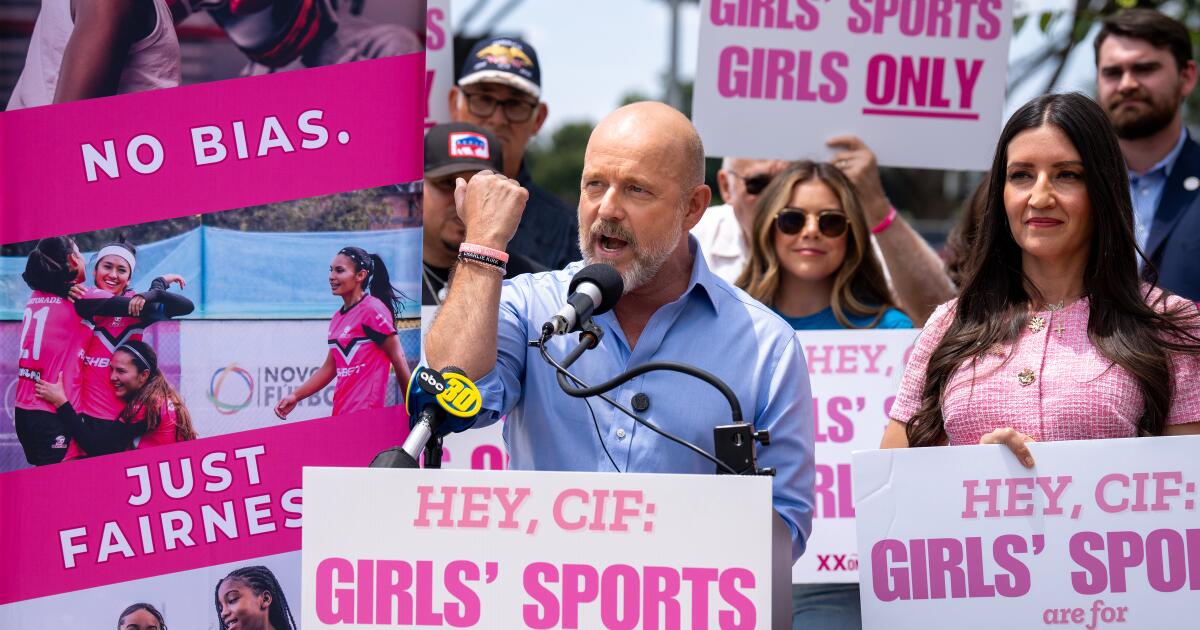
At the Supreme Court, the unfounded fear of boys masquerading as girls in youth sports rolled the clock back on gender equality.
On the surface, the Supreme Court’s June 30 opinion upholding state laws barring transgender girls from women’s and girl’s sports teams looks like a victory for women’s rights.
The 6-3 opinion by Justice Brett M. Kavanaugh certainly presents itself that way. “Females and males have inherent physical differences relevant to athletic performance,” Kavanaugh wrote. “Therefore, in contact sports, forcing female athletes to compete against males can create significant safety risks.” He also asserted that “forcing female athletes to compete against males can undermine competitive fairness.”
The ruling applied to prohibitions enacted in Idaho and West Virginia against “biological” males’ participation on women’s teams in public schools. Federal judges in both states overturned the bans. The Supreme Court majority restored them. The ruling essentially upholds similar bans enacted in 25 other states.
There was no record of any transgender person participating in school sports in the State, let alone any ‘problem’ with transgender students … creating unfair competition or unsafe conditions.
— Justice Sonia Sotomayor, demolishing the Supreme Court’s argument in favor of banning transgender girls from girl’s sports
Kavanaugh, like Donald Trump and others in the anti-transgender camp, maintained that one’s gender is an immutable fact of life, established even before birth.
Anything else, Trump stated in an executive order he issued on inauguration day 2025, could only be the product of “gender ideology extremism.” The U.S., his order stated, recognizes “two sexes, male and female. These sexes are not changeable and are grounded in fundamental and incontrovertible reality.” That’s a “biological truth,” he declared.
In his own version of this overconfident and factually insupportable conclusion, Kavanaugh wrote: “As all agree, females and males have inherent physical differences relevant to athletic performance.”
Science recognizes that some people are “born with sex traits that don’t fit into typical male or female patterns,” to cite a discussion on the Cleveland Clinic web page on the topic “intersex.” The condition “may involve chromosomes, hormones, reproductive organs or genitals.”
From a psychological standpoint, medical science recognizes “gender dysphoria” as a real condition often requiring counseling and medical intervention such as the use of puberty blockers and hormones to stave off the development of secondary sex characteristics until the condition can be resolved.
No one disputes that there are physical differences between the sexes. Few would dispute that on average or even at the median, males may be bigger and more powerful than females, or that in certain contact sports the difference may be telling and on occasion dangerous.
But that’s not the same as asserting that the physical differences between males and females invariably mean that men will invariably prevail over women in all competitions or that their participation will endanger women.
The International Olympic Committee — in a policy statement Kavanaugh cited incompletely — says that in “most running and swimming events,” males have a 10% to 12% advantage over women. That’s a range that would accommodate the full spectrum of outcomes — transgender females win, cisfemales win, they tie. (The “cis” prefix denotes those living consistent with their birth gender.)
West Virginia and Idaho addressed this ambiguity by banning transgender women from all girls’ teams. So under their rules transgender girls can’t play football or soccer with cisgirls. But what’s the argument in favor of banning them from the 100-yard dash, or cross-country track, or diving, or archery?
But something else is going on here. The Supreme Court’s ruling was almost preordained, given the years-long campaign by conservatives to demonize transgender individuals as if they’re members of an alien species.
It will be recalled that during his presidential campaign, Trump spun a despicable fantasy in which children were kidnapped in school and secretly subjected to sex-change operations.
Trump’s executive order wiped out policies aimed at protecting transgender adults from discrimination. He moved to outlaw gender-affirming medical therapies for anyone under 19 by cutting off federal funding for healthcare institutions that provide such care.
He banned transgender individuals from serving in the military and ordered federal prison officials to move transgender inmates into the general populations consistent with their birth genders, which exposes them to physical assault. (Federal Judge Royce Lamberth of Washington, D.C., has blocked the government from transferring three transgender women into the male prison population or terminating their hormone treatments.)
I wrote during Trump’s first term, when his anti-transgender policies were still gestating, that the goal was to show that “one can target any community, as long as it doesn’t have a strong political voice or political power. These are the actions of bullies and cowards, pretending to be strong.”
Last year, the Supreme Court struck its first blow against transgender rights by upholding a Tennessee law banning transgender care, including puberty blockers and hormone therapy, for minors. Similar laws have been enacted in 25 other states. The majority in that ruling by Chief Justice John G. Roberts Jr. was identical to the one in the June 30 ruling — Roberts, Kavanaugh, and Justices Clarence Thomas, Samuel A. Alito Jr., Neil M. Gorsuch and Amy Coney Barrett.
Who are the targets of this ideological campaign? They number only about 1.6 million U.S. adults, or one-half of 1% of the U.S. population. About 300,000 adolescents ages 13 to 17, or 1.4%, identify as transgender, according to a study by UCLA School of Law.
In West Virginia, as Justice Sonia Sotomayor observed in her dissenting opinion, “there was no record of any transgender person participating in school sports in the State, let along any ‘problem’ with transgender students … creating unfair competition or unsafe conditions.”
In endorsing the flat bans directed at transgender women in Idaho and West Virginia, Kavanaugh argued that any attempt to implement case-by-case judgments of students’ requests to join sports teams inconsistent with their biological gender would create “an enormous practical and administrability problem.”
Is that so? That wasn’t the case in Maine, where the annual K-12 population is more than 170,000. There, a committee was charged with determining whether a student’s participation in a sport consistent with their gender identity but inconsistent with their biological sex would “result in an unfair athletic advantage” or present a risk of injury to others. The committee held 56 hearings from 2013 through 2021, or an average of seven per year. During the entire time span, only four involved transgender girls. (The outcome of those hearings couldn’t be learned.)
It was Maine’s policy, one might recall, that provoked a confrontation between Trump and Maine Gov. Janet Mills at the White House last year, when Trump threatened to withhold federal funding from the state unless it barred transgender students from competing on women’s sports teams. “We’ll see you in court,” Mills snapped.
Whether the Idaho and West Virginia laws genuinely protect girls from unfair competition is questionable. (The Idaho law is styled the “Fairness in Women’s Sports Act.”) In practice, the laws may subject women in public schools to “invasive sex verification procedures,” as educational expert George Theoharis of Syracuse University wrote after the court ruling.
They’re also based on a retrograde view of women as fragile creatures needing men’s protection, Theoharis wrote — “the same logic that has historically been used to justify excluding women from making their own healthcare decisions and girls from rigorous math and science; that physically demanding work is simply beyond them.” (There don’t appear to be any state laws barring transgender women from competing in men’s sports.)
Becky Pepper-Jackson, the plaintiff in the West Virginia case, in which she is identified only as B.P.J., is the only transgender girl who sought to join girl’s teams — track and cross-country — in the state. That was in 2021, just after West Virginia passed its law and she was about to enter sixth grade. She didn’t appear to pose any competitive risk to others on the track and cross-country teams she applied to join — her lawyers told the Supreme Court that on those no-cut teams, she “came in near the back.”
Anyway, she had not gone through male puberty, which theoretically might have endowed her with a competitive advantage, because she had been taking puberty blockers and female hormones.
Thanks to the court’s ruling, Sotomayor observed in a dissent joined by Justices Elena Kagan and Ketanji Brown Jackson, West Virginia can deny Becky access to school sports “because it thinks they have an inherent athletic advantage, even if the facts show that they do not.”
B.P.J., Sotomayor wrote, “cannot practice on girls’ teams, even if she would not take anyone’s spot in an eventual competition, even if everyone who tries out for the team makes it, and even if having the chance to participate could aid immensely in treating B. P. J.’s gender dysphoria.”
So whose interest was really protected by the Supreme Court?
-

 Kentucky10 minutes ago
Kentuckians deserve honesty about McConnell’s health | Letters
-

 Louisiana13 minutes ago
Leadership Louisiana Health Fellows Welcomes Inaugural Class – Leaders for a Better Louisiana
-

 Maine18 minutes ago
A hard lesson for Democrats in Maine. Plus, we have some news about Ed Markey. – The Boston Globe
-

 Maryland25 minutes ago
Governor Moore Announces Awardees for $1.23 Million Investment to Help Maryland Workers Thrive in a Changing Economy
-

 Michigan28 minutes ago
‘Big Brother’ season 28 to premiere this week. One guest from Michigan
-

 Massachusetts28 minutes ago
Cool off this summer at these 10 splash pads in central Massachusetts
-

 Minnesota40 minutes ago
EF2 tornado injures two, damages homes near Detroit Lakes, Minnesota
-

 Mississippi43 minutes ago
Mississippi’s first Dutch Bros now open in Pearl

