
The apparently illegal demolition of two of San Francisco’s few remaining earthquake shacks has been stopped by city building inspectors, but not before they had been reduced to the roofs and some framing.
San Francisco, CA
‘Worst fears’: Historic S.F. earthquake shacks destroyed without permits, neighbors say


The roofs and frames are all that remain of a pair of 1906 earthquake refugee shacks at 369 Valley St. in Noe Valley after the rest of the structures was demolished last week. The shacks were joined to form one cottage.
The historic structures, at 369 Valley St. on a steep block of Noe Valley, have been at the root of preservationist and neighborhood fights against a residential developer for more than 10 years. According to neighbors, a building permit had been issued that required preservation of the two shacks, which were joined to form one cottage, while a single-family home behind the two shacks was approved for demolition and reconstruction. But that permit allowed only for the shacks to be lifted and moved forward on the lot, not the near-total demolition that happened before the project was red-tagged late last week.
Neighborhood preservationists who are organized enough to have a website called savetheshack.net are demanding that the shacks be reassembled using as much of the historic debris that was left on-site in the demolition as possible.
Article continues below this ad
“After a 10-year struggle to preserve the cottages, we now see that our worst fears may be coming true, that the cottages may be destroyed,” said Marc Norton, a retired hotel worker who has lived across the fence from the shacks since 1984. “We always feared that the developer would destroy the cottages in the process of development and act like it was an accident. It looks like that is what happened.”
Norton said the original developer, John Schrader, who saw the project through to the permit stage, recently sold it. The new owner is not adhering to the agreed upon plan to conserve the shacks as part of the development. The violation notice posted by the Department of Building Inspection states that work is being done “that is beyond the scope of the permit.”
Make us a Preferred Source on Google to see more of us when you search.
Add Preferred Source
After the stoppage, Norton emailed Kelly Wong, enforcement officer for the planning staff, stating that “the only proper course of action is a thorough reassembly of the historic resource. Without such reassembly there is an environmental impact that cannot be mitigated.”
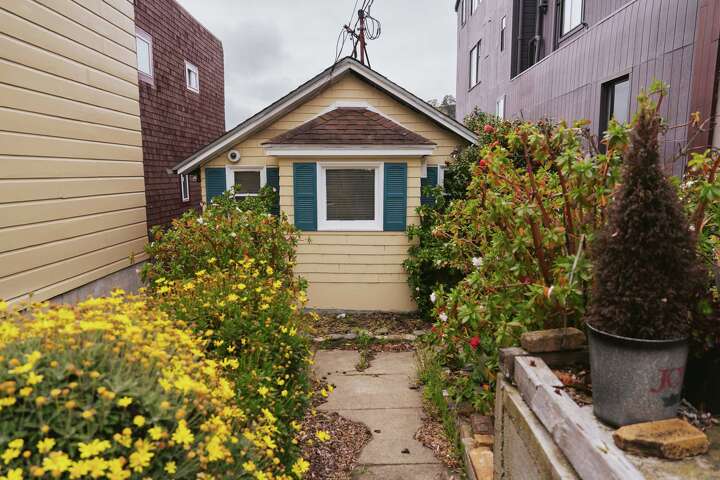
A 1906 earthquake shack in San Francisco’s Noe Valley, shown in 2023, was reduced to a roof and frame last week.
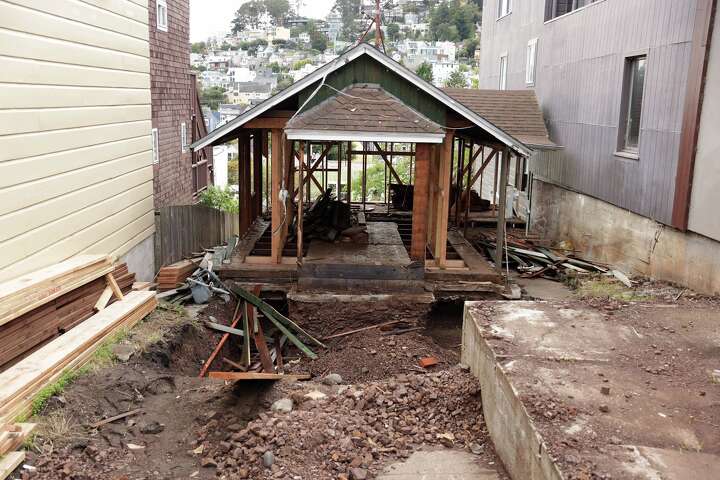
The roofs and frames are all that remain of a pair of 1906 earthquake refugee shacks at 369 Valley St. in Noe Valley after the rest of the structures was demolished last week. The shacks were joined to form one cottage.
The two shacks in question have been empty since the property sold in 2014. They are set back to the rear of the lot and pinned between taller residential buildings on both sides. The building at the back of the lot was unpermitted construction and was already demolished by the developer, Benjamin Steiner. From Norton’s property, he can see the weather vane of a rooster, though that is about all that is still standing.
Article continues below this ad
But the rubble from demolition is just as important.
“The debris is essential to any reassembly of the cottages,” Norton said. “We are demanding that the planning staff order the developer to leave everything as is, until a plan can be made to reassemble the cottages, under the supervision of a qualified preservation architect.”
On Friday, a next door neighbor sent photos to planning staff, complaining that the shacks were being destroyed. Agents from the Department of Building Inspection were sent out to stop work.
The developer, Benjamin Steiner, did not respond to requests for comment Sunday. San Francisco Supervisor Rafael Mandelman, who represents the district, also did not respond to a request for comment.
Jane Cryan, a preservationist known as the Cottage Lady, estimates there are now fewer than 20 earthquake cottages left in the city out of 5,610 built in the aftermath of the 1906 earthquake and fire. She took a census in 1983 and has been fighting for the dwindling supply, even after she was priced out of the city and living in Oshkosh, Wis.
Article continues below this ad
Cryan said the cottage at 369 Valley was made up of two shacks, one 10 by 14 feet and the other 14 by 18, and they were attached, as was the norm. Cryan, who has written two books on the shacks, said they were most likely hauled out of their original quake refugee camps in Precita Park and dragged up onto the 369 Valley by their owner, as was allowed once the camps closed in 1908. The third structure in the compound was built to mimic an earthquake shack but was not historic, and that’s why it was allowed to be demolished previously, she said.
“A whole lot of people became homeowners because of these shacks being built with the idea that people who paid $2 installments on them could take them to a lot and join two or three of them together and make a cottage out of them,” said Cryan, who lived in a cluster of three shacks in the Sunset District and was able to get them declared a city landmark. Cryan said a survey mounted in 2015 identified only 43 quake cottages in the city, with two sets in Noe Valley.
“Earhquake shacks were the greatest act of charity the world has ever known, and they’ve been mowed down by developers,” she said. “They are very endangered, and it is a terrible thing the city allowed to happen in Noe Valley.”



San Francisco, CA
Crash on freeway in Millbrae leaves driver dead after reportedly overturning multiple times, CHP says

A driver died Thursday evening after reportedly overturning multiple times and being ejected from the vehicle in Millbrae, authorities said.
The California Highway Patrol said the crash happened around 7 p.m. on southbound Highway 101 at Millbrae Avenue.
Officers said they received a report that a vehicle had overturned multiple times and that an occupant was possibly ejected.
At the scene, officers found a man, who was determined to be the driver of a white Toyota Camry, lying in the road with major injuries. He was taken to a hospital where he later died, officers said.
It was determined that a second vehicle was involved in the crash and no one was injured in the second vehicle.
The CHP said the driver of the Camry was not wearing a seatbelt.
Three lanes of southbound Highway 101 were closed for an extended period.

A jury in San Francisco returned to a packed courtroom Thursday morning to tell a judge that it was deadlocked on two counts in the case against seven pro-Palestinian protesters who shut down traffic on the Golden Gate Bridge in 2024 to denounce U.S. aid to Israel in the Israel-Hamas war.
The jury indicated that it could likely reach a decision on one of the deadlocked counts, but the other it could not. San Francisco Superior Court Judge Teresa Caffese asked the jury to resume deliberations on one of the two deadlocked counts.
“Why don’t I send you back, and then we’ll go from there,” Caffese said.
Six of the protesters who chained themselves together on vehicles on the bridge and a protester who was designated to communicate with authorities are each facing eight to nine charges of felony conspiracy and false imprisonment.
The seven defendants sat in the courtroom with anticipation for a verdict, wearing keffiyehs around their necks. Dozens of their supporters packed the courtroom to the brim.
The jury reached unanimous decisions on the rest of the counts. It did not indicate which two counts it was deadlocked on.
Supporters of the seven protesters said that a verdict on the rest of the counts is expected to be read out sometime Thursday.
San Francisco, CA
Discovery Bay driver arrested for San Francisco fatal vehicle collision | Contra Costa Herald

Killed pedestrian, struck 3 more people
By San Francisco Police Department
On May 25, 2026, at approximately 12:13 am, San Francisco Police officers responded to the area of 16th and Mission Streets regarding a vehicle collision.
Officers were advised that a collision occurred between a vehicle and a pedestrian.
Officers arrived on scene and located a pedestrian victim being treated by paramedics for life threatening injuries. Paramedics transported the victim to a local hospital.
Despite lifesaving efforts of medical staff, the victim was later declared deceased at the hospital.
A preliminary investigation revealed that a vehicle collided with a pedestrian and struck three additional victims.
The three victims were medically assessed on scene for non-life-threatening injuries.
Through the course of the investigation, officers located the suspect vehicle and detained the occupant of the vehicle.
The Traffic Collision Investigations Unit (TCIU) responded to scene and conducted their investigation.
Through the course of the investigation, TCIU investigators developed probable cause to arrest the driver identified as 57-year-old Samuel Powell of Discovery Bay on June 30, 2026.
Powell was arrested and charged for vehicular Manslaughter 192(c)(2) PC and the driver’s responsibility to exercise due care for the safety of any pedestrian within the roadway 21955(b)(3) CVC.
Although an arrest has been made, this remains an open and active investigation. Anyone with information is asked to contact the SFPD at 415-575-4444 or text a tip to TIP411 and begin the message with SFPD.
-

 Los Angeles, Ca35 minutes ago
Boy, 17, with autism accused in murder of 4-month-old girl at Claremont daycare
-

 Detroit, MI57 minutes ago
Brief rally not enough for Tigers vs Rangers as win streak ends at 3
-

 San Francisco, CA1 hour ago
Crash on freeway in Millbrae leaves driver dead after reportedly overturning multiple times, CHP says
-

 Dallas, TX1 hour ago
Paige Bueckers, Azzi Fudd do the usual in Hartford, win. This time with Dallas Wings
-

 Miami, FL1 hour ago
World Cup-inspired art exhibit transforms Miami’s Wynwood with interactive soccer experience
-

 Boston, MA1 hour ago
Stairlift brings relief to residents stuck in building with broken elevator
-

 Denver, CO1 hour ago
Free agent point guard Tyus Jones re-signs with the Denver Nuggets – Denver Stiffs
-

 Seattle, WA2 hours ago
Husky Recruit To Move From Seattle to Florida For High School Ball

