San Francisco, CA
The Best Happy Hours in San Francisco Right Now


The primary purpose of a great happy hour is to do exactly what it promises it’s going to do: make you happy. We’ve all had those days, when work was too damn frustrating or we just couldn’t shake that thing from our mind that’s been eating at us — and there’s nothing like gathering with friends over drinks and bites, or even saddling up to a bar solo, to put a smile on your face before the evening comes around. San Francisco has tons of happy hours sprinkled throughout the city, but there are some can’t-miss ones you should seek out. Whether you’re after fresh oysters and drinks on the cheap, a rooftop with a view before sunset, or even a late-night cocktail and a bite, these S.F. happy hours will fill those needs and more.
Monday-Thursday, 3-5 p.m.
This cozy, bright space with ample sidewalk seating in the Marina packs a legit happy-hour punch for an introduction to chef/co-owner Melissa Perfit’s seafood dishes. Start with the $5 cured trout deviled eggs, with the oils from the fish melding divinely with a dash of fine olive oil sinking into the canals around the filling inside of the egg white — definitely as delicious as it sounds. The grab a pair of BBQ oysters for $8, or venture into the main menu for the Velma grilled oysters with nori, yuzu and trout roe surrounded by compound butter. Cava, a French white and Portuguese rosé are all just $7, and if you come on Tuesdays, wildly fresh Miyagi oysters are $2 all day. There’s hardly a more lovely corner of the city for a glass of wine and a dozen oysters.
2095 Chestnut St
Daily, 2:30-5 p.m.
Sitting outside on the patio at Waterbar, looking out at the Bay Bridge, might just be the most scenic happy hour in the city. If you opt to stay inside, you’ll feel the same grandeur sitting at their gorgeous wraparound bar. It’s a beautiful Embarcadero destination with a $1.55 daily featured oyster special served with a hibiscus apple mignonette. The happy hour beer selection is $5, wine is $8 and cocktails are $10. Once happy hour is over, expand beyond these and try one of Beverage Director Valentina Moyà’s memorable drinks, like the Queen Bee with Barr Hill Gin, St. Germain, Lillet, chamomile, prosecco, honey and lemon.
399 The Embarcadero
Monday-Friday, 4-6 p.m.
On the far edge of Golden Gate Park, across the street from the crashing waves of Ocean Beach, Park Chalet has the most thorough happy hour menu in town. While sister restaurant Beach Chalet offers an iconic dining experience upstairs, it’s the open-air dining room and grassy patio at Park Chalet that totally rules for soaking in the sun over house-brewed beers and diverse bites. All draft beers are $4. Head brewer Marco Tapiz’s Presidio IPA and the more tropical Sea Serpent IPA are killer; meanwhile, the VFW is one of S.F.’s best long-standing locally-made light beers. Start with a half dozen oysters for $14, then move into crispy buttermilk fried calamari for $8. There’s also taco, slider and wing specials to be had in this sweeping backyard patio.
1000 Great Highway
Monday-Friday, 5-8 p.m.
Time melts away when you’re sitting down at this Castro haunt on Upper Market. Blackbird’s happy hour has been so steady for so long — plus, I just love how expansive the space is; on a random weekday, it’s spacious enough to feel like you have your own small domain within it all, no matter where you’re sitting. Proper cocktails and beers are $1 off, including a house Old Fashioned, Aperol Spritz and rotating selection of local brews on draft from Temescal, Standard Deviant, etc. Oh, and you’re more than likely gonna hear solid gold ’90s R&B on the speakers. This is simply a wonderful spot for a catch-up with a friend.
2124 Market St
Monday-Friday, 4-6 p.m.
Quickly establishing itself as one of the most versatile spaces in the city, Cavaña — which was named one of Tales of the Cocktails’s top new cocktail bars in the U.S. — recently launched their La Hora Dorada happy hour, and it crushes. The multiculturally Latin-focused bar has drink specials led by a Margarita that’s downright transportive and a game-changing Michelada Verde with tomatillo, cilantro, cucumber, pineapple, lime and Tajín. Chef Edwin Bayone III’s chicharron de pollo (fried chicken thighs with coriander crema, salsa macha and herbed cucumber) is an absolute show-stealer, while the guacamole is an easy call to start. The latest full cocktail menu feels like a trip around the world, highlighted by drinks like the Feijoa, with Cañada rum from Oaxaca, Bolivian singani, New Zealand feijoa, honeydew lime leaf apéritif, lime and egg white (yes, please). Cavaña is a great spot for an upscale happy hour before a Giants game across the street, and the late afternoon rooftop views (of the city and the ballpark!) are truly golden.
100 Channel St, 17th Floor
Monday-Friday, 4-6 p.m.
While San Francisco’s SOMA and Financial District after-work scene hasn’t completely recovered since the pandemic, there’s something incredibly commendable about how the bright and sunny, women-owned Wine Down has kept chugging along through these valleys. Owned by Sarah Garand and Jaime Hiraishi, Wine Down is committed to featuring mostly small-production California wines from women, LGBTQ+ and BIPOC winemakers. Happy hour has $5 off carafes of wine and $9 pours of intriguing selections like Terah’s Orange Falanghina. Meanwhile, $7 drafts from local breweries like Harmonic, Laughing Monk and Fieldwork pair nicely with mushroom empanadas or charcuterie plates featuring local cheeses. This is a top-notch wine bar (and more) that even has a monthly wine club showcasing favorite bottles.
685 Folsom St
Tuesday-Friday, 3-5 p.m.
Noe Valley’s Billingsgate is probably the only full-service fish market in town that sports a happy hour. On a charming stretch of 24th Street, you can get half off cava and fresh oysters — like briny shigoku and St. Simon — from one of the best seafood counters in town. If Billingsgate’s oysters might hit a little different, it’s because the fishmonger is part of local seafood purveyor Four Star Seafood, which provides fish to restaurants and markets all over the Bay Area. There’s a half dozen two-top tables inside by the fish counter and two coveted sidewalk tables outside. The menu also features poke with your choice of fish, along with cioppino, seafood salads and other delights. When you’re done with happy hour, definitely look to take home fresh fish for dinner, like Mt. Lassen trout, king salmon and local rockfish, along with something from the fresh produce and herbs selection to help you prepare it.
3859 24th St
Tuesday-Saturday, 9 p.m. onwards
For all of the afternoon happy hours in the city, there aren’t nearly enough late-night ones. Enter the Madrigal, which offers a badass happy hour that’s especially friendly for the post-concert crowd at nearby venues off of Van Ness like Davies Symphony Hall and Rickshaw Stop. Get started with $7 beers, plus $10 wine and cocktails (the Tough Honey with Scotch, ginger and honey is aces), before digging into a house burger with truffle aioli, or the real lifesaver, a “Breakfast on a Bun” with house-made sausage, fried egg, cheddar and hash browns on a potato bun for only $9. There’s ample seating in the crescent-shaped booth area along the window, but if it’s not busy, saddle up at the bar for the best vibes. This is a rare late-night find that does things right.
100 Van Ness Ave
Monday-Friday, 4-6:30 p.m.
Inside of the Hotel Zeppelin, PLS on Post is a classic rock-and-roll and smashburger joint right off of Union Square that has some seriously boozy shakes. Happy hour features a rotating $5 cocktail like a Smoky Margarita, $6 draft beers and sangria, plus discounts on all food and shakes. So yeah…about those? Flavors like Cookies and Cream and the peanut-buttery Choco Nut are served in pretty decadent fashion, especially when you add a shot of peanut butter whiskey. It all pairs well with the Classic American smashburger heaped with caramelized onions, or the Korean Smash with gochujang cucumbers and Korean slaw. It’s a fun room, spruced up with Jerry Garcia ephemera and the Zeppelin’s groovy ’60s decor and psychedelic motifs.
545 Post St
Join America’s Fastest Growing Spirits Newsletter THE SPILL. Unlock all the reviews, recipes and revelry — and get 15% off award-winning La Tierra de Acre Mezcal.



SOUTH SAN FRANCISCO, Calif. – You’re not dreaming. Gas prices really are that high.
National average $4 a gallon, California $6
In fact, at the Shell station at 248 S. Airport Boulevard in South San Francisco, regular gas was going for $6.89 a gallon on Tuesday, about four weeks after the United States and Israel started a war in Iran.
Most people didn’t even stop to fill up; instead, drivers seemed to just pass the station by.
Juan Buenrostro did stop, though, and said it costs him about $300 to fill up his truck. He lives in Santa Cruz and had to drive to the Marina in San Francisco.
“It’s been crazy, man,” he said. “I have to work extra hours to make extra income. We’ve been struggling.”
That price is roughly double what the national average is. AAA said the average price of gas was $3.97 a gallon as of Tuesday, and the average price in California was $5.82.
Prices are so high that the state’s petroleum watchdog, the Division of Petroleum Market Oversight, has launched an investigation into possible price gouging, specifically at gas stations charging $7 or $8 a gallon.
A Chevron in downtown Los Angeles was selling gas for $8.71 a gallon this week.

Gas was selling for $8.71 a gallon at a downtown Los Angeles Chevron station. Photo: Fox11. March 23, 2026
Kate Gordon, CEO of California Forward and a former senior adviser to the U.S. Secretary of Energy, said $10 gas is not out of the question under certain conditions.
“Can you imagine a world where we’re paying $10 a gallon? … Yes, I can,” Gordon said.
Gas prices on March 24, 2026. Source: AAA
Last year, prices lower
A year ago, the average price in the United States was $3.13 a gallon, and the average price in California was $4.64 a gallon, according to AAA.
The highest average price for gas in California ever recorded was $6.44 on June 14, 2022, when Russia invaded Ukraine.
War in Iran
Regular gas was selling for $6.89 a gallon at a Shell gas station in S. San Francisco. March 24, 2026
Oil and gas prices have been soaring since the war in Iran began a month ago, and when Iran began retaliating against the United States by choking off the Strait of Hormuz – a critical oil passageway.
Gas prices are likely to remain elevated for some time, even if the war ends soon, because shipping and production have been disrupted and will take time to recover. Economists now expect slower growth this spring and for the year as a whole, as dollars that are spent on gas are less likely to be used for restaurant meals, new clothes, or entertainment.
Lower income households bearing the brunt
Lower and middle-income households are likely to be hit particularly hard, because they receive lower refunds, while spending a greater proportion of their earnings on gas.
Neale Mahoney, director of the Stanford Institute for Economic Policy Research, calculates that gas prices nationwide could peak in May at $4.36 a gallon, based on oil price forecasts by Goldman Sachs, followed by slow declines for the rest of the year. The notion that gas prices decline much more slowly than they rise is so ingrained among economists that they refer to it as the “rocket and feathers” phenomenon.
In that scenario, the average household would pay $740 more in gas this year, nearly equal to the $748 increase in refunds that the Tax Foundation has estimated the average household will receive.
And it’s only worse in California.
The impact will likely worsen the “K-shaped” narrative around the U.S. economy, analysts said, in which higher income households have fared better than lower-income households. The bottom 10% of earners spend nearly 4% of their incomes on gasoline, Pantheon Macroeconomics estimates, while the top 10% spend just 1.5%.

In the North Bay, the SMART commuter rail line will begin work next week to extend service to the city of Healdsburg, with plenty of challenges, both in construction and in finding long-term funding.
As the largest city north of Santa Rosa, Healdsburg is generating considerable excitement among those who await SMART’s arrival. But first there’s a lot of work to do, starting next week.
“It starts with a topographical survey,” said SMART Chief Engineer Bill Gamlen. “Monday, we’ll be moving into geotechnical boring, where we’ll have a drill rig out on the site, and we are taking cores of soil samples. There’ll be a lot of things going in parallel. We’re going to be taking things apart, tearing out old track, taking out old bridges, tearing up grade crossings. The bridge across the Russian River will be one of the first activities there.”
That bridge was built in the 1870s and will need a complete replacement to carry the weight of the modern SMART trains. The prep work will take about a year, with actual construction beginning next spring. The $270 million in funding for the extension is already in place and SMART expects to be pulling into the old Healdsburg station sometime in late 2028.
“We think it’s a big milestone,” said Gamlen. “You know, Healdsburg is a delightful place to go visit on the weekends, and even vacation there. So, we see a lot of ridership heading up to Healdsburg, a destination, probably, more than an origination point.”
But that’s a problem, according to Mike Arnold, an economist and outspoken critic of SMART, living in Novato. Arnold said he thinks SMART will never be financially feasible because it doesn’t take people to any large urban job centers.
“The primary problem is the economics,” he said. “Passenger rail in suburbia just doesn’t get the ridership. And the reason is because there just isn’t a place for people to get to easily. There is no major employment center in either Marin or Sonoma Counties. And so, therefore, when you take people to stations, how are they going to get where they want to go? The answer is, very few of them do, and that’s why they get very few riders.”
Currently, kids and seniors pay no fare, and Arnold said that means more than 40 percent of riders are riding for free. And he points to Hwy 101, where SMART was supposed to relieve traffic during morning commute times.
Changes in work habits, brought on by the pandemic, have decreased the number of commuters, but Arnold said it has simply compressed the traffic jams into a smaller time period, with little impact from SMART.
“You’ve narrowed the peak,” he said. “But when you talk about peak-hour congestion at 7:30 in the morning, it looks like it hasn’t changed at all. And the answer is, based on the count on the cars, it really hasn’t changed at all.”
The debate matters because in June voters will be asked to decide whether or not to extend, for another 30 years, the quarter-cent sales tax to continue funding SMART. The current tax will sunset in 2029, shortly after the Healdsburg extension is scheduled to be finished.
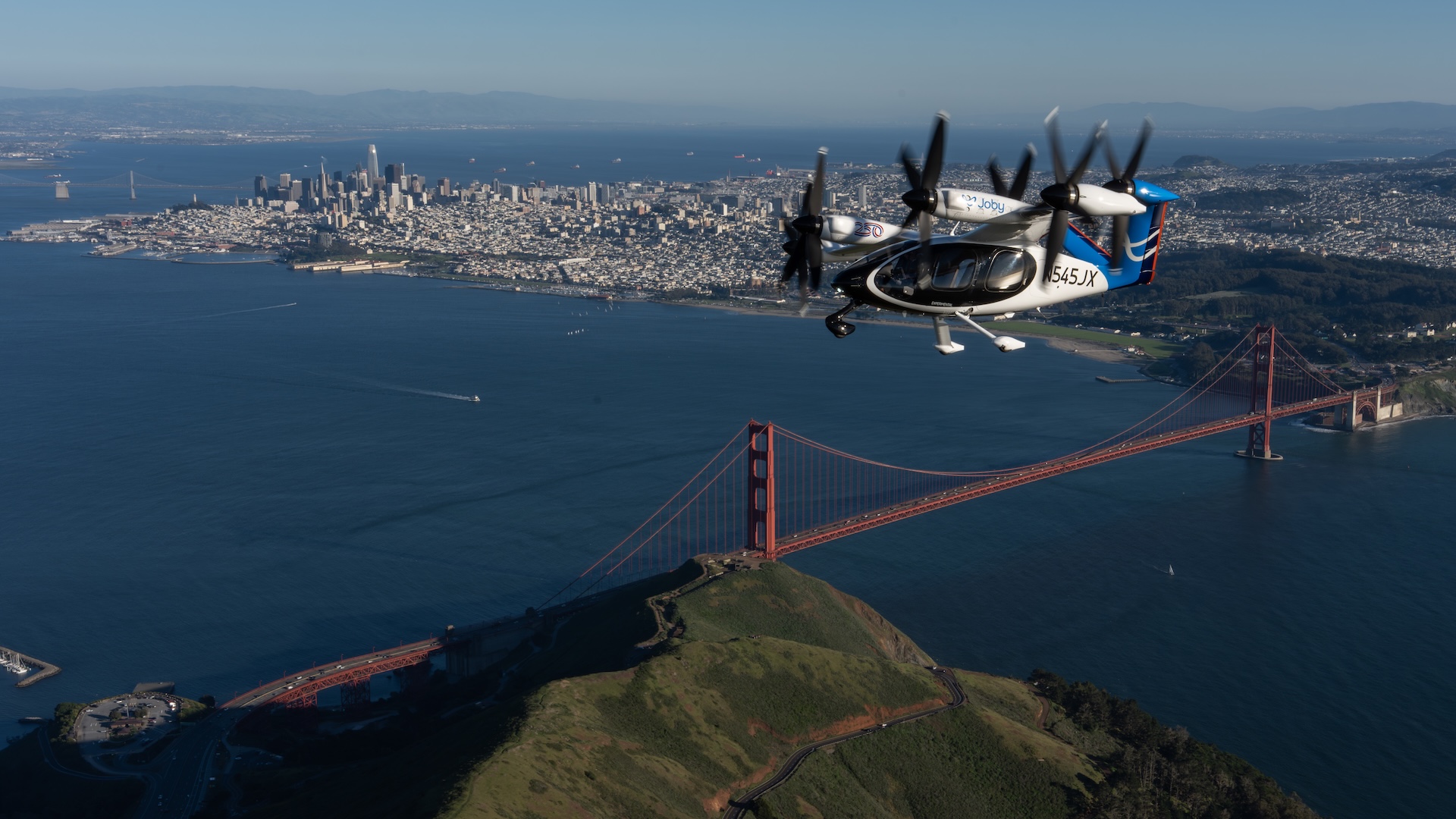
Joby Aviation has kick-started a nationwide tour of its flying taxi. The first flight saw its aircraft fly over the San Francisco Bay Area and around the Golden Gate Bridge.
The flight took place around the same time the FAA announced a nationwide pilot program aimed at finally making commercial air taxi services a reality.
Joby Aviation kickstarts nationwide eVTOL tour
The Joby air taxi is piloted, though the company eventually aims to automate its flight services. It will be capable of flying as many as four passengers on short, urban trips, reaching cruise speeds of roughly 200 mph. Its fixed wings feature six propellers and are capable of swiveling forward after takeoff for increased speed.
Joby Aviation’s nationwide tour, dubbed the “Electric Skies Tour”, will include demonstrations in several cities throughout the US.
In a press statement, the company stated: “With one of the world’s most recognizable skylines as a backdrop, the company showcased its operational readiness in a region defined by traffic congestion, demonstrating that the future of quiet, emissions-free flight, is not just a concept, but nearing commercial readiness.”
The San Francisco flight was conducted using a pre-production prototype, designated N545JX. According to a report by the San Francisco Chronicle, the N545JX aircraft “cruised along in virtual silence” as it flew across the bay. Separately, Joby revealed earlier this month that it had flown its first “FAA-conforming” air taxi.
“With an operational foundation built on thousands of test flights and more than 50,000 miles logged across its fleet, the company is now ready to scale its presence across the US,” the company said in its statement.
The Trump administration’s air taxi push
Joby Aviation also noted that it is among a handful of firms selected as partners in the White House’s recently announced eVTOL Integration Pilot Program (eIPP). The other companies selected are Archer Aviation, BETA Technologies, Electra, Wisk, Ampaire, Elroy Air, and Reliable Robotics.
“Here’s an opportunity for the industry to roll out in a similar way to how Waymo rolled out,” Archer Aviation CEO Adam Archer explained in a video on X after the eIPP announcement. “Rather than an all-or-nothing type certificate where you can go anywhere, or no type certificate where you can’t go anywhere… You can think about it as a few concentrated areas with very, very high margins of safety, allowing us to start very low-level operations, and then expand from there.”
According to Joby, eIPP gives it the opportunity to “begin early operations across 10 states: Arizona, Florida, Idaho, New Jersey, New York, North Carolina, Oklahoma, Oregon, Texas, and Utah.” The company added that the program also has the “potential to meaningfully accelerate the path to commercial service.”
If all goes to plan, Joby Aviation claims it will help realize a society where a daily commute can “take minutes, not hours.”
“Our technology provides an opportunity to build on the immense potential of this region while protecting it for the next generation,” said JoeBen Bevirt, founder and CEO of Joby. “By providing clean, quiet service with minimal infrastructure investment, we are making flight an everyday reality for the community.”

Her mother murdered her father in an infamous case. Now, she’s telling her own story

Apple launches iOS 26.4 with AI playlists, purchase sharing, and more

Who actually runs Iran right now? The key power players as Trump claims talks to ‘top’ official

King Charles to address Congress in historic first state visit to Washington

March Madness sparks surprising surge in sexual procedure for men

Florida High School Football Rankings: Top 25 teams – Oct. 21

How old is Bo Nix? What to know about Oregon quarterback ahead of 2024 NFL Draft

Cleary's 21 help Le Moyne down Central Connecticut State 69-64 in OT

99th annual Pony Swim held in Virginia

Indiana Members Credit Union announced as new anchor tenant at Bottleworks District
King Charles to address Congress in historic first state visit to Washington

Iran names successor to security chief killed in US-Israeli attack

See How the LaGuardia Plane Crash Unfolded

Mullin confirmed as DHS chief as lawmakers near solution on shutdown standoff

Von der Leyen clinches Australia trade deal
-

 Detroit, MI6 days ago
Drummer Brian Pastoria, longtime Detroit music advocate, dies at 68
-

 Oklahoma1 week ago
Family rallies around Oklahoma father after head-on crash
-

 Georgia1 week ago
How ICE plans for a detention warehouse pushed a Georgia town to fight back | CNN Politics
-

 Movie Reviews6 days ago
‘Youth’ Twitter review: Ken Karunaas impresses audiences; Suraj Venjaramoodu adds charm; music wins praise | – The Times of India
-

 Alaska1 week ago
Police looking for man considered ‘armed and dangerous’
-

 Education1 week ago
Video: Turning Point USA Clubs Expand to High Schools Across America
-
 Science1 week ago
Long COVID leaves thousands of L.A. county residents sick, broke and ignored
-

 Sports3 days ago
IOC addresses execution of 19-year-old Iranian wrestler Saleh Mohammadi