Business
Column: Black spatulas and mystery drones: Your guide to the unfounded panics of the season


The “silly season” of news coverage used to refer to the dog days of summer, when there was so little of importance happening that newspapers and cable channels filled the vacuum with fluff.
Not this year.
Starting in October and gaining intensity through the season, Americans have found themselves awash in panicky health and safety warnings about previously unappreciated threats.
Most people don’t look at the sky. They don’t know what airplanes look like up there, particularly at night, and they don’t know what the stars and planets look like.
— Scientist Cheryl Rofer explains the drone panic
It started with warnings about your black plastic spatulas and other such implements. Spurred by a study and press release issued Oct. 1 by the Seattle nonprofit Toxic-Free Future, news organizations from coast to coast — including The Times — posted articles advising consumers to ditch their black food utensils and children’s toys with black plastic pieces.
The black spatula panic was soon outrun by the drone panic, which has Americans scanning the skies for menacing aircraft.
As is typically the case, both of these panics springs from a nugget of truth. It’s true, for example, that chemicals that could theoretically harm people’s health at high exposure levels can be found in some household products — chiefly chemical flame retardants in black plastic electronic devices that have been banned from new uses but have been getting recycled into the consumer stream.
It’s also true that drones, ranging in size from the lightweight models deployed by hobbyists to large commercial models, are becoming a pain in the neck, with the largest craft posing a real danger to commercial aircraft.
But the distance between those nuggets of reality and the level of public hysteria is so great that the latter can be explained mostly by two factors: the desire for clicks on news sites and to fill newspaper columns, and the impulse of preening politicians to show they’re attentive to constituents’ concerns, no matter how dubious.
Let’s take these panics in order, starting with the black utensils. For a time, press advisories that people ditch their black spatulas were impossible to ignore. The most alarmist was probably an offering from The Atlantic, which was headlined: “Throw Out Your Black Plastic Spatula/It’s probably leaching chemicals into your cooking oil.”
The piece ran under an illustration of a black spatula dripping sinister goblets of melting plastic, against a background of bilious green. It gave prominent space to the Toxic-Free Future study, as well as to research papers by the British scientist Andrew Turner, who has been studying the contamination of household goods by those electronic flame retardants for years.
A few points about the Toxic-Free Future paper, which spurred all that news coverage. First, it’s based in part on a massive mathematical error. The paper calculates that users of “contaminated kitchen utensils” would have a median intake of BDE-209, one of the common flame retardants, of 34,700 nanograms per day. (A nanogram is a billionth of a gram.)
The paper states that this daily exposure “would approach” the reference dose set by the U.S. Environmental Protection Agency of 7,000 nanograms per kilogram of body weight per day, which the the paper says pencils out at 42,000 nanograms per day for a 60-kilogram adult. Pretty good ground for concern, since the EPA uses the reference dose to measure the level of health risk from exposure to a toxin.
Except: 7,000 times 60 isn’t 42,000; it’s 420,000. The median intake for a 60-kilogram adult, in other words, isn’t anywhere close to the EPA’s reference dose.
Toxic-Free Future has issued a correction to its paper, acknowledging that the daily intake it calculated doesn’t “approach” the EPA reference dose but is one-tenth of the reference dose. (The Times has followed up with an article about the correction; several other publications that went to town on the black utensil threat have also done so.) But it also says “the calculation error does not affect the overall conclusion of the paper.”
Megan Liu, the paper’s lead author, told me that it wasn’t really designed as a risk assessment, but chiefly as a study of how much of these contaminants has entered the consumer economy through kitchen utensils, children’s toys and other products. “Flame retardants shouldn’t even be in these products at all,” she says, which is true.
Yet the issue for the average consumer is how dangerous are these products, really? The answer is, not very.
In a study cited by Liu’s paper, researchers found that some chemicals leached from a black spatula into cooking oil.
The Atlantic’s take on this was that the paper “found that flame retardants in black kitchen utensils readily migrate into hot cooking oil.” Not so readily, however: The researchers cut a black spatula into small pieces and basted them in 320-degree cooking oil for 15 minutes. Who does that? As epidemiologist Gideon Meyerowitz-Katz points out, “most people don’t leave their spatulas in the fryer and walk away for a quarter of an hour.”
More issues are related to this paper. One is that 60 kilograms, or about 132 pounds, isn’t the average weight of American adults. The U.S. Centers for Disease Control and Preventgion places the average weight for an adult male at about 200 pounds, and for a female about 171.
Using those weights would have shown that the potential for health effects is even more remote than the overheated news coverage of the paper suggests. In any case, the evidence for long-term human health effects from the normal exposure to these chemicals is scanty. It comes almost entirely from experiments on lab mice and rats subjected to doses unlikely to occur in the real world, and to an experiment on human cells also in the laboratory.
Of course, if you’re inclined to eliminate all artifacts of modern commerce from your life, no one is stopping you. Liu and her colleagues observe that kitchen implements made from wood or stainless steel are widely available. They’ve also properly noted that among the real problems with the recycling of plastics in consumer goods is that we don’t know anything about how much goes into which products and where they’ve come from.
Some legislatures have moved toward requiring more disclosure, which is to the good. But if you spent the last few weeks or months doing a hard target search for black implements in your house, you probably didn’t have to.
Now on to the drones. When I first heard of New Jersey residents expressing panic over mysterious lights overhead, I flashed on the Firesign Theatre line, “Big light in sky slated to appear in East.” Except that the Firesign Theatre was a satire troupe of the 1960s and ‘70s, the line originated in their parody of a post-apocalyptic news broadcast, and the game was given away by the title of their best album, “Don’t Crush that Dwarf, Hand Me the Pliers.” The current panic appears to be for real.
All the worrying got me thinking about the interview I conducted in September with Sean M. Kirkpatrick, who had recently retired as the Pentagon’s chief investigator of UFO reports. As he had written in a Scientific American op-ed, he and his team had been overwhelmed by a “whirlwind of tall tales, fabrication and secondhand or thirdhand retellings of the same,” producing “a social media frenzy and a significant amount of congressional and executive time and energy spent on investigating these so-called claims.”
Sound familiar?
The claims of an invasion of the Eastern seaboard by swarms of drones has every marker of a groundless social media frenzy. This started with some truly baroque partisan speculation; on Dec. 11, Rep. Jeff Van Drew (R-N.J.) cadged himself some airtime on Fox News by claiming that his home state was under attack from Iran.
“I’m going to tell you the real deal,” he said. “Iran launched a mother ship that contains these drones. It’s off the East Coast of the United States of America. They’ve launched drones.”
Three days later, New York Gov. Kathy Hochul, a Democrat, declared “this has gone too far,” grousing that mystery drones had closed down a metropolitan New York airport. The bare-bones reporting on this event might have made people think that JFK or LaGuardia had been attacked by mystery drones. In fact, the airport was Stewart Airport, which is 60 miles from Manhattan, is served mostly by the ultra-low-cost Allegiant Airlines with routes to Florida, and was closed for one hour.
My favorite performance was that of former Maryland Gov. Larry Hogan, a Republican, who reported via X that on Dec. 12 he “personally witnessed (and videoed) what appeared to be dozens of large drones in the sky above my residence … (25 miles from our nation’s capital). I observed the activity for approximately 45 minutes.”
It didn’t take long for Hogan to be inundated with responses from astronomers and meteorologists that what he had videotaped weren’t drones flying over his house, but the constellation Orion, which as meteorologist Matthew Cappucci informed him crisply, is “made up of stars between 244 and 1,344 light years away.”
Since then, neighborhood groups in New Jersey have organized “sky watches” to track the invading swarms and traded reports via their Ring doorbells. Donald Trump advised people to shoot the drones down, which is a good way to make things worse.
Some people conjecture that the drone hysteria is the product of the public’s mistrust of government. That doesn’t explain much, since a large share of the hysteria has been promoted by elected officials themselves. Politicians are naturally averse to calling their constituents idiots, so they have been responding by demanding more transparency from government officials at the Pentagon and other agencies. It’s always safe for politicians to assure voters that they’ll hold bureaucrats’ feet to the fire.
The problem here is that government agencies have been very clear about what’s happening overhead. The “drone” sightings, they say, are of commercial or U.S. military aircraft, helicopters, and perhaps drone flights by hobbyists wanting to get in on the fun. Most of it is surely the product of ignorance. How much more do we need federal agencies to explain?
“Most people don’t look at the sky,” notes Cheryl Rofer, a retired nuclear scientist. “They don’t know what airplanes look like up there, particularly at night, and they don’t know what the stars and planets look like. They can’t estimate distance — which is tricky in the sky — and they aren’t aware of how things can seem to move. They aren’t aware of how to check if those objects in fact are moving.”
There may be one other explanation for why there are so many purported drone sightings in New Jersey. As the blogger Kevin Drum writes, there are a lot of drones in New Jersey, in part because a state law “indemnifies drone fliers against lawsuits from New Jersey landowners for use of their property for drone overflights.”
So, sure. New Jersey loves drones, which nobody noticed until a local congressman decided to blame Iran.
That should cover the hysterias of the moment. Black spatulas won’t kill you, and the lights in the sky aren’t alien spaceships or Iranian bombers. Any questions?


The luxury shopping center in Pacific Palisades will reopen next month after more than $100 million in renovations forced by the January 2025 wildfire that devastated the Los Angeles neighborhood.
Palisades Village will reopen Aug. 15, owner Rick Caruso announced Wednesday. The outdoor center survived the blaze that destroyed homes and other businesses but needed refurbishment to eliminate contaminants that the fire could have spread.
Crews are putting finishing touches on mall buildings after tearing them down to the studs, treating the wood and rebuilding the walls, Caruso said.
“Everybody’s working, and stores are moving their products in,” he said. “It’s a really cool feeling that people have really locked arms and are working together.”
An electrician installs lighting for a restaurant at Rick Caruso’s Palisades Village on Thursday. The shopping center is scheduled to reopen mid-August.
(Myung J. Chun / Los Angeles Times)
Pacific Palisades resident Allison Polhill, who is rebuilding the home of 30 years that her family lost in the blaze, said she is “thrilled” at the prospect of returning to the mall she used to frequent. Its comeback is a boost for the community, she said.
“Every single step that we make to reopen our commercial corridors is going to bring more people back into the Palisades,” said Polhill, who expects to move back into her home at the end of August.
A total of 6,822 structures were destroyed in the Palisades fire, including more than 5,500 residences and 100 commercial businesses, according to the California Department of Forestry and Fire Protection.
Caruso previously attributed the mall’s survival to the hard work of private firefighters and the fire-resistant materials used in the mall’s construction.
The $200-million shopping and dining center opened in 2018 with a movie theater and a roster of upmarket tenants, including Erewhon, which may be the only grocer in the heart of the fire-ravaged neighborhood when it opens.
Caruso’s company was able to fill the mall with tenants despite the long shutdown.
Palisades Village is 99% leased, with the majority of tenants returning, said Jackie Levy, chief financial and revenue officer. Nearly one-third of the shops and restaurants are new to the property.
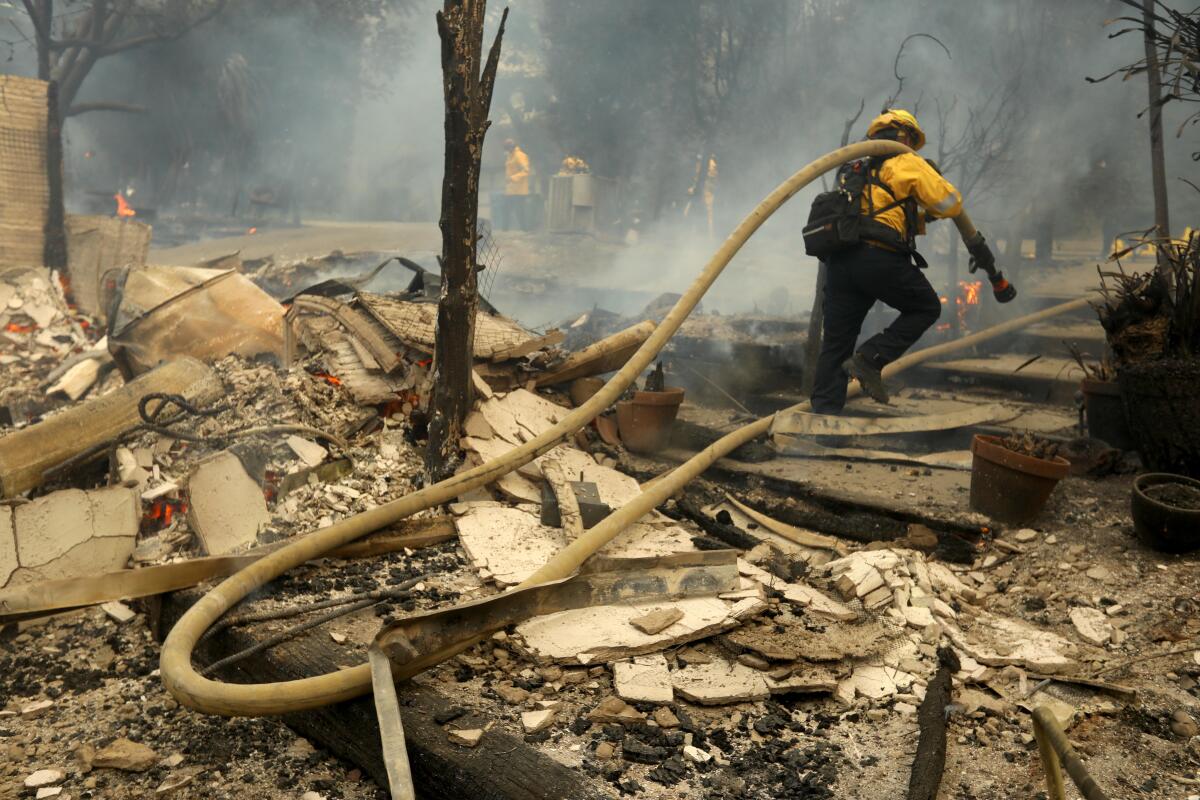
A firefighter carries a hose back to his rig while walking through a destroyed home from the Palisades fire in Pacific Palisades on Jan. 7, 2025.
(Genaro Molina / Los Angeles Times)
Last year, Pacific Palisades-based fashion designer Elyse Walker said she would reopen her eponymous store in Palisades Village after losing her 25-year flagship location on Antioch Street to the inferno.
Other neighborhood shops destroyed in the fire that are reopening at the mall include K Bakery and Loomey’s Toys, which caters to children up to age 12 and used to be across the street from Palisades Elementary Charter School.
“It’s been a journey and I’m excited because I wasn’t sure that there was going to be a place to come back to,” said toy store owner Amanda Rastegar. “Hopefully we can bring some of that magic back.”
Rastegar’s home in the Palisades survived but was damaged by the fire. The family returned about eight weeks ago. Her last memory of the fire was a burning supermarket.
“I just couldn’t wrap my brain around what was happening,” she said. “By the time I left, Gelson’s was on fire.”
Among the returning tenants is Angelini Ristorante & Bar. Well-known Los Angeles chef Gino Angelini said he will be in the kitchen next month for a return of the Italian restaurant.
“We won’t do a big celebrity open,” he said. “We want to have a very soft opening and see our customers come back.”

Construction takes place at Rick Caruso’s Palisades Village on Thursday. The shopping center is scheduled to reopen mid-August.
(Myung J. Chun / Los Angeles Times)
An elaborate celebration would not feel “correct for me,” Angelini said, because the devastation has been “very sad” for so many.
Other new tenants include local chef Nancy Silverton, who has agreed to move in with a new Italian steakhouse called Spacca Tutto. Women’s activewear retailer LESET will open its first West Coast location.
Caruso said he is optimistic that customers will return to the center, even though many Pacific Palisades residents are still dispersed. One tracking system estimated that about 30% of the Village’s customer base was impacted by the fire, he said.
“That means 70% did not get impacted, so there’s a lot of customers still left out there,” Caruso said. Historically, the center drew customers from as far away as Beverly Hills and Calabasas, as well as Malibu, Brentwood and Santa Monica.
He also hopes many will be inspired to visit the revived mall.
“I believe in the goodness of people and I believe that people are going to want to support the Palisades,” he said. “They’re going to want to be there and support the businesses that have had the courage and the heart to reopen.”

Walmart is rapidly expanding its network of electric vehicle chargers designed for customers to use while they shop.
The network could help fill gaps in EV infrastructure in states with greater need for chargers. Walmart, which has more than 5,000 locations in the U.S. and hundreds in California, says more than 90% of Americans live within 10 miles of one of its stores.
The chargers also offer an incentive for customers to choose Walmart — Walmart Plus members will receive a 10% discount off an average price of $0.46 per kilowatt-hour of energy at the company’s chargers.
Walmart chargers are already available at more than 75 locations in 17 states, with Texas boasting the most charging stations, followed by Florida and Arizona.
Matthew Nelson, Walmart’s director of energy policy, said last week on LinkedIn that the network will soon reach 29 states, including California.
“We are delivering on the promise of affordable, reliable and convenient charging,” Nelson said in his post.
According to Walmart’s website, six charging stations are coming to California soon, though the company did not offer a specific timeline.
The chargers will be installed at stores in Antelope, Brea, Fresno, Stockton, Suisun City and Vallejo.
Most charging sites in California will include eight to 16 fast-charging stalls, said Walmart spokesperson Kelsey Bohl.
The company first announced plans in April 2023 to install its own EV chargers at Walmart and Sam’s Club stores, with a goal of installing thousands of chargers by 2030. Partnering with ABB E-Mobility and Alpitronic, it added 25 new charging sites this past May and six more in June.
“Walmart is building a leading retail-integrated EV fast-charging network, focused on delivering an affordable, reliable and convenient charging experience where customers already shop,” Bohl said in an emailed statement. “Customers can charge while they shop, access stations through the Walmart app they already use, and benefit from affordable pricing.”
The charging stations already available include 612 individual charging stalls using 400-kilowatt chargers. Each stall has a dual charging cord with both Combined Charging System and North American Charging Standard connectors. The standard connectors, designed by Tesla, are smaller and lighter than the combined systems.
The primary way to pay for the chargers is through the Walmart app, but the company is also experimenting with built-in credit card readers to allow those without the app to use the stations.
Customers can check charger availability on the Walmart app. The company said the chargers will be available 24 hours a day.

Robotaxis could be turning into robocops.
A self-driving Waymo reported two teens to San Mateo, Calif., police on Monday after they were found drinking alcohol and shooting toy guns in the back of the vehicle.
According to a social media post from the San Mateo Police Department, officers detained two 15-year-olds after the Waymo they were riding in contacted the department and stopped in a parking lot until law enforcement arrived.
“Parents do you know where your teens are?” the San Mateo Police Department wrote on Facebook following the incident. “Waymo does!”
Officers removed both teens from the vehicle and determined they were using toy guns to shoot Orbeez out the windows. Orbeez are small, water-absorbing beads sold at toy stores.
“Toy guns, water guns, and BB guns all pose real dangers, especially to an untrained eye,” the Police Department said. “The simple handling of them can cause fear in [passersby].” “
A video posted on Facebook shows at least five officers and a police dog responding to the scene and approaching the Waymo with their weapons raised.
Waymo did not immediately respond to a request for comment.
Waymo vehicles have internal cameras and microphones that may be used in an emergency or to “promote safety and security,” according to Waymo’s online support page.
The cameras are also used to ensure the vehicles are clean and to help find lost items, according to the support page.
The company said it does not use facial recognition or other biometric identification technologies to identify individuals.
“In more urgent circumstances, support may access live video during a trip,” the Waymo page said.
The San Mateo Police Department’s Facebook post has garnered nearly 60 comments, with one user accusing Waymo of “snitching.”
“At least they got a designated driver?!” one user commented.
-

 Sports4 minutes ago
Justin Verlander announces he will retire after this season: ‘I’ve realized that time has come’
-

 Technology6 minutes ago
Apple AI security update proves hackers move fast
-
Business11 minutes ago
Fire-damaged Pacific Palisades shopping center sets reopening date
-
 Entertainment18 minutes ago
Rhea Seehorn celebrates her ‘Pluribus’ Emmy nomination as she waits to hear about Carol and the atom bomb
-

 Lifestyle21 minutes ago
Urban Jürgensen: Introducing Elite Watchmaking to New Audiences
-
 Politics27 minutes ago
Commentary: On Skid Row, it’s been decades of frustration. Will the next mayor have a plan?
-
 Science34 minutes ago
What’s the deal with … coffee enemas?
-
 Sports37 minutes ago
LAPD weighs canceling academy classes to get more cops on streets for Olympics

