San Francisco, CA
Now San Francisco Shares with Las Vegas, New York City, Chicago, Miami, Boston in Facing International Leisure Tourism Drop, Latest Update You Need To Know – Travel And Tour World


Saturday, July 12, 2025
Once glittering symbols of America’s allure, cities like San Francisco, Las Vegas, New York City, Chicago, Miami, and Boston are now grappling with an unexpected challenge in 2025: a pronounced drop in international leisure tourism. From the cable cars of San Francisco to the neon glow of Las Vegas and the skyscrapers of New York, these urban icons are feeling the sting of fewer foreign visitors strolling their streets, dining in their restaurants, and filling hotel rooms.
Political tensions, visa hurdles, rising costs, and shifting global travel preferences are combining into a perfect storm that’s reshaping how travelers see the U.S. This isn’t merely a seasonal dip—it’s a trend with deep economic consequences, threatening billions in revenue and the livelihoods of workers across these bustling metropolises. Here’s what’s driving the decline, how each city is coping, and why the story of America’s cities is at a critical turning point.
San Francisco at a Crossroads: Inside the City’s Unsteady Tourism Comeback in 2025
A City Reawakening — But Not Fully Recovered
San Francisco has always been a city of contrasts: fog and sun, boom and bust, innovation and nostalgia. In 2025, its tourism story is no different. The City by the Bay is clawing its way back toward the bustling days of pre-pandemic travel, but data and industry insiders reveal a more complicated reality behind the glossy brochures.
On paper, things look promising. Passenger numbers at San Francisco International Airport (SFO) are surging. International arrivals are running about 10% higher than before the pandemic. Hotels are gradually lifting room rates, and the city’s iconic convention scene is roaring back to life. Yet a closer look shows that the rising tide isn’t lifting all boats—especially when it comes to leisure travelers from abroad.
The Paradox of Full Flights and Empty Streets
One of the most striking contradictions facing San Francisco in 2025 is the gap between airport arrivals and actual tourism in the city. SFO is handling nearly 93% of its pre-pandemic passenger load, an impressive feat considering the challenges of global travel over the past five years. International routes are back in force, from London to Tokyo to Mexico City.
But a large slice of those passengers isn’t staying long enough to boost the city’s hotels, restaurants, and attractions. Many are transferring to other destinations, heading straight into Silicon Valley for business, or simply choosing to spend fewer days in the city. According to tourism officials, international leisure visits to San Francisco have slipped by roughly 5% in 2025, even while airport arrivals are climbing.
This disconnect has left local businesses puzzled. “We see people coming through the airport, but not enough of them are coming to stay,” said Joe D’Alessandro, President and CEO of the San Francisco Travel Association. “We’re working harder than ever to remind travelers why San Francisco is worth the stop.”
Convention Business Pulling Heavy Weight
If San Francisco’s tourism recovery has a saving grace, it’s the convention sector. The Moscone Center—an economic engine for the city—is booked solid through much of 2025. High-profile gatherings like the RSA Cybersecurity Conference and Microsoft Ignite are drawing tens of thousands of business travelers.
The numbers speak volumes. Moscone events are forecast to generate nearly 667,000 room nights this year, up roughly 70% from 2024. Hotel occupancy is projected to climb to about 64.4%, with average daily rates inching upward to around $233. Revenue per available room (RevPAR) is expected to increase by nearly 5%.
For hotels and downtown businesses, conventions are a lifeline. During large conferences, hotel lobbies buzz with business chatter, restaurants fill up, and Uber and taxi drivers log long hours shuttling delegates. But without enough leisure tourists, the city remains heavily reliant on these business events—a reality that worries some industry watchers.

Tourism Headwinds: Politics, Prices, and Perception
So why are international leisure travelers giving San Francisco a pass, even while other global cities are bouncing back faster? Several factors converge to complicate the city’s recovery.
First, there’s geopolitics. Many visitors from Europe, Canada, and Asia report travel anxiety stemming from American immigration policies and political rhetoric. The so-called “Trump effect,” lingering from the previous administration and rekindled during recent political debates, has left some foreign travelers wary of visiting the U.S. at all. This isn’t just conjecture—reports show Canadian visitors alone are down as much as 20% to 30%, with land crossings plunging by nearly a third.
Second, cost remains a formidable obstacle. San Francisco has never been cheap, but visitors today face hotel rates that have climbed well past $230 a night, high restaurant tabs, and costly tickets to attractions. In an era where European cities and Asian destinations are rolling out discounts to entice travelers, San Francisco sometimes feels like an expensive proposition.
Third, perception matters. News stories over recent years about homelessness, street conditions, and public safety have filtered into international media, influencing travel choices. Though many areas of the city remain perfectly safe and vibrant, lingering narratives about urban challenges cast a long shadow.
The Silver Lining: SFO and Infrastructure Investment
Yet it would be a mistake to write San Francisco off. Underneath the turbulence, there are encouraging signs that the city is repositioning itself for future tourism success.
SFO has invested heavily in infrastructure, transforming terminals into modern, art-filled spaces that celebrate local culture. The airport’s leadership has a clear strategy: keep travelers in San Francisco instead of simply letting them pass through. Efforts include partnerships with local tourism boards, curated layover experiences, and targeted marketing in key international markets.
Within the city, new hotels are opening, historic properties are being renovated, and developers are snapping up discounted hotel assets, betting on a rebound. Large-scale events like the upcoming FIFA World Cup matches and the Super Bowl are expected to provide powerful spikes in tourism over the next two years.

A Path Forward — With Caution
San Francisco’s tourism forecast for the rest of 2025 remains cautiously optimistic. City officials expect total visitor numbers to inch upward, from about 23.06 million in 2024 to roughly 23.33 million this year. Visitor spending is projected to grow modestly from $9.26 billion to about $9.41 billion.
But these gains lean heavily on conventions, business travel, and domestic tourism. International leisure travel, the kind that brings people to stroll Fisherman’s Wharf, photograph the Painted Ladies, or cruise out to Alcatraz, is still below pre-pandemic levels.
Industry experts predict it could take until at least 2028 or 2029 before San Francisco fully restores its international tourism volume to where it stood in 2019. Much will depend on the broader geopolitical climate, the strength of foreign currencies against the U.S. dollar, and the city’s ability to tell a new story—one that counters the narrative of high costs and urban challenges.
Why San Francisco Still Matters
Despite the hurdles, San Francisco remains one of the world’s most iconic cities. The Golden Gate Bridge glows just as brightly in the evening sun. Neighborhoods like North Beach, Chinatown, and the Mission District still hum with unique cultural energy. The city’s natural beauty, culinary creativity, and artistic spirit endure.
For travelers willing to navigate the complexities, San Francisco offers experiences they won’t find anywhere else. And for the tourism industry, the mission is clear: transform the millions of travelers flying into SFO into visitors who stay, explore, and fall in love with the city all over again.
Whether that happens swiftly or over several more years will define the next chapter in San Francisco’s tourism saga—and shape the future of one of America’s most remarkable cities.
Few cities in the world conjure as many vivid images as San Francisco. The fog tumbling over the Golden Gate Bridge. Cable cars rattling up steep streets. Colorful Victorians perched like jewels on sun-dappled hills. But beyond the postcards, San Francisco is a living, breathing city, always reinventing itself while fiercely holding onto its spirit.
Welcome to a 2025 guide to San Francisco — a city that’s weathered booms, busts, and even a pandemic, and still stands as one of America’s most charismatic urban playgrounds.
The Lay of the Land: Neighborhoods Worth Exploring
San Francisco packs an astonishing variety into just under 50 square miles. Each neighborhood is practically its own small city, with unique vibes, flavors, and stories.
North Beach
Once the stomping grounds of Beat poets and Italian immigrants, North Beach remains a seductive mix of old-world charm and modern buzz. Sip espresso in a café on Columbus Avenue, then wander up to Coit Tower for sweeping views.
The Mission District
This is San Francisco’s creative core. Murals explode with color on nearly every wall. Trendy bars and taquerias share blocks with vintage shops. Be sure to grab a Mission-style burrito — they’re legendary for a reason.
Chinatown
The oldest Chinatown in North America is an electric swirl of lanterns, herbal shops, and dim sum joints. The Dragon Gate at Grant Avenue is your entry point into this lively maze.
Haight-Ashbury
Synonymous with the Summer of Love, the Haight still hums with countercultural spirit. Vintage record stores, tie-dye boutiques, and indie bookshops line Haight Street. Nearby, Golden Gate Park stretches out like a green ocean.
SoMa (South of Market)
Once industrial warehouses, this district is now an urban canvas of art museums, tech startups, and craft breweries. The Museum of Modern Art (SFMOMA) is a must-visit, boasting one of the world’s premier contemporary art collections.

Iconic Sights (And Some Hidden Gems)
No visit to San Francisco is complete without a few classics:
- Golden Gate Bridge: Walk, bike, or simply gaze at this crimson marvel, often wreathed in ethereal fog.
- Alcatraz Island: The notorious prison-turned-national-park remains a haunting, fascinating place to explore.
- Fisherman’s Wharf: Tourist-heavy but fun for a stroll, especially to watch the sea lions barking on Pier 39.
But don’t stop there. The real magic often lies in lesser-known corners:
- Lands End Trail: A rugged coastal path with dramatic ocean views and glimpses of shipwrecks below.
- The Wave Organ: An acoustic sculpture by the bay that turns the tides into music.
- 16th Avenue Mosaic Steps: A stunning staircase decorated with intricate tile mosaics, leading to breathtaking vistas.
Culinary Adventures: Taste the City
San Francisco is a city for people who love to eat. It’s a melting pot where chefs experiment fearlessly, where fresh seafood meets global flavors, and where innovation often starts at the dinner table.
Start with these essentials:
- Sourdough Bread: Tangy, chewy, and delicious, local sourdough is an institution. Boudin Bakery remains iconic, but many artisanal bakeries are now turning out incredible loaves.
- Dim Sum in Chinatown: For a lively, shareable meal, head to spots like Good Mong Kok or City View for dumplings and buns.
- Mission Burrito: A massive flour tortilla stuffed with rice, beans, meat, and salsa. Try La Taqueria or El Farolito.
- Seafood at Swan Oyster Depot: A beloved counter-service spot serving pristine oysters, crab, and clam chowder.
Beyond the classics, the city’s food scene in 2025 has seen a rise in plant-based innovation, pop-up dining events, and high-concept tasting menus blending Californian and Asian influences.
A City of Arts and Culture
For a city just shy of a million people, San Francisco boasts a cultural footprint far larger than its size. In 2025, the city’s arts scene is roaring back with new vigor.
- San Francisco Museum of Modern Art (SFMOMA) houses works from giants like Warhol and Rothko.
- Asian Art Museum offers an astonishing collection spanning 6,000 years.
- The Fillmore remains hallowed ground for live music fans, hosting everyone from rock legends to rising indie stars.
On any given week, you might stumble across a poetry slam in the Mission, a jazz festival in North Beach, or an immersive art exhibit in a warehouse in SoMa.
Getting Around: A City Made for Wandering
San Francisco’s streets twist and turn, sometimes feeling like a carnival ride. But that’s part of the fun. Here’s how to get around:
- Cable Cars: Still charming, though mostly for the tourist experience.
- Muni buses and light rail: Affordable and widespread, though sometimes slow.
- Biking: Great along flatter areas like the Embarcadero, but those hills are real.
- Walking: The city is surprisingly compact, making it easy to explore neighborhoods on foot.
For those arriving by air, San Francisco International Airport (SFO) has become a destination itself, featuring art installations and new dining options designed to keep travelers lingering longer.
Where to Stay
San Francisco’s hotel scene caters to every budget and style. In 2025, the city has seen new boutique hotels sprouting up alongside grand old classics.
- The Fairmont: Historic elegance atop Nob Hill.
- Hotel Nikko: A sleek, modern choice with a great indoor pool.
- The Proper Hotel: Trendy design and rooftop views in the heart of downtown.
- HI San Francisco Downtown Hostel: A solid budget pick with a social vibe.
For longer stays, many visitors are opting for rentals in quieter neighborhoods, giving them a “local” taste of city life.
Navigating the Challenges
San Francisco isn’t perfect. In 2025, the city is still wrestling with issues like housing costs and visible homelessness in some areas. While most tourist zones remain safe, it’s wise to stay aware of your surroundings, especially at night.
Local businesses and city officials are actively working on solutions, and many visitors find that these challenges, while real, don’t overshadow the city’s charm and warmth.
Why San Francisco Stays Magical
Despite changing trends, rising costs, and a few rough patches, San Francisco’s allure remains potent. Few cities offer such a potent cocktail of history, natural beauty, culture, and innovation. One minute, you’re gazing out over the Pacific from a cliffside trail; the next, you’re eating ramen in a neon-lit alley or chatting with artists in a Mission gallery.
San Francisco thrives on constant reinvention. In 2025, it’s writing a new chapter in its story—a city looking forward, yet always anchored to its unique past.
So pack your curiosity (and a light jacket for the fog), and come see why San Francisco still casts such a powerful spell.
America’s Tourism Dip in 2025: Why Travelers Are Steering Clear of Iconic US Cities
A Tourism Titan Under Pressure
In the summer of 2025, American tourism finds itself caught in unexpected turbulence. Once the world’s heavyweight champion of international travel dollars, the United States is witnessing a marked downturn in visitors across many of its most iconic cities. From the neon glow of Las Vegas to the soaring skyscrapers of New York, cities that bank on global visitors for billions in economic lifeblood are confronting empty hotel rooms, quieter attractions, and growing uncertainty.
The trend is neither small nor purely anecdotal. Data compiled from industry reports and government sources indicate that international visitor spending, which reached about $181 billion in 2024, is forecast to shrink to roughly $169 billion in 2025—a loss of over $12 billion. And while American domestic travel remains relatively robust, foreign arrivals are lagging, reshaping the tourism map of the nation.
Las Vegas: High Prices and Visitor Fatigue
Few cities epitomize the paradox of America’s tourism boom-and-bust cycle as vividly as Las Vegas. Visitor numbers have fallen by roughly 6.5% to nearly 8% compared to last year. And while casinos and hotels still glitter under the desert sun, many international travelers are deciding that Sin City simply costs too much.
A recent exposé by The Times revealed eyebrow-raising prices—$33 for a bagel, $26 for bottled water—and escalating resort fees that leave tourists feeling squeezed. It’s not just high-rollers skipping town; middle-market tourists from Canada and Europe are steering their dollars elsewhere, unwilling to pay steep prices for experiences they can increasingly find closer to home. The city’s gaming revenue has also taken a hit, dropping around 11% as fewer visitors try their luck at the tables.
New York City: From Global Magnet to Measured Retreat
New York City, America’s top urban tourism destination, is grappling with a stark reality: it’s poised to lose over 800,000 international visitors this year. That represents a drop of nearly 17% compared to 2024 figures.
For a city built on the perpetual churn of global visitors—business travelers, cultural tourists, students—such a downturn cuts deep. The Metropolitan Opera has reported that only 11% of its audience now comes from overseas, down from about 20% pre-pandemic. Attractions like the Empire State Building and Broadway are seeing softer footfall, translating to nearly $4 billion in lost economic activity.
Much of the damage stems from shifting geopolitics and strict U.S. travel policies. International travelers report visa hassles, heightened border scrutiny, and an increasingly hostile political tone. Canadians, in particular, have reduced trips to the U.S., with land crossings down as much as 32%. For New York, which relies on Canadian and European tourists for a hefty portion of its foreign visitor base, that’s a painful blow.
California’s Double Bind: Wildfires and Waning Interest
California, a longtime darling of international tourism, is another major casualty of the 2025 downturn. International arrivals have declined by more than 9% year-over-year, with some cities facing even sharper drops.
In San Francisco, holiday-weekend tourism dipped below 2024 levels despite San Francisco International Airport reporting near-record passenger volumes. Many tourists remain wary of high prices and, more recently, extreme weather events like Tropical Storm Chantal that caused widespread travel disruptions.
Los Angeles, meanwhile, has suffered a one-two punch: foreign visitors remain cautious amid reports of wildfires, and visa backlogs continue to impede travel plans. For cities that thrive on overseas travelers coming for Hollywood, beaches, and cultural events, the combination of natural disasters and policy roadblocks has proven costly.
Florida: Sunshine State Faces Clouds
Florida, America’s tourism powerhouse, is not immune to the trend. The state has seen international visits drop by roughly 9% in 2025, driven in large part by a steep reduction in Canadian travelers—once a reliable winter lifeline for Florida’s hotels and attractions.
Orlando and Miami, two of the country’s biggest tourism magnets, are both reporting holiday seasons that fell short of projections. The combination of high costs, geopolitical tension, and shifting consumer priorities has left Florida’s tourism industry nervous as it heads into the back half of the year.
Hawaii: Island Paradise, Distant Reality
Even the idyllic Hawaiian islands have felt the squeeze. Hawaii’s visitor arrivals dipped around 4% this summer, with further declines forecast into 2026. The state expects to lose around $1.6 billion in visitor spending over the next year.
Japanese and Canadian travelers, historically Hawaii’s strongest foreign markets, have both pulled back. The long-haul nature of the trip, combined with economic factors like a strong U.S. dollar, has led many travelers to seek closer, more affordable alternatives.
The Economics Behind the Decline
Why is tourism in the U.S. experiencing such a pronounced slump in 2025? Several factors converge to create this perfect storm.
First is policy. Visa processes have grown more cumbersome, and some foreign governments have issued travel advisories or political warnings about visiting the United States. For example, Canada has seen air bookings to the U.S. fall between 13% and 40%, depending on the region, largely due to diplomatic tensions and higher border scrutiny.
Second is cost. The U.S. dollar remains strong against many global currencies, making American vacations significantly more expensive for foreign tourists. Add in surging hotel rates, restaurant prices, and fees for everything from resort stays to checked luggage, and the sticker shock becomes real.
Finally, perceptions matter. Media reports about political instability, high-profile immigration crackdowns, and isolated incidents of traveler detentions have created a ripple effect of anxiety among would-be visitors.
A Long Road to Recovery
Industry analysts believe that America’s tourism shortfall will not resolve quickly. Oxford Economics predicts the country may not return to pre-pandemic levels of inbound tourism until as late as 2029. The global tourism pie is also getting more competitive, with travelers increasingly choosing destinations that offer hassle-free entry, lower prices, and perceived safety.
Major U.S. cities are working aggressively to counteract these trends. New York City is ramping up marketing campaigns highlighting Broadway and cultural institutions. Las Vegas is offering promotions to lure back international visitors. California is investing in new events and attractions to keep the Golden State shimmering in travelers’ eyes.
Yet the challenge is formidable. For cities whose economies are intertwined with foreign tourism, the stakes could hardly be higher. The dip in 2025 isn’t just a seasonal lull—it’s a warning sign that the United States may need to rethink how it welcomes the world.
The Future of American Travel
America’s tourism decline in 2025 serves as a potent reminder that even the world’s most iconic destinations cannot rest on their laurels. From visa policy to price perception, the forces shaping global travel are shifting fast.
For travelers, the U.S. remains a place of incredible diversity, natural beauty, and cultural dynamism. But for cities like Las Vegas, New York, Los Angeles, and others, convincing the world to keep coming back may take more than neon lights, celebrity chefs, or Broadway shows. It may require a genuine reevaluation of how America positions itself as a welcoming, affordable, and accessible destination in an increasingly competitive world.
Whether 2025 becomes a blip or the beginning of a deeper decline remains to be seen. But one thing is clear: the U.S. travel industry is at a crossroads, and the next steps it takes will determine whether it can reclaim its throne as the world’s favorite playground.
Las Vegas: A City That Once Knew No Limits Faces New Realities
Las Vegas, the city of neon dreams, is waking up to a new and sobering reality in 2025. For decades, this glittering oasis in the Nevada desert seemed untouchable—a place where crowds surged, hotels brimmed with guests, and the economy soared on a tide of constant spectacle. But this year, the city finds itself in unfamiliar territory: grappling with dwindling visitor numbers, slipping revenues, and questions about how much longer it can sustain its allure.
The latest figures from the Las Vegas Convention & Visitors Authority paint a stark picture. Visitor attendance in May dropped by 6.5% compared to last year, following a 5.1% decline in April. By the close of early 2025, over 1.1 million fewer people had walked the famed Strip, leaving hotel lobbies quieter and casino floors echoing with a touch more emptiness.
Skyrocketing Prices Test Visitor Patience
For many travelers, the decision to skip Vegas isn’t a lack of love for the city—it’s a matter of economics. In recent months, reports of outrageous prices have spread far beyond local news and into global headlines. A bagel for $33. A bottle of water for $26. A $60 fee just to check in a few hours early.
Tourists are speaking out. From online forums to candid interviews, the sentiment is the same: Vegas has become a city where visitors feel squeezed at every turn. While high costs were once an accepted part of the Sin City experience, today’s travelers—especially those coming from middle-income backgrounds—are starting to wonder if the magic is worth the price.
Industry experts say the pricing spike isn’t just inflation—it’s part of a deliberate shift toward catering to wealthier travelers. The city’s big resorts have increasingly focused on premium experiences and high-spending clientele. But the unintended consequence may be pushing away the very masses who made Las Vegas what it is today.
Airport Traffic and Casino Chips Down
It’s not only hotel corridors that are emptier. Harry Reid International Airport reported a 3.9% drop in passenger traffic in May, mirroring the city’s broader tourism slump. And on the Strip, gaming revenue dipped by 3.9%, with statewide numbers slipping 2.1%.
These figures might seem modest in isolation, but combined, they point to an unsettling trend: fewer people are coming, and those who do seem to be spending less. In a city where tourism is the lifeblood, even a small decline ripples out into every corner of the local economy—from casino staff to cab drivers to the sprawling networks of small businesses that feed off the tourist trade.
Global Politics Cast a Long Shadow
Vegas’s troubles aren’t purely homegrown. Global politics and economic shifts are playing a decisive role in reshaping travel patterns. The so-called “Trump slump”—a mix of trade tensions, visa policy shifts, and geopolitical uncertainty—has driven down international travel to the United States.
Canada, a traditionally strong feeder market for Las Vegas tourism, saw a staggering 21.7% drop in visitors to Vegas in May alone. Travel sentiment surveys reveal Canadian tourists increasingly view Vegas as too expensive and less welcoming due to complex border policies and economic anxiety.
Senator Jacky Rosen has voiced concerns about America’s standing as a travel destination, warning that international tourism to Vegas is “in trouble.” For a city so dependent on a global audience, these political ripples are turning into waves.
Convention Business Falters
Las Vegas has long relied on conventions as a reliable anchor for its economy. Yet even this pillar is starting to wobble. In the first quarter of 2025, convention visitor numbers fell to 1.8 million, down 1.6% year over year. Overall visitor numbers were down nearly 7%.
Conventions aren’t just about filling hotel rooms—they sustain restaurants, entertainment venues, taxi services, and countless other sectors. In 2024, convention business poured $10.1 billion into the local economy and supported over 70,000 jobs. Now, with attendance dipping and corporate travel budgets tightening worldwide, Vegas faces the unsettling prospect of losing a key revenue stream.
A Record High in 2024, Now a Sharp Descent
The current downturn stands in stark contrast to the city’s roaring performance just a year ago. In 2024, visitor spending hit an astounding $55.1 billion, generating a total economic impact of $87.7 billion and supporting employment for over 385,000 people.
Back then, Las Vegas seemed invincible, riding high on post-pandemic revenge travel. But as 2025 progresses, it’s clear that record-breaking years can quickly become a distant memory. The higher the peak, the steeper the fall—and Vegas is feeling that whiplash now.
Local Businesses Bear the Brunt
It’s not just mega-casinos feeling the pain. Small tour operators catering to Canadians report business down by as much as 40%. Independent restaurants, boutique shops, and show producers echo the same refrain: fewer customers, lower revenues, and growing anxiety about what comes next.
One visitor on Reddit summed it up starkly: the downtown ambiance has changed. Once-bustling streets and vibrant crowds have given way to quieter evenings and empty tables.
Betting Big on Sports and Attractions
In the face of these challenges, Vegas isn’t standing still. The city is investing heavily in diversifying its appeal beyond gambling and traditional tourism. It was crowned America’s “most exciting sports town” in 2024, thanks to NFL, NHL, WNBA, Formula 1, and ambitions for MLB and NBA franchises.
New attractions are also in the pipeline. Universal Horror Unleashed, a new theme park, opens in August 2025, aiming to draw family visitors. Qantas is trialing direct flights from Sydney to Vegas, hoping to tap into Australian tourists. The futuristic entertainment hub Area15 continues to expand, luring younger travelers with immersive experiences.
These moves are bold—but whether they’re enough to offset broader economic and political pressures remains to be seen.
Luxury Pivot: A Double-Edged Sword
To cope with shrinking visitor numbers, the Strip has pivoted toward a more affluent clientele. The median income for Las Vegas visitors has now climbed to $93,000. Upscale restaurants, exclusive nightclubs, and VIP experiences have become the city’s new calling cards.
While this strategy protects margins, it risks alienating the traditional Vegas crowd—the millions of middle-income travelers who once filled every hotel room and show seat. Industry insiders warn that if Vegas becomes solely a playground for the wealthy, it may lose its unique identity as America’s democratic escape—a place where anyone could come for a taste of extravagance.
The Crossroads of Vegas
Las Vegas finds itself at a crossroads. If city leaders and business owners can recalibrate pricing, recapture middle-class travelers, and rekindle international appeal, the Strip may yet roar back to life.
But if the current trends continue unchecked—rising costs, falling visitor numbers, and geopolitical headwinds—the city risks losing not just tourists, but a piece of its soul.
For now, all eyes are on how Vegas responds. Because in a town built on high stakes, the biggest gamble might be saving itself.




Comments Are Temporarily Disabled
Streetsblog is in the process of migrating our commenting system. During this transition, commenting is temporarily unavailable.
Once the migration is complete, you will be able to log back in and will have full access to your comment history. We appreciate your patience and look forward to having you back in the conversation soon.

Closing soon
Coming soon
The gallery scene
Ashley Voss updates a local gallery guide weekly. Check out the guide’s Instagram account and website.
At the Museums
To artists: The city is launching its competition for the 2027 Art on Market Street Poster Series. Deadine is April 17. From the city’s website: “The 2027 Program will feature the work of four artists/artist teams with each series on view for a period of three months…” You can learn more here.
To art supporters, there are donations to be made and fêtes to attend:
- MOAD is having a Spring Affair luncheon Wednesday, April 8. The honorees include the Crankstart Foundation, Kaiser Permanente and the artist Mildred Howard. For more information, click here.
- SFMOMA is having its bash Wednesday, April 29, from 6 p.m. to 1 a.m. Tickets and perks here.
It’s a difficult time for many of the city’s museums and cultural centers. The Mission Cultural Center for Latino Arts has suspended operations. City Hall promises action, but in the meantime, it’s a significant loss of children’s programming, exhibits, and events. You can donate here.
SFMOMA
Monday, Tuesday, Friday, Saturday and Sunday, 10 a.m. to 5 p.m; Wednesday, closed; Thursday, noon to 8 p.m.
Reimagined: The Fisher Collection at 10, a rehanging and consideration of the collection. This online countdown leading up to the reopening on April 18 is fun to poke around in.
It’s a spectacular collection and KQED has a good piece on the reinstallation.
Already two exhibitions–Alexander Calder and Claes Oldenburg + Coosje van Bruggen: Thinking Big have opened to the public.
-
Claes Oldenburg and Coosje van Bruggen, Sculpture in the Form of a Match Cover, 1987; The Doris and Donald Fisher Collection at the San Francisco Museum of Modern Art; © Claes Oldenburg and Coosje van Bruggen. Photo by Katherine Du Tiel -
Claes Oldenburg and Coosje van Bruggen, Geometric Apple Core, 1991; The Doris and Donald Fisher Collection at the San Francisco Museum of Modern Art; © Claes Oldenburg and Coosje van Bruggen. Photo by Ian Reeves


Three more floors of the collection open on April 18:
Ways of Seeing: Fourteen Artists (on Floor 4)
Calder, Kelly, LeWitt: Fundamentals of Form (on Floor 5)
Memory and Matter: Personal and Collective Histories (on Floor 6)
In all, the Fisher Collection will be highlighted in five exhibitions across four floors of the museum.
I will remind you later this month, but a lot of events are planned for the weekend of the 18th when all will be unveiled.
The museum’s finalists for the SECA awards: Sholeh Asgar, Windy Chien, CrossLypka, Soleé Darrell, Hughen/Starkweather, Xandra Ibarra, Em Kettner, Charles H. Lee, Yameng Lee Thorp, Aspen Mays, Adia Millett, Lorena Molina, Tricia Rainwater, Chanell Stone, Livien Yin, Jes Young.
The winners will be announced in April and a show of their work will go up in December. The award highlights Bay Area artists who have yet to receive “substantial recognition from a major institution.” It’s interesting to look at their work. Any favorites? I’m partial to Livien Yin and her big oils of everyday life.
“Rose B Simpson: Behold,” is on view on SFMOMA’s fourth-floor terrace a bronze sculpture visible from multiple locations. And good news! It has been extended through February 7, 2027.
Also new: “Samia Halaby: Kinetic paintings,” four new works in SFMOMA’s Evelyn and Walter Haas Jr. Atrium.

“Alejandro Cartagena: Ground Rules” is on view until April 19.
-
Alejandro Cartagena, Rivers of Power #71, from the series Rivers of Power, 2010–16© Alejandro Cartagena, courtesy the artist -
Alejandro Cartagena, Suburban Bus #56, from the series Suburban Bus, 2016; © Alejandro Cartagena, courtesy the artist -
Alejandro Cartagena, Invisible Line DAUGHTER #34, from the series Invisible Line, 2010–17; © Alejandro Cartagena, courtesy the artist -
Alejandro Cartagena, Carpoolers #21, from the series Carpoolers, 2011–12; © Alejandro Cartagena, courtesy the artist


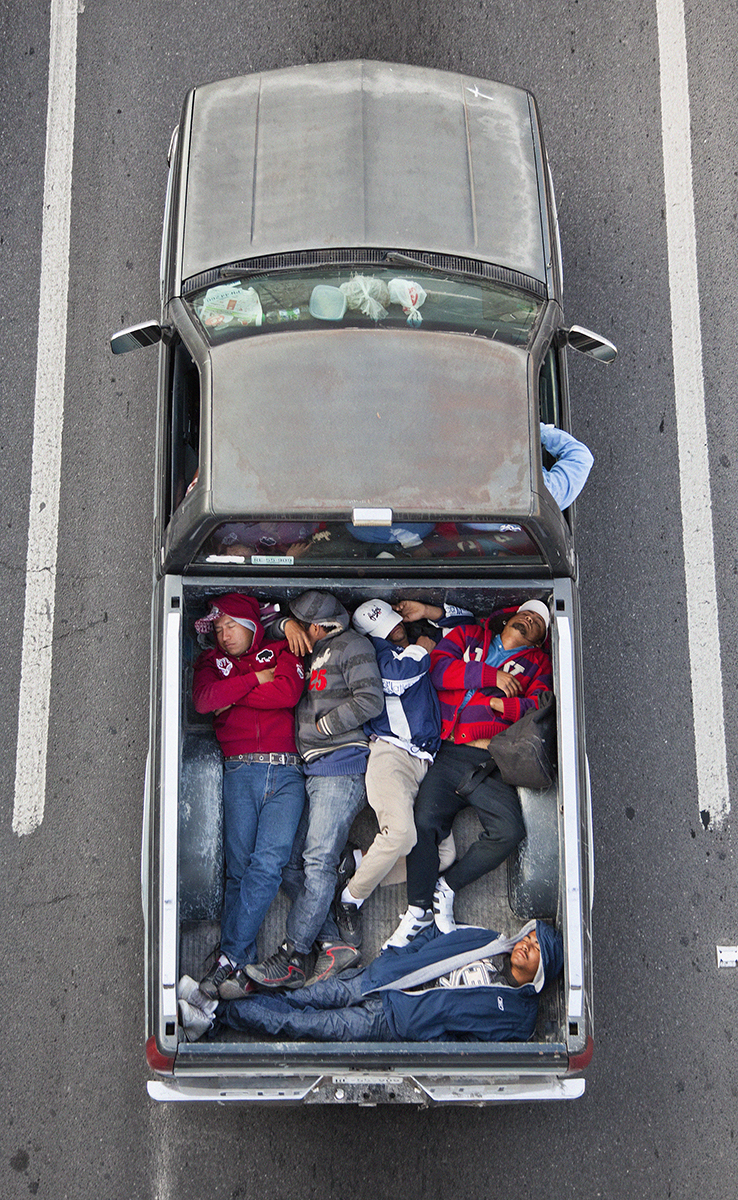
Mission Local’s Marina Newman went to Cartagena’s talk in November, to discover that the photographer has moved away from photography.
“KAWS: Family” is open until May 3, 2026. The exhibit features more than 100 artworks created over three decades. KAWS (Brian Donnelly) began painting graffiti in Jersey City and Manhattan, but in 1996 received his BFA in illustration from the School of Visual Arts.
We sent Charles Lewis III to take a look.
“In his younger days, Donnelly would snatch subway advertisements, integrate his own characters and then replace the advertisements, making it seem as if his designs were always a part of the image,” Lewis writes. In the new show, he writes “for KAWS, family is about the art of marketing.”
The New York Times has a 2021 profile of KAWS here. He’s controversial, to say the least.
The exhibit includes a 36-foot-tall inflatable sculpture on SFMOMA’s rooftop.

The photo exhibit, “(Re)Constructing History,” fills three rooms on the third floor. The title plays on Carrie Mae Weems’ featured series “Constructing History,” asking viewers to consider “the layers of history we encounter through a seemingly fixed image.”
A contemporary Black artist — including Nona Faustine, Carla Williams, and Dawoud Bey — anchors each room.
-
Carrie Mae Weems, The Tragedy of Hiroshima, from the series Constructing History, 2008; promised gift of Paul Sack to the Sack Photographic Trust; © Carrie Mae Weems. -
Nona Faustine, From Her Body Came Their Greatest Wealth, Wall St, NYC, 2013; San Francisco Museum of Modern Art, purchase through a gift of Ty Ahmad-Taylor and Accessions Committee purchase, by exchange, through a gift of Michael D. Abrams; © Nona Faustine. -
Rephotographic Survey Project, Rick Dingus for the Rephotographic Survey Project, 1978. Witches Rocks, Weber Valley, Utah., 1977–79; San Francisco Museum of Modern Art, Accessions Committee Fund purchase; © Rephotographic Survey Project. -
Dawoud Bey, Untitled #17 (Forest), from the series Night Coming Tenderly, Black, 2017; San Francisco Museum of Modern Art, Accessions Committee Fund purchase; © Dawoud Bey. -
Carla Williams, Side, from the series How to Read Character, 1990, printed 2024; San Francisco Museum of Modern Art, Accessions Committee purchase, by exchange, through a gift of Michael D. Abrams; © Carla Williams.


“People Make This Place: SFAI Stories” is open through July 5, 2026, at SFMOMA. The exhibit looks at the the San Francisco Art Institute’s importance to the local arts eco-system and includes work from 50 alumni and former faculty in the museum’s collection.
“New Work: Sheila Hicks” on the fourth floor illustrates how Hicks turns fiber into sculpture.
Asian Art Museum
“Two Home Countries” by Japanese contemporary artist, Chiharu Shiota, opens April 2 with lots of planned events on Free First Sunday. One will be a talk with the Hyde Street Mural Artist Kayan Cheung-Miaw.
And here is some of the work you will be seeing from Shiota.
-
Chiharu Shiota, Inner Home, 2024. Metal frame, wire, beads. Photograph by Sunhi Mang. © ARS, New York, 2025 and the artist -
Sketch for KINKAKUJI by Chiharu Shiota. © ARS, New York, 2025 and the artist -
Installation view of Chiharu Shiota_ Two Home Countries at Japan Society Gallery, New York, 2025. Photo by Waso Danilenko -
Chiharu Shiota, Out of my Body, 2022. Installation – leather, bronze. Aros Museum, Aarhus, Denmark. Photo Anders Sune Berg. © ARS, New York, 2025 and the artist


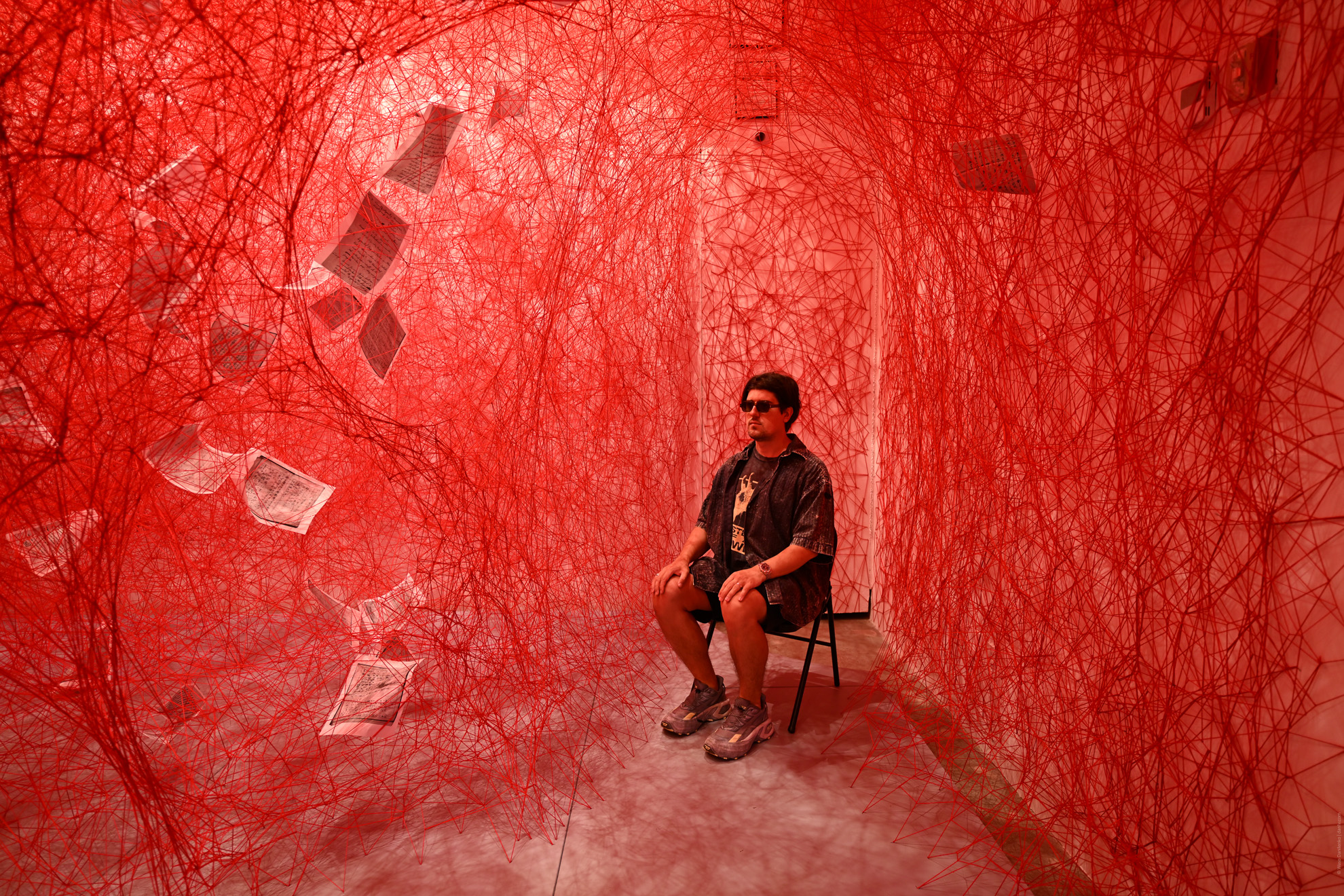

Here is a video of Shiota talking about her webs.
Here is the Hyde Street mural by artist and activist Kayan Cheung-Miaw who will be at the museum on Sunday. “This Asian American Life” shows scenes from Chinatown from the POV of a child. It is part of a public-art series on Chinatown’s mothers, workers and tenants.

“Echoes in the Small Mountain: Park Dae-sung and the West Coast” is open until July 26.
Dae-sung (b. 1945) is “credited with reinventing the techniques of traditional Korean ink painting,” according to the museum’s website. The paintings are based on California landscapes and are spectacular.
“Jitish Kallat: Covering Letter (Terranum Nuncius)” invites visitors to reflect on the things that unite humanity.

You will also see cutting-edge claywork from Japan in “New Japanese Clay.”
The museum has a series, “Takeout Tuesdays,” where you can meet online to talk about a piece of art with docents and others.
General admission is free on the first Sunday of every month and the special exhibitions are discounted. Here is more information for free and reduced-cost admission. The museum also hosts a robust list of events.
de Young Museum
Tuesday to Sunday, 9:30 a.m. to 5:15 p.m.
Saturdays are free for residents of the Bay Area’s nine counties.
“Monet and Venice” opens Saturday and to help you prepare we have a review by Julie Zigoris. She writes, that the French painter had all but decided to give up his water-lily project when his wife Alice, suggested a trip to Venice – thereby rescuing the water lily project and giving us some exquisite paintings from Venice.
It is meant to be in dialogue with “Venice Drawn” at the Legion of Honor and will be on view through July 26.
“Boom and Bust: Photographing Northern California,” featuring photographs of “San Francisco before and after the 1906 earthquake and fire, the construction of the Golden Gate Bridge and Bay Bridge, and the development of San Francisco’s South of Market neighborhood.” It is on through August 2.
-
Janet Delaney, “Mercantile Building, Mission and 3rd Street,” 1980.. Photograph by Jorge Bachmann, courtesy of the Fine Arts Museums of San Francisco -
Arnold Genthe, “The Street of Painted Balconies, from the Chinatown Series,” ca. 1896 -
Daniel Postaer, “San Francisco, Fillmore Street,” 2012 -
Willard E. Worden, “An Awe-Inspiring View of the Burning City from a Hastily Improvised Campsite West of Van Ness Avenue and Fort Mason, in the District Now Known as the Marina,” 1906 -
Willard E. Worden, “The Cliff House (Low Tide),” 1904 -
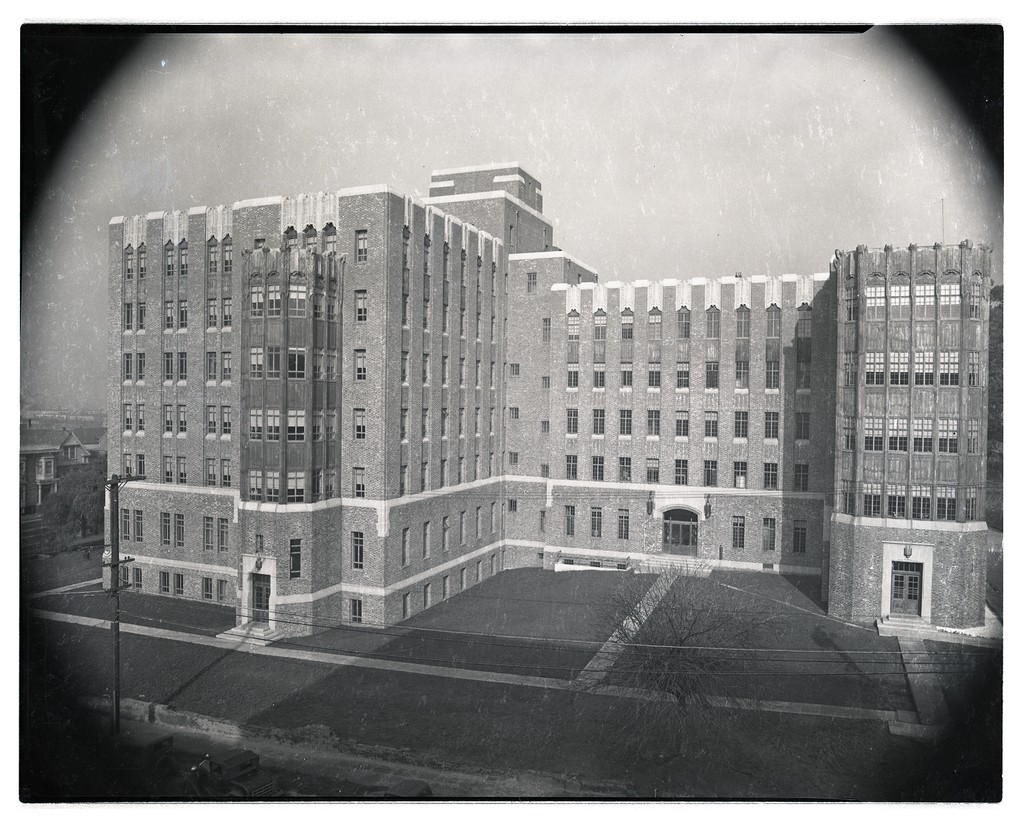
San Francisco General Hospital Buildings 80 and 90 circa 1937. Photo courtesy UCSF, San Francisco General Hospital archives. -
Carleton E. Watkins, “The Golden Gate from Telegraph Hill, San Francisco,” 1868



Artist Rose B. Simpson’s show “LEXICON” will be on until Feb 7, 2027.
Noma Faingold writes in her review, “Coming from a long line of Native American ceramic artists of the Santa Clara Pueblo (Kha’po’oe Ówîngeh), based just south of Española, New Mexico, pottery is in Simpson’s DNA. While she still lives at the pueblo and has her studio close by, she has forged a different creative path, while examining the past, present and future.”

Simpson’s exhibit is all part of the opening of four galleries dedicated to Arts of Indigenous America, which draws on the permanent collections, new acquisitions and artists like Simpson.
The New York Times has an excellent piece by Carolina A. Miranda on the development of the Arts of Indigenous America galleries.
“Leilah Babirye: We Have a History” is the Ugandan artist’s first solo show in the United States. It closes May 26, 2026, Babirye creates sculptures in ceramic, wood and discarded objects.
I don’t know her work, but am excited to get to know it. Here is an introductory video with Babirye and the curator of SFMOMA’s African collection, Natasha Becker. Contemporary artists like Babirye are being invited to have their work in conversation with the museum’s excellent permanent collection.
Museum of Craft and Design (MCD)
Thursday to Sunday, noon to 5 p.m.
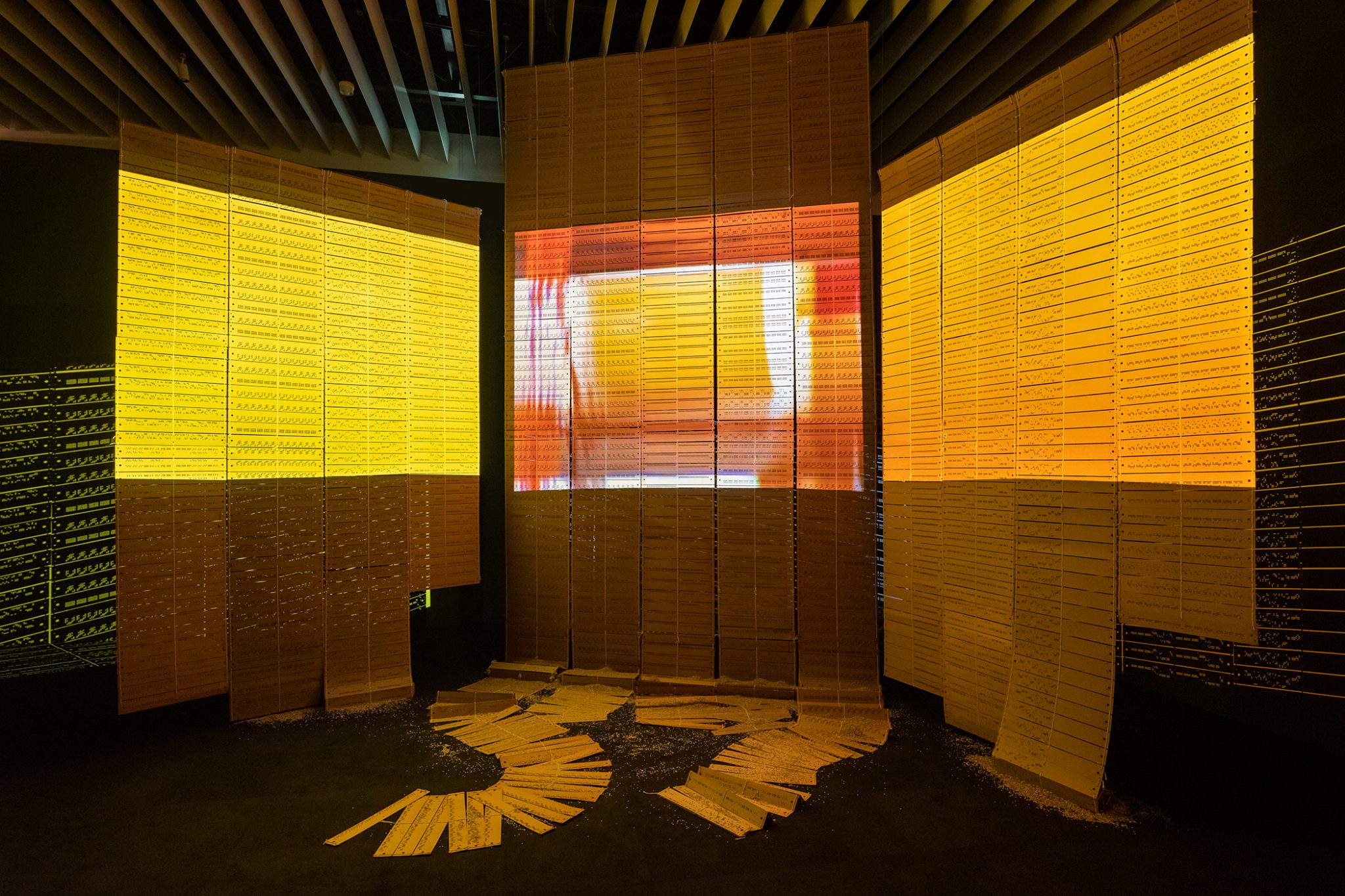
“Video Craft” is open until August 16. From the website: “‘Video Craft’ explores the formal and technical properties that video, film, and early moving image technologies share with more traditional craft media like ceramics, textiles, and glass.”
The images look stunning.
-
Greg Climer, The Animated Quilt of Nathan and Bryan,
2022. Courtesy of the artist. -
Senga Nengudi, Warp Trance, 2007. Installation view,
Another Energy: Power to Continue Challenging—16
Women Artists from around the World, Mori Art Museum,
Tokyo, 2021
Photo by Furukawa Yuya. Photo courtesy of Mori Art
Museum, Tokyo. -
Ahree Lee, Bojagi, 2015, Digital video with sound, 15m.
Courtesy of the artist. -
Richard Vijgen, Hyperthread, 2024, various yarns. Photo
courtesy of Studio Richard Vijgen.



Legion of Honor Museum
Tuesday to Sunday, 9:30 a.m. to 5:15 p.m.
“Drawn to Venice” will be on until Aug. 2, 2026. The exhibition is designed to be “in dialogue with ‘Monet and Venice,’ on view until July 26, 2026, at the de Young.” See our review of the latter here.
-
Bust of a Girl Holding an Apple. Drawing. Giovanni Battista Piazzetta (Italian, 1682-1754). Museum purchase, Bruno and Sadie Adriani, Ludwig A. Emge, Ruth Haas Lilienthal, Roscoe and Margaret Oakes Income Fund, and Lucie Stern Fund. -
Portrait of a Lady as Diana. Drawing. Rosalba Giovanna Carriera (Italian, 1671-1757). Gift of Mr. and Mrs. Prentis Cobb Hale Jr.


The exhibit includes 30 drawings and prints from 16th-century Venice, including landscapes and figure studies, from such artists as Giovanni Battista Tiepolo (1696–1770), Rosalba Carriera (1673–1757) and Canaletto (1697–1768).
“Ferlinghetti for San Francisco” draws from the museum’s collection of prints, etchings and lithographs. Here is a 2012 profile from SFGate of the poet, artist, activist and founder of City Lights Book Store. The show is open until July 19, 2026.
Ferlinghetti died in 2021, but what a life. Even before arriving in San Francisco, he had earned a master’s degree from Columbia University and a doctorate from the Sorbonne.
If you get into Ferlinghetti‘s history, visit the Counter Culture Museum, City Lights Book Store and the Beat Museum.
-
Lawrence Ferlinghetti -
Lawrence Ferlinghetti

You can view the Legion of Honor’s full list of exhibitions here.
The museum offers Free Saturdays to residents of the Bay Area’s nine counties.
The Tenderloin Museum
Open Tuesday to Saturday from 10 a.m. to 5 p.m.
On April 2, “Finding Our Way Home: Mary TallMountain in the Tenderloin’ opens.
A friend just saw “The Compton’s Cafeteria Riot” and loved it. It is at the museum’s venue at 835 Larkin St and runs every Friday and Saturday at 7 p.m. You can get tickets here. Chris Carlsson writes about the 1966 riots and resistance on FoundSF, a great resource for history.
The San Francisco Chronicle wrote about the Tenderloin Museum’s planned expansion to 10,000 square feet from 3,000, adding a room for San Francisco’s neon history, including a sign from Hunt’s Donuts, once based in the Mission District and known as the “epicenter of crime.”
There is a lot more going on at the Tenderloin Museum, including the permanent collection that explores the neighborhood’s history and upcoming events, such as a walking tour focused on the area’s LGBTQIA+ history. Other walking tours are listed here.
SOMArts
“Tabi Tabi Po: Come Out with the Spirits!” featuring the works of artist and muralist Cece Carpio is open and on view until March 29.
-
Cece Carpio
Anagolay
Acrylic on canvas
2019 -
Cece Carpio
Gumeng at Mula’s White Lies
Acrylic on wood
2025 -
Cece Carpio
Ylang at Ylang
Acrylic on Canvas
2025


Museum of the African Diaspora
Tuesday, Wednesday, Friday, Saturday, and Sunday, 11 a.m. to 5 p.m. Thursday, noon to 8 p.m.
“Beauty Plus” by photographer Jasmine Ross at MOAD opened March 18 and will run through May 31 as part of the museum’s Emerging Artists Program.
-
Jasmine Ross
Lady #5, 2025
4 x 5 color film printed as museum-grade archival pigment print on Hahnemühle Fine Art Paper -
Jasmine Ross
No Returns/Life’s Work, 2025
4 x 5 color film printed as museum-grade archival pigment print on Hahnemühle Fine Art Paper. -
Jasmine Ross
What’s Left #1, 2025
4 x 5 color film printed as museum-grade archival pigment print on Hahnemühle Fine Art Paper. -
Jasmine Ross
Ms. Purple, 2025
4 x 5 color film printed as museum-grade archival pigment print on Hahnemühle Fine Art Paper


MOAD also announced MoAD Announces its Spring Affair for Wednesday, April 8. The honorees include the Crankstart Foundation, Kaiser Permanente and the artist Mildred Howard. For more information, click here.
Also on at the Museum of the African Diaspora, “Unbound: Art, Blackness and the Universe,” which runs through Aug. 16, 2026.
Teresa Moore reviews “Unbound” this writing, “Over three floors, she (curatorial chief Key Jo Lee) presents an African diaspora that is “unbound” from earthly and chronological conceptions of diaspora.”
-
Didier William Dark Shores,2024. Courtesy of the artist and Altman Siegel -
Rodney Ewing. Light Years: A Cenotaph for a Better Place,2025. Courtesy of Rena Bransten Gallery, SF and the artist. -
Oasa DuVerney BLACK POWER WAVE as Bodhisattva Manjushri Sankofa, 2023, Courtesy of the artist and Welancora Gallery


The Letterform Archive
Thursday,1 to 8 p.m. and free to all; Friday to Sunday: 11 a.m. to 6 p.m.; closed Monday to Wednesday.
This place looks to have many interesting offerings, including a new portfolio of French sign painters‘ alphabets and a collection of Chinese lettering manuals.
“Good Luck 2026” opened recently and will be up until April 4. Here is an explainer from the website: “Building on our first show in 2025, the exhibition returns for the Year of the Fire Horse with an expanded focus on the cultural ties between San Francisco and New York City’s Chinatowns through a cross-country exchange with our partners on the East Coast, the W.O.W. Project, Midnight Project, and lucky risograph who organize the NYC-based Lunar New Year exhibition From Chinatown, With Love.”

“Piet Zwart: Brand Architect” opened Nov. 8.
From the website: “From the 1920s to the 1960s, Zwart profoundly influenced both the Netherlands and the international graphic design community, and many of his works are celebrated as milestones in design history.”
There are many great examples of his work in this piece by Steven Heller, a former senior art director at The New York Times.
And here is more from the Letterform Archive when it reprinted “Inside NKF: Piet Zwart’s Avant-Garde Catalog for Standard Cables, 1927–1928.” It also publishes his seminal essay, “from old to new typography.”
The new, he writes, “rejects a predetermined formal structure, but builds up forms according to the function … the new typography incorporates active red as a functional element: as a signal, an eye-catcher.” Sounds like an interesting fellow.
See all events and programming here.
“Localization: 15 Years of LetterSeed” opened in mid-August. It explores Korean typography.

The Letterform Archive is a nonprofit arts center focused on graphic design.
California Academy of Sciences
Monday to Saturday, 9:30 a.m to 5 p.m; Sunday, 11 a.m. to 5 p.m; Thursday, NightLife (21+ with ID): 6 to 10 p.m. (Last entry is always one hour before closing time.)
There’s a lot going on here.
The newly renovated Wilson Family Nature Lab is open with lots of hands-on learning.
-
WelcomeWinterNight 2024. Courtesy of the California Academy of Science -
Nature Lab Opening. Courtesy of the California Academy of Arts -
WelcomeWinterNight 2024. Courtesy of the California Academy of Science -
WelcomeWinterNight 2024. Courtesy of the California Academy of Science


“Big Picture” competition winners are on view.
Make sure to plan ahead and see the admission and ticketing page for more information. Also, see how you can get a free or reduced rate for your next visit.
Counterculture Museum
Wednesday to Sunday, 11 a.m. to 6 p.m.
We have more museums in town. This one is at the corner of Haight and Ashbury streets with a whole lot of San Francisco history.
I could see a whole weekend, or a couple of weekdays, spent between the Counterculture Museum, the Beat Museum and the “Ferlingetti for San Francisco” show at the Legion of Honor. It would be like a graduate seminar on the late ’50s, ’60s and ’70s.
Beat Museum
Thursday to Sunday, 11 a.m. to 7 p.m.
The Beat Museum is at 540 Broadway, across the street from City Lights, the bookstore founded by Lawrence Ferlinghetti.
“We are dedicated to carrying on the Beats’ legacy by exposing their work to new audiences, encouraging journeys — both interior and exterior — and being a resource on how one person’s perspective can have meaning to many,” according to a statement from the museum.
This sounds like a great place to visit.
500 Capp St.
Friday and Saturday, noon to 5 p.m.: Free self-guided tours. Saturday at 4 p.m.: A guided tour for $20.
500 Capp Street and Root Division are collaborating on “Open Your Eyes to Water,” a solo exhibition of the work of San Francisco-based visual artist Trina Michelle Robinson that spans both venues.
-
2. A still from Transposing Landscapes- A Requiem for Charles Young, 2025 -
Memory Index_ Imagined Family Heirlooms -
Trina Michelle Robinson Studio Portrait


Yerba Buena Center for the Arts
Wednesday to Sunday, 11 a.m. to 5 p.m.; free on Wednesdays and second Sundays.
“The Prince of Homburg: A Solo Exhibition by P. Staff” runs until June 24. From the website: “Loosely inspired by Heinrich von Kleist’s 1810 play of the same name, the work explores exhaustion as a response to structural oppression. The centerpiece of the installation is a 23-minute video…”
San Francisco State University’s Fine Arts Gallery
The gallery is open Tuesday to Friday, noon to 4 p.m.
“Slow Burn” is on. “Guest curated by Lorena Molina, ‘Slow Burn’ centers how BIPOC artists use slowness as a form of refusal and a way to highlight the systems of oppression that structure their lives,” according to the press release.
-
Ana Mendieta- Title Untitled (Blood Sign #2/Body Tracks) Video, 1974 (Courtesy of Walker Art Center) -
Elaine Nguyen Title: Ngoại ăn, Ngoại có sức khỏe, -
Maria Gaspar Title: Disappearance Jail (excerpt series)
Hundreds of perforated Archival Inkjet prints on rice paper, 5 x 7, 2021-Ongoing (Courtesy of the Artist)
Photo documentation credit: Clare Britt -
Tesora Garcia. Tesora’s Third Eye


San Francisco State University’s Global Museum
It’s a teaching lab and open to the public during the school year – Oct. through May. 11 a.m. to. 4 p.m., Tuesday through Thursday, and by appointment. Location: Fine Arts Building, Room 203
Now on: “Craft or Commodity?” And “Please Touch!” “Both exhibits focus on themes of responsible stewardship of cultural heritage, decolonizing museum work, and expanding accessible museum experiences,” writes Marley Townsend, a graduate student in Museum Studies.
The Walt Disney Family Museum
Thursday through Sunday, 10 a.m. to 5:30 p.m.
“Happiest Place on Earth: The Disneyland Story” is open. The museum described it as a “treasure trove of Disney history” taking “will take “guests behind the scenes of one of the most groundbreaking endeavors of the 20th century — the creation and opening of Disneyland in Anaheim, California.”
The museum is showing rare objects featured in the book “Walt Disney Treasures: Personal Art and Artifacts from The Walt Disney Family Museum.” The objects will change every two months.
Visit the museum’s website for more information on admission costs and reduced ticketing options. The special exhibits are free with a suggested $5 admission fee.
Exploratorium
Closed Mondays. Sunday, 10 a.m. to noon (members/donors only); noon to 5 p.m. for everyone. Tuesday to Saturday, 10 a.m. to 5 p.m. Thursday, 6 to 10 p.m. for 18+.
Experience After Dark at Pier 15. Every Thursday evening, immerse yourself in more than 700 interactive exhibits. For people 18 and older. The museum advertises a carefree environment with new themes each night. Here is information for reduced admission.
The Chinese Historical Society of America
The museum is closed for renovations, according to its website.
The Mission Cultural Center for Latino Arts
Closed until further notice.
See the center’s website for offerings.
Institute for Contemporary Art
The Institute is now nomadic and leaving its permanent home. You can read more about the decision here.
Jewish Contemporary Museum
The museum closed in December for at least a year as it works out its financial situation. You can learn more here. Laura Waxmann wrote a good piece for the San Francisco Chronicle about the difficulties museums are facing.
Its closure is a reminder to visit our museums.
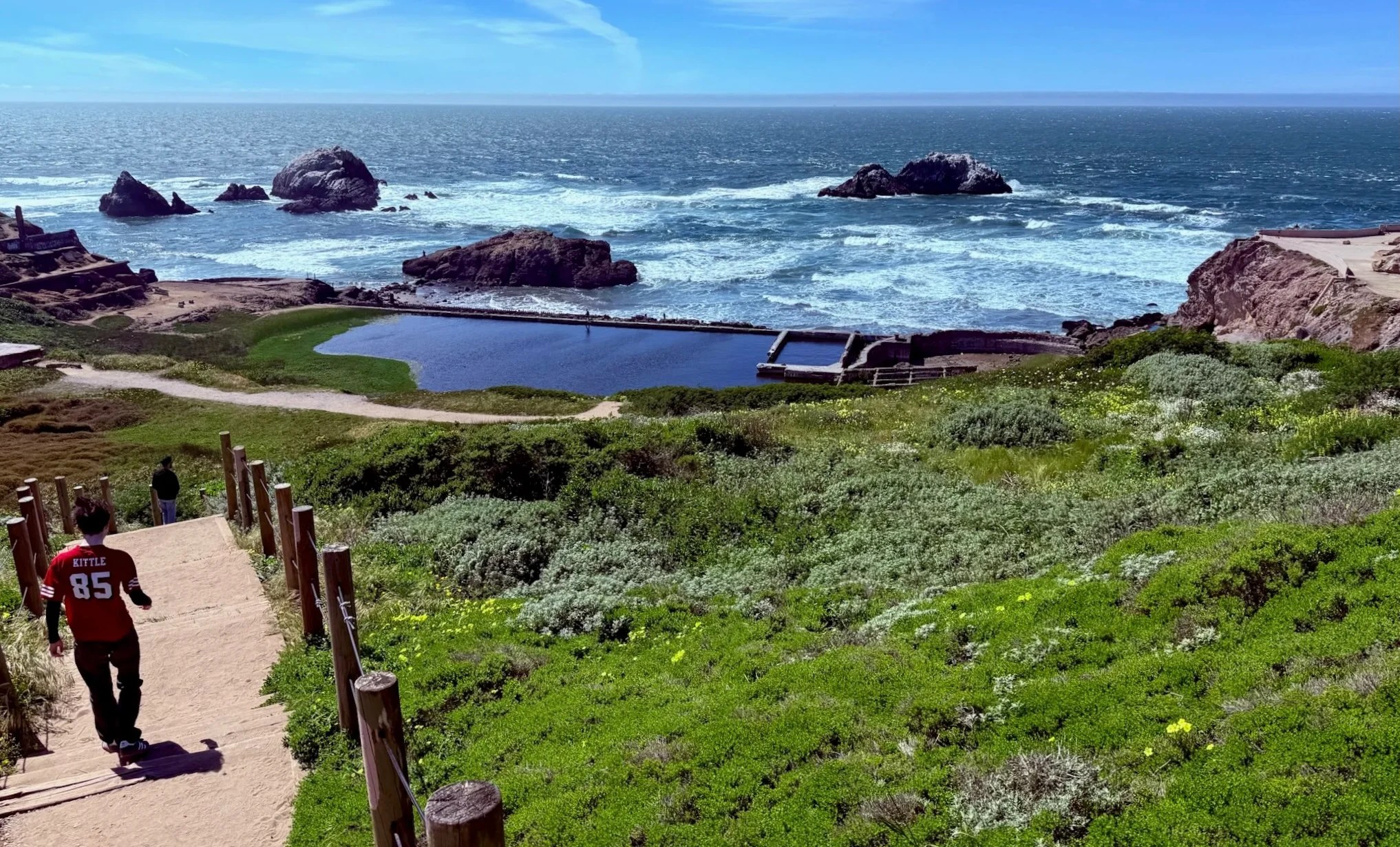
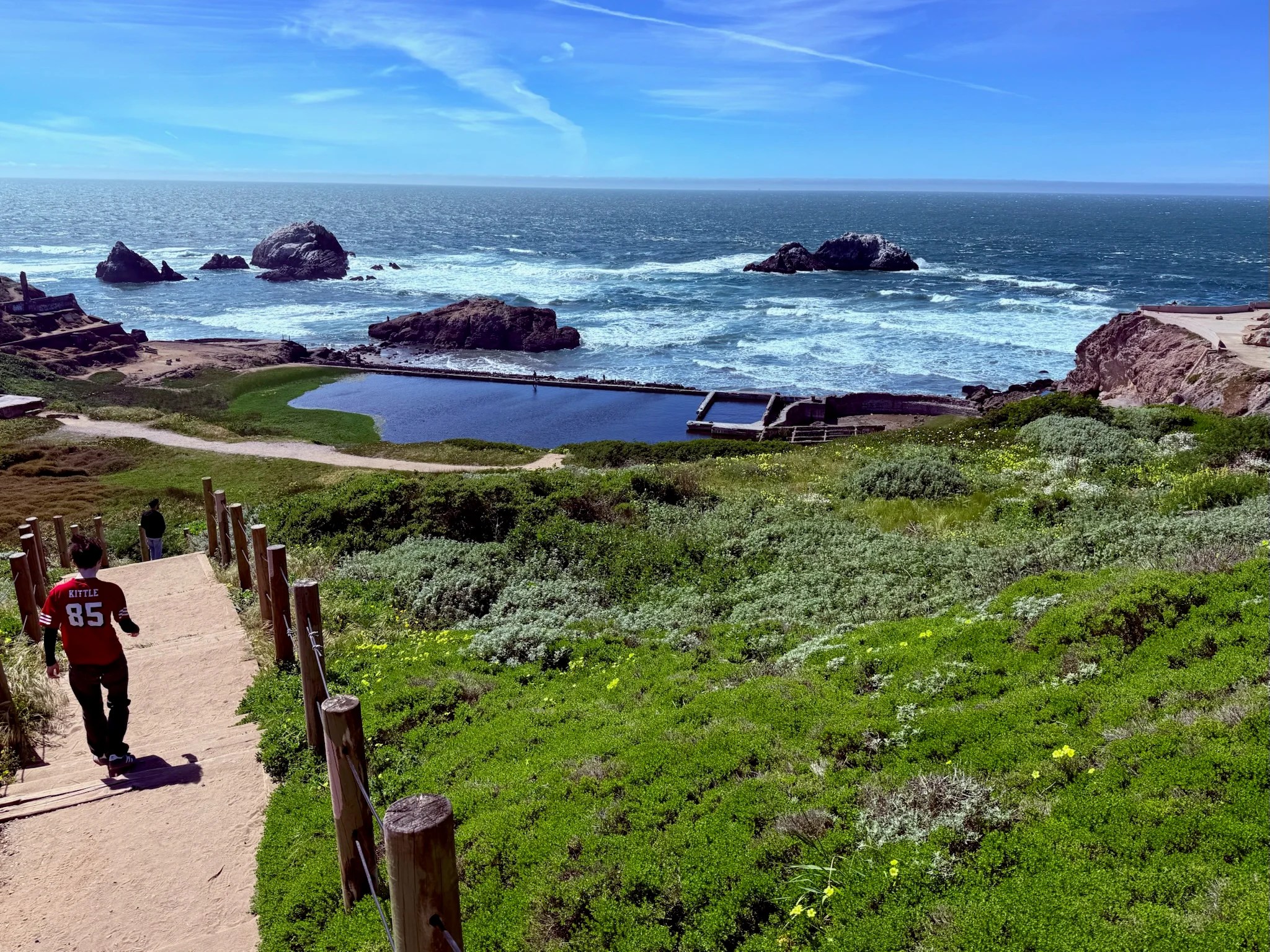
This year, Toby and Anton are in different schools, so they have different spring breaks, for the first time ever. The silver lining was that we could take one-on-one trips, which felt really special. Last week, Toby and I went to San Francisco to visit our family…

As soon as we arrived, we beelined to my sister Lucy’s house. How cute is she?

My niece and I have a long tradition of playing Block Blast while chatting about everything/nothing in particular; so after taking an evening walk and eating pasta for dinner, we did just that.
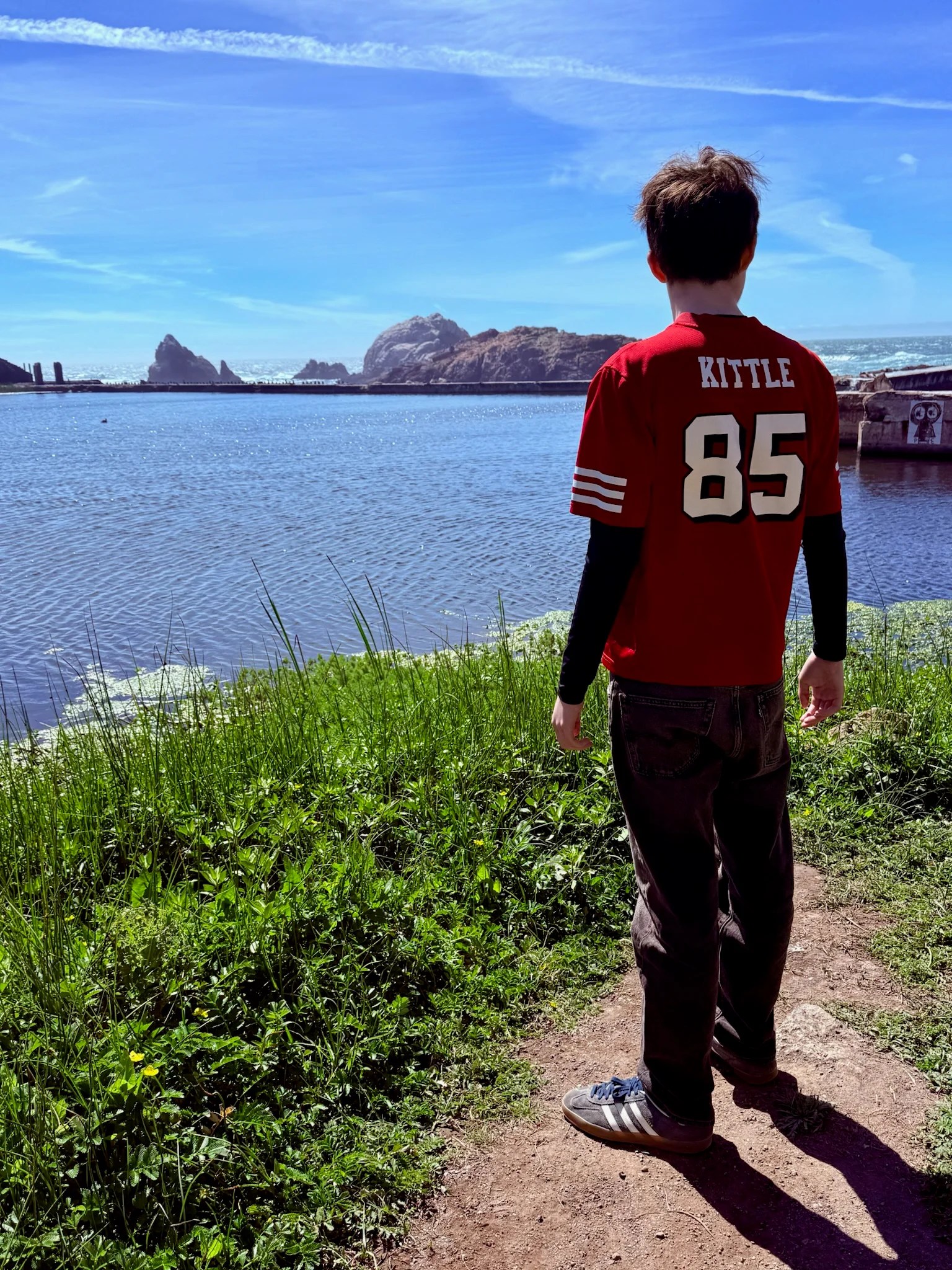
The next day, Toby and I went to Sutro Baths, the former public indoor swimming pool complex. The fresh ocean air felt so good on our faces.
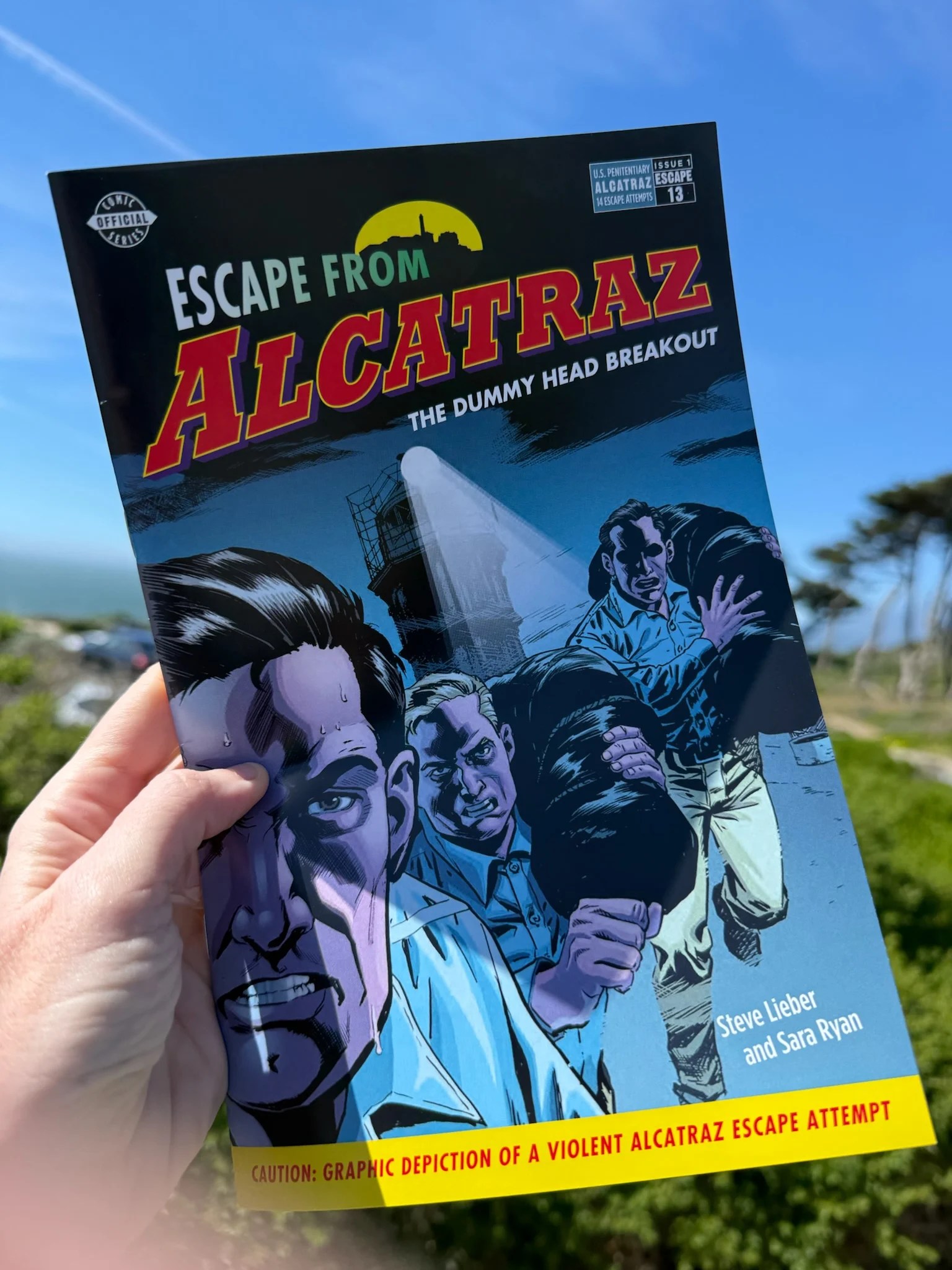
We also got this cool comic book to bring home to Anton.

Separately, since we’ve talked about packing a lot in the past, I was happy with my packing strategy! Mostly black, white, cream, gray, and blue, so everything was mix and match. Pictured here: jacket, shirt, jeans, and similar loafers.

We borrowed my sister’s car to get around, but one afternoon, just for fun, we took a self-driving Waymo. Watching the steering wheel turn on its own is trippy at first but soon feels VERY safe — Waymos are basically like A+ students, who come to a full roll-back stop at every stop sign. My brother-in-law Jeevan told me that he once saw a line of 10 Waymos patiently following a garbage truck up a hill without even attempting to go around, haha.

We were lucky enough to see some friends, like Julia and her toddler daughter…

…who gazed at teenager Toby like he was the world’s biggest celebrity.
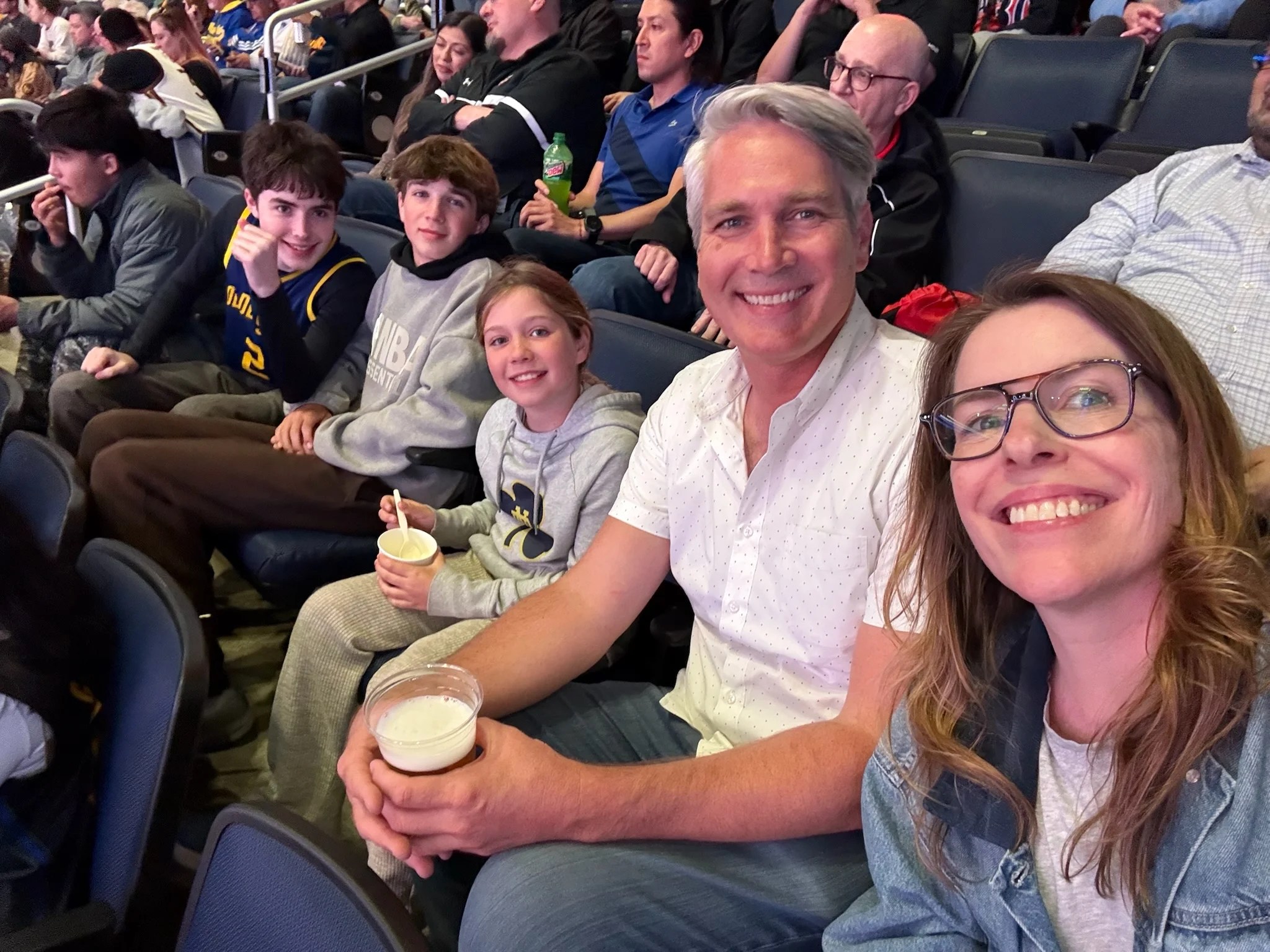

We also went to a Warriors game with some pals.

A real nail-biter…

…but they pulled off a 109-106 victory in the final MINUTE.

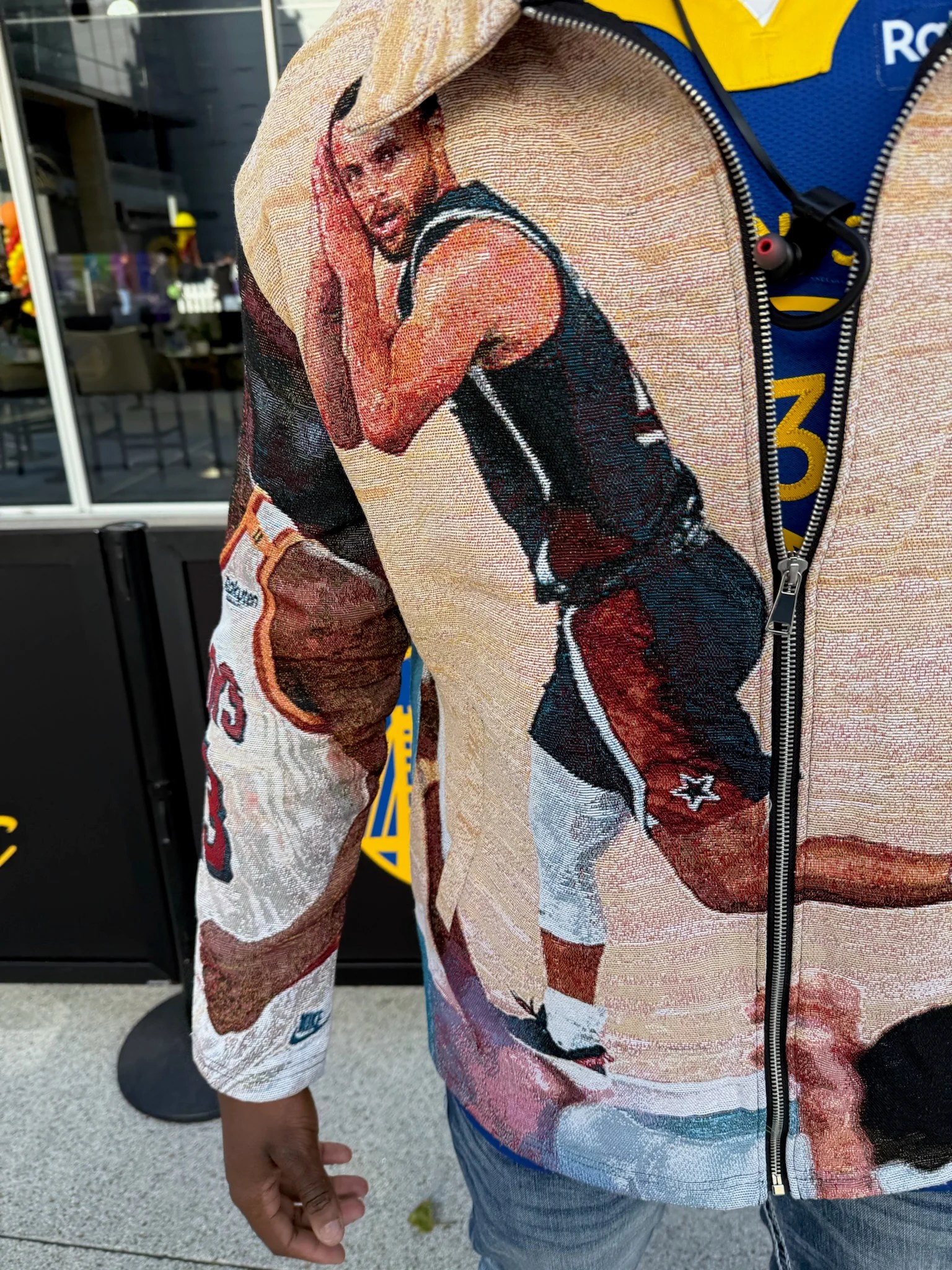
Also, how cool is this jacket???? The guy wearing it told me it was made by Elias Guting.
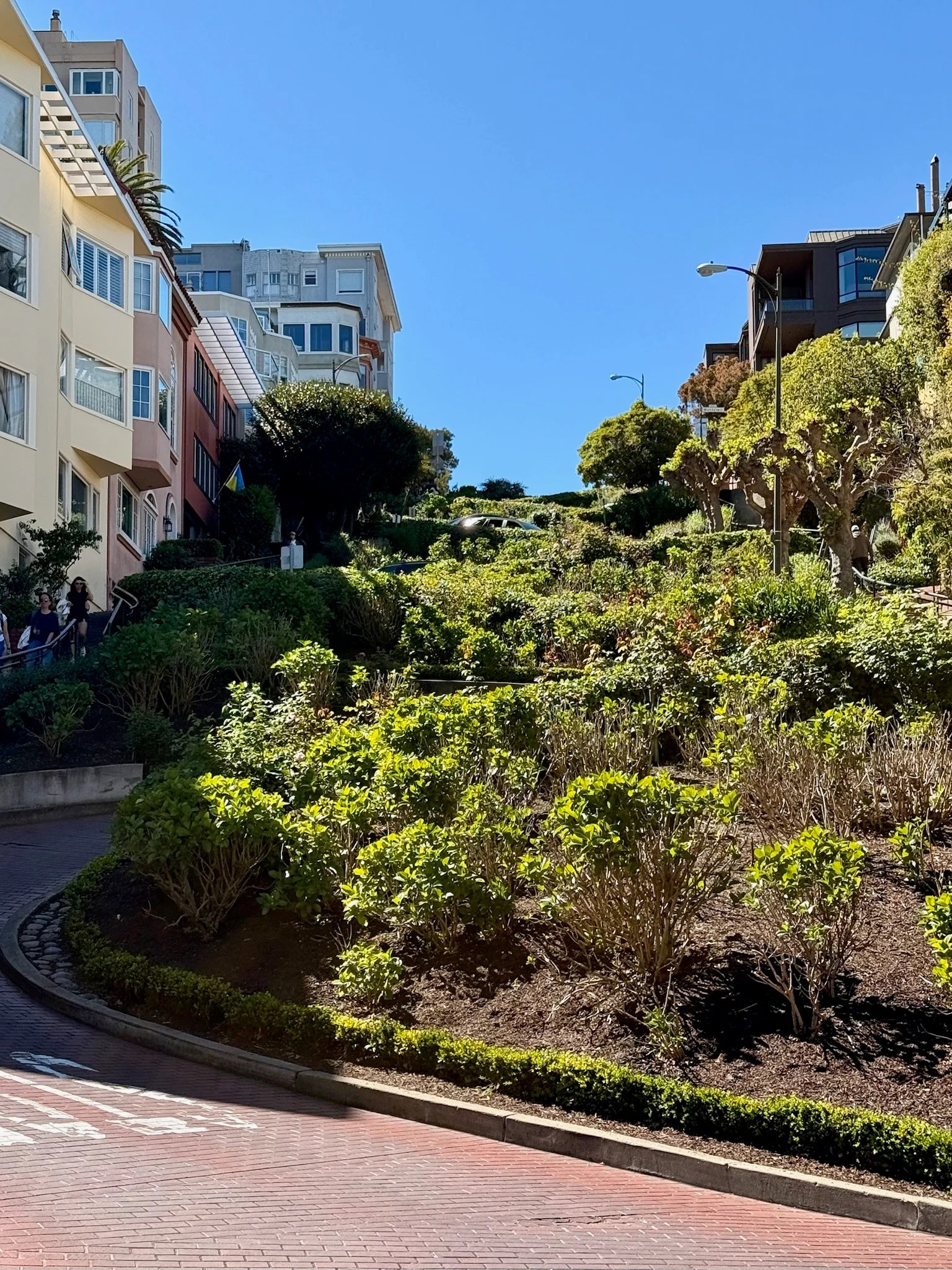
The next day, Toby and I walked along the water, explored the Ferry Building, and drove down twisty Lombard Street (hard to capture in photos!).
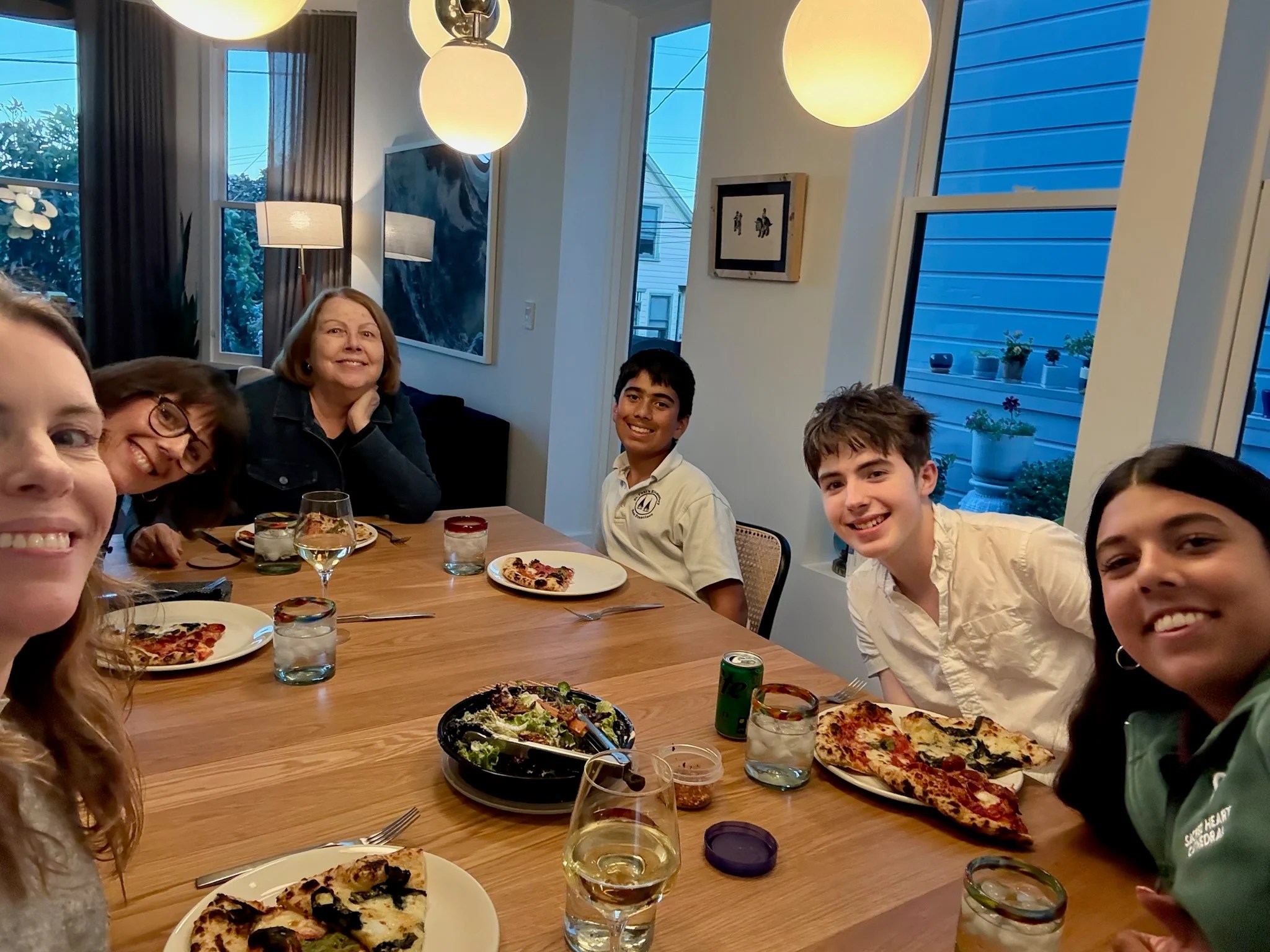
Last but not least, we had dinner with the cousins…
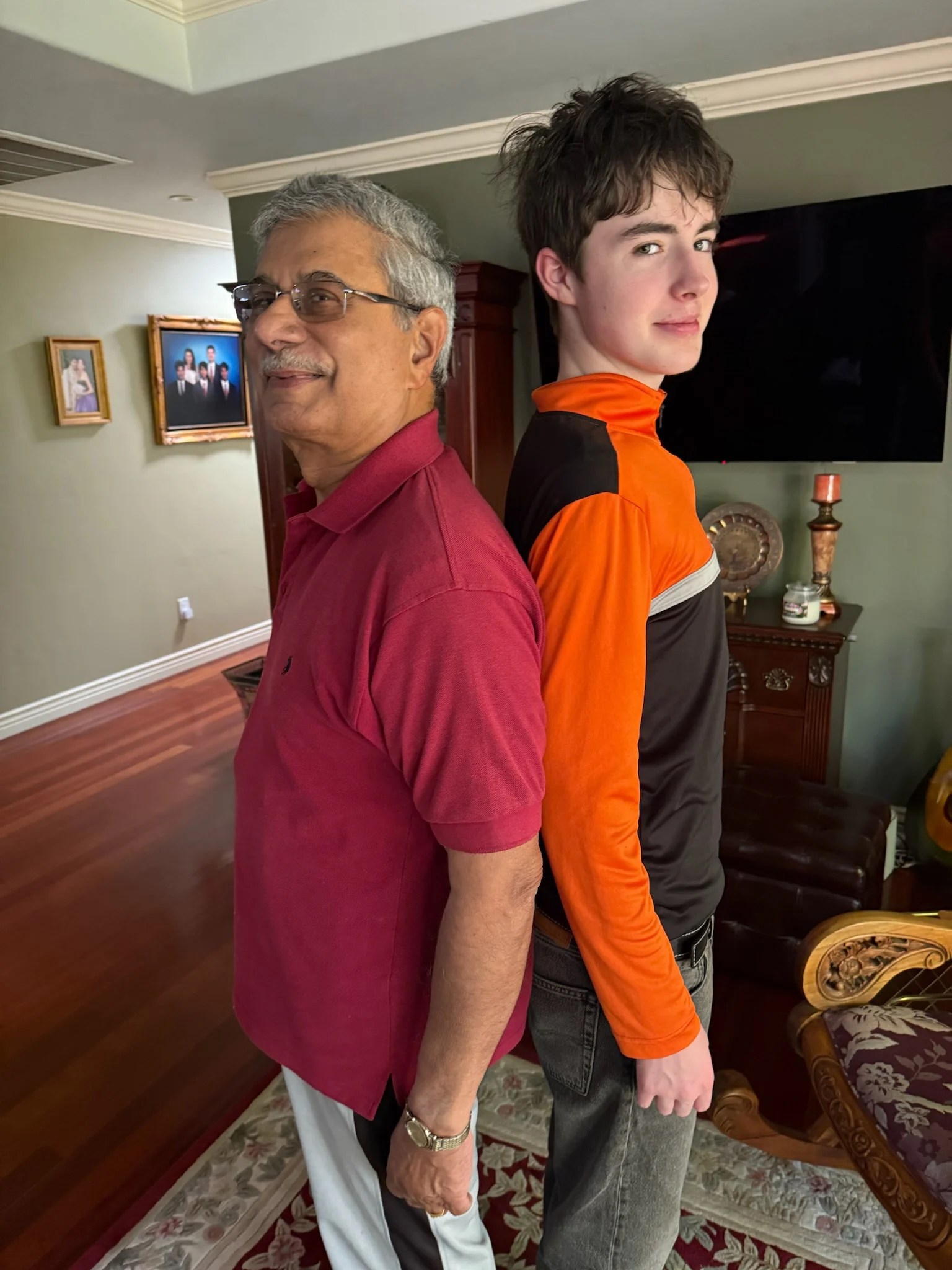
…and did a quick height check. As I took this photo, Dr. Kalanithi asked, “Are we the same?????” to which I replied, “Not even a little bit.”
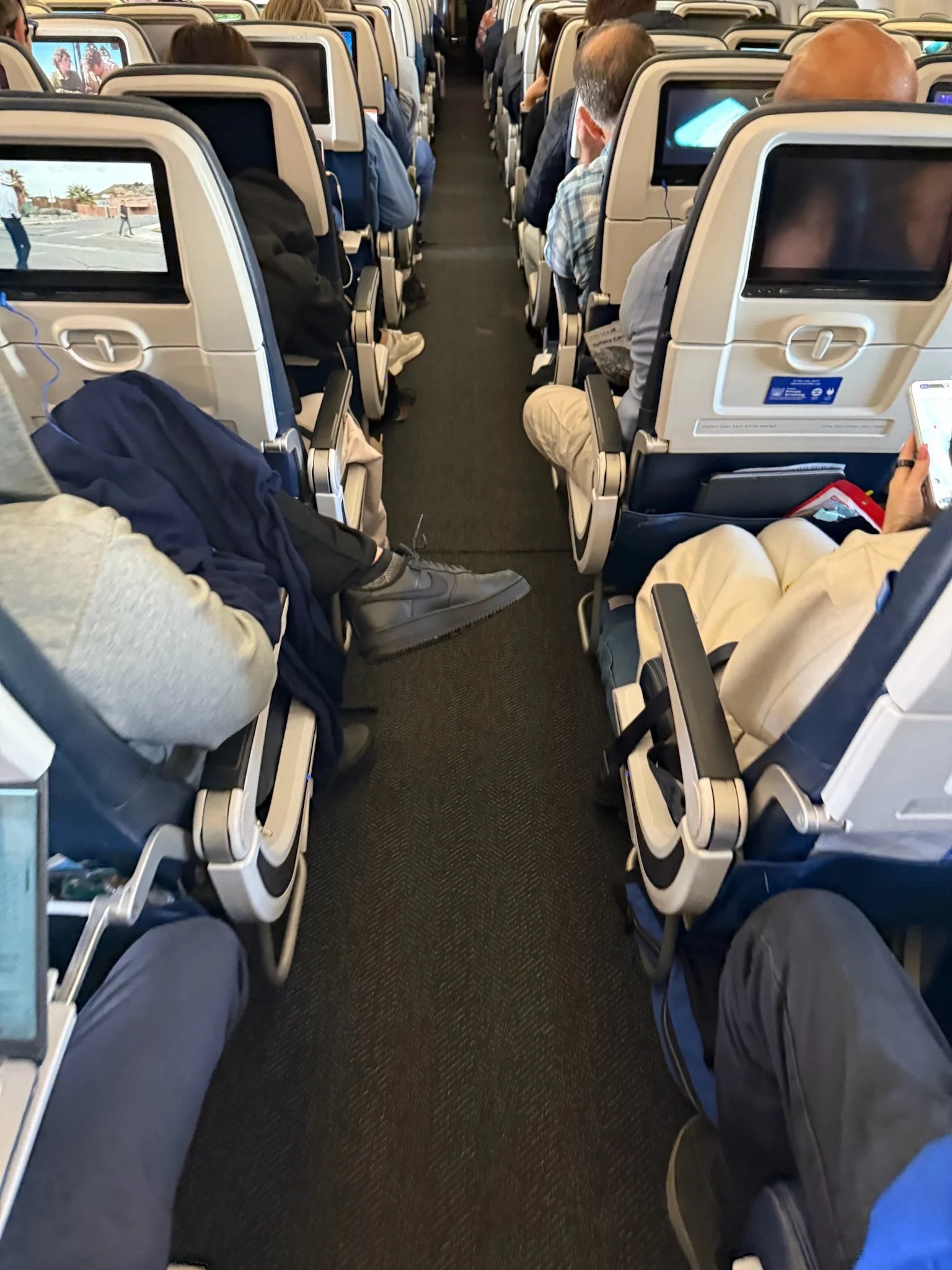
Finally, we said goodbye and flew home, stepping over this dude’s foot every time we had to get up lol. It was such a joyous trip and we felt so, so lucky to be able to see everyone. California, we love you!
Where does your family live? Close by or far away? How do you stay in touch? My sister and I also do five-minute phone calls.
P.S. Past California trips, and what it’s like to be twins.

Soaring fertilizer prices from Iran war impacting Connecticut farmers

Proposed bill aims to expand wetlands protections across Delaware

Florida woman arrested after allegedly squatting in home and selling owner’s appliances

GOP Senate candidates campaign in Coastal Georgia

Hawaiian Electric warns of coming bill spike | Honolulu Star-Advertiser

Florida High School Football Rankings: Top 25 teams – Oct. 21

How old is Bo Nix? What to know about Oregon quarterback ahead of 2024 NFL Draft

Cleary's 21 help Le Moyne down Central Connecticut State 69-64 in OT

99th annual Pony Swim held in Virginia

Indiana Members Credit Union announced as new anchor tenant at Bottleworks District

GOP leaders endorse Trump’s shutdown-proof move to end DHS funding lapse

Palestinians in West Bank protest, strike against Israeli death penalty law

Judge delays Luigi Mangione’s federal trial by about a month but won’t push it to next year | CNN

Video: Trump Says U.S. to Leave Iran ‘Very Soon’

April showdowns: 4 key races to watch this month that will test Trump, GOP grip on power
-

 South-Carolina4 days ago
South Carolina vs TCU predictions for Elite Eight game in March Madness
-

 Miami, FL6 days ago
Jannik Sinner’s Girlfriend Laila Hasanovic Stuns in Ab-Revealing Post Amid Miami Open
-

 Culture1 week ago
Do You Know the Comics That Inspired These TV Adventures?
-

 Education1 week ago
Video: Trader Joe’s Dip Head-to-Head Taste Test
-

 Minneapolis, MN7 days ago
Boy who shielded classmate during school shooting receives Medal of Honor
-

 Tennessee1 week ago
Tennessee Police Investigating Alleged Assault Involving ‘Reacher’ Star Alan Ritchson
-

 Culture1 week ago
Wil Wheaton Discusses ‘Stand By Me’ and Narrating ‘The Body’ Audiobook
-

 Vermont4 days ago
Skier dies after fall at Sugarbush Resort