San Diego, CA
Guest Commentary: How bad are San Diego’s streets? We can see for ourselves


Another new, and expensive, comprehensive survey to tell us what we already know about San Diego’s streets (“Just how bad are San Diego’s streets? With two major evaluations coming, the city faces a watershed moment,” Jan. 4, La Jolla Light).
City officials say they’ll take it as a “call to action.” Taxpayers need action, period!
Simply drive around our city’s streets, as we do daily, to see the pathetic shape of our infrastructure. Residents have been complaining for years, with meager action from city officials. But this time will be different? Suddenly city Transportation Director Bethany Bezak has had an epiphany because a new laser study will produce more data to tell us what we already know?
The referenced 2016 study illustrated what everyone knew about San Diego’s streets: They were a disaster. Now they are worse. The streets were so poor in 2016 that a City Council member sponsored Proposition H, a measure in which a dedicated fund, including from tax revenue, was earmarked for street and infrastructure improvements. Proposition H was supported by 65 percent of San Diego voters in 2016 and adopted. What has happened to the money from the adoption of Proposition H?
The City Council voted in 2021 to allocate the money to the city’s general fund. The money has effectively been stolen from taxpayers who voted for its intended use — to fix our infrastructure. City officials are mum about Proposition H and the total tax money diverted.
Now a sales tax increase is being discussed to pay for some of the road repairs San Diego taxpayers voted to pay for in 2016 with Proposition H.
It appears city officials will recommend bringing more road repairs in-house due to a lack of local contractors. This is comforting news because the historical street maintenance overseen by the city has resulted in the infrastructure we have today: complete failure.
The city also oversees its infamous Get It Done app for street repairs. How has this worked?
Perhaps the shortage of local contractors is due to the city’s litany of qualifications required for city work eligibility, eliminating many willing to bid. Taxpayers get less results for more money.
Our city might want to consider best practices of other cities. Drive to any incorporated area in San Diego and look at the streets. Drive to Orange County, where medians are tidy and streets are silky smooth. Even Los Angeles’ streets are superior to San Diego streets.
How is it that San Diego has lagged so far behind other municipalities with the maintenance of its streets and sidewalks? What have our mayor, City Council and streets department been doing?
Suddenly San Diego is going to magically shuffle the deck of ineptitude because of a new laser study, create a new tax and then, poof, our streets will be repaired? We are asked to trust these same people to do a job they have been unable to accomplish over the past 10 to 15 years? Taxpayers would be foolish.
It is incomprehensible that the city is still studying this problem. The mismanagement of our infrastructure is alarming, and citizens should demand change. The status quo cannot be depended on to produce results due to a new study.
We need street work now, not a “call to action” based on a new study.
Ted Levis is the owner of Emerald Properties in La Jolla. ◆



CHULA VISTA (CNS) – The California Highway Patrol activated a Silver Alert today to help locate a 79-year-old woman last seen in Chula Vista.
Evangeline Rodriguez was last seen about 5:55 a.m. Thursday at Wildbrook Place and Woodspring Drive in Chula Vista. She is believed to be driving a white 2018 Honda CRV with California license plate 9JBS786.
Rodriguez is Hispanic, 5 feet, 2 inches tall, 130 pounds, with brown hair and brown eyes, last seen wearing a T-shirt and blue jeans.
Anyone who sees Rodriguez, or knows where she is, is urged to call 911.
The CHP activates a Silver Alert when an elderly or developmentally or cognitively impaired person is missing and determined to be at risk. It is
hoped providing immediate information to the public will aid in their swift
recovery.
Copyright 2026, City News Service, Inc.

Jim Dutton, local bestselling author, will discuss his legal thriller Path to Revenge at an in-person meeting at 2 p.m. on Thursday, July 23. hosted by Del Mar Community Connections Page Turners. The meeting will be held at St. Peter’s Parish Hall, 334 14th St. in Del Mar. The discussion occurs in partnership with the Del Mar branch library. Registration is required. DMCC has reserved a limited number of complimentary copies of the novel for 92014 residents who want to get in on the discussion.
Revenge is a dish best served cold, and in this explosive sequel, it’s lethal. Path to Revenge is a gripping psychological legal thriller that dives into government corruption, internal affairs investigations, and grand jury drama. Haunted by his past and driven by a relentless need for justice, Nick Drummond finds himself torn apart by an organized crime vendetta and his actions to bury the truth. If you love unreliable heroes, hard-boiled detectives, and high-stakes litigation, this is your next binge-worthy read, a news release states.
Dutton was a career prosecutor in California. National television shows 48 Hours, Cold Case, and Forensic Files have featured his murder trials. He prosecuted numerous child molestation and rape cases. He was the chief of the California Attorney General’s Money Laundering Program for 20 years and testified before the U.S. Congress several times on that subject. Dutton was the representative for human trafficking for the San Diego-based California Attorney General’s Office and incorporated a human trafficking analysis in his Money Laundering Manual for law enforcement, the news release stated.
Dutton is an avid outdoorsman, photographer, and traveler. He has written numerous travel and legal articles over the years. He lives with his wife, two sons, and their incorrigible, skunk-seeking dog, Wylie Coyote, in Del Mar.
Del Mar Community Connections (DMCC) is an independent 501c3 nonprofit organization with a mission to support and serve the older adults of Del Mar so that they may age independently at home. DMCC helps seniors live active, vibrant lives by providing transportation, education, and social activities, including cultural discussions like Page Turners. Those interested in attending the discussion will find the registration link at www.dmcc.cc/PageTurnersRegistration, or call the DMCC office at (858) 792-7565 to receive assistance.

LOS ANGELES — Adrian Morejón made the pitch he was supposed to and got the result he was supposed to.
But that pitch might have begun the Padres’ final minute of relevance in 2026.
Because 58 seconds later, as Teoscar Hernández’s grand slam cleared the wall in left-center field, Dodger Stadium was literally rocking and the Padres were clearly shaken.
“Games like this, games like the last six nights, it’s not great,” second baseman Jake Cronenworth said late Friday night. “We’ve got to somehow turn it around, and me not making that play doesn’t help.”
He referred to a 4-3 loss to the Dodgers that ran the Padres’ losing streak to seven games, and he referred to his booting a double-play grounder in the seventh inning that immediately preceded Hernández’s homer.
“I lost this game,” Cronenworth said. “Simple as that.”
It was a bitter ending to a night that showed the potential of the Padres’ No.1 starter and their offense to keep the team contending.
Michael King worked six scoreless innings in the most economical way, and the Padres built a 3-0 lead by scoring in the first, fourth and sixth innings against Shohei Ohtani.
Then King’s command faltered at the start of the seventh inning, and the Padres’ season continued to slip away with it.
Two innings later, they were officially a sub-.500 team.
The Padres did not reach base against Edgardo Henriquez in the eighth or Tanner Scott in the ninth, meekly finishing off their 26th loss in the 40 games since they beat the Dodgers on May 18 to move into first place in the National League West.
The Padres were 29-18 at that point. They are now 43-44 and sit four games out of the final NL wild-card spot.
Their five losses on this road trip included a 23-3 drubbing Wednesday in Chicago and a 12-7 loss Thursday in a game they led 6-0 after two innings.
“They’re testing how we can handle the failures of the season and if we can come back,” manager Craig Stammen said of the recent results. “And I like the attitude of this team. I think we will come back. Right now, it stinks. It feels very awful. It’s a gut punch, but we’ve got to bounce back tomorrow and play our best game.”
That was what especially stung Friday. They played well.
King’s outing was the first in seven games by a Padres starting pitcher that lasted longer than 4⅔ innings. It was the first time in 10 games that a Padres starter made it through six innings.
But he began the seventh by walking Mookie Betts and yielding a soft single to Max Muncy.
Morejón was brought in to face Kyle Tucker and got him to hit what seemed to be a double-play grounder directly at Cronenworth, who hurried a bit too much and had the ball come out of his glove as he went to transfer it to his hand.
“Morejón coming into the game, I know a groundball is coming to me,” Cronenworth said. “I was anticipating it the whole time he walking in from the bullpen and I didn’t make the play and lost the game for us.”
That and the slider Morejón left thigh high and over the middle of the plate.
“Obviously, it’s frustrating,” Morejón said through interpreter Jorge Merlos. “You’re talking about a bullpen that everybody relies on, and unfortunately today it was my day that it hit me. We’re going through a rough spot. And it just feels even more difficult, not just for myself but especially the outing that Michael had out there and the way he was throwing. They call on me for those situations that I’ll be able to get out of it, and unfortunately it didn’t happen tonight.”
The normally loquacious and candid King was in no mood to discuss the outing in depth. For the first time in his three seasons with the Padres, his postgame answers were clipped and terse.
His pitches were doing what he wanted and going where he wanted for six innings, perhaps on par with his best outings of the season.
“Fine,” he said of his outing. “Didn’t win the game.”
While King frequently is of the opinion he should be left in a game, it seemed readily apparent he did not think he should have been taken out after 75 pitches.
“I wanted the next batter,” he said.
Stammen had other plans. He decided to try to ride Morejón and closer Mason Miller for the fional nine outs.
“Dominated,” Stammen said of King. “Great outing by him. One of his best. He had a tough one the last one, and he bounced back with one of his better ones. He knew we needed it, and he gave it to us. We just weren’t able to finish it off for him.
“It always makes it tougher when you have a lead late in the game and aren’t able to hold it and finish the game. He was very efficient with his pitch count and probably had more in the tank, but at that point we felt really good about going to our bullpen and using one of our best guys to get some of their left-handed hitters.”
Instead, after Morejón got through the seventh, Bradgley Rodriguez worked the seventh.
Where the Padres’ offense failed at the end, getting runners on first and second with one out in the seventh before making the final eighth outs in succession, it started well against Ohtani, who shut them out over five innings last month and entered the game with a 1.58 ERA.
The Padres scored the first run Ohtani surrendered in the first inning this season when Fernando Tatis Jr. and Cronenworth walked to start the game and Gavin Sheets drove in Tatis with a one-out single.
That hit also got Cronenworth to third, where he was stranded when Ty France and Jackson Merrill struck out.
All three pitches to Merrill were fastballs — the first and last at 100 mph, the middle one at 101.
Ohtani threw 29 pitches in the first and then retired the next eight batters on 34 pitches before Merrill came up with two outs in the fourth and homered to center field on a 100 mph fastball — on a 2-0 pitch that immediately followed Merrill winning an ABS challenge.
The Padres scored in the sixth on a two-out single by Merrill and Xander Bogaerts’ double.
King got through MLB’s most dangerous lineup in 30 pitches and without anyone reaching base before allowing his first hit — a two-out single by Freddie Freeman — in an eight-pitch fourth inning.
Against the Dodgers five days earlier at Petco Park, King navigated four innings having allowed a run on two hits and thrown strikes on nearly three-quarters of his 61 pitches. Then, in his words, he “fully lost it.”
He retired one of the six batters he faced, walked three, hit one and allowed a single as the Dodgers scored three runs and ran him from the game.
On Friday, King struck out two and added just 12 pitches in a 1-2-3 fifth inning and was at 68 pitches after stranding runners at first and second in the sixth.
Then came the end, with the Padres’ best starter unable to get an out and one of their best fielders making an error and one of their best relievers making a bad pitch.
“It’s a tough game and good opponent,” Stammen said. “Sometimes, things you think should always happen — it’s a game of failure and bouncing back, and tonight that kind of hurt us there in just that one inning, but we played eight other good innings. … It adds to the frustration of this last week of baseball for us. Those guys are very dependable players.”
-

 Kansas3 minutes ago
2026 K-State Football Early Opponent Preview, Game 6: Kansas
-

 Kentucky3 minutes ago
Recovery operations underway to find possible drowning victim on Kentucky Lake | NewsRadio 1230 AM/99.3 FM | Hopkinsville’s News Leader
-

 Louisiana11 minutes ago
Man killed, officer injured in shooting in alleyway near Sand Bar in downtown Shreveport
-
Maine18 minutes ago
People We’ve Lost
-
 Maryland21 minutes ago
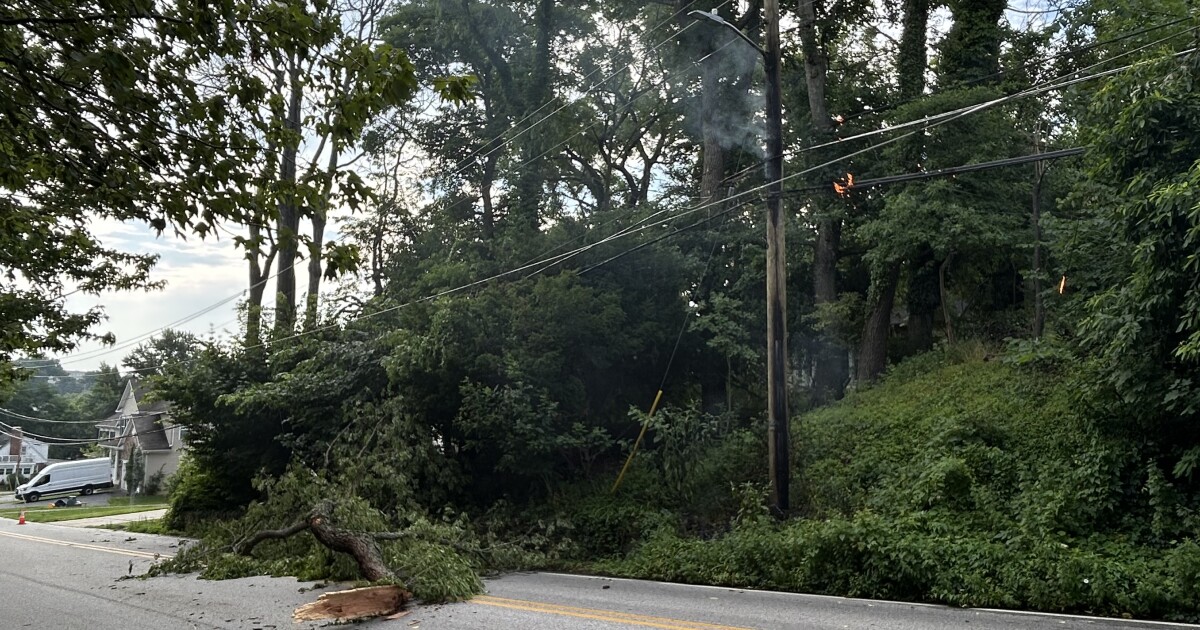
BGE working to restore power to over 40,000 customers after July 4th storms move through central Maryland
-

 Michigan26 minutes ago
Fifth Third, Comerica merger: What Michigan customers need to know
-

 Massachusetts33 minutes ago
EV sales have slowed down. That puts pressure on Massachusetts’ climate goals. – The Boston Globe
-

 Minnesota35 minutes ago
Summer heat and humidity continue in Minnesota with low storm chances midweek

