San Diego, CA
Dodgers swept in San Diego as Clayton Kershaw struggles


SAN DIEGO — The windup looks the same, his arms stretching toward the sky and one leg paused in mid-air before delivery. The stuff coming out does not.
In his second start since returning from shoulder surgery, Clayton Kershaw was roughed up by the San Diego Padres for seven runs and failed to get through four innings in an 8-1 loss for the Dodgers on Wednesday night.
“Not very good,” Kershaw said afterward. “Just not a lot went well at all. Just got to pitch better.”
The same could apply to the Dodgers as a whole.
The surging Padres completed a sweep of the two-game series and have won nine of their past 10 games. The Dodgers finished with a losing record in July (11-13), their first losing record over a full calendar month since April 2018.
The combination has pulled the Padres to within 4½ games of the Dodgers in the National League West – the smallest the Dodgers’ lead has been since May 4.
“It’s a long year,” Dodgers catcher Will Smith said. “There’s going to be injuries. There’s going to be tough times. There’s going to be good times which have been this year. So, yeah, it’s part of it. We’ll come out of it. No doubt about it. We’re the Dodgers. We’re the best team in baseball.”
There has been precious little evidence of that recently – and even farther back than just July. Since May 20, they are 30-29, the ninth-best record in the National League.
“The defense I love. We’re playing hard. I think offensively, the guys we run out there are prepared. They’re putting good at-bats together,” Dodgers manager Dave Roberts said. “Overall, the pitching in general, we just haven’t had the effectiveness, the command. There’s a lot more homers in the last 30 days, in the month of July. The walk is up from all the pitchers. And it just puts a lot of stress on the offense.
“Yeah, we’re going to get back to health. I still like the guys we got. I still feel good every time we start a game. But we still have to go out there and play 27 outs.”
Kershaw could only get 11 of those against the Padres.
When Kershaw made his comeback start against the San Francisco Giants last Thursday, he allowed six hits in four innings – but he also struck out six and got 14 swings-and-misses in all, eight on his slider.
There was none of that against the Padres. He didn’t strike out a batter – the first time in his career that Kershaw started a regular-season game and didn’t record a strikeout. He didn’t get a swing-and-miss until his 23rd pitch (a slider to Padres catcher Luis Campusano) and got just one more (on the 81st of his 83 pitches).
In his four innings against the Giants, Kershaw’s fastball averaged 90.6 mph – in line with his average fastball over the three seasons before shoulder surgery. Against the Padres, it dipped below 90 mph.
“Just wasn’t executing,” Kershaw said. “Wasn’t throwing really anything that I wanted to, where I wanted to. Frustrating overall.”
Roberts said it’s not surprising that Kershaw’s return from surgery would have its bumps.
“I think it’s hard to ever bet again Clayton,” he said. “The last one (against the Giants) I thought was very good and tonight just wasn’t great. I think he’ll be the first to say that. But it’s part of the process. I just don’t think that anyone can expect him to come back and be lights out every start out, certainly after two starts.”
Kershaw acknowledged that there might be some rust after rehab.
“Physically I feel fine,” he said. “I mean honestly I felt pretty good with the last one overall. But this one obviously, this was really bad. I didn’t think there was rust, but maybe. I don’t know. Just got to pitch better.
“There’s a lot you can overanalyze when you pitch bad, but for right now I’m just going to say it was bad and try to pitch better the next one.”
Kershaw’s troubles started in the second inning when the Padres scored four times on three singles, a walk and a wild pitch. Kershaw could have limited the damage but he fumbled Bryce Johnson’s squeeze bunt, allowing a run to score and extending the inning for Jurickson Profar’s two-out RBI single.
“I gotta make that play,” Kershaw said. “That was an easy out at home right there. The bunt was right back to me. Have to make that play, and the inning’s a lot different. That’s on me. That was super easy. That was a super frustrating mistake there.”
He retired the side in the third but gave up a one-out home run to Campusano in the fourth and then singles to Johnson and Profar wrapped around an error by second baseman Gavin Lux. After Xander Bogaerts drove in the third run of the inning with a sacrifice fly, Roberts pulled Kershaw rather than have him face Manny Machado for the third time in four innings.
Four of the Padres’ runs off Kershaw were unearned, still leaving him with a 5.87 ERA after two starts. More troubling perhaps, the two lineups he has faced have batted .333 (12 for 36) against him.
“I just think it’s executing it, where it’s getting to,” Smith said. “It’s nothing concerning to me at all. It was just one of those days.”
Padres starter Dylan Cease was making his first start since pitching a no-hitter against the Washington Nationals and a three-start stretch in which he allowed a total of two hits in 22 innings. Cease was not as dominant. He only went 5⅔ innings and needed 101 pitches (only 59 strikes) to do that.
But the Dodgers managed just one run against him on an RBI double by Lux in the third inning. They struck out six times against Cease and four more times in 3⅓ hitless innings against the Padres’ bullpen.
While losing four of the first five games on this road trip (which continues in Oakland this weekend), the Dodgers’ depleted lineup has managed 31 hits while striking out 66 times.
“Those guys – Mookie, Muncy, Freddie, other guys – those are dudes. Those are dudes that help us win ballgames so it’s tough,” Smith said of the key parts missing from the Dodgers’ lineup. “We still have a really good ballclub here without those guys. We just need to play better and win some ballgames.”
Originally Published:



Here is what you need to know in the March 23, 2023, Streamline newsletter:
The Trump administration has ordered ICE agents to airports across the U.S. to help shorten security lines as the partial government shutdown surpasses the 40-day mark.
Just as last week’s heat wave comes to an end, another round of high temperatures is coming back to San Diego County. Max Goldwasser’s microclimate forecasts will help you get ready for this week’s warm weather.
In your consumer news, we’ve got details on the “Buy Nothing Project,” a global movement that is connecting people with the things they need for free.
WEEKEND WRAP-UP
THE STREAMLINE
WATCH — ABC 10News brings you The Streamline for Monday, March 23 — everything you need to know in under 10 minutes:
The Streamline: Monday, March 23
TOP STORY
ICE agents were expected to begin handling some security duty at numerous U.S. airports Monday amid an ongoing partial government shutdown that has sidelined many Transportation Security Administration officers, with border czar Tom Homan in charge of the effort.
Federal officials said Sunday that border czar Tom Homan would be in charge of the effort to use immigration enforcement personnel to supplement security at airports amid the shutdown, which has left roughly 50,000 TSA employees working without pay, contributing to increased absenteeism and staffing shortages at airports nationwide.
Early Monday morning, ABC News — citing sources — published the following list of airports where ICE agents would be deployed:
- Chicago-O’Hare International Airport
- Cleveland Hopkins International Airport
- Hartsfield-Jackson Atlanta International Airport
- Houston’s William P. Hobby Airport
- Houston’s Bush Intercontinental
- John F. Kennedy International Airport (New York)
- LaGuardia Airport (New York)
- Louis Armstrong New Orleans International Airport
- Luis Munoz Marin International Airport (San Juan, Puerto Rico)
- Newark Liberty International Airport
- Philadelphia International Airport
- Phoenix Sky Harbor International Airport
- Pittsburgh International Airport
- Southwest Florida International Airport (Fort Myers, Florida)
It was unknown if San Diego International Airport would be added to the list.
Meanwhile, some local officials balked at the Trump administration’s announcement, including a top TSA official at San Diego International Airport.
“I have no idea how they can contribute at an airport unless it was for intimidation purposes,” Aaron Vazquez, a TSA lead transportation security officer at SAN and assistant airport steward for the American Federation of Government Employees Local 1260 in San Diego, told City News Service on Sunday. “What are they going to do, find somebody and shoot them?”
Vazquez said his job is to make sure travelers are not a threat to security, which has nothing to do with immigration enforcement.
“I don’t want them anywhere near the checkpoint and officers that I’m in charge of. I don’t want them interfering with what the officers are trying to do,” Vazquez told CNS.
“I don’t need an ICE agent telling passengers what to do. We are trained to be nice to passengers. They are law enforcement so they are armed. TSA is not,” he added.
City Councilwoman and Airport Authority Board Member Marni von Wilpert also objected to the idea.
“ICE’s aggressive, abusive conduct makes us less safe. Putting ICE in our airports will make travel more chaotic, more stressful, and less secure — not better,” she said. “ICE has already shown it refuses to follow the law and respect our communities — so I’m deeply concerned about what this deployment will mean for San Diego travelers and the thousands of workers at San Diego International Airport.
“… The solution to long security lines and airport delays is simple: Congress needs to properly fund and staff TSA now,” von Wilpert added.
“.. I have been in touch with San Diego Airport Authority staff and legal counsel. We do not yet know the full scope of ICE’s plans at the airport, but we are working to get answers and minimize disruption and anxiety for travelers and our workforce.”
Rep. Scott Peters, D-Poway, posted a photo of long lines at the airport on Sunday with the following message:
“View from the San Diego airport at 6:30 this morning. It doesn’t have to be like this. I have a bill to pay TSA workers, Coast Guard and emergency management without adding more to ICE and Border Patrol. Easy, right? But Trump won’t allow it. As the DHS shutdown drags into nearly 40 days, federal workers and travelers shouldn’t have to suffer from Republican inaction.”
Homan told CNN’s “State of the Union” on Sunday that the effort was about “helping TSA do their mission and get the American public through that airport as quick as they can while adhering to all the security guidelines and the protocols.”
“We’re simply there to help TSA do their job in areas that don’t need their specialized expertise, such as screening through the X-ray machine,” he said. “Not trained in that? We won’t do that. But there are roles we can play to release TSA officers from the non-significant roles, such as guarding an exit so they can get back to the scanning machines and move people quicker.”
On Saturday, President Donald Trump said he would order ICE agents to assist with airport security if Congress did not immediately reach an agreement to fund TSA officers.
In a social media post, Trump said ICE agents could also be tasked with making immigration arrests at airports.
“If the radical left Democrats don’t immediately sign an agreement to let our country, in particular, our airports, be FREE and SAFE again, I will move our brilliant and patriotic ICE agents to the airports where they will do security like no one has ever seen before,” Trump wrote on Truth Social.
The proposal comes as a partial government shutdown has left roughly 50,000 TSA employees working without pay, contributing to increased absenteeism and staffing shortages at airports nationwide.
Administration officials said about 10% of TSA workers failed to report for duty on some recent days, compared to typical rates of less than 2%.
“Officers have to take matters into their own hands and not come to work,” Vazquez said. “They are stressed, they are coming to me saying `what can I do?’ They can’t afford gas to get to work.”
The usual un-planned absence call-out before the shutdown was about 20 officers per day in San Diego. Now there are about 70 to 80 officers per day who are not going to work, according to Vazquez.
“They (ICE agents) can monitor traffic of the passengers to make sure they don’t get out of line or go through the stanchions,” Vazquez said. “I don’t understand what we need help with if it’s not people that are able to screen the passengers.”
Meanwhile, travelers are being warned to expected delays. The San Diego County Regional Airport Authority issued a travel advisory Sunday for passengers traveling out of the city’s airport.
“Passengers traveling out of San Diego International Airport are encouraged to check their flight status before coming to SAN and plan to arrive at least two hours before their flight,” airport spokeswoman Nicole Hall said Sunday, the second day the airport was experiencing delays.
“Checkpoint wait times and flight scheduling are subject to the operations of our federal and airline partners. These operations are, at times, affected by the federal government shutdown.”
Hall said an influx of seasonal spring break travelers was also affecting wait times, which could take up to one hour during a “fluid situation.”
“We appreciate the ongoing commitment from TSA, FAA, and our partner airlines to maintain the safety and reliability of the national transportation system during this challenging time,” Hall said. “Our focus remains on ensuring a safe and efficient airport experience.”
Travelers to SAN were encouraged to plan ahead and arrive two hours before domestic flights and three hours prior to international departures.
Travelers can check flight status updates at https://www.san.org/Flights/Flight-Status.
The average wait time is about 20 minutes to get through airport security at SAN when fully staffed with a maximum wait time of 30 minutes, but some wait times on Saturday were up to an “unheard of” 80 minutes, according to Vazquez, who said “Saturdays are usually chill.”
Before the shutdown, about 500 to 550 officers were available to screen each day in San Diego.
Story by City News Service
MICROCLIMATE FORECASTS
Coasts
Inland
Mountains
Deserts
BREAKING OVERNIGHT
President Trump on Monday morning announced he is ordering the postponement of airstrikes on Iran’s energy facilities because of what he cited as “very good and productive” talks with Iranian leadership to end the war.
The president said the pause would last five days; several days ago, Trump set a deadline for Iran to reopen the Strait of Hormuz or the U.S. would “obliterate” Iranian power plants.
In response, Iran issued its own threat of laying mines across the entire Persian Gulf.
Trump calls for five-day pause in strikes on Iranian power plants, energy sites
CONSUMER
An online platform is helping people turn to their neighbors instead of stores for all sorts of items — for free!
WATCH — Consumer reporter Marie Coronel explains how the “Buy Nothing Project” is not only connecting community members, but also saving them money:
How the ‘Buy Nothing Project’ is helping consumers find necessities for free
WE FOLLOW THROUGH
The escalating conflict in the Middle East is driving up fuel prices nationwide, and in the North County, several Oceanside gas stations have already surged past the six‑dollar mark.
AAA reports that the average price for a gallon of regular gas in San Diego County has climbed to $5.86 — up $1.20 from this time last year. Meanwhile, the national average is creeping closer to $4.
WATCH — Reporter Jane Kim spoke with some San Marcos residents who are finding ways to cope with the higher costs cutting into their budgets:
Gas prices in San Diego County hit highest levels since 2023 as the war in Iran impacts crude oil costs
Thanks for waking up with us! If you have a story you want ABC 10News to follow through on, fill out the form below:
We Follow Through
Want us to continue to follow through on a story? Let us know.

It’s your girl Jenna Bay here in San Diego with Sports Illustrated, about to talk to some diehard college basketball fans.
Which team are you here to support?
Panthers.
Lawrence, Kansas, baby.
Go Jayhawk.
Let’s go, Rockhaw.
You and I, Panthers, baby.
Let’s go.
Go, Panthers.
Villanova, Utah State.
Utah State Aggies.
Now what does it mean to have the heart of a Panthers?
Small town of Iowa.
We’ve got a lot of.
Alum that are out here from the West Coast here to support Crimson and Blue, baby.
Ever since I was born, Lawrence, Kansas, rock shock.
So my brother is the starting center, Duke Brennan.
So it’s huge, it’s awesome.
We have the whole family here and it just means so much that he’s a part of such a grand program, a blue blood and a brotherhood.
Live and breathe Panther basketball and all their sports.
We’ve won 3 Natties, so you know, winning is in the DNA, you know, having that Philly toughness, having that pride.
Do you have a favorite memory of being a supporter, a fan?
Yeah, in 2008, Mario Chalmers, you know, Darnell Jackson, Sharon Collins.
I was in 8th grade, won the national championship.
I was there at that parade.

For more than 30 days now, TSA employees have been working without pay. That has caused more than 400 TSA workers to quit. Others are calling out sick in record numbers. Those shortages have been triggering hour-long security lines.
The head of TSA operations in San Diego said the partial government shutdown is not only impacting TSA lines at airports, but also his livelihood and the lives of many federal employees who are experiencing a lot financial pressure.
“Absolute shock because that’s just the most ridiculous thing I’ve heard yet out of this,” Robert Mack said.
This is how Robert Mack is responding to President Trump’s announcement on Truth Social to send ICE agents to airports on Monday as Senate leaders failed again to reach a deal to fund the Department of Homeland Security.
Mack oversees TSA operations at San Diego International Airport and is the Chief Steward with the American Federation of Government Employees 1260.
He joined the agency in the wake of the 9/11 attacks because he felt called to fulfill a civic duty.
“My heart spoke to me. You have an opportunity to defend your homeland your homefront,” Mack said.
But now, the career he once considered promising is bringing him and many other TSA employees financial strain and instability.
“We’re all hurting. Literally, checking accounts are all wiped out. We haven’t recovered from the last two that we’ve had before,” Mack said.
Mack is among the thousands of TSA employees working without pay since funding for DHS ran out last month.
Democrats vowed to withhold funding until Republicans agree to new reforms for ICE.
On Saturday, Senate Republicans blocked a Democratic bill that would have funded only TSA, but not the rest of DHS.
President Donald Trump then warned on social media that if TSA is not funded by Monday, “ICE is ready to go,” and will provide airport security.
And their work would include the “immediate arrest of all Illegal Immigrants who have come into the country.”
“I think he’s wrong completely… there are really good immigrants here, they’ve been here for 20, 30, 40, 50 years… they pay their taxes and they’re good people,” Barnard Jourdain, who was travelling through San Diego said.
As agents continue to struggle without a check and the political stalemate continues, Mack anticipates more TSA employees will call out in the coming days or move on from what they once considered a promising career.
“My duty is still the same, but at the end, if I can’t put food in my stomach, I can’t keep a roof over my head, the people I’m supposed to be taking care of are failing me,” Mack said.
NBC 7 San Diego reached out to TSA for a comment and is awaiting a response.

How a Family of 3 Lives on $500,000 on the Upper West Side

Human remains found in 1977 in California identified as Detroit-area native

US: Electric air taxi flies over San Francisco in major demonstration

The best day to list your home in Dallas-Fort Worth is less than a month away

Miami-Dade trainer helps young athletes chase their next big opportunity

Florida High School Football Rankings: Top 25 teams – Oct. 21

How old is Bo Nix? What to know about Oregon quarterback ahead of 2024 NFL Draft

Cleary's 21 help Le Moyne down Central Connecticut State 69-64 in OT

99th annual Pony Swim held in Virginia

Indiana Members Credit Union announced as new anchor tenant at Bottleworks District

Video: Plane Collides With Vehicle at LaGuardia Airport

As cattle herds shrink and beef prices rise, investors back AI cow collars

French elections: Paris stays left as far right makes mixed gains

ICE officers set to deploy to airports as delays mount, border czar Homan confirms

Video: ICE Agents Will Be Deployed to U.S. Airports, White House Confirms
-

 Detroit, MI5 days ago
Drummer Brian Pastoria, longtime Detroit music advocate, dies at 68
-

 Oklahoma1 week ago
Family rallies around Oklahoma father after head-on crash
-

 Georgia1 week ago
How ICE plans for a detention warehouse pushed a Georgia town to fight back | CNN Politics
-
 Science1 week ago
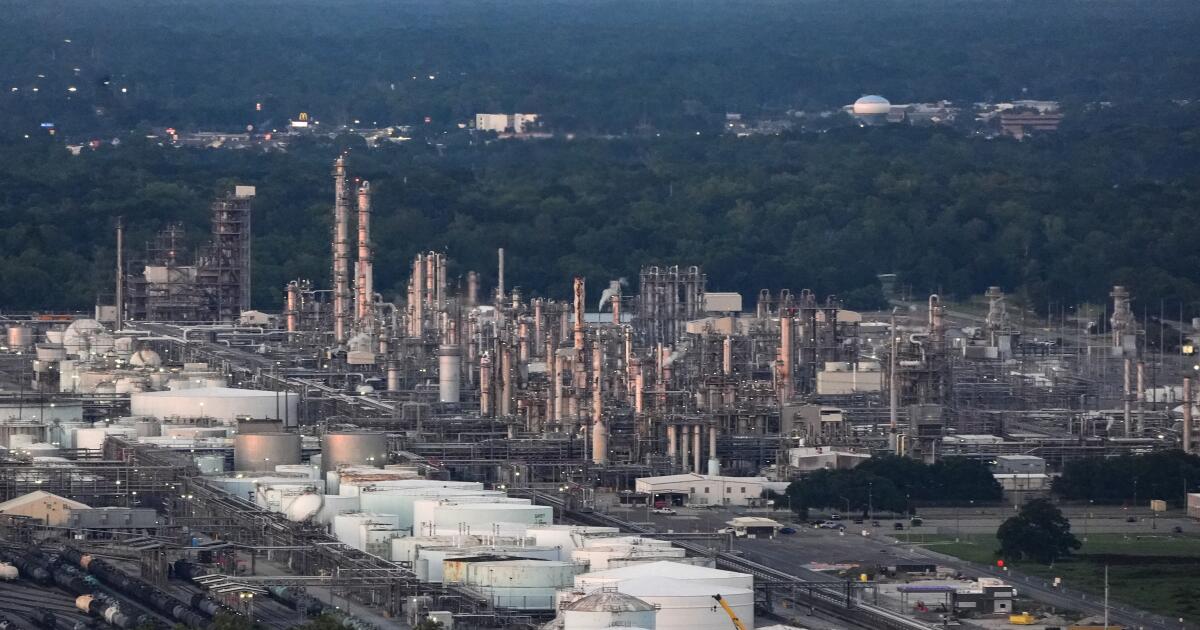
Federal EPA moves to roll back recent limits on ethylene oxide, a carcinogen
-

 Alaska1 week ago
Police looking for man considered ‘armed and dangerous’
-

 Movie Reviews4 days ago
‘Youth’ Twitter review: Ken Karunaas impresses audiences; Suraj Venjaramoodu adds charm; music wins praise | – The Times of India
-
 Science1 week ago
Long COVID leaves thousands of L.A. county residents sick, broke and ignored
-

 Texas3 days ago
How to buy Houston vs. Texas A&M 2026 March Madness tickets