California
10 of 15 Southern California industries slow their hiring pace

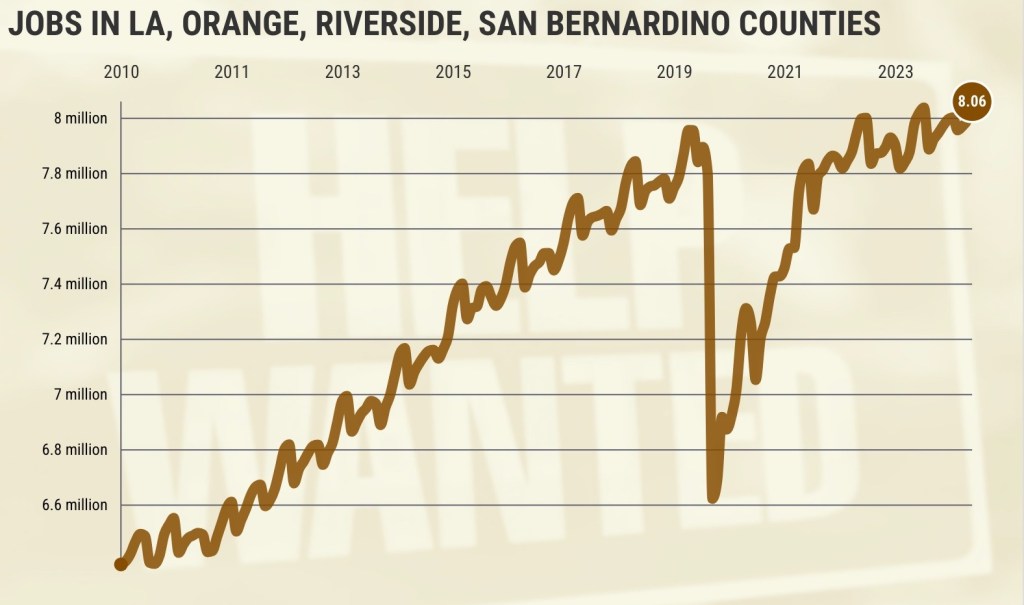
Southern California’s bosses added 80,700 workers in the past year to a record 8.06 million jobs – but that hiring pace is roughly half of the pre-pandemic job market’s gains.
My trusty spreadsheet – filled with state job figures for Los Angeles, Orange, Riverside, and San Bernardino counties – compared employment changes for the region and 15 industries in the year ended in October with the average yearly hiring pace before coronavirus upended the economy.
Yes, there have never been more Southern Californians employed. However, the recent hirings that created the all-time high staffing are far below the average job creation of 159,600 a year in 2015-19.
This is one of many signals of cooler business trends. It’s a chill significantly tied to the Federal Reserve’s attempts to slow what was once an overheated economy.
But Southern California bosses have another challenge – a shortage of workers. The region’s workforce, a measure of labor supply, is basically flat comparing 2024 to 2015-19. Fewer choices of workers have added difficulty for local businesses trying to meet their staffing needs.
Think of that when you learn that among the 15 Southern California business sectors tracked – hiring in 10 industries is below pre-pandemic years compared with five industries with improvements.
The downs
First, contemplate the 10 industries where the hiring pace has weakened, ranked by the size of the decline …
Professional-business services: 1.14 million workers in October – down 4,600 in a year vs. 24,100 annual gains in 2015-19. This net downturn of 28,700 jobs is unnerving because this white-collar work typically pays above-average salaries.
Construction: 378,700 workers – down 3,100 in a year vs. 16,200 annual gains in 2015-19. A building slowdown due to lofty mortgage rates created this 19,300 reversal.
Logistics-utilities: 820,800 workers – up 6,800 in a year vs. 25,800 annual gains in 2015-19. What’s at least a temporary oversupply of warehouses in the region may be behind this 19,000 slowdown.
Manufacturing: 558,400 workers – down 15,300 in a year vs. 4,100 annual cuts in 2015-19. This 11,200 drop is continued losses of local factory work tied to high cost of doing business in the region.
Fast-food restaurants: 359,400 workers – up 3,400 in a year vs. 12,400 annual gains in 2015-19. Weaker consumer spending and a hike in the industry’s minimum wage contribute to this 9,000 drop.
Hotels/entertainment/recreation: 268,300 workers – up 3,400 in a year vs. 9,600 annual gains in 2015-19. This 6,200 cooling reflects worker shortages.
Full-service eateries/food service: 339,100 workers – up 1,600 in a year vs. 6,600 annual gains in 2015-19. Inflation making shoppers pickier is part of this 5,000 cooling.
Information: 214,200 workers – down 100 in a year vs. 3,700 annual gains in 2015-19. Weakness in tech businesses and Hollywood productions created the 3,800 net downturn.
Personal services: 266,600 workers – up 500 in a year vs. 3,200 annual gains in 2015-19. Again, it is hard to find people to do this work. Thus, a 2,700 cooling.
Government: 1.03 million workers – up 11,600 in a year vs. 12,500 annual gains in 2015-19. This 900 dip is status quo.
The ups
Ponder the five industries where the hiring pace rose in the past year, ranked by the size of the gains …
Social assistance: 512,300 workers – up 28,200 in a year vs. 18,300 annual gains in 2015-19. The 9,900 addition comes as more folks need help at home for healthcare and child care.
Healthcare: 836,700 workers – up 30,100 in a year vs. 20,900 annual gains in 2015-19. The 9,200 growth parallels the region’s aging population and its need for medical services.
Retailing: 748,300 workers – up 8,300 in a year vs. 300 annual cuts in 2015-19. This somewhat surprising 8,600 improvement may be consumers tiring of online commerce and wanting to get out to shop.
Financial: 364,100 workers – up 4,400 in a year vs. 3,900 annual gains in 2015-19. The minor 500 improvement is a return to normalcy. Super-heated hiring came in the pandemic days thanks to a brief drop in mortgage rates to historic lows.
Private education: 215,700 workers – up 5,500 in a year vs. 5,100 annual gains in 2015-19. This 400 uptick reflects the growing interest in alternatives to public schooling.
Bottom line
While it’s rare for all industries to be growing at the same time – minus, say, just after an economic downturn – this 2024 edition of the winners vs. losers list raises an important issue.
It appears much of the past year’s job creation is coming from industries that historically pay meager wages. That’s an especially worrisome trend in high-cost Southern California.
Jonathan Lansner is the business columnist for the Southern California News Group. He can be reached at jlansner@scng.com



Huntington Beach police are vowing to prevent a potential “takeover” event being promoted across social media that they believe could get out of control.
Police said they became aware of the event from a flyer online advertising an “end of summer beach bash” in the city.
“Dear ‘Beach Bash’ organizers…” police said in an Instagram post Thursday. “Thanks for the flyer. We’ve seen it too.”
They continued, “We have no intention of allowing that to happen here.”
No further details were provided about when the event was planned to take place or the exact location.
Police and the city of Huntington Beach said they’re working to prevent the event following similar events in Southern California that resulted in violence, vandalism and other criminal activity.
One chaotic event that was held in Newport Beach on the Fourth of July ended with more than 400 people being arrested, according to police. Some partygoers were seen fist fighting, while others allegedly vandalized property and local businesses, including a Pavilions grocery store.
Newport Beach police said social media posts drew a large influx of people to Newport Pier in a short amount of time, and the event got out of control.
Huntington Beach PD warned that anyone who organizes, promotes or participates in criminal activity associated with a takeover event may be arrested or prosecuted. Charges may include incitement to riot, vandalism, theft, assault, reckless driving, unlawful assembly, conspiracy or other applicable offenses.
They also warned that juveniles would not be exempt from punishment, and parents or guardians may also be liable for damages caused by their child’s actions.
The HBPD Special Investigations Bureau has already identified individuals believed to be involved in organizing and promoting the event, according to police.
If you have information regarding this event, you are urged to contact Huntington PD’s Special Investigations Bureau at 714-536-5991.
California
Popular California Fast-Casual Chain Mendocino Farms Opens 100th Location in Santa Barbara – edhat

Santa Barbara has become home to a milestone location for a popular sandwich and salad chain.
Mendocino Farms has officially opened its doors at La Cumbre Plaza, marking the company’s 100th location.
Located at 3851 State Street, the restaurant is Mendocino Farms’ first location in Santa Barbara.
Announcing its new store in a social media post, Mendocino Farms said the restaurant offers chef-curated sandwiches and fresh salads using seasonal ingredients.
“Whether you’re fueling your next adventure or settling in for a sunny lunch with friends, we can’t wait to be part of your community. Here’s to our next chapter, together!” the business wrote on Instagram.
View this post on Instagram
The restaurant features a custom mural by local artist DJ Javier, as shared by Mendocino Farms in an Instagram post.
The store opened on June 30 and marked its first day with a host of activities to celebrate its launch.
The opening day featured a live DJ, activities such as ‘Rodeo Riviera’, a hat bar, live sandwich-making sessions with the chefs, and a postcard station.
The location is open daily between 10:30 a.m. and 9 p.m., according to its website.
Diners can enjoy a special summer menu along with the regular options of sandwiches and salads that Mendocino Farms is known for.
View this post on Instagram
In addition to its menu options, the restaurant also offers catering services with deliveries available from 10 a.m. onwards.
The space occupied by Mendocino Farms earlier housed Panera Bread, which closed in 2025, per the Restaurant Guy.
About Mendocino Farms
The Los Angeles-based fast-casual chain is known for its selection of freshly made sandwiches, salads, wraps, and soups.
Founded in 2005, Mendocino Farms offers classic as well as limited signature items.
The company opened its first location below the Museum of Contemporary Art in Los Angeles and has since expanded into a regional brand, according to the Restaurant Guy.
In addition to California, Mendocino Farms has locations in Arizona, Colorado, Illinois, Texas, and Washington, the company’s website shows.
The restaurants feature a rotating menu of items, along with a range of kids’ menu items that are served with a beverage and a choice of side.
Additionally, the chain offers a variety of dessert options, packaged chips, and packaged beverages.
The company is known for sourcing all its ingredients from ethical local farms and small producers.
All meat and poultry items served are antibiotic-free and humanely raised, while eggs are sourced from cage-free farms, according to its website. Fruits and vegetables are hand-picked, and bread is locally and freshly sourced.
The menu includes a range of items to accommodate all types of diets, such as flexitarian, vegan, and gluten-free.
California
Toddler sustains brain injury in fall after California childcare worker threw him into the air, lawsuit says

A fitness club is being sued after an employee at one of its childcare facilities in Southern California threw a 23-month-old child in the air and failed to catch him, resulting in a traumatic brain injury, according to the complaint.
Matthew and Elena Kittle filed the lawsuit July 2 against The Bay Club, an upscale club with multiple locations, including one in El Segundo, just south of Los Angeles.
They allege that while their son, identified by the initials C.K., was at the daycare center at The Bay Club El Segundo on March 17, 2025, an employee tossed him into the air — 6 feet above the ground — but failed to catch him, the lawsuit says. C.K. fell to the ground and hit his head on the hardwood floor, and the employee fell backward and landed on top of him, the suit says.
It says The Bay Club downplayed the severity of the fall to the boy’s parents. C.K. sustained a concussion and still experiences side effects from the fall, the suit says.
The complaint, filed against The Bay Clubs Co. LLC and Bay Club South Bay LLC, alleges negligence; negligence per se; negligent hiring, retention and supervision; negligent infliction of emotional distress; fraud — intentional concealment; intentional infliction of emotional distress; and battery.

The Bay Club said it is unable to comment on ongoing litigation.
“At the Bay Club, the safety of our members, team members, and the families we serve is our highest priority,” it said in a statement.
The Bay Club LLC owns and operates private fitness and country clubs across the West Coast, including locations in Oregon, Washington and California.
Its El Segundo location has the El Segundo Clubhouse, which the club’s website describes as a 14,000-square-foot childcare center, where kids participate in activities under supervision.
The day of the incident, C.K.’s father dropped him off at the El Segundo Clubhouse. He told staff members he would be at the Bay Club Manhattan Country Club, a mile away, for the next three hours, according to the complaint.
C.K. was injured at 9:20 a.m., the suit says.
Security video, which was included in the lawsuit, shows a female employee holding a child by his hands and swinging him between her legs. She then throws the boy over her head, letting go of the child’s hands, and fails to catch him. The child falls to the floor behind her, and the employee falls backward and appears to land on top of him, the video shows. The employee then appears to hold the child while they are on the floor.
Other staff members react with shock and concern after the fall, the video shows.
The club called C.K.’s parents separately afterward. Matthew Kittle picked up the call at 9:30 a.m. and was told that C.K. had “fallen” and had since “calmed down,” the lawsuit says. He called back and said he would pick up his son at the end of his session.
At 9:45 a.m., the club called him again, suggested C.K. needed to be picked up and said that “they had not been able to settle C.K. down,” the filing says.
When Matthew Kittle picked up C.K. at 10:10 a.m., he found his son’s face was “badly bruised,” with his right eye swollen shut and his mouth swollen, the suit says. Once he was at home, C.K. was “extremely drowsy, lethargic, and irritable,” and his parents became concerned, the suit says.
Elena Kittle spoke with an employee, who described herself as the aquatics director, at 10:44 a.m., according to the filing.
The aquatics director said that C.K. “was being held by an employee who fell over while she was in a squatting position” and that “C.K. was only about ‘1.5 feet above the ground’ when the fall occurred,” the suit says. She also said that C.K. wanted to “go to sleep immediately after the fall” and that employees “had trouble keeping him awake,” the suit says.
An hour later, C.K. was checked into the emergency room at a medical center in Torrance. There, the medical staff also questioned the accuracy of The Bay Club’s description of the incident, “because the injuries weren’t consistent with a fall from 1.5 feet,” the suit claims.
C.K. underwent a CT scan and a neurological exam and was diagnosed with a concussion, blunt head trauma and facial abrasion, the complaint says.
At 2:22 p.m. that day, Elena Kittle spoke with The Bay Club’s general manager, who said she reviewed video of the incident and also claimed C.K. fell from 1.5 feet, according to the filing.
The parents asked for the video, which they received March 21, 2025 — which left them “shocked” by the “severity of the fall” and by “the fact that the Bay Club tried to cover up the true nature of the incident,” the suit says. The complaint says the video showed the child was at least 6 feet in the air — not 1.5 feet, as the club had said.
Weeks after the incident, C.K. had symptoms including sensitivity to light and sound, irritability, irregular sleep, lethargy and attachment issues, the suit says. A neurology specialist who examined him in April 2025 said C.K. was still experiencing concussion symptoms, the filing says.
“It was assessed that C.K. suffered a ‘definite concussion with a discrete enough force and clinical signs that indicate he’s in pain and behavioral changes,’” the complaint says. The filing says C.K. continues to experience symptoms, including loss of hearing.
The suit also alleges that the daycare center was not operating legally.
Under California law, childcare centers require licenses from the state Department of Social Services. Some child daycare programs can be exempt from licensing if parents and guardians are on the same premises and if they are not operated on certain sites, including malls or ski facilities.
The suit alleges The Bay Club does not fall under that exception because parents are not necessarily always on the premises. Children can be left at the Bay Club El Segundo Clubhouse while parents go to The Bay Club’s Manhattan Country Club a mile away, the suit says.
The club’s website says a parent or guardian has to be on-site during a reservation.
The parents, represented by the law firm Rosen Saba, demand a jury trial, exemplary and punitive damages and civil and statutory penalties.
-

 New Mexico4 minutes ago
New Mexico’s ban on liquor ‘minis’ yields mixed results five years later
-

 North Carolina7 minutes ago
NC state budget includes $27M for Madison County’s new public service complex
-

 North Dakota12 minutes ago
The Women’s College Fan Guide To 2026 Junior Nationals – FloWrestling
-

 Ohio19 minutes ago
Ohio reports nearly 200 cases of ‘explosive diarrhea’ illness
-

 Oklahoma22 minutes ago
Every Oklahoma State Cowboys’ College Football 27 Preseason Player Rating
-

 Oregon27 minutes ago
Illicit massage businesses shut down in Washington County
-
Pennsylvania34 minutes ago
Man arrested over alleged antisemitic threats to Gov. Josh Shapiro | The Jerusalem Post
-

 Rhode Island37 minutes ago
Aquatic Weed Treatments Planned for 2 RI Ponds, 1 Lake


