Connect with us

West

Pilot survives crash landing at California golf course with barely a scratch

Published

on

Pilot survives crash landing at California golf course with barely a scratch
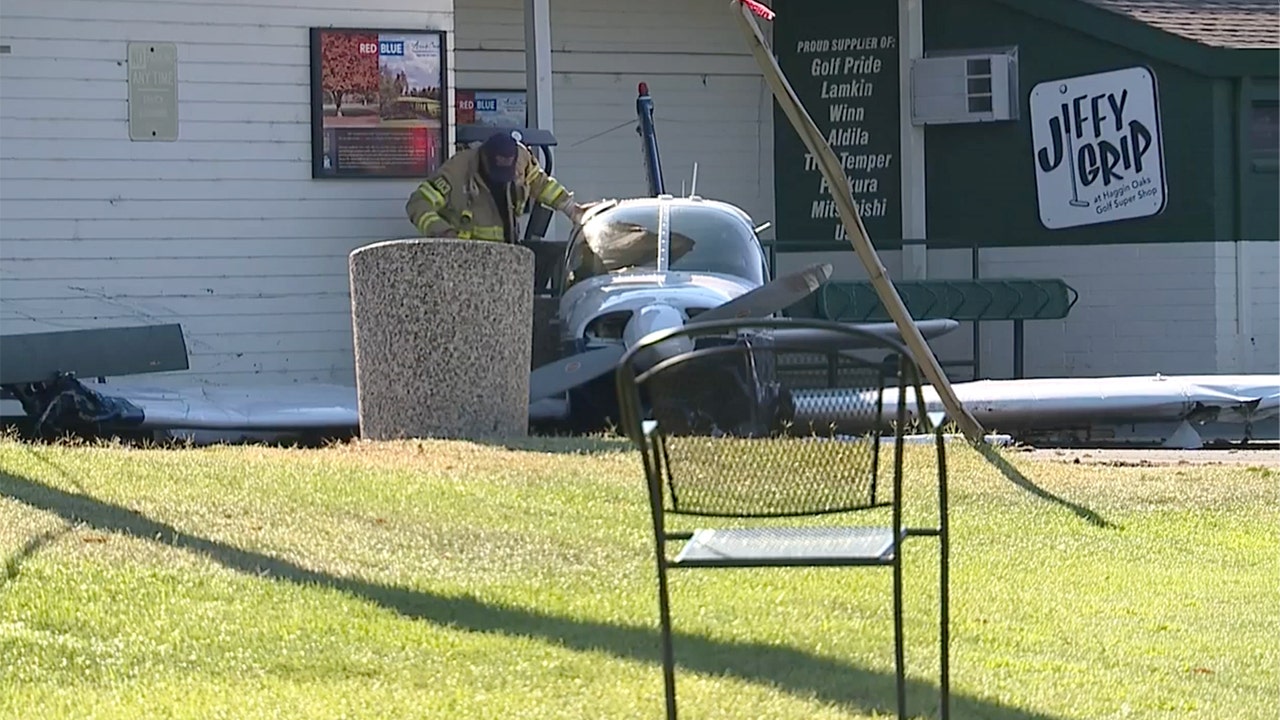
A pilot and a bystander are lucky to be alive after a plane crash-landed at a California golf course on Sunday.

It happened at Haggin Oaks Golf Complex around 1:18 p.m., the Sacramento Fire Department confirmed to Fox News Digital. The small plane, identified by KCRA-TV as a single-engine Piper PA28, came to a rest next to the pro shop, surveillance video shows, after it narrowly avoided hitting someone. 

Sacramento Fire Department spokesperson Capt. Justin Sylvia told Fox News Digital that the pilot said he experienced mechanical failure and the plane lost power. The pilot explained that at about 400 feet, he decided to land on the fairway of the golf course, Sylvia said. The pilot got out of the plane and only suffered a “minor laceration to his hand,” Sylvia added.

“He picked a golf course, which is a pretty good location – nice and open,” Sylvia told local FOX40. “It’s very fortunate that no one was injured, including the pilot.”

2 HIKERS IN YOSEMITE NATIONAL PARK REPORTED MISSING

Advertisement

The plane can be seen narrowly missing a bystander as it crash-lands at the golf course on Aug. 4, 2024. (Obtained by FOX40/KTXL)

The pilot was taken to a hospital about 45 minutes into the incident for not feeling well, Sylvia said. No other injuries were reported.

The plane was found to be leaking fuel but not on fire, Sylvia said. 

“We heard a boom, but we didn’t know what it was,” golfer Tim Cowan told FOX40. “This is a first. I guess cross it off my bucket list.”

Golf course employee Charlie Lewis described the crash to FOX40 as “nothing like I’ve ever seen before” and “insane.”

Advertisement

KAMALA HARRIS PLAYED ‘CRITICAL’ ROLE IN CALIFORNIA CRIME LAW NOW ON CHOPPING BLOCK

The plane stopped next to the golf course’s pro shop, video shows. (FOX40/KTXL)

Sylvia said when the plane landed, it slid across a practice putting green before stopping against the pro shop’s building. The damage to the facility is minor, Haggin Oaks Golf Complex said on Facebook.

“We are incredibly grateful to the first responders from the fire department and law enforcement for their swift and professional reaction,” the post said. The restaurant and pro shop was closed for the rest of the day, but the Golf Super Shop and driving range remained open after the crash. 

A firefighter can be seen at the site of a plane crash at Haggin Oaks Golf Complex. (FOX40/KTXL)

Advertisement

The Federal Aviation Administration and the National Transportation Safety Board are investigating the crash, CBS News Sacramento reported.

Read the full article from Here

Continue Reading
Click to comment

Leave a Reply

Your email address will not be published. Required fields are marked *

This site uses Akismet to reduce spam. Learn how your comment data is processed.

Oregon

Distracted teen driver veers off Hwy 99W, fatally strikes pedestrian near Junction City

Published

on

Distracted teen driver veers off Hwy 99W, fatally strikes pedestrian near Junction City


A pedestrian was killed when a driver drifted from her lane of travel, striking a Junction City man, according to Oregon State Police.

At 4:48 p.m. on May 5, Oregon State Police responded to a vehicle versus pedestrian fatal crash on Highway 99W near milepost 110.5 in Lane County.

Police say a blue Hyundai Elantra driven by a 16-year-old female, was southbound on Highway 99W near Junction City when she became distracted, left the travel lane, and struck a pedestrian.

The pedestrian, Joel Robert Benjamin Coriell, 35, of Junction City, had been walking along the southbound shoulder of the highway.

Advertisement

Coriell was transported to an area hospital with serious injuries and later died at the hospital.

The driver of the Hyundai had reported minor injuries. She remained on scene and cooperated with the investigation, police said.

The highway was not impacted during the on-scene investigation, OSP stated.

OSP was assisted by the Junction City Police Department, Lane County Sheriff’s Office, and the Oregon Department of Transportation.


Source link

Advertisement
Continue Reading

Utah

Hill AFB ends Starbase program that sparked STEM interest among Utah students

Published

on

Hill AFB ends Starbase program that sparked STEM interest among Utah students


CLEARFIELD — A program empowering northern Utah children to discover the possibilities of science, technology, engineering, and mathematics will end after more than a decade of operation.

This week, Hill Air Force Base announced that it is ending its sponsorship of the Starbase program.

Starbase, a U.S. Department of Defense program, is offered throughout the country to provide hands-on learning experiences to young students — primarily fifth graders, according to a description on the curriculum’s website.

Starbase at Hill Air Force Base opened in 2011, and over the past 15 years, has ignited early STEM interest in more than 25,000 students in Davis and Weber counties.

Advertisement

Heather Ingle, a mother of two daughters — 14 and 11 — who have been in the program, said she was sad to hear that Starbase will no longer be offered at the northern Utah base.

“Just the thought of other kids not being able to have that guaranteed program, I think it’s sad,” she said.

Ingle’s oldest daughter participated in the weeklong Starbase program in Montana while their family was stationed in the Great Falls area. More recently, her 11-year-old daughter participated in it at Hill Air Force Base while the family has been stationed in Utah.

She said her 14-year-old was “strongly influenced” through the exploration of hands-on science, technology, engineering and mathematics experience and has shifted her career goals around based on what she learned.

Her younger daughter, on the other hand, wasn’t initially as interested in it.

Advertisement

“And then the first day happened, she came home and she loved it, and totally denied that she didn’t want to go that day,” Ingle told KSL. “She really enjoyed it — she likes to learn new things.”

A Hill Air Force Base press release issued Tuesday didn’t go into specifics about why they’re concluding the program, but it did allude to a funding issue.

“Today, northern Utah benefits from a robust network of STEM programs, many of which were inspired or accelerated by Starbase’s early success. This expansion, combined with changes in national program funding, marks a natural moment for transition. Concluding the program allows Hill AFB to realign resources to meet the growing demands of its core national security mission, confident that the community is well supported by a diverse and vibrant STEM landscape,” the base said.

Starbase’s final days at Hill Air Force Base raised a question for Ingle regarding the program’s future elsewhere, as their family will soon be relocating back to Montana and hopes their youngest child has an opportunity to experience it.

“I have a 5-year-old as well, and I really am hoping that the Starbase program in general continues,” she said.

Advertisement

A spokesperson for Hill Air Force Base said the program there will finish out the remainder of the school year and that it’s still active “at some other bases currently.”


Northern Utah benefits from a robust network of STEM programs, many of which were inspired or accelerated by Starbase’s early success.

–Hill Air Force Base


The base said it’s thankful to the many people who helped make Starbase a cornerstone in local STEM education.

“The base remains deeply committed to community partnership and will continue supporting educational outreach that inspires the next generation of innovators, leaders and problem‑solvers,” the base said.

For Ingle, she’s grateful for the opportunities her daughters have had at Starbase and for how it showed them a career they, too, can one day pursue.

Advertisement

“Outside of the doctor, lawyer, cop, firefighter — you know, it opens their eyes into so many different careers and specialties out there that you can touch, and I love that exposure,” she said.

The Key Takeaways for this article were generated with the assistance of large language models and reviewed by our editorial team. The article, itself, is solely human-written.


Source link

Continue Reading

Wyoming

Forest Service’s rural schools payout includes $4.5M for Wyoming

Published

on

Forest Service’s rural schools payout includes .5M for Wyoming


The federal government owns nearly half the land in Wyoming. That gives Wyomingites easy access to national forest and Bureau of Land Management (BLM) lands, but it also means they miss out on the property taxes that would be paid by private landowners.

The federal Secure Rural Schools (SRS) program aims to rectify that.

Under the program, the U.S. Forest Service will be giving Wyoming $4.5 million this year to support rural schools and roads. That’s the state’s cut of this year’s $248 million total payout.

Wyoming Congresswoman Harriet Hageman touted the program on the House floor in December.

Advertisement

“With such a large percentage of Wyoming’s resources historically locked up in federal lands, including national forests, communities across my state have long weathered challenges associated with reduced flexibility and a decreased tax base,” she said. “Since [the program’s] creation, Wyoming communities have received vital funding to support infrastructure projects, public education, search and rescue operations and other critical emergency services.”

The program has been repeatedly reauthorized for decades with only a few lapses. A bill resuming the payments after its most recent lapse in 2024 advanced through Congress and was signed by Pres. Trump in December.

In April, the U.S. Forest Service announced that this year’s payout, which is determined by a complex calculation, would be $248 million across the country.

“Secure Rural Schools payments reflect our strong partnership with the counties and communities that surround national forests,” Forest Service Chief Tom Schultz said in a news release. “These funds support critical infrastructure, while advancing active forest management and restoration that keep forests resilient and communities safer. We remain committed to deliver this support directly to rural communities that depend on these resources.”

The payments will be distributed to 19 of Wyoming’s 23 counties in roughly the following amounts:

Advertisement
  • Albany: $328,000
  • Big Horn: $320,000
  • Carbon: $331,000
  • Converse: $19,000
  • Crook: $136,000
  • Fremont: $715,000
  • Hot Springs: $31,000
  • Johnson: $179,000
  • Lincoln: $370,000
  • Natrona: $3,000
  • Park: $664,000
  • Platte: $1,000
  • Sheridan: $166,000
  • Sublette: $571,000
  • Sweetwater: $69,000
  • Teton: $550,000
  • Uinta: $46,000
  • Washakie: $29,000
  • Weston: $5,000

The payments to Converse, Crook, Teton, and Weston Counties do not technically stem from the Secure Rural Schools program, though they are included in the forest service’s $248 million total and Wyoming’s $4.5 million.

For these four Wyoming counties, the payments are authorized by an older program, a 1908 act of Congress that gives counties 25% of the revenue generated on federal lands within their boundaries. Individual counties may choose to receive this revenue share instead of the SRS payment, and often do when the share is higher than their SRS payment would be.

For most counties in Wyoming, the SRS payment is more generous.

From timber sales to federal compensation

Legislation passed more than a century ago saw the federal government pay states some of the revenue it generated from logging activities in national forests. That was great for counties with federal forests in their backyards, but less so for counties with other less monetizable federal lands.

In 1976, the federal government started making Payments in Lieu of Taxes (PILT) to these counties to address this disparity. A 2025 congressional overview of that program states:

“PILT was enacted in response to a shift in federal policy from one that prioritized disposal of federal lands — in which federal ownership was considered to be temporary — to one that prioritized retention of federal lands, in perpetuity, for public benefit … Along with this shift came the understanding that, because these lands were exempt from state and local taxation and were no longer likely to return to the tax base in the foreseeable future, some compensation should be provided to the impacted local governments.”

Advertisement

Logging revenue declined in the 1990s, so Congress stepped in with the Secure Rural Schools and Community Self-Determination Act of 2000. It provided for six years of payments to the counties that had historically shared in the federal government’s logging revenue.

“It was intended to be temporary,” said Mark Haggerty, a senior fellow with the Center for American Progress, a liberal think tank. “The payments actually declined over those six years, and then they sunset. And the idea was that those counties would transition [so] they’re not going to be reliant on timber anymore. But they’ll become a recreation county, or they’ll become a remote work county, or they’ll be a retirement [county], like they’ll find another way to pay for their budgets.”

But “a lot of these rural counties have not transitioned,” Haggerty said. So the temporary program has become a semi-permanent one, with repeated reauthorizations throughout the years, often driven by the states with the most to lose if the funding went away completely.

“Wyoming is a classic case,” Haggerty said. “Wyoming pays for things with oil and gas money. It’s hard to develop a diversified tax structure around recreation in Wyoming, because you don’t have the taxes to pay for it, right? You don’t have an income tax. You have low sales taxes because you pay for things other ways.”

As the program has been renewed, its formula has been tweaked. Its overall payouts have fallen from a peak of more than $500 million when it was first reauthorized in 2008.

Advertisement

But some of the formula changes have benefited certain counties more than others. Now, in addition to a county’s historic timber sales, the SRS payout also takes into consideration federal land acreage and relative income levels.

“For some poor counties that have a lot of federal land but didn’t used to get a lot of timber receipts, all of a sudden their payments went up through the roof because those other formula factors really benefited them,” Haggerty said.

In Wyoming, that included Park County, which never saw Oregon-levels of logging but does have a lot of federal land.

Center for American Progress

Advertisement
An interactive map published by the Center for American Progress shows Park County, Wyoming, gains more from the Secure Rural Schools program than it once did under the old revenue-sharing model — especially after the payment formula was tweaked in 2008.

Those same formula factors disadvantaged richer communities like Teton County, which left the program in 2008 when those changes took effect.

An interactive map published by the Center for American Progress shows Teton County, Wyoming, gains more from revenue-sharing than from the Secure Rural Schools program — especially in the wake of 2008's formula changes.

Center for American Progress

An interactive map published by the Center for American Progress shows Teton County, Wyoming, gains more from revenue-sharing than from the Secure Rural Schools program — especially in the wake of 2008’s formula changes.

Today, all of these forces, as well as recent moves by the Trump administration, might be driving a wedge into the coalition of states that historically backed the SRS program.

A bipartisan coalition fractures

In the summer of 2025, SRS funding was removed from the One Big Beautiful Bill before the legislation’s passage. The Center for American Progress published an interactive map showing how the end of that funding would affect rural counties.

Advertisement

Each county has the option of receiving its SRS payment or taking its share of logging or other federal land revenues under the program that’s been going since 1908. When Teton County left the SRS program in 2008, it reverted to accepting revenue shares.

For many years, especially in the early years of the SRS program, it made more sense for counties to take SRS payments instead of the 1908 shares. That meant the SRS program usually had just enough support to be reauthorized. Haggerty said support came from Congress members of both parties, but only from those representing the states that benefited.

“It’s just really difficult politically,” he said. “It’s not a partisan issue, because both Republicans and Democrats in the states that get it support it. It’s a geographic problem. They just don’t have enough places that need it.”

Today, with SRS payments falling and a presidential administration pushing for more logging on national forests, Haggerty said some counties that once benefited from the SRS payments are eying a return to revenue-sharing.

“Either they think they can get more out of revenue-sharing than what a Secure Rural Schools payment might be, or they think by tying their budgets to activities on public lands, they can force the politics to open the public lands up again to more extraction,” Haggerty said. “That’s fragmented the coalition that already wasn’t big enough to consistently get it authorized. And so the future of Secure Rural Schools, I think, is probably less secure now than it has been in the past.”

Advertisement

The payments lapsed in 2016, and again in 2024, when Congress did not reauthorize them. The latest reauthorization also includes retroactive payments for 2024.


Source link

Continue Reading
Advertisement

Trending
