Oregon
Oregon has been planning for this playoff moment since last year and it’s paying off


The Oregon Ducks host a college football playoff game on December 20 for the first time in program history.
Big deal? Yes. Huge undertaking? Not so much.
The No. 5 Ducks hosting No. 12 James Madison in the College Football Playoff isn’t exactly a situation of “been there, done that,” but planning and executing such an event has not created panic within the Ducks’ athletic department.
In many ways, hosting the game is no different from the seven other home games Oregon hosts in most seasons, except for a few tweaks required by the CFP.
Through extensive planning that began last year, Oregon expects to make a seamless shift to hosting the event, with perhaps the only source of trepidation being the weather forecast, which as of Sunday appeared favorable.
“It’s for the most part, business as usual, like any other game,” said Aaron Wasson, Oregon senior associate athletic director, equipment operations and championships.
Planning started in 2024
Oregon received a jump start on learning the requirements for hosting a first-round playoff game last year.
Programs were required to provide the CFP with information, documents and images of facilities and infrastructure to demonstrate preparedness to host a major event. The CFP sent a how-to planning manual to many of the top programs in October 2024, the first year of the expanded 12-team format.
“We started preparing as soon as the CFP announced that as a first-round host, you could host on campus,” Wasson said.
Oregon completed its planning due diligence just in case the Ducks hosted a playoff game last year. The Ducks avoided doing so by defeating Penn State 45-37 in the Big Ten Championship game to earn a first-round bye.
“We went through the entire exercise all the way up until when we won the Big Ten Championship,” Wasson said. “We had to prepare like we were going to host.”
That initial exploratory preparation set the stage for an easy transition into playoff mode this year.
“We certainly had a pretty clear sense of what to expect,” said Jimmy Stanton, UO senior associate athletic director.
The top four seeds in the playoff earn a first-round bye. Teams seeded No. 5 through No. 8 host a first-round game.
Oregon’s probability of hosting ticked up Oct. 11 after the Ducks lost 30-20 to Big Ten Conference rival Indiana, creating a strong possibility that the Ducks would not qualify for the conference title game.
Numerous meetings were held during the season to smooth out communication ahead of Oregon becoming a host site.
“We’ve had a significant number of meetings throughout the fall, internally, as well as with other potential hosts and the CFP,” Wasson said. “Just ensuring everyone is on the same page.”
Each host university receives $3 million to cover expenses other than the opposing team’s travel. Then it’s on them to make the events happen.
Oklahoma, Mississippi and Texas A&M also host first-round games.
Setting up game day experience
A key requirement for hosting is the ability to support a major broadcast, which requires a heightened level of infrastructure and technology. Oregon, which has hosted every major network that broadcasts college football games, is well ahead of the game in that area.

This season alone, ESPN’s College Gameday visited Oregon twice before games broadcast by other networks.
“From an operational and logistical standpoint, we’re certainly wired up for a major broadcast,” Stanton said.
The playoff game will air on TNT, truTV, and be streamed on HBO Max.
For the most part, Stanton said, Oregon’s game will feel like an Oregon home game, save for a few exceptions. A few enhancements will be announced in the coming days, he adds.
All sponsorships and signage installed by Oregon must be removed from the stadium.
“It’s a CFP game from that standpoint,” Stanton said.
The field will feature the CFP logo, but both end zones will still include “OREGON.”
In-game activities can remain the same, but cannot include sponsor attachment.
So, expect to hear Mat Kearney’s “Coming Home (Oregon)” and fans getting softer and softer singing “Shout” before cranking up the volume for the crescendo.
“There are a few CFP elements that people will notice,” Wasson said. “Mostly video board game presentation-type pieces like any other postseason championship.”
The CFP controls ticket pricing and keeps revenue from ticket sales. Ticket prices on Tickemaster range from $154 to $661 per seat.
Oregon banks the revenue generated from concessions and parking.
James Madison received 3,500 tickets to sell to fans eager to see the Dukes participate in their first CFP game. That’s the same amount opposing teams receive during the regular season. As of Friday, thousands of tickets remained available on Ticketmaster, including many being sold on the secondary market.
“We’ll have a great crowd like we always do,” Stanton said.
Because the Dukes plan to arrive in Eugene a couple of days before the game, Oregon must provide them with an indoor and outdoor practice space. JMU will have access to the indoor Moshofsky Center, Autzen and an undisclosed offsite venue, kept secret to prevent fans from watching the workout.
Perhaps the most significant shift is that teams must be off the field 30 minutes before kickoff following warmups, rather than the usual 22 minutes — a requirement for all playoff games.
Mild conditions expected
FBS schools hosting football games in late December is new and carries the risk of challenging weather.
But it appears Oregon will avoid such a problem. Forecasts call for a 60% chance of rain with a high of 48 degrees. Wasson said he was crossing his fingers and hoping for the best, but noted that Oregon did put in place a snow plan just in case.

“Looking at the long-range forecast here in eight days, it looks like – knock on wood – we’re going to be okay,” Wasson said.
It’s a stark contrast to three of last year’s first-round playoff games played at Ohio State, Penn State and Notre Dame in South Bend, Indiana. Snow hit all three sites in the days leading up to the games and temperatures dipped into the high 20s and low 30s.
Minimal local impact
Eugene and Springfield will enjoy an extra weekend of football-generated revenue. According to eugenecascadescoast.org, a game weekend generates between $6-$8 million.
But hosting an eighth football game isn’t expected to create additional headaches.
“UO athletics really take the lead in this and we just kind of offer support and they haven’t indicated to us that they expected anything different,” said Marion Barnes, Eugene public affairs manager for public works.
One potential difference, Barnes noted, is that the playoff game could attract more fans from out of town than a regular-season game.
Those making the trip will face higher hotel rates, as is common on other game weekends. For example, rooms at the Courtyard by Marriott in Eugene/Springfield that go for $171 per night this weekend will run $495 per night during game weekend.

As for hotel operations that weekend, Courtyard manager Eman Berumen said he expected the weekend to go like any other football weekend.
“For the university, it’s a big deal, it’s a playoff game and all that, but for us, it’s just another game weekend,” Berumen said.
Randi Olsen, general manager of the Hop Valley Brewing Company in Springfield, said she expects a booming weekend in line with those seen with major programs visiting Eugene, such as No. 1 Indiana earlier this season.
Most game days generate roughly double the regular business enjoyed, Olsen said, especially those that attract visiting fans staying in nearby hotels.
Hoosiers fans, she said, began rolling in on Thursday and kept business brisk through the weekend. She hopes for the same during playoff weekend, although she would have preferred Notre Dame to be UO’s opponent.
“It’s okay,” she said with a laugh. “It’s still a playoff game.”
More could come Oregon’s way through the years.
Oregon’s program could be in the playoff mix numerous times over the years, making hosting future first-round games very likely.
The athletics department welcomes the opportunity to host next week, despite a few additional weeks of event preparation.
“We absolutely are looking forward to it,” Wasson said. “It’s exciting. There’s a lot of excitement around the complex right now, around the community. So, it is a little bit of extra work but we’re embracing it, and we’re looking forward to it.
No. 12 James Madison (12-1) at No. 5 Oregon (11-1)
- When: Saturday, Dec. 20
- Time: 4:30 p.m. PT
- Where: Autzen Stadium
- TV: TNT/HBO Max



Oregon tight end Jamari Johnson, after an impressive 2025 season with the Ducks, now becomes the leader at his position following the departure of star Kenyon Sadiq to the NFL.
With an Oregon offense set to return several top stars and bring in two talents at the tight end position, Johnson looks to not only improve as a leader but build off his impressive 2025 season, in which he recorded 32 receptions for 510 yards and three touchdowns.
Here’s everything Johnson had to say during his media appearance following Oregon’s scrimmage on Saturday, with the spring game on the horizon.
Everything Tight End Jamari Johnson Said After Spring Scrimmage
What He Learned From Playing With Tight End Kenyon Sadiq:
“So many, but one is training. Everybody in this facility harps on it, and it’s just a standard here. It’s like him from last year, that man strained his guts out almost every play. I just feel like I got to do the exact same thing or even more to uphold the standard.”
Stepping Up At Tight End:
“It just changed because obviously Kenyon leaving somebody has to step up and be a leader in the room, and me being one of the older guys, it just happens to be me. I just accepted that role, and I actually kind of like it, getting these young guys going, getting them in the playbook and getting them used to college football.”
Participating Again In Spring Practice:
“It feels good coming back. Feels like I have something to prove for me personally, I feel like I haven’t really done anything in college football. I feel like this year is that year for me to show everybody what I’m about.”
On Tight Ends Kendre Harrison and Andrew Olesh:
“Both good dudes, they both got that dog in them. Andrew, he came from Penn State. He’s been coming along well, getting in the playbook. Kendre, he’s a big, tall guy, getting in the playbook too. They’ve been getting after it, man. It’s been good taking them under my wing. Hopefully, we just get going this year.”
Goals and Expectations Ahead of Spring Game:
“I’ll say one expectation that we really try to harp on in the room is just going 100 percent. That’s with your effort, that’s with knowing the plays and just giving it your all. A goal is just to get in that endzone. That’s one of the goals for the tight end room right there.”
Why He Returned to Oregon:
“Like I said earlier, to me, I felt like I haven’t really done anything in college football. That was one of the reasons, and another is I wouldn’t say I’m not ready for the NFL, but like that’s pretty much what I’m getting at, is just like I have a lot of stuff to work on that’s within footwork and hand placement, block in the run game, and route details. Getting to the right depth and just touching up everything I can so when I get to the NFL, there’s none of those problems, it’s just the big problems I have to fix.”
How Reps Helped Him Improve:
“It really helped me. Last year, we ran a lot of twelve personnel at the end of the season because we had a couple of injuries, but that really helped me. This year, I feel like I’m coming in rolling off the ground. It’s just so much more fluent, and those reps really helped me with the playbook. Playbook is way easier now, and I’m getting a good feel for it.”
His Leadership Traits:
“I like to get the guys going. I have a real voice on the field, and if y’all hear me on the field, I get the guys going. I wouldn’t say I’m a vocal leader, but I lead by example. Vocal leader, probably something I need to work on.”
On New Offensive Coordinator Drew Mehringer:
“It’s been different. They’re two different people, coach (Will) Stein and coach Drew. My guy’s getting us going. I’m excited for this season.”
Supporting Dakorien Moore At Track Meet:
“Yesterday, that touched my heart, man. Just all of us going out there, and it wasn’t even just for Dakorien. It was really for Oregon. It was just more for Dakorien because we see him every day. That really touched my heart, and the connection is just unbelievable. I don’t think many people are doing that for their teammates.”
Quarterback Dante Moore’s Growth:
“That guy has his head on his shoulders at all times. He’s been growing consistently, but it’s a couple of different things. I probably can’t name them right now, but he’s been having his head on his shoulders. He’s just been on the climb.”
Sign up to our free newsletter and follow us on Facebook, X and Instagram for the latest news.
 Add us as a preferred source on Google
Follow
Oregon
Oregon man mounted a jet engine on a 60-year-old fishing boat to blast around a lake and thinks he may have set a world record

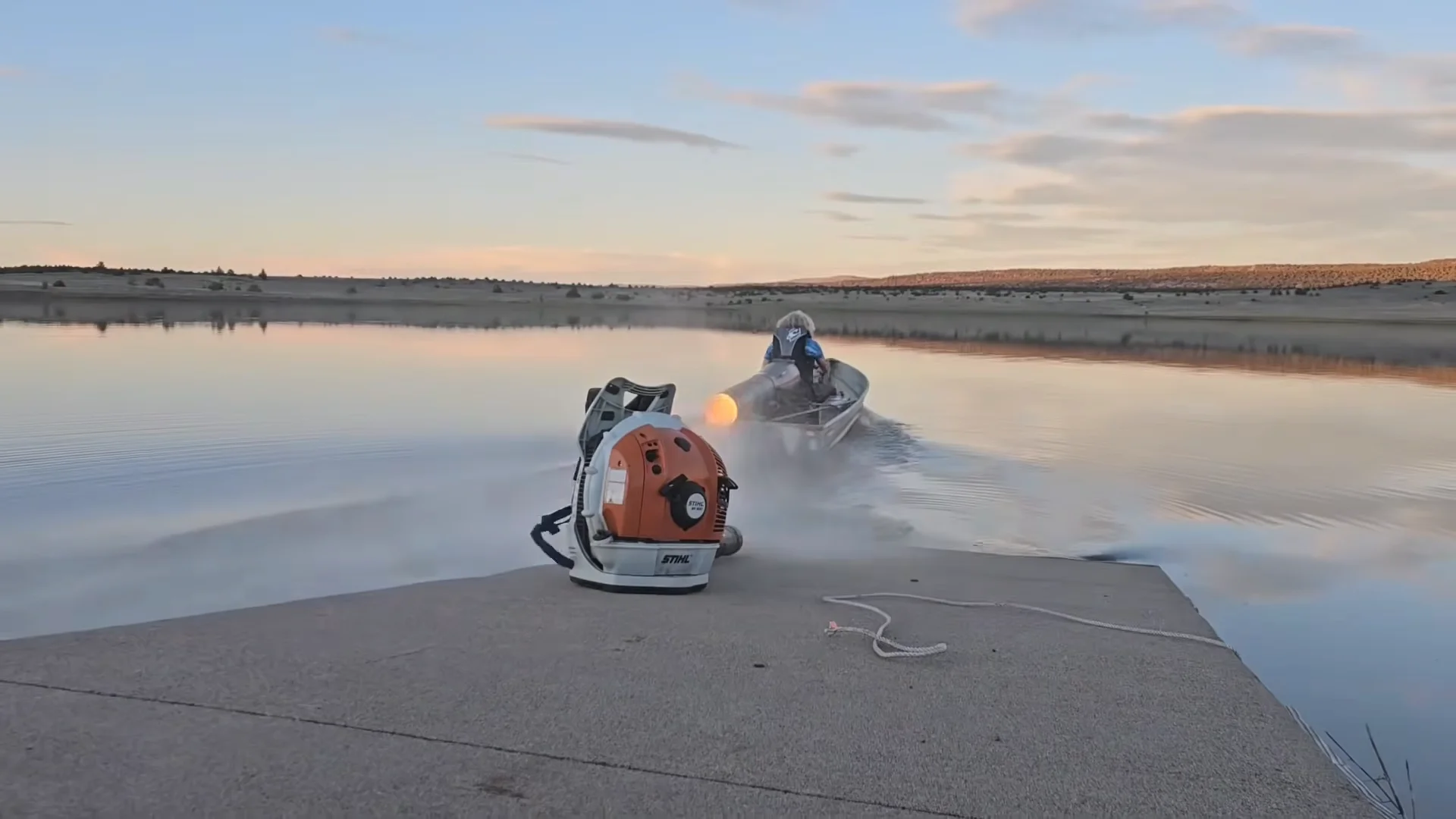
A man from Oregon has unveiled something truly crazy after he added a jet engine to the back of a 60-year-old fishing boat – and he suspects he might have broken a world record.
YouTuber Robert Maddox from CrazyRocketman mounted a pulsejet engine and its 230lbs of thrust to the back of a 1965 12-foot Sears fishing boat.
A wild juxtaposition by any standard, and the video he posted on YouTube confirms that as the diminutive boat roars away.
But did the YouTuber actually actually get the record?
How does this 1965 Sears fishing boat get its power?
The video shows the Oregon man hurling the boat around a lake, with the engine glowing behind him.
Strapped to the back of the boat is a pulsejet engine that produces 230lbs of thrust.
Pulsejet engines are smaller, lighter jet engines with combustion occurring in pulses.
Such is their simplicity that they can be made with few or even no moving parts at all.
Engines like these were used on the German V-1 Flying Bomb from World War II.

These were the Argus As 014 engines, the very first pulsejet ever to be mass-produced.
It is a smaller and even simpler version of these that Maddox has put on the back of his boat.
The funny noise they make comes from the way in which the jet makes its power.
This old boat could be a record holder
In his video, Maddox had clearly enjoyed his outing on the boat.
“Man, this boat really is super controllable,” he said, highlighting the ease with which it handles.
The video suggested there are a few niggles still to sort out on the boat.
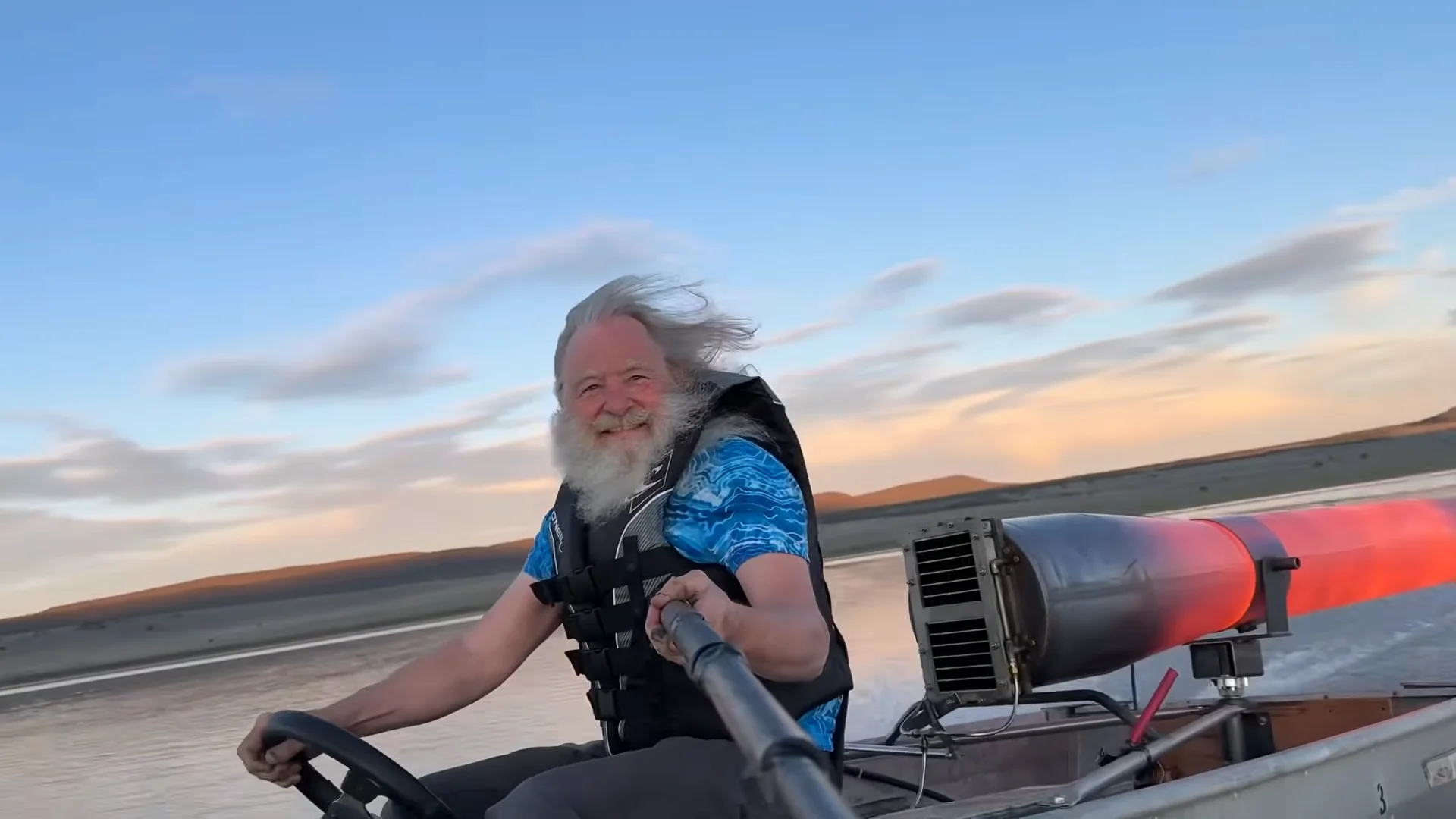
“It was making all kinds of fuel noises, I’ve probably got a fuel pump out or something,” he added.
Yet this isn’t the end of the road for this particular project.
“I’m going to do a lot with this boat, and put a twin engine on it,” Maddox said in the video.
Given the speed of the vessel, with two pulsejet engines, this should rocket through the water.
That means another world record could be up for grabs for the Oregon YouTuber.
If there was any doubt over a world record with one engine, two engines should end the debate in an instant.
Jet engine timeline
150 AD – Hero of Alexandria invents the aeolipile, a steam-powered device demonstrating the basic jet principle
1930 – Frank Whittle successfully patents the first design for a working gas turbine jet engine
1937 – Hans von Ohain tests his first centrifugal turbojet engine prototype in Germany
1939 – The Heinkel He 178 makes the first successful flight powered entirely by a jet engine
1941 – The Gloster E.28/39 completes the first British jet flight using Whittle’s engine design
1944 – The Messerschmitt Me 262 enters combat service as the world’s first operational jet fighter
1949 – The de Havilland Comet makes its maiden flight to become the first commercial jet airliner
1958 – The Boeing 707 enters commercial service and officially kicks off the global Jet Age
1969 – Concorde takes off for the first time to pioneer supersonic passenger jet travel
The global premium car auction platform powered by Supercar Blondie
DISCOVER SBX CARS:

CASCADE LOCKS, Ore. — DNA analysis has identified the remains found in a car in the Columbia River as those of an Oregon family that went missing in 1958 while on a trip to find Christmas greenery, authorities said Thursday.
The state medical examiner’s office has identified parents Kenneth and Barbara Martin and their daughter Barbie from remains located in the river within the wreckage of the car, the Hood River County Sheriff’s Office said. The sheriff’s office said it concluded its investigation and found no evidence of a crime.
The Ford station wagon thought to belong to the family was found in 2024 by a diver who had been looking for it for several years. Authorities pulled part of the car from the river the following year.
The family vanished in December of 1958. The bodies of two of the family’s children were found months after the disappearance, but the other members never turned up.
The search for the Martin family was a national news story at the time and led some to speculate about the possibility of foul play, with a $1,000 reward offered for information.
“Where do you search if you’ve already searched every place logic and fragmentary clues would suggest?” an Associated Press article asked in 1959, months after the disappearance.
Only the frame and some attached components were retrieved from the water because of the “extent to which the vehicle had been encased in sediment,” the sheriff’s office said. Analysis of those items allowed investigators to conclude that it was indeed the Martin family’s car.
Later in 2025, the diver located human remains that were ultimately turned over to the state medical examiner’s office.
Scientists developed DNA extracts from the remains and generated a profile that was compared with relatives of the Martin family, allowing for the identifications, authorities said.
-
 News25 minutes ago
Real estate investors are buying up long-term care facilities. Residents can suffer
-

 Detroit, MI2 hours ago
Former Piston shows Detroit what they’re missing as he dominates next to LeBron
-

 San Francisco, CA3 hours ago
Eastbound I-80 closure in San Francisco snarls traffic, slows business
-

 Videos3 hours ago
Can Keir Starmer survive the latest Mandelson revelations? | BBC News
-

 Dallas, TX3 hours ago
Petar Musa’s Brace Not Enough as FC Dallas Draws LA Galaxy 2-2
-

 Miami, FL3 hours ago
MLS: Messi double helps Inter Miami slay Rapids in front of huge crowd
-

 Boston, MA3 hours ago
From across Boston they flock to play for Latin Academy boys’ tennis, a co-op of 29 schools – The Boston Globe
-

 Denver, CO3 hours ago
Dale Kistler Obituary | The Denver Post