West
On this day in history, August 21, 1959, Hawaii becomes the 50th state: 'A stronger nation'

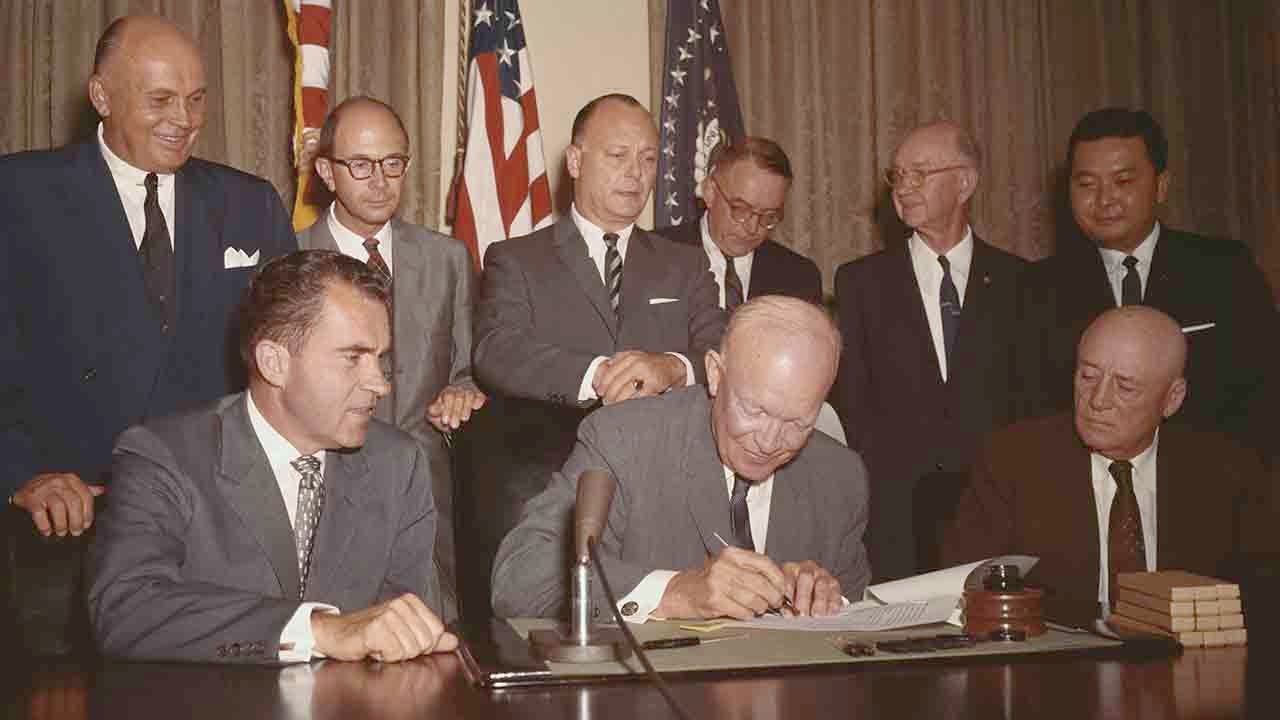
President Dwight Eisenhower signed a proclamation declaring Hawaii the 50th state on this day in history, Aug. 21, 1959.
“All 49 states will join in welcoming the new one – Hawaii – to this union,” said Eisenhower in extemporaneous remarks made after signing the proclamation.
He noted the “truly historic” nature of the time, as Hawaii was the second state added to the United States within that year.
ON THIS DAY IN HISTORY, AUGUST 20, 2017, LEGENDARY COMEDIAN JERRY LEWIS DIES
“We will wish for her prosperity, security, happiness, and a growing closer relationship with all the other states. We know that she is ready to do her part to make this union a stronger nation – a stronger people than it was before because of her presence as a full sister to the other 49 states,” said Eisenhower.
Hawaii’s statehood marked the first time in 158 years that the makeup of Congress consisted only of senators and members of Congress, rather than the “delegates” that had represented the Hawaii Territory and the Alaska Territory.
President Dwight D. Eisenhower is shown signing the proclamation adding Hawaii to the U.S. as the 50th state on Aug. 21, 1959. (Getty Images)
“The delegates are gone and in their place we have senators and congressmen,” noted Eisenhower.
The position of “delegate” would return to Congress in the 1970s.
As of 2023, the District of Columbia, American Samoa, U.S. Virgin Islands, Guam and the Northern Mariana Islands have a non-voting delegate in Congress, according to the official website of Congress.
Hawaiian statehood came about as a result of the Hawaii Admission Act, passed into law in March 1959.
ON THIS DAY IN HISTORY, JAN. 11, 1935, AMELIA EARHART IS FIRST AVIATOR TO FLY SOLO FROM HAWAII TO CALIFORNIA
Section 7b of that law required that Hawaiians be given the opportunity to vote on whether they wished to join the United States as a state and if they agreed with the rest of the provision of the Hawaii Admission Act.
Hawaii was defined in the bill as “all the islands, together with their appurtenant reefs and territorial waters, included in the Territory of Hawaii on the date of enactment of this Act, except the atoll known as Palmyra Island, together with its appurtenant reefs and territorial waters, but said State shall not be deemed to include the Midway Islands, Johnston Island, Sand Island (off-shore from Johnston Island), or Kingman Reef, together with their appurtenant reefs and territorial waters.”
Hawaii became America’s 50th state on Aug. 21, 1959. (iStock)
In a June 27, 1959, election, Hawaiians voted overwhelmingly to be admitted to the United States as a state.
That remains the highest electoral turnout in state history.
Hawaii’s statehood came about more than half a century after the United States annexed the island chain in 1898. The area’s history, however, goes back much further.
ON THIS DAY IN HISTORY, DEC. 7, 1941, PEARL HARBOR ATTACK KILLS 2,403 AMERICANS, LAUNCHES US INTO WWII
Roughly 1,500 years ago, Polynesians arrived in Hawaii, as the Hawai’i Tourism Authority website noted.
In 1778, Captain James Cook landed on the island of Kauai, becoming the first European to reach any of the Hawaiian Islands. He named the islands the Sandwich Islands.
Cook would be killed on the island of Hawaii one year later, noted the Hawai’i Tourism Authority.
In 1810, King Kamehameha I united the Hawaiian islands under his rule. The Kamehameha dynasty would lead Hawaii from 1795 until 1874, when William Charles Lunalilo, known as King Lunalilo, died without an heir.
Lydia Kamekeha Liliuokalani was the last Queen of the Hawaiian Islands. She died in 1917. (Hulton Archive/Getty Images)
Hawaii was officially led by a monarch until 1887.
That year, the 1887 Constitution of the Kingdom of Hawaiʻi was signed — thus “stripping King Kalākaua and therefore the Hawaiian monarchy of much of its authority, empowering the legislature and cabinet of the government,” said the Hawai’i Tourism Authority.
The following year, the Republic of Hawaii was established.
King Kalākaua signed the constitution under force, which led to its nickname of the Bayonet Constitution.
Hawaii would continue to have a monarch until 1893, when Queen Liliʻuokalani was overthrown in a coup, according to the History Channel’s website.
HAWAII WILDFIRE ‘ADDED’ TO FAMILY’S TRAGEDY AND TURMOIL: SAMARITAN’S PURSE REVEALS DEVASTATION IN MAUI
The following year, the Republic of Hawaii was established; it was led by Sanford Dole.
Dole would continue as the head of the Republic of Hawaii until the creation of the Territory of Hawaii in 1900, per the Encyclopedia Britannica.
Japan’s attack on Pearl Harbor triggered the entry of the United States into World War II. Here, uniformed American sailors place leis over the graves of the casualties of the attacks on Pearl Harbor in a spring 1942 photo. (PhotoQuest/Getty Images)
After that, President William McKinley appointed Dole as “territorial governor” of the Hawaiian territory.
For more Lifestyle articles, visit www.foxnews.com/lifestyle
Hawaii burst into the public consciousness on Dec. 7, 1941, when Japanese forces bombed the U.S. Navy base located at Pearl Harbor.
That attack saw 2,403 American service members and civilians killed, with scores more injured, said the National Park Service’s website for the Pearl Harbor National Memorial.
Of the 2,341 service members who died in the attack, 1,177 died on the USS Arizona, which was sunk by Japanese bombs.
August 21 is officially known as “Statehood Day” in Hawaii, although the event is observed each year on the third Friday in August.
Read the full article from Here


Turner was selected by the Detroit Tigers
New Mexico State pitcher Jack Turner has been taken in the 10th round of the 2026 MLB Draft by the Detroit Tigers.
Turner becomes the 14th Aggie player selected in the MLB Draft since 2015 and the eighth selected in the first 10 rounds. The most recent NM State players selected in the MLB Draft prior to Turner were outfielders Keith Jones II, a 10th-round pick by the Texas Rangers, and Titus Dumitru, a 16th-round pick by the Atlanta Braves, both in 2024.
Turner spent the 2025 and 2026 seasons with the Aggies after arriving from Suffolk County Community College (New York), where he was a 2024 NJCAA Division III First Team All-American. He made 24 pitching appearances, 17 being starts, and recorded a 6.15 ERA over those two years. Turner struck out 100 batters in 112.2 innings pitched across 2025 and 2026 and made one save in 2026.
He ended his NM State run on a high note by not allowing a run in the Aggies’ penultimate game of 2026 against Florida International on May 15. Turner struck out five batters that day and allowed only three hits in six innings to help NM State win 6-5.
Turner played for the Trenton Thunder and the State College Spikes, collegiate summer league baseball teams playing in the MLB Draft League, after leaving the Aggies. He recorded a 4.09 ERA with the Thunder and a 5.14 ERA with the Spikes.
Turner made eight pitching appearances for Trenton and struck out 17 batters, allowed only five earned runs and walked eight batters in 11 innings pitched. He started two games for State College, striking out five batters, allowing four earned runs and registering a 1.114 WHIP in seven innings pitched.
Turner received recognition after his first start for the Spikes on June 3 after pitching a sinker and a sweeping curve that each had over a foot of horizontal movement.
Turner becomes the seventh NM State player to be selected by Detroit in the MLB Draft, the first being former NM State AD Mario Moccia in the 44th round of the 1989 draft. The most recent was pitcher Ryan Beck in the 30th round of the 2013 draft.

“),r.close()),!r)throw Error(“base not supported”);var a=r.createElement(“base”);a.href=n,r.getElementsByTagName(“head”)[0].appendChild(a);var i=r.createElement(“a”);return i.href=t,i.href}finally{e&&e.parentNode.removeChild(e)}}());var l=i(t||””),f=function(){if(!(“defineProperties”in Object))return!1;try{var e={};return Object.defineProperties(e,{prop:{get:function(){return!0}}}),e.prop}catch(t){return!1}}(),h=f?this:document.createElement(“a”),m=new o(l.search?l.search.substring(1):null);return m._url_object=h,Object.defineProperties(h,{href:{get:function(){return l.href},set:function(e){l.href=e,r(),u()},enumerable:!0,configurable:!0},origin:{get:function(){return”origin”in l?l.origin:this.protocol+”//”+this.host},enumerable:!0,configurable:!0},protocol:{get:function(){return l.protocol},set:function(e){l.protocol=e},enumerable:!0,configurable:!0},username:{get:function(){return l.username},set:function(e){l.username=e},enumerable:!0,configurable:!0},password:{get:function(){return l.password},set:function(e){l.password=e},enumerable:!0,configurable:!0},host:{get:function(){var e={“http:”:/:80$/,”https:”:/:443$/,”ftp:”:/:21$/}[l.protocol];return e?l.host.replace(e,””):l.host},set:function(e){l.host=e},enumerable:!0,configurable:!0},hostname:{get:function(){return l.hostname},set:function(e){l.hostname=e},enumerable:!0,configurable:!0},port:{get:function(){return l.port},set:function(e){l.port=e},enumerable:!0,configurable:!0},pathname:{get:function(){return”https://www.opb.org/”!==l.pathname.charAt(0)?”https://www.opb.org/”+l.pathname:l.pathname},set:function(e){l.pathname=e},enumerable:!0,configurable:!0},search:{get:function(){return l.search},set:function(e){l.search!==e&&(l.search=e,r(),u())},enumerable:!0,configurable:!0},searchParams:{get:function(){return m},enumerable:!0,configurable:!0},hash:{get:function(){return l.hash},set:function(e){l.hash=e,r()},enumerable:!0,configurable:!0},toString:{value:function(){return l.toString()},enumerable:!1,configurable:!0},valueOf:{value:function(){return l.valueOf()},enumerable:!1,configurable:!0}}),h}var c,s=e.URL;try{if(s){if(“searchParams”in(c=new e.URL(“http://example.com”))){var f=new l(“http://example.com”);if(f.search=”a=1&b=2″,”http://example.com/?a=1&b=2″===f.href&&(f.search=””,”http://example.com/”===f.href))return}”href”in c||(c=undefined),c=undefined}}catch(m){}if(Object.defineProperties(o.prototype,{append:{value:function(e,t){this._list.push({name:e,value:t}),this._update_steps()},writable:!0,enumerable:!0,configurable:!0},”delete”:{value:function(e){for(var t=0;t document.createElement(“picture”);
The Olive Butte Fire is one of several blazes burning in Eastern Oregon, as of Sunday morning.


SAN JUAN COUNTY, Utah (ABC4) — The Babylon Fire, currently the largest wildfire in the United States, has grown to 106,324 acres, according to Utah Fire Info. The blaze is now 47% contained.
The wildfire is burning about 25 miles southwest of Monticello. Officials said five structures have been lost and 1,467 personnel are assigned.
Current operations
Firefighters are conducting an aggressive attack along the active fire edge, officials said, with a “specialized helitack crew” entering the Dark Canyon to secure the western edge into the bluffs. Crews in Trail Canyon continue to reinforce the fire line.
Fire personnel have reportedly secured containment lines off Steamboat Point and Dry Mesa.
A spot fire remains active on the north-facing slope of Jackson Ridge, officials said. Firefighters continue to protect a critical communication site on Abajo Peak.
Firefighters are using grass and brush on the south slope to keep the fire in heavy timber. Intense fire activity caused fire crews to pull back from Indian Creek, officials said. Complete containment from the southern line back to South Cottonwood is expected by the end of Sunday’s shift.
Firefighters assigned to the structure protection group on the Babylon Fire string hoses connected to a portable water tank along a dozer line west of Monticello, Utah, on July 11, 2026. (Courtesy: Geoff Liesik/U.S. Wildland Fire Service)
Upcoming weather, fire behavior
A critical shift is happening as monsoonal moisture moves in from the south. This will heighten the chance for critical fire weather conditions.
Temperatures will be slightly cooler and morning winds will be breezy, officials said, with some gusting along ridge tops. The main concern is forecasted scattered thunderstorms after noon, with dry storms bringing the potential for lightning and erratic, severe outflow winds.
See a current map of the Babylon Fire, as well as a smoke outlook, below.
-
Babylon Fire Smoke Outlook, July 12, 2026. (Courtesy: Utah Fire Info)

Evacuations, closures
There are 23 evacuation zones in “SET” status at this time. This includes all zones west of Highway 191, south of State Route 211, and north of State Route 95.
All National Forest lands, roads, and trails within the Monticello Ranger District of the Manti–La Sal National Forest are closed. The Needles District of Canyonlands National Park is also closed to ensure public safety and aid firefighting operations.
All BLM-managed public lands west of Harts Draw Road and north through the Indian Creek Corridor to Indian Creek Falls are temporarily closed. This closure reportedly includes key recreation and backcountry areas like Shay Mesa, Beef Basin, Dark Canyon, and the Sweet Alice Wilderness Study Area.
“Anyone not directly involved in firefighting operations must stay out of all closure areas and avoid public lands within the boundary formed by State Route 211 to the north, U.S. Route 191 to the east, and State Route 95 to the south,” fire officials said. “These restrictions are in place to protect the public and allow firefighters to operate safely and effectively.”
Evacuation and closure information can be found on the Babylon Fire Inciweb page here.
-

 New Mexico2 minutes ago
New Mexico State’s Jack Turner taken in 10th round of 2026 MLB Draft
-
North Carolina2 minutes ago
Eastern North Carolina under a flood watch until Monday morning, says the NWS
-

 North Dakota14 minutes ago
NDSU Sets North Central Research Extension Center Field Day for July 15
-

 Ohio17 minutes ago
Yosteria opens its enoteca
-

 Oklahoma22 minutes ago
Where Every Oklahoma Player was Selected in the MLB Draft
-

 Oregon29 minutes ago
Evacuation orders in effect as Olive Butte Fire bears down on small city
-

 Pennsylvania32 minutes ago
3 dead in wrong-way crash on I-76 in Montgomery County, Pennsylvania, state police say
-

 Rhode Island37 minutes ago
Massachusetts and Rhode Island residents arrested after woman found nude inside Target


