California
Nordstrom Rack expands in Southern California with new stores

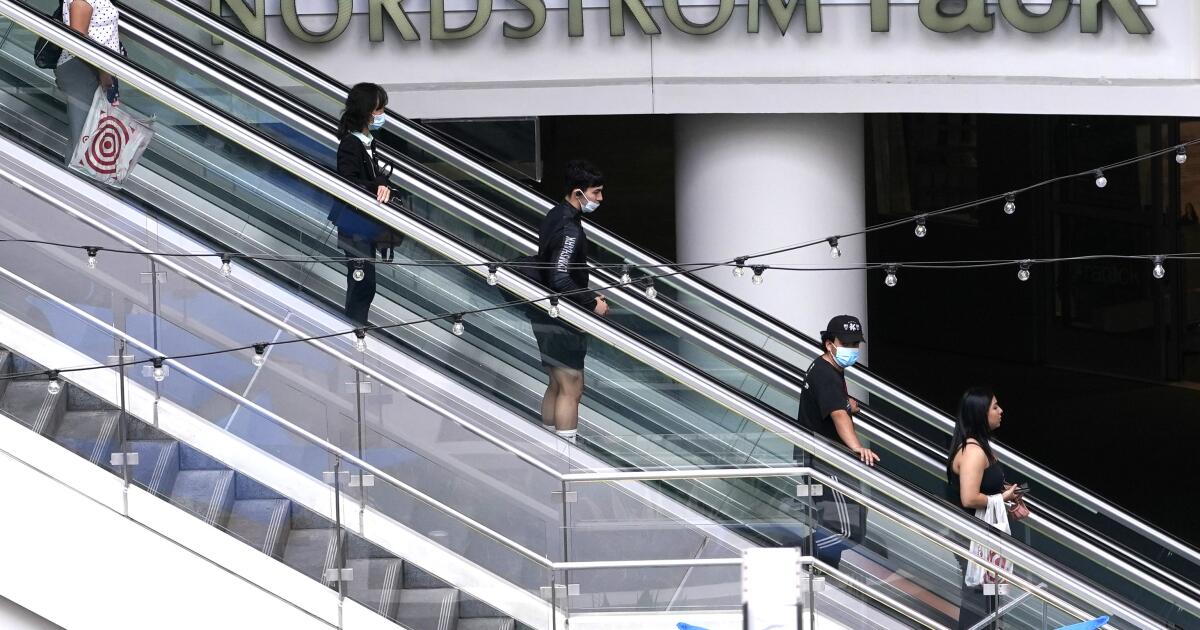
Nordstrom Rack will open two new Southern California stores next year.
The discount outlet said on Wednesday that it will open new stores in Marina del Rey in the spring of next year and in Torrance later that summer. The locations join 69 Nordstrom Rack locations already operating in the state.
“We’re excited to grow our footprint in the Los Angeles market and introduce new customers to the Nordstrom experience,” Gemma Lionello, president of Nordstrom Rack, said in a news release.
Nordstrom Rack is an outlet version of the upscale retailer Nordstrom, offering merchandise from top brands at a discount.
Bargain retailers have expanded in California recently, benefiting from increasingly cost-conscious customers, who are motivated to spend less by economic anxiety and inflation.
Discount outlets such as Ross, T.J. Maxx and Dollar General have capitalized on the tough economic times and experienced accelerated growth. Ross reported record sales in 2025, up 8% from the year prior.
Bargain retail stores have acquired a larger supply of discounted products by buying unsold merchandise from struggling high-end stores. Customers who feel destabilized financially by tariffs and global conflict have used the stores to try to find lower prices.
The new Nordstrom Rack storefronts will be in Marina Marketplace in Marina del Rey and Rolling Hills Plaza in Torrance.
“The Los Angeles retail market continues to see growth from retailers like Nordstrom looking for anchor space in vibrant areas,” Scott Burns, senior managing director for the company that manages Marina Marketplace, said in a news release.
The bargain outlet boom comes as department stores and malls struggle. Nordstrom, the upscale retailer, closed a Santa Monica location in July. Macy’s shuttered two California locations this year and will reduce its footprint by 30% in 2027.
Shopping malls across Southern California have also struggled to bring sales back as immigration raids continue to scare customers away.



Top universities reject Trump’s ‘compact’ over academic freedom
Massachusetts Institute of Technology, Brown University, University of Pennsylvania, and University of Southern California rejected Trump’s “compact.”
To the surprise of perhaps no Californians, several California universities appeared in the top rankings of the world’s best universities in the latest U.S. News and World Report rankings released on June 16.
Of the more than 2,250 worldwide research institutions that U.S. News & World Report evaluated for this list, six California universities ranked in the top 50 globally, with an even split among Northern and Southern California institutions.
The 2026 list includes universities from more than 100 countries, with the following countries receiving the most schools in the overall rankings:
- China: 409
- United States: 275
- India: 123
- United Kingdom: 93
- Japan: 86
Did your California alma mater appear among the top global universities?
U.S. News and World Report methodology
When determining a university’s placement on the list, U.S. News & World Report considered factors more relevant to research-oriented institutions than to undergraduate-focused metrics like bachelor’s degree graduation rates.
It focused on aspects like academic institutions’ research and reputation, number of publications, the quality of publications and citations. It considers other factors, including location, campus culture, the strength of particular programs, and cost, which are also very important.
“For students seeking universities with strong academic excellence and global recognition, the Best Global Universities rankings offer an essential comparative resource,” said LaMont Jones, Ed.D., managing editor for Education at U.S. News.
“Our methodology focuses on a school’s research mission and scholarly impact, helping students identify institutions that are truly at the forefront of global knowledge creation.”
Out of the top 10 global universities, two California institutions made the list:
- Harvard University
- Massachusetts Institute of Technology (MIT)
- Stanford University
- University of Oxford
- University of Cambridge
- Tsinghua University
- University of California Berkeley
- Yale University
- University College London
- Columbia University
How did California colleges rank in U.S. News and World Report’s Best Global Universities 2026 list?
Outside of the top 10 universities, California saw a handful of other institutions rank highly on U.S. News & World Report list.
Notably, the University of California – Los Angeles just missed the top 10 list, ultimately ranking as the 11th-best global university and the second-best public institution on the list. It was beaten out as the best public institution by its academic counterpart, the University of California, Berkeley, which was ranked the 7th-best global university.
Additionally, a number of University of California schools made the top of the list, ultimately reaffirming the quality of the institutions’ public campuses across the state.
“Research from the University of California is vital to work that benefits all Americans, from breakthroughs in the treatment of Parkinson’s to the science behind previously unimagined successes in fighting cancer and the development of quantum computers that will enable the critical advances of the 21st century,” the University of California said in a press release about its rankings.
Here’s the list of California universities that made the top 100 list:
- 3. Stanford University
- 7. University of California Berkeley
- 11. University of California – Los Angeles
- 22. University of California – San Francisco
- 23. (Tied) California Institute of Technology
- 23. (Tied) University of California – San Diego
- 74. University of Southern California
- 95. University of California – Davis
- 99. University of California – Irvine
- 100. University of California – Santa Barbara
Noe Padilla is a Northern California Reporter for USA Today. Contact him at npadilla@usatodayco.com, follow him on X @1NoePadilla or on Bluesky @noepadilla.bsky.social. Sign up for the TODAY Californian newsletter or follow us on Facebook at TODAY Californian.

The most significant seismic event in California’s history – an earthquake of 7.9 magnitude – occurred in 1857 and ruptured about 225 miles on the San Andreas Fault. That earthquake, dubbed the last “Big One,” killed two people and produced shaking that lasted between one and three minutes.
Since then, California has exploded in population and been has been rattled by many major earthquakes. But Californians have also grown familiar with the existential dread of another “Big One” looming.
Researchers have long warned there will be another massive earthquake in Southern California. They just don’t know when.
A recent study says warning signs continue to grow in 2026. The San Andreas and San Jacinto fault systems have reached the highest stress levels seen in the past 1,000 years, according to a study conducted at the University of Hawaiʻi at Mānoa.
The San Andreas fault runs throughout the state, passing through San Francisco and San Bernardino, while the San Jacinto fault is in Southern California and runs through Riverside, San Diego and Imperial Counties.
Unable to view our graphics? Click here to see them.
Why the San Andreas Fault is so risky
Faults rupture on the San Andreas Fault approximately every 150 years, according to UCLA professor Jonathan Stewart, who studies earthquake engineering.
But it’s been over 300 years since the last “large rupture” occurred south of the 1857 Fort Tejon earthquake, Stewart said. “As far we know it didn’t produce a large rupture since around 1690. To the present that’s a lot more than 150 years, so there’s a lot of build-up. That doesn’t mean it’s going to happen immediately, it just means there is more stress built-up.”
When the earthquake happens, it is likely to cause a lot of damage. One major concern is the state’s water systems.
“An earthquake like this would rupture most, if not all of the major aqueducts bringing water into Southern California,” Stewart said. “Most people will not be in a collapsed structure after this earthquake, but everybody’s going to be affected by water problems.”
Study highlights longstanding risk
To investigate the probability of an earthquake occurring, researchers built a physics-based simulation and fed it the earthquake history from the region. By doing so, they were able to estimate how much stress has built up along the southern San Andreas and San Jacinto fault systems.
The results suggest that catastrophe may be near.
“Right now, with stress at historically high levels across the region and more than 160 years elapsed since the last major rupture, the system is in a critically loaded state,” lead author Liliane Burkhard said.
Most importantly, the Cajon Pass, at the junction of the San Andreas and San Jacinto faults, could facilitate a joint rupture of the two faults. This scenario, according to the study, would probably be “significantly more damaging” than a single-fault event.
How is earthquake safety considered?
Seismic hazard assessments are critical for the safety of the millions of residents in California’s densely-populated and earthquake-prone areas.
Seismic Hazard maps show the relative hazard associated with earthquakes using information on past faults, the behavior of seismic waves and the near-surface conditions of specific locations, according to the U.S. Geological Survey.
Larger values indicate a stronger level of earthquake shaking. A peak ground velocity of 269 cm/sec would correspond to extreme shaking and heavy damage. For reference, the largest ground velocity recorded in Taiwan’s 1999 Chi-Chi earthquake reached 318 cm/sec and had a magnitude of 6.7.
That earthquake killed more than 2,000 people and incurred approximately $14 billion in damage.
How do the fault lines rupture?
The San Andreas and San Jacinto faults are strike-slip faults, which typically cause horizontal displacement. Both faults comprise the geologic boundary between the Pacific Plate and the North American Plate.
If a major earthquake occurs on the San Andreas fault, it is likely to produce surface rupture, which occurs when a fault breaks through to the surface. Most earthquakes, however, do not produce surface rupture, according to USGS.
In a major rupture, strong shaking could cause severe damage near the fault and in areas built on soft or water-saturated soils, which can amplify shaking. Rupture can directly offset roads, buildings, and other structures that span the fault trace.
Although the study helps explain the risk associated with the California fault lines, Burkhard emphasized that it shouldn’t serve as a forecast.
“This is not a prediction of when an earthquake will happen,” Burkhard said. “However, studies like this are important contributions to national and global earthquake hazard research in that we are using rigorous, quantitative science to better understand the risk facing millions of people.”
Contributing: Brandi D. Addison, USA TODAY NETWORK
California
California lawmakers seek $32M to combat invasive pest found on grapevines sold at Costco

FRESNO COUNTY, Calif. (FOX26) — California lawmakers are now asking the federal government for more than $32 million in emergency funding to stop the spread of an invasive insect that was recently discovered on grapevines sold at Costco stores across the state.
The request comes about a month after Fresno County agricultural officials discovered grapevine plants infested with the glassy-winged sharpshooter, a pest capable of spreading Pierce’s Disease, a deadly infection that can kill grapevines.
In a letter sent to U.S. Agriculture Secretary Brooke Rollins, Sens. Adam Schiff and Alex Padilla joined Reps. Mike Thompson, David Valadao and other members of California’s congressional delegation in requesting $32.2 million in emergency funding to contain and eradicate the pest.
[RELATED] Fresno County grapevine plants shipped to Costco were infested with bugs
Lawmakers say the infected nursery stock was identified Mat 19 by the California Department of Food and Agriculture and the Fresno County Agricultural Commissioner’s Office.
The plants had been distributed to Costco stores in more than two dozen California counties before being sold to customers.
Officials believe some of the infested plants have since been transported to homes in at least 38 counties across the state.
The movement of infested nursery stock into and near key grape-producing regions, including areas critical to California’s winegrape and fresh table grape production, significantly elevates the urgency of this response.
The glassy-winged sharpshooter feeds on grapevines and spreads Pierce’s Disease, an incurable bacterial infection that can destroy vineyards by preventing vines from transporting water.
Lawmakers warned that the pest poses a serious threat to California’s wine and table grape industries.
According to the Wine Institute, California’s wine industry supports 1.1 million jobs nationwide and generates an economic impact of more than $170 billion.
California also produces 99% of the nation’s table grapes, with an annual crop value estimated at $2.59 billion.
If the pest spreads unchecked, the California Department of Food and Agriculture estimates losses associated with Pierce’s Disease and the glassy-winged sharpshooter could exceed $104 million annually.
The requested funding would support emergency response efforts, including tracing the movement of infested plants, surveying affected areas and expanding trapping programs.
Additional funding would also be used for long-term monitoring and eradication efforts over the next several years.
The lawmakers are asking the U.S. Department of Agriculture to immediately release the funding through the Commodity Credit Corporation, arguing that the outbreak meets the federal definition of an agricultural emergency.
Growers have already contributed more than $62 million toward research and mitigation efforts over the past 25 years through industry assessments, according to the letter.
Federal officials have not yet announced whether the funding request will be approved.
-

 New York36 minutes ago
Video: Fans Show Up to the Parade in Their Best Knicks-Themed Attire
-

 Los Angeles, Ca44 minutes ago
Victims sought after man allegedly points gun at passing cars in Santa Clarita Valley
-

 Detroit, MI1 hour ago
Best barbershop in Metro Detroit: Finalists for this year’s Vote 4 The Best
-

 San Francisco, CA1 hour ago
How to watch San Francisco Giants vs. Miami Marlins
-

 Dallas, TX1 hour ago
Drivers in North Texas struggle with Friday floods
-

 Miami, FL1 hour ago
Three wildfires burn more than 20,000 acres in Miami-Dade, force road closures
-

 Boston, MA2 hours ago
MBTA, state transportation chief apologizes for ‘insensitive’ employee hair-pulling incident
-

 Denver, CO2 hours ago
Man arrested on suspicion of murder in Denver shooting near South Park Hill, Hale

