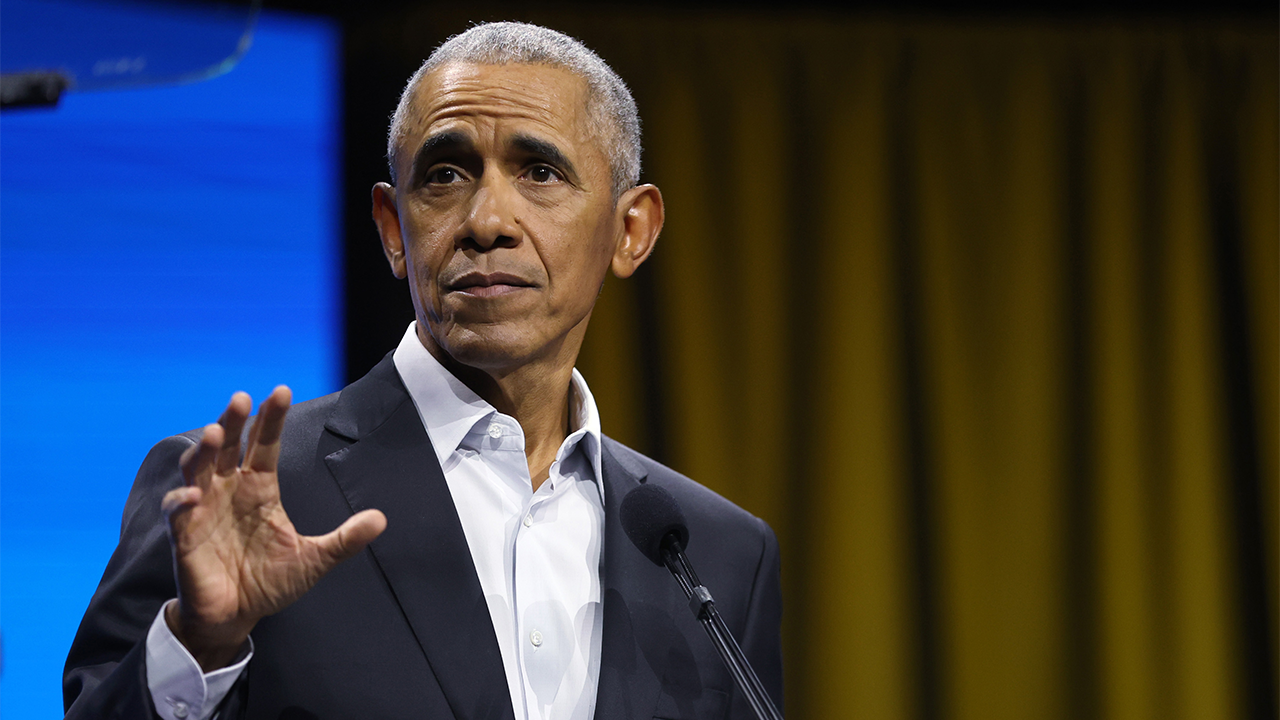
Former President Barack Obama criticized the homelessness crisis in Los Angeles, calling it an “atrocity” given the billions of dollars elected officials have thrown at the problem over the years.
Obama was speaking with YouTuber Brian Tyler Cohen when he touched on criticism local residents and business owners have voiced for years.
“I think it is morally — ethically speaking — it is an atrocity that in a country this wealthy, we have people just on the streets, and we should insist on policies that recognize their full humanity — people who are houseless — and be able to provide them with the help and resources that they need,” Obama said.
DAVID MARCUS: I’VE SEEN ENOUGH HUMAN SUFFERING IN HOMELESS ENCAMPMENTS TO KNOW TRUMP’S NEW POLICY IS RIGHT
Advertisement
Former President Barack Obama called the homelessness crisis in Los Angeles County an “atrocity” during a podcast appearance.(Getty Images)
“We should recognize that the average person doesn’t want to have to navigate around a tent city in the middle of downtown,” he added. “That’s a losing political strategy.”
Obama noted that building support for programs and resources to assist those living on the streets needs to come with some level of accountability for those being offered the help.
“We’re not going to be able to generate support for it if we simply say, ‘You know what, it’s not their fault and so they should be able to do whatever they want,’ because that’s a losing political strategy,” he said.
FORMER OBAMA OFFICIAL FREAKS OUT AT CALIFORNIA DEMOCRAT OVER HER RECORD AMID HOUSING CRISIS DEBATE
Advertisement
A person walks amid large trash piles at a sprawling homeless encampment near East 14th Street in downtown Los Angeles on Sept. 25, 2025.(Allen J. Schaben/Los Angeles Times via Getty Images)
“That doesn’t mean that we care less about those folks,” he added. “It means if we really care about them, then we got to try to figure out how do we gain majority support and be practical in terms of what we can get through at this moment in time and build on those victories,” he added.
Fox News Digital has reached out to Los Angeles Mayor Karen Bass.
California has spent billions to combat homelessness. In his State of the State address last month, California Gov. Gavin Newsom touted a 9% statewide drop in homelessness.
In January, he announced new investments to create more shelters and services.
Advertisement
A homeless encampment in Koreatown on Sept. 12, 2025, in Los Angeles.(Carlin Stiehl/Los Angeles Times via Getty Images)
“No one in this country should be without a place to call home. In California, we’re proving there is a solution,” Newsom said in January. “The strategies we’ve put in place are working, and they’re turning this crisis around — but we’re not done. We won’t stop until everyone has a safe, stable place to call home.”
Newsom spokesperson Tara Gallegos told Fox News Digital that the governor agrees with Obama and was working to create a model to combat the problem that should be replicated nationwide.
“That’s why Governor Newsom is the first governor in California history to make addressing homelessness a statewide priority,” she said. “He is turning around a crisis that was decades in the making by building supports and systems of care to help people exit homelessness for good.”
Advertisement
“That’s also why, for the first time in decades, California saw a 9% decrease in unsheltered homelessness in 2025,” she added. “California is a creating a model that should be replicated nationwide — building more housing, reforming mental health systems, removing encampments, and creating stronger support and accountability.”
NM FAST (New Mexico Federal and State Technology) is now accepting applications for a free space-sector accelerator cohort designed to help New Mexico-based technology companies compete for federal funding through the Small Business Innovation Research (SBIR) and Small Business Technology Transfer (STTR) programs. The cohort targets founders and researchers pursuing grants from NASA, Space Force and related federal agencies, with programming set to launch July 21.
The cohort will admit six to 10 New Mexico companies and run for 10 to 12 weeks, meeting in weekly sessions of approximately one and a half to two hours. Programming covers the full arc of federal commercialization strategy, including space-sector SBIR/STTR opportunities and federal funding pathways, proposal development for technical narratives and commercialization components, federal procurement positioning and agency discovery, capital strategy and follow-on funding options, and transition planning from Phase I to Phase II awards. Participants also receive targeted one-on-one advisory support throughout the program. The cohort is offered at no cost to accepted companies.
The program is open to companies at both the pre-award and early-award stages. The majority of cohort seats are designed for Phase 0 companies preparing to submit Phase I SBIR/STTR applications to NASA or Space Force. A limited number of seats are available for Phase I awardees working toward Phase II readiness and Phase III transition planning.
Advertisement
“New Mexico has a deep base of research and a growing pipeline of founders ready to translate that work into companies that can compete for federal R&D dollars,” said Carlos Murguia, director of the Technology and Innovation Gateway at Arrowhead Center. “This cohort focuses specifically on the space sector, pairing New Mexico companies with Larta’s expertise in SBIR and STTR commercialization to give founders a clear, structured path from early-stage research to federal award.”
Larta Institute, NM FAST’s commercialization partner for this program, will lead the full design and delivery of the accelerator curriculum. Larta has supported startups that have collectively raised more than $23.7 billion since 1993 and brings that track record to founders working in New Mexico’s growing aerospace and space technology sector.
The cohort aligns with the aerospace priority sector named in the New Mexico Entrepreneurship Programmatic Support Grant and is relevant to companies working at the intersection of advanced computing, bioscience and advanced energy applications in space-related contexts.
NM FAST is administered by Arrowhead Center at New Mexico State University and operates statewide, serving founders in Las Cruces, Albuquerque, Los Alamos and rural communities across New Mexico. Over more than a decade of programming, NM FAST has supported more than 470 New Mexico startups and helped companies secure nearly $28 million in federal SBIR awards. Targeted outreach is directed to rural, women, veteran and minority entrepreneurs.
The program is sponsored by the New Mexico Economic Development Department’s Technology and Innovation Office through the New Mexico Entrepreneurship Programmatic Support Grant, which supports continued statewide programming for SBIR/STTR-eligible companies in the four priority sectors.
Advertisement
Applications are open now and will be accepted through July 14, 2026. Interested companies can apply at forms.gle/CqSwEL7LahqB5pGu9. Space is limited, and selected companies will be notified before the program launch.
PORTLAND Ore. (KPTV) – As we approach the hottest days of the year, people are finding ways to stay cool.
It’s been two weeks since Portland turned on splash pads across the city.
The water was just one of the ways people were keeping cool on Friday.
“Did you see our cooler? We have a bunch of water in there. More water, stay in the shade, I mean look at these trees, it makes you feel comfortable,” said Beaverton resident Ailan Roman.
Advertisement
Oregon Health Authority says young children and older adults are just a couple of groups of people that face a higher risk of heat related illness.
OHA says in addition to staying hydrated and lounging in the shade, wearing loose fitted, lightweight clothing can make a big difference.
Roman makes sure her, and her grand kids are protected using several different defenses.
“Sunscreen, we have to put that in order to protect our skin,” Roman said.
When temperatures rise, OHA officials recommend staying in air-conditioned buildings.
Advertisement
But for some Portlanders, that’s not always an option, so to cool down, they must get creative.
“We get cheap kiddy pools, and we just stick our feet in it, drink lots of water and beer and weight our feet in the pool and that’s how we stay cool,” said park goer, Jill.
And most Oregonians can agree, water in all its forms is the best way to beat the heat.“You have the water view and then you have the water fountain and I think it’s quiet, I don’t see no issues around,” said Roman.
The CDC shares how you can recognize heat related illnesses. While OHA shares how to avoid issues in the heat.
SANDY — Vibes were as high as the temperature in some cases as thousands gathered at Real Salt Lake’s home stadium to cheer on the United States’ 2-0 win over Australia in the second match of the 2026 FIFA World Cup.
Fernando Sanchez took it all in, between belts of his drum standing in front of more than 4,000 people at the Sandy stadium.
“I was born and raised in Mexico City,” said Sanchez, who hosts a podcast called the “Fercho Show” from his current home in Utah. “But I’m from the U.S. now.”
Four years after scoring just two goals in three group games before a 3-1 exit to the Netherlands in the Round of 16, the United States is flying under Mauricio Pochettino, exciting fans across the country — from the sellout crowd at 69,000-seat Lumen Field in Seattle to watch parties around the world, including Friday in Sandy.
Advertisement
“The vibe is amazing,” Sanchez told KSL.com. “You can see all of the people who came out, everybody is happy because this World Cup means so much for Utah, for everybody. It’s the best of the best from each country fighting on the field. That’s what it feels like, and it’s so good to be part of this game.”
Less than 24 hours after some 9,200 fans showed up at America First Field for Mexico’s 1-0 win over South Korea, Real Salt Lake employees braced to host as many as 6,000 American fans who submitted an RSVP to spend a portion of the Juneteenth holiday in 94-degree weather.
In-game hydration breaks became as much of a necessity for fans as the players in Seattle, with hundreds flooding the open hydration stations, concessions area, and a few food trucks at each “quarter break” installed by FIFA for the first time at a men’s World Cup.
While final attendance dropped to around 4,500 fans in Sandy, the spirits remained high as Folarin Balogun, who scored two goals in a 4-1 win over Paraguay in the World Cup opener, forced the opening goal off Australia’s Cameron Burgess.
Alex Freeman, the son of former Super Bowl champion Antonio Freeman who at 21 is the youngest player on the roster, doubled the advantage in the 43rd minute off a set piece that was initially ruled offside.
Advertisement
But after a lengthy video review where fans refused to sit down, pandemonium ensued as the U.S. fans in Sandy recognized their national team was moments away from clinching passage out of the group in the first men’s World Cup on home soil since 1994.
It’s the first time the United States men’s national team has won consecutive games at a World Cup tournament since 1930.
Yet it’s not just the wins, but how the Yanks are winning that has Americans excited about a sport that has made significant strides domestically in three decades since the founding of Major League Soccer.
The U.S. is winning with an exciting brand of attacking soccer led by Balogun, who grew up in England but chose to represent the country of his birth over his parents’ native Nigeria in 2023, and Christian Pulisic, the AC Milan winger with 33 goals in 87 international appearances from Pennsylvania who did not play Friday due to a calf injury.
About 4,500 United States fans and supporters gathered for a watch party in Sandy, Utah, as the USA defeated Australia 2-0 in a group-stage game at the 2026 FIFA men’s World Cup, Friday, June 19, 2026. (Photo: Sean Walker, KSL.com)
“There’s a lot of American pride,” said St. George youth soccer player Tate Hurst, who showed up to the watch party with a half-dozen club teammates at Fire SC during Western Presidents Cup regional this weekend. “The American dream.”
Advertisement
Sunburn, heat and hydration aside, the moment created a memory for thousands of soccer fans and casuals alike. That included RSL season ticket holders, waiting until the end of the month-long international break for the club’s MLS season to resume in July.
But for one afternoon — and perhaps another, as the club plans to host a similar watch party next Thursday when the United States hosts Türkiye in Los Angeles (8 p.m. MT, FS1) — each soccer fan was pulling for the same team.
Except, perhaps, for the dozen or so Australia fans in the corner of the east lawn who represented their own Socceroos for the entire 90 minutes.
“Soccer brings everybody together,” one RSL staff member said over the public-address system as fans headed for the parking lot while James Brown’s “Living in America” blasted over the sound system after the full-time whistle. “That’s what today was all about.”