New Mexico
El Paso residents rally to protect a Rio Grande Wetland • Source New Mexico


EL PASO—Dozens of people crammed into a conference room on the eastern edge of El Paso on a recent Thursday evening. Some brought signs, some wore T-shirts, others diligently wrote their feedback on notecards. But the message was resounding: Don’t build a highway near our wetland.
Conservation advocates in El Paso say the Texas Department of Transportation (TxDOT) should steer clear of the Rio Bosque Wetlands Park as it considers potential highway expansion in southeast El Paso County. TxDOT is in the early planning phase to improve mobility in the Mission Valley. A corridor study identified three possible routes to extend a highway through the area. All three routes run alongside the Rio Bosque, a 372-acre park managed by the University of Texas at El Paso (UTEP) and the local water utility, El Paso Water.
The idea has elicited an uproar among El Paso residents who treasure the restored wetland ecosystem at Rio Bosque. Wetlands lined the Rio Grande in El Paso before a series of engineering projects straightened the river and encased the riverbed in concrete. But beginning in the 1990s, UTEP led a group of local conservationists who revived a dried-out river bend to make the Rio Bosque park. The wetland ecosystem now attracts hundreds of bird species and local universities rely on the park for fieldwork.
Rio Bosque is one of a handful of wetlands restoration projects along the Rio Grande in Southern New Mexico and West Texas, which environmental scientists compare to a “string of pearls” that improves wildlife connectivity across the region.
Conservation advocate Jon Rezendes said a highway next to Rio Bosque would be a “death trap” for birds and flying insects. “It will functionally kill Rio Bosque,” he said.
Transportation is the second-biggest source of greenhouse gas emissions in Texas after industry, accounting for about a third of emissions. Carbon emissions from vehicles in Texas are steadily increasing. Texas is increasing funding for highways, with the most recent budget appropriating $32.7 billion for state highway projects.
But both in Texas and nationwide, the role of highways is being re-examined. Residents have organized against highway expansions in cities like Houston and Austin, and federal transportation agencies are addressing the legacy of highways that pass through communities of color. In El Paso, TxDOT has studied the possibility of extending the Border Highway, which runs through south-central and southeast El Paso along the border wall, further east since the 1990s. But the latest iteration of the study has sparked spirited opposition from conservation advocates.
TxDOT says the area needs more road capacity. But El Pasoans are calling for alternatives that don’t impact Rio Bosque and other historical and cultural sites in the area.
Jennifer Wright, a spokesperson for TxDOT’s El Paso office, said that if a project comes out of the corridor study, it will take years to secure funding and go through the permitting process.
For now, she said, the concept maps are nothing more than ideas from engineers about what options would be “reasonable and feasible” to address traffic issues in the area. She said there is no “imminent threat” to Rio Bosque.
El Paso lost its wetlands — until Rio Bosque
When the city of El Paso took ownership of Rio Bosque in 1973, it was a dry patch of land overtaken by invasive saltcedar trees. But local conservationists had a vision: to restore the wetlands that once lined the banks of the Rio Grande.
In the late 19th and early 20th centuries, seasonal floods on the Rio Grande caused widespread damage in El Paso and Ciudad Juárez, its Mexican sister city. The Treaty of Guadalupe Hidalgo at the end of the Mexican-American War established the river as the international border in 1848. But the river changed course with each flood season, flummoxing officials trying to map the official boundary.
To prevent floods, improve irrigation and solidify the international boundary, the meandering Rio Grande through El Paso-Juárez was straightened and encased in concrete between the 1880s and the 1930s. “There are few river systems in the world that have experienced such massive transformation so rapidly,” wrote a group of environmental scientists in a 2023 paper.
University of Texas at Austin environmental historian C.J. Alvarez, who studies construction on the border, calls the Rio Grande through El Paso and Ciudad Juárez “more damaged, more manipulated, and more engineered” than any other section of the 1,900-mile long river. 
The free-flowing Rio Grande was transformed into a channel dedicated to farm irrigation.
The bends and oxbows of the river were eliminated. The wetlands along the river’s banks dried out.
The Rio Bosque land occupied one of those old, dried-out river bends.
The idea to create a wetland at Rio Bosque got off the ground in the late 1990s. UTEP’s Center for Environmental Resource Management signed on to manage the site. John Sproul has served as the park’s manager ever since, now with the help of assistant park manager Sergio Samaniego, a UTEP graduate.
Their biggest challenge is securing water to fill the wetlands, especially in dry years like 2023, when El Paso only received 4.34 inches of rain, about half of the average annual precipitation. El Paso Water provides treated wastewater from its nearby treatment plant. The park also gets irrigation water from the Rio Grande and relies on wells.
But the hard work is paying off and native vegetation like Rio Grande cottonwoods and Goodding’s willows are now well-established. Birds have flocked to the park, which the border fence separates from the Rio Grande. Threatened species like the western yellow-billed cuckoo, which migrates from Central and South America and had not been sighted for years in El Paso, was first spotted at Rio Bosque in 2007. It’s become a popular spot for birders who keep a running list online of their sightings.
“Any effort, no matter how small, to remind people what it would look like to rewild the place—to look back in time before the big engineering projects—is a good thing,” Alvarez said.
Growing pains in the Mission Valley
While the Rio Bosque wetlands was taking shape in the late 1990s, transportation planners were also eying the area. TxDOT completed a feasibility study in 1997 that laid out conceptual designs for a highway stretching 20 miles between the Zaragoza bridge—two miles north of Rio Bosque — and the border crossing at Fabens, Texas. That first study references Rio Bosque and the “proposed wetlands preserve.”
The study sat dormant for years. TxDOT revisited the study in 2013 and 2014 to create an updated Border Highway East Corridor Study. The conceptual route for the highway ran northeast of Rio Bosque. During public comments in 2013, numerous people urged TxDOT to move the highway further away from Rio Bosque.
Meanwhile, the communities around Rio Bosque were changing. Farmland was gradually being developed for housing, bringing more cars to the area’s aging roads. Commercial truck traffic from Juárez into El Paso at the Ysleta-Zaragoza International Bridge steadily increased. By 2020, there were over 587,000 truck crossings into El Paso at the bridge, up 52 percent from 2010.
“With the increase in population and commercial traffic and activity at the port of entry, the congestion is getting worse and worse,” said Iliana Holguin, county commissioner for Precinct 3, which includes Socorro and the Lower Valley. “We have tremendous mobility needs in that area but we also have to protect the resources that are there.”
El Paso’s Mission Valley is named for the area’s three original Spanish missions: Ysleta, Socorro and San Elizario. Ysleta is now within the El Paso city limits, just north of Rio Bosque, and Socorro and San Elizario are municipalities south of the park. Socorro, the area’s first mission, was founded in 1682.
The valley is also El Paso’s most important agricultural area, fed by the Rio Grande. It is also home to Ysleta del Sur Pueblo, one of three federally recognized tribes in Texas. Also known as Tigua Pueblo, its members were displaced from what is now New Mexico in the 1600s and resettled on their current lands.

TxDOT’s concepts also have the highway passing by the Tigua’s tribal lands. The Tribal Council did not respond to a request for comment on TxDOT’s corridor study.
“[Rio Bosque] is a place of prayer, a place to have peace,” said Andrea Everett, a member of the Ysleta del Sur Pueblo and environmental scientist. “It is the last place that actually looks like when our ancestors were displaced here in 1680.”
Everett, who studied the impacts of environmental change on the Ysleta del Sur Pueblo in her graduate studies at UTEP, said that Rio Bosque is an important place for her and her family to connect with their ancestors and the riparian ecosystem that once surrounded their tribal lands.
“We’re already an urban tribe but we’re trying to hold on to what we have,” she said.
‘A rewilding success story’
Jon Rezendes fell in love with El Paso and its mountains while serving in the military at Fort Bliss. After leaving the military, Rezendes and his wife and children stayed in the desert city. Rezendes started taking his kids to Rio Bosque, where they would watch for birds and explore miles of dirt trails.
“Rio Bosque is a true rewilding success story,” Rezendes said, referring to the process of increasing biodiversity and restoring the natural processes of an ecosystem, including the reintroduction of native species. “For me the idea of returning the land to its natural state in any way we can is beautiful.”
Rezendes learned about the corridor study, and as a volunteer with local conservation groups, he spread the word about TxDOT public meetings held the first week of May. He attended a meeting on May 2 wearing a Protect Rio Bosque t-shirt and said he will keep fighting until TxDOT abandons the idea.
During the public meeting, concept maps were rolled out on tables and participants voiced their opposition on sticky notes affixed to the maps: “We need public transportation,” one read. “Wouldn’t the completion of a border bike system be awesome?” read another.
Wright, TxDOT’s spokesperson, said public transportation is not currently included in the concepts.
UTEP declined to make Rio Bosque staff available for interviews. While TxDOT’s conceptual routes do not directly cut onto the park property, two routes lay just northeast of the park and the third to the southwest of the park, between its boundaries and the border fence. The Rio Bosque newsletter for April alerted supporters to the risks if a highway is built in this buffer zone, stating that the buffer provides “an avenue for wildlife movement between the park and other areas.”

El Paso Water, which helps manage the park, came out against the three concepts from TxDOT’s study, saying a highway could impact the utility’s nearby wastewater treatment plant and Rio Bosque. In a statement, the utility said all three options would “pose serious environmental threats” to Rio Bosque.
Rio Bosque “is also one of the few and unique public open spaces in the Lower Valley where families can enjoy trails, go bird watching, and learn what El Paso looked like prior to modern development,” said Gilbert Trejo, the utility’s vice president of operations.
TxDOT project manager Gus Sanchez said he and his colleagues heard the feedback in 2014 and moved the potential routes to go around Rio Bosque and not cross the property. Opponents say even if the highway does not cross Rio Bosque property, wildlife will be in danger and noise and light pollution would fundamentally change the park.
“We’re constrained because we have Rio Bosque on the south side and neighborhoods on the north side,” Sanchez explained. “It’s not like we can move it a half-mile north.”
Wright said there are models for creating wildlife crossings that TxDOT has used in other locations. She referenced crossings for ocelots in South Texas as one example. Once a specific design is completed, the project would be subject to further review, including one to ensure it complies with the National Environmental Protection Act.
“We’re not interested in destroying habitat,” Wright said. “[Rio Bosque] is clearly a treasured element in our city. But we need to take a look.”
If the vigorous debate at public meetings this month is any indication, the fight for Rio Bosque is only getting started. For many in this border city, the 372-acre park is more than a place to go birding or hiking: it’s a symbol of the river ecosystem that was lost and recovered and, with enough will, might be preserved for future generations.



Photo: Kent Paterson.
If there is any place on the map that captures the depth of the global revolt over AI data centers, it might well be little Socorro County, New Mexico. Located astride the Rio Grande and almost smack dab in the center of New Mexico, at first glance, rural Socorro County seems an unlikely center for the rebellion.
But at a May town hall, matters of environment and climate change, gaping economic inequality and creeping oligarchy, local land use, legacies of the nuclear weapons age and space exploration, democratic governance and transparency, and then some all boiled over in a lively, memorable meeting fit for the history books.
The occasion was Canadian company Green Data’s proposal, in possible partnership with Socorro-based New Mexico Institute of Mining and Technology (better known as New Mexico Tech), to build a massive data center on 10,000-plus acres of land owned by the public university. Last January, unbeknownst to locals, the New Mexico Tech administration signed a letter of intent with Green Data to explore a possible deal.
In Spanish, Socorro means “help,” and in a fitting display of wordplay, data center opponents outside New Mexico Tech’s Macey Conference Center on May 19 distributed buttons and t-shirts with the words “S.O.S. Socorro.”
Interviewed inside the Macey Center as locals waited for the town hall to commence, resident Beaumont Chrismer immediately raised the water question that is unnerving Socorro and New Mexico, as drought emergencies are declared and supply restrictions implemented. Consequently, residents of Socorro County and across the Southwest are increasingly alarmed at the prospect of a hyperscale data center moving into their neighborhood. The facilities require water-often lots of it-to cool their systems.
“Water is life in the Southwest, as you know, and stocks of water have been continuously depleting due to drought,” Chrismer said.
James Boswell, who lives south of the village of San Antonio, described the Rio Grande near his home as “bone dry, just nothing but a sand box.”
Other reasons against siting a local data center voiced by speakers at the town hall included intrusions on sacred indigenous and historic Chicano lands, noise pollution, and health hazards from stirring up depleted uranium contamination originating from previous tests conducted by
“I’m very concerned about the dust that accumulated from the testing of depleted uranium in the area,” former Socorro resident Damacio Lopez said. Data center construction activities could result in exposures to workers and others, he contended. Lopez works with Veterans for Peace and is co-chair of the Uranium Weapons Working Group.
Victor Savedra urged officials to “respect our people who live on this land grant.”
Other attendees brought up the possibility of electronic interference from a data center to the National Science Foundation and National Radio Astronomy Observatory’s Very Large Array (VLA), one of the world’s leading astronomical radio observatories, which consists of 27 radio antennas set in a Y-shaped field configuration about 50 miles west of Socorro.
Grower Cari Powell, who’s now the Democratic candidate for the Socorro County District 1 Commission seat, held aloft a big poster with a painting of a mushroom cloud accompanied by the words “Don’t Sacrifice Us Again,” in allusion to the first atomic bomb test that was conducted by the U.S. government about 40 miles to the southeast of Socorro in July 1945. Decades later, New Mexico is still witness to the generations of downwinders affected by the cancer-causing radiation fallout from the blast
The town hall was attended by about 200 people, while others connected online. Days prior to the meeting, New Mexico’s Alumni Association delivered a scathing statement opposing the proposed data center to their alma mater’s Board of Regents. As of June 5, a petition opposing a Socorro County data center had attracted 4,665 signatures on Change.org. According to the 2020 census, Socorro County had a population of 16,505 people.
As the town hall proceeded, farmers and ranchers, rednecks and longhairs, techies and townies all took a stand against a data center in their county.
On the defensive, New Mexico Tech President Michael Jackson (no relation to the King of Pop) insisted that he was performing his “due diligence” as the school’s leader by looking out for the financial health of New Mexico Tech at a time when the (Democratic-dominated) New Mexico State Legislature was telling the state’s institutions of higher learning that they must become more “self-sufficient” and “entrepreneurial,” and contribute to the Land of Enchantment’s economic development.
A partnership with Green Data was one opportunity for needed revenue that should be considered, Jackson asserted. Despite a study that concluded New Mexico Tech was underfunded to the tune of $7 million, New Mexico’s lawmakers had failed to fund the gap, according to the university leader. Pending a lengthy consultation process with stakeholders and university officials, no contracts had been signed or a decision reached to move forward with the data center, Jackson insisted.
In attendance at the town hall, Green Data CEO Jason Bak attempted to convince locals that Green Data could operate in an environmentally friendly, technologically innovative and sustainable manner.
Until now, Green Data hasn’t developed a data center, but its chief executives count previous experience in varied corners of high tech, renewable energy and venture capital. The company’s website lists the senior leadership team alongside Bak as Christy Swearingen (Amazon, Microsoft, Oracle), Simon Lee (Sapience Capital Partners, Infotech Venture Partners, Baker Capital and Equinix, among others), Jake Millan (Tesla), and Marina Ondarza (Google, Quantum Switch).
For his part, Bak served a 17-year stint as CEO and Chairman of Finavera Renewables and Solar Alliance, according to the website.
“I understand where you are coming from. There’s a sign there that says ‘Big Data, Big Lie’,” Bak said, referring to a placard held by an attendee. “You’re not wrong, you’re not wrong. And I think the opportunity here is to do something different, and that’s our intent.”
But the handwriting was on the wall. On June 2, New Mexico Tech President Michael Jackson announced that the Green Data project had been relegated to a long shelf, though he held out the possibility of a future data center deal.
“During the initial phase of this process, we identified several material considerations that led (New Mexico Tech and Green Data) to mutually conclude that proceeding under the current framework is not the right path at this time,” Jackson said in a statement.
Not letting their guard down, one group of residents quickly announced the formation of a non-profit organization to defend against any future data center and advocate for water protection and other issues dear to the heart of a rural community.

Photo: Kent Paterson.
The Specter of Project Jupiter/Stargate
A noteworthy feature of the showdown in Socorro was mention of the giant Project Jupiter/Stargate data center currently under construction about two-and-a-half hours to the south in the U.S-Mexico border community of Santa Teresa, New Mexico. Instead of the model for AI and economic development, Project Jupiter/Stargate developers promoted in the lead-up to the groundbreaking last year, the Santa Teresa example is increasingly viewed as something to avoid, as was voiced at the Socorro town hall.
Greenlighted by the Doña Ana County Commission amid robust public opposition last September, the hyperscale AI data center under development for Oracle and OpenAI was vigorously pitched by developers and supporters, including the New Mexico Economic Development Department, as a boon to local jobs and tax revenues. Boosters even framed it as a game-changer for a perpetually struggling and poor county.
While the construction phase of the project has provided jobs to many out-of-state contractors and workers, controversy continues to swirl around anticipated water usage and still ungranted state air quality permits for the energy sources needed to power the big complex. Recently, “wanted” posters of the four county commissioners who approved tax incentives for Project Jupiter/Stargate were spotted on the New Mexico State University campus in Las Cruces
A lawsuit filed by the New Mexico Environmental Law Center (NMELC) in New Mexico State District Court seeks to void the ordinances approved by the Doña Ana County Commission last year that facilitated the Santa Teresa development.
Daisy Maldonado, a leading critic of Project Jupiter/Stargate, won the June 2 Democratic primary for a Doña Ana County Commission seat.
Sustained public opposition to two upcoming data centers in neighboring El Paso, Texas, is likewise a big story in the borderland. One facility is for Meta, while the second one- still in a planning phase- involves an expected partnership between the U.S. Department of Defense and the Carlyle Group to build a data center for the U.S. Army at Ft. Bliss.
Like the Project Jupiter/Stargate battle, El Paso activists oppose the data centers because of strains on water resources in a drought-stricken region as well as the new air pollutant emissions from fossil fuel-powered plants needed to keep the data centers buzzing. Together with neighboring Ciudad Juárez, a hop, skip and a jump across the US-Mexico border, El Paso and Doña Ana County form the binational Paso del Norte region, which already ranks as one of the most polluted airsheds in North America.
Following weeks of public meetings and grassroots organizing by groups, including the Sembrando Esperanza Coalition and the Amanecer Peoples Project, the El Paso City Council voted unanimously on May 26 to not actively recruit, pursue, or incentivize future hyperscale data centers. Additionally, future hyperscale tax centers are now barred from receiving tax abatements, rebates, permit fee waivers, public financing assistance, economic development grants, or similar economic development tools, according to the measure.
However, efforts to halt the Meta data center, which has a legal agreement with the City of El Paso and is fast under construction, face an uphill battle.
Far Reaching Movements Sweep the Globe
Uprisings against heat-generating data centers come on the heels of last year’s report by the World Meteorological Organization that rated the period between 2015 and 2025 as the hottest 11 years on the planet, prompting UN General-Secretary António Guterres to warn of a state of climate emergency. “Planet Earth is being pushed beyond its limits,” Guterres said. Every key climate indicator is flashing red.” As a weather-altering El Niño system develops in the Pacific Ocean, predictions abound of an even hotter year in store for 2026.
Socorro, New Mexico and the binational Paso del Norte are two fronts in an escalating fight over rapidly expanding data centers that stretches from coast-to-coast in the U.S. and across oceans to several continents. The NMELC noted that grassroots community and labor activism around data centers has sprouted up in North America, Europe, Asia, Africa and Latin America.
According to the environmental law advocates, the burgeoning global activism spells “something the AI industry would prefer not to acknowledge-that AI is neither an unstoppable force nor beyond democratic contestation, and that people across every continent are willing to challenge its supposed inevitability.”
U.S. battles unfolding at the local, state and federal levels range from campaigns for construction moratoria or outright bans on data centers to zoning restrictions and prohibitions on public tax support for private developers. In the June 2 California primary election, voters in Monterey Park, California, overwhelmingly passed a ban on data centers in their community.
On June 3, New Year state lawmakers passed a one-year data center moratorium; it remains to be seen if Democratic Governor Kathy Hochul vetoes the bill, as Maine Governor Janet Mills did with a similar measure earlier this year.
“Modern hyperscale data centers are a new and unregulated industrial sector,” Bridge Rauch, environmental justice organizer for the Clean Air Coalition of Western New York, was quoted in Inside Climate News. Time is needed to “develop and pass local and state regulations,” Rauch added.
Though grassroots opposition to data centers is gaining traction across the nation, pushback is also growing from pro-industry forces.
In the U.S. Congress, meanwhile, Senator Bernie Sanders and Representative Alexandria Ocasio-Cortez have proposed legislation enacting a national moratorium on data center construction until environmental, consumer and community safeguards are established.
Further, Sanders advocates that the U.S. government take a 50 percent ownership stake in the big AI companies as well as create a sovereign wealth fund that would distribute the profits of AI to the citizenry at large.
“Artificial intelligence will almost certainly be the most transformational technology in the history of the world. It will profoundly affect the life of every man, woman and child in our country,” Sanders wrote. “It will bring — and is already bringing — unimaginable changes to our economy, our democracy, our emotional well-being, our environment and how we educate and raise our children…”
Taken together and viewed in a historical lens, the new grassroots movements sprouting up in response to date centers and AI are as potentially consequential as the labor movements of yore that rose up during an earlier industrial revolution and, while much unfinished business is left over from that epoch, gained the eight hour day, restrictions on child labor, safety regulations, social security and pensions, and steps toward gender and racial equity and empowerment.
Stay tuned to more developments in an issue that’s defining the future of the Southwest, the United States and the world.
New Mexico
New Mexico attorney general calls out lack of DOJ cooperation in Epstein ranch investigation

-
Now Playing

New Mexico attorney general calls out lack of DOJ cooperation in Epstein ranch investigation
06:44
-
UP NEXT
John Bolton expected to plead guilty for retaining national security information
01:19
-
Blanche ‘honored and humbled’ that Trump plans to nominate him as attorney general
00:51
-
George Santos reported to federal prosecutors on suspicion of insider trading
03:23
-
Acting AG Blanche says DOJ is not moving forward with ‘anti-weaponization’ fund
02:55
-
Trump to drop controversial ‘anti-weaponization’ fund
02:21
-
Pam Bondi tells lawmakers during closed interview that ‘redaction errors’ were made in Epstein files
05:33
-
Judge temporarily blocks Trump administration’s ‘anti-weaponization’ fund
02:13
-
Biden sues Justice Department to stop release of interview tapes
01:30
-
Florida Rep. Díaz-Balart says Castro indictment brings justice to 4 killed Cuban Americans
08:46
-
Acting Attorney General Todd Blanche says Castro indictment is ‘big step forward’
08:07
-
Jan. 6 officers sue over Justice Department’s $1.8 billion ‘anti-weaponization’ fund
03:57
-
Mother of victim says Raúl Castro is ‘not going to get away with it’
04:45
-
Blanche faces questions over how Castro will stand trial in the U.S.
02:19
-
How the Raúl Castro indictment compares to the case against Nicolás Maduro
05:10
-
Justice Department indicts former Cuban leader Raúl Castro
05:34
-
‘Anybody can apply’: Blanche pressed over who can get compensation from DOJ fund
01:15
-
Blanche makes opening statement during Senate budget hearing
06:12
-
Justice Department sets up ‘anti-weaponization fund’ after Trump drops IRS lawsuit
02:30
-
James Comey makes initial appearance in federal court
02:06
Hallie Jackson NOW
-
Now Playing
New Mexico attorney general calls out lack of DOJ cooperation in Epstein ranch investigation
06:44
-
UP NEXT
John Bolton expected to plead guilty for retaining national security information
01:19
-
Blanche ‘honored and humbled’ that Trump plans to nominate him as attorney general
00:51
-
George Santos reported to federal prosecutors on suspicion of insider trading
03:23
-
Acting AG Blanche says DOJ is not moving forward with ‘anti-weaponization’ fund
02:55
-
Trump to drop controversial ‘anti-weaponization’ fund
02:21

Daily Update: June 9, 2026
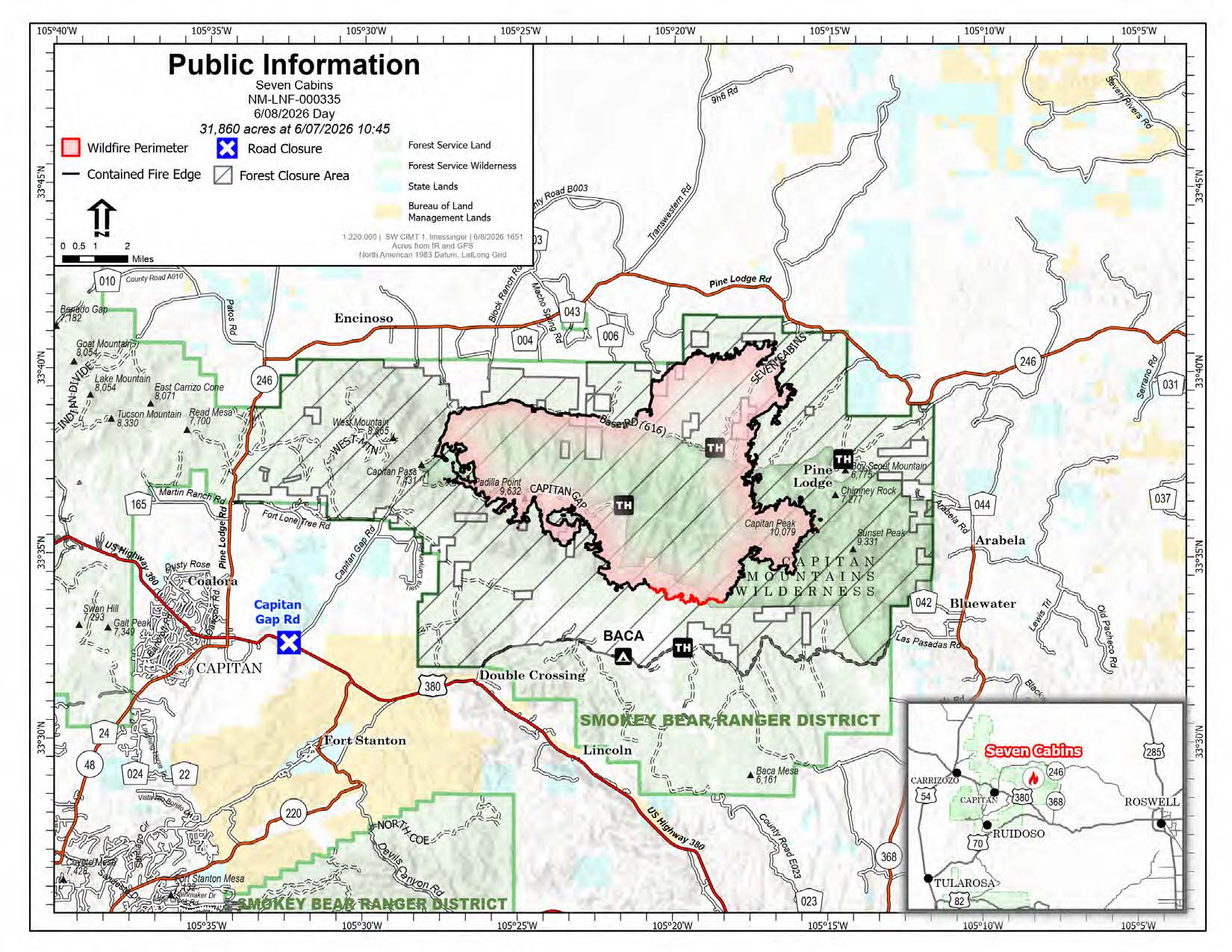
Acres: 31860 Start Date: May 14, 2026
Location: Capitan Mountain Wilderness Cause: Human caused
Personnel: 327 personnel Containment: 94%
Fuels: Heavy dead fuels in the Peppin burn scar contained
Highlights: The hard work and dedication of firefighters have brought containment on the 104 mile perimeter of the Seven Cabins Fire to 94%.
Operations: Today members of Pecos Zone Type 3 Incident Management Team are shadowing their Southwest Complex Incident Management Team 2 counterparts. Wednesday morning the team will take command of the fire. During and after the transition, work to complete suppression repair and initial attack will continue uninterrupted. After the type 3 team takes command, inquiries for information about the fire should be directed to Lincoln National Forest by calling their Public Affairs Officer at 575-314-1597, emailing sm.fspao.imf@usda.gov, or checking the forest webpage https://www.fs.usda.gov/r03/lincoln. In addition to the type 3 team, a Burned Area Emergency Response (BAER) team has already been in place for a week and has completed their assessment. The assessment is available on the BAER team’s Inciweb page for this incident, available at https://inciweb.wildfire.gov/incident-information/nmlnf-2026-baer-seven-cabins. The assessment indicates which parts of the burn area require immediate treatment to protect life, property and critical natural and cultural resources. The BAER process, which can take years, seeks to rehabilitate land that is unlikely to recover naturally from the fire.
Weather: Today will be mostly sunny and warm with a high in the upper 80s. A south wind will be moderate. The afternoon may bring isolated showers or thunderstorms. The chance of precipitation is 20%.
Smoke: With limited smoldering within the fire’s perimeter, no meaningful impacts to air quality are expected outside the immediate area of the fire. All sites will have good air quality. For air quality information, please check local conditions at Fire.AirNow.gov.
Closures and Warnings: A forest closure is in effect across the Capitan Mountain area, extending east and south of Highway 246 to the Forest Service boundary and continuing south to Forest Service Road 57. Baca campground is included in the closure. Stage 1 fire restrictions also remain in effect. The State of New Mexico has issued fire restrictions for all non-federal, non-tribal, non-municipal areas. A Temporary Flight Restriction (TFR) is in place over the fire to ensure safe access for firefighting aircraft. If a non-fire aircraft enters the restricted airspace, all firefighting aircraft must be grounded to ensure safety. Remember “If You Fly, We Can’t.”
Forest Closure Order: (https://www.fs.usda.gov/r03/lincoln/alerts/order-03-08-01-26-001-seven-cabins-fire-closure) Forest Fire Restrictions: (https://www.fs.usda.gov/r03/lincoln/alerts/order-03-08-26-001-stage-1-fire-restrictions) New Mexico Fire Restrictions: https://www.emnrd.nm.gov/sfd/find-current-fire-restrictions/
Evacuations: There are no evacuation orders associated with this fire at this time. For more information or to sign up for alerts, visit (https://www.lincolncountynm.gov/services/fire___emergency_services/index.php).
Safety: Despite recent rains, the southwest remains in serious drought conditions. By following guidelines to keep your property safe, you help protect lives and property of your neighbors as well as your own. For information on the Firewise program, visit https://www.nfpa.org/education-and-research/wildfire/firewise-usa. Crews, heavy equipment, and machinery remain active in and around the incident. The safety of firefighters and the public is our highest priority, and we ask everyone to stay aware of ongoing operations. Fire personnel continue working along area road systems, and increased caution from the public helps keep both firefighters and community members safe.
Phone Number: 505-217-0120 (7a.m. – 7p.m.)
Email: 2026.SevenCabins@firenet.gov
Inciweb: https://inciweb.wildfire.gov/incident-information/nmlnf-seven-cabins-fire
Facebook: https://www.facebook.com/SevenCabinsFire/
-

 Pennsylvania4 minutes ago
Man pleads guilty to stabbing wife to death inside Pennsylvania home
-

 Rhode Island11 minutes ago
Scottish soccer fan nears end of 3,000-mile walk for mental health awareness
-

 South-Carolina14 minutes ago
OFFICIAL: South Carolina hires Kevin Schnall as Baseball Head Coach
-
 South Dakota19 minutes ago
South Dakota tribes revoice claim to Black Hills through joint resolution
-

 Tennessee26 minutes ago
Wanted murder suspect sought by US Marshals, TBI says
-

 Texas29 minutes ago
Texas landowners fight massive transmission line project at Austin hearing
-
 Utah34 minutes ago
Utah conservation organization pledges $5.1M for wildlife recovery
-

 Vermont41 minutes ago
‘Like Christmas’: For Vermont’s Congolese community, a historic World Cup bid is cause for celebration – VTDigger

