
Ahead of the 2026 Maccabiah Games, an event often called the “Jewish Olympics” and the largest Jewish sporting competition in the world, which are set to begin next week, social media influencer, dancer, and singer, Montana Tucker expressed her excitement to be hosting the delegation parade at the event and said that the games were taking place at a critical point for the global Jewish community.
Montana
Montana Is a Frontier for Deep Carbon Storage, and the Controversies Surrounding the Potential Climate Solution – Inside Climate News


A new project aims to take carbon dioxide pollution, likely from two natural gas processing plants in Wyoming, and store it thousands of feet underground beneath the wide-open prairies of southeastern Montana.
The project, currently in the final phase of public input, comes as new federal pollution rules prioritize capturing and storing the climate-warming gas emissions from fossil fuel-burning plants to prevent them from entering the atmosphere.
The Snowy River Carbon Sequestration Project in Carter County is the first in Montana to use the space under federal public lands as a storage vessel for greenhouse gas emissions. The new federal rules could lead to much more storage in the decades ahead.
Explore the latest news about what’s at stake for the climate during this election season.
But the potential climate solution has been criticized by scientists and policy experts who claim the reductions in atmospheric concentrations of greenhouse gases the technology could bring have been significantly overstated. In the meantime, ranchers, conservationists and nearby residents are concerned about the impacts the projects’ pipelines and injection wells will have on the landscape and the potential for accidents and contamination.
“This project is going to change our way of life here forever,” said Jack Owen, a rancher in Carter County who leases from the Bureau of Land Management on the southern side of the project area and is also a member of Save Native Range, a small group of community members who have come together to oppose the project.


“Our native range is composed of indigenous plants,” he said. “They’re going to bring bulldozers, roads, Caterpillars and trucks. When they’re done, the area will be nearly taken over by invasive species.”
Other residents worry about possible disruptions to cattle grazing, impacts on water resources, damage to roads and infrastructure, potential health risks from pipeline explosions for humans and wildlife, threats to sage grouse populations and the possibility that the project might drive down property values.
Owen is concerned about the devaluation of his private properties surrounded by the project area.
“People don’t want to live near fossil fuel activities,” Owen said. “If I want to sell some of my land in the future, I worry, it won’t have the same value.”
Private CCS Projects, Public Land
In April 2024, the Environmental Protection Agency implemented a new rule aimed at curbing greenhouse gas emissions from fossil fuel power plants. Specifically targeting coal-fired plants scheduled to operate beyond 2039 and new or modified gas-fired plants, the regulation mandates the adoption of the best available emissions reduction technology and requires these plants to use carbon capture and sequestration technology (CCS) to capture 90 percent of their carbon dioxide emissions.
The Snowy River project is owned by a subsidiary of Exxon Mobil. Over 20 years, the project plans to store 150 million tons of carbon dioxide, which some sources have indicated will come from two natural gas processing plants in Wyoming: Exxon’s Shute Creek plant and the Contango plant in Lost Cabin. The BLM concluded its public comment period for the environmental assessment of the project on May 17 and is currently reviewing the submitted comments.
To accommodate the infrastructure necessary to move and store the CO2, which often requires extensive amounts of land, the federal Bureau of Land Management is providing rights-of-way for CCS projects. “This policy is an important tool to help the BLM combat the climate crisis and supports the Biden-Harris Administration’s goal of reaching net zero emissions economy-wide by no later than 2050,” BLM Director Tracy Stone-Manning said when the BLM published its policies for geologic carbon storage in June 2022.
That year, the agency approved the first private CCS project on public land—Exxon Mobil’s operation at Shute Creek, Wyoming, which stores carbon from Exxon’s adjacent natural gas processing plant. This is also one of the two plants in Wyoming that will send carbon dioxide to the proposed CCS plant in Carter County. Since then, four other CCS projects have been proposed on BLM land—three in Wyoming and one in Montana.


On a federal level, momentum grew for CCS with the expansion of the 45Q tax incentive under the Inflation Reduction Act of 2022. This incentive, initially established in 2008, was enhanced through the IRA, providing fossil fuel companies with an $85 credit for each ton of carbon stored underground.
Such initiatives are gaining traction in states that have embraced robust legal frameworks to support CCS.
In 2009, Montana enacted a forward-looking carbon sequestration and management regulation law. Former Montana State Rep. Keith Bales, who sponsored the bill during his tenure from 2007 to 2011, said his goal was to nurture a new industry as the coal sector declined.
“In this case, I wanted to ensure that if a mandate for carbon sequestration materializes, there would be a structured framework enabling companies to proceed,” Bales said.
Usually, the Environmental Protection Agency oversees Class VI injection wells—the type designated for CCS projects to inject CO2 into deep rock formations. However, Wyoming obtained federal “primacy” in 2020 to regulate its own CCS industry, a pioneering move nationwide. That same year the state enacted legislation mandating Wyoming power plants using fossil fuels to incorporate carbon capture by 2030, further incentivizing companies using coal and gas to generate electricity to develop CCS infrastructure and expertise.
The alignment of the new Biden administration rule, financial incentives, evolving regulations from government agencies facilitating rights-of-way and state governments’ pursuit of new opportunities for fossil fuel-dependent economies have created a pivotal moment for CCS.
Realities On, and Under, the Ground
Carter County, in the extreme southeast corner of Montana, borders Wyoming and South Dakota. Denbury Inc., an Exxon subsidiary and Montana’s larger producer of crude oil, plans to inject 150 million tons of CO2 below the surface of BLM lands there.
Denbury’s 105-mile-long Cedar Creek Anticline pipeline currently transports CO2 from the Shute Creek plant in Wyoming through Carter County north to Fallon County, Montana. There the carbon is used to force oil to the surface at Denbury’s Coral Creek oil field, a long-established technique known as enhanced oil recovery.


The Snowy River CCS plan calls for Denbury to send additional carbon dioxide through the Cedar Creek pipeline to be drawn off and stored before it reaches Fallon County. This storage is solely for Exxon to earn a tax credit from the federal government for managing its carbon emissions instead of releasing them into the atmosphere.
Denbury plans to lease about 100,000 acres of land and porous space from the BLM for 30 years to store CO2 underground, but the carbon would be stored, the project proponents hope, in perpetuity. After Denbury’s lease expires, the Environmental Protection Agency will continue monitoring, as they are the authority to permit the injection wells.
The proposed Carter County site was chosen by Denbury due to the availability of vast uninterrupted public land, which comprises 92 percent of the area. Factors such as geological formations, existing pipelines and environmental considerations such as impacts on sage grouse habitat and other wildlife, invasive weeds, sediment levels in water bodies, and topsoil management were found to be minimal.
Carter County is flat, dry and sparsely populated, with an average of about three residents per square mile across its approximately 3,500 square miles. Anyone driving a car is assumed to be an outsider and it’s a rarity to see more than one vehicle on the road at a time. Traveling through the area can evoke a sense of desolation in visitors, yet it offers glimpses of the classic Montana culture, with cowboys crossing the highway on horseback. Known for its expansive skies, vast flatlands and low hills, the community embraces isolation and self-sufficiency, fostering a tight-knit bond where everyone knows each other.
Although the Snowy River project has been in the works for three years, few people in Carter County have a solid understanding of what Denbury is proposing and many feel excluded from the process. Traditionally, ranchers and farmers in the area have regarded the BLM as stewards of the land, but they perceive a growing conflict of interest as the agency prioritizes infrastructure projects, particularly those supported by fossil fuel companies.
Liz Barbour, who manages a ranch on the eastern side of the project area, pressed the BLM to conduct an Environmental Impact Statement, which the agency declined to do, stating the project would not have a significant impact. In response, Barbour has made multiple trips to Washington, D.C., this year to lobby against the Snowy River project.
“BLM already has a no surface occupancy stipulation on that specific piece of land for sage-grouse habitat,” Barbour said. “It doesn’t matter if you’re putting in oil wells or a theme park.”
Supported by the Northern Plains Resource Council, an organization that brings farmers and ranchers into discussions about environmental and climate issues, Barbour has met with Stone-Manning—the director of the BLM, as well as the director of the BLM in Montana, and nearly all Montana legislators. So far, she hasn’t received a response from any authority that convinces her of the safety of the project.
“I partner with the land every day and feel it’s my responsibility to protect it,” she said. “We have demanded the BLM conduct an EIS so that we can assess the exact impact of this project on our environment.”
Mike Hansen, a third-generation rancher in Carter County, has properties on the southeast side of the project area. Approximately 8,000 acres of his private property are adjacent to the proposed project areas, and he also holds a BLM grazing lease on 4,000 acres within the project boundaries.
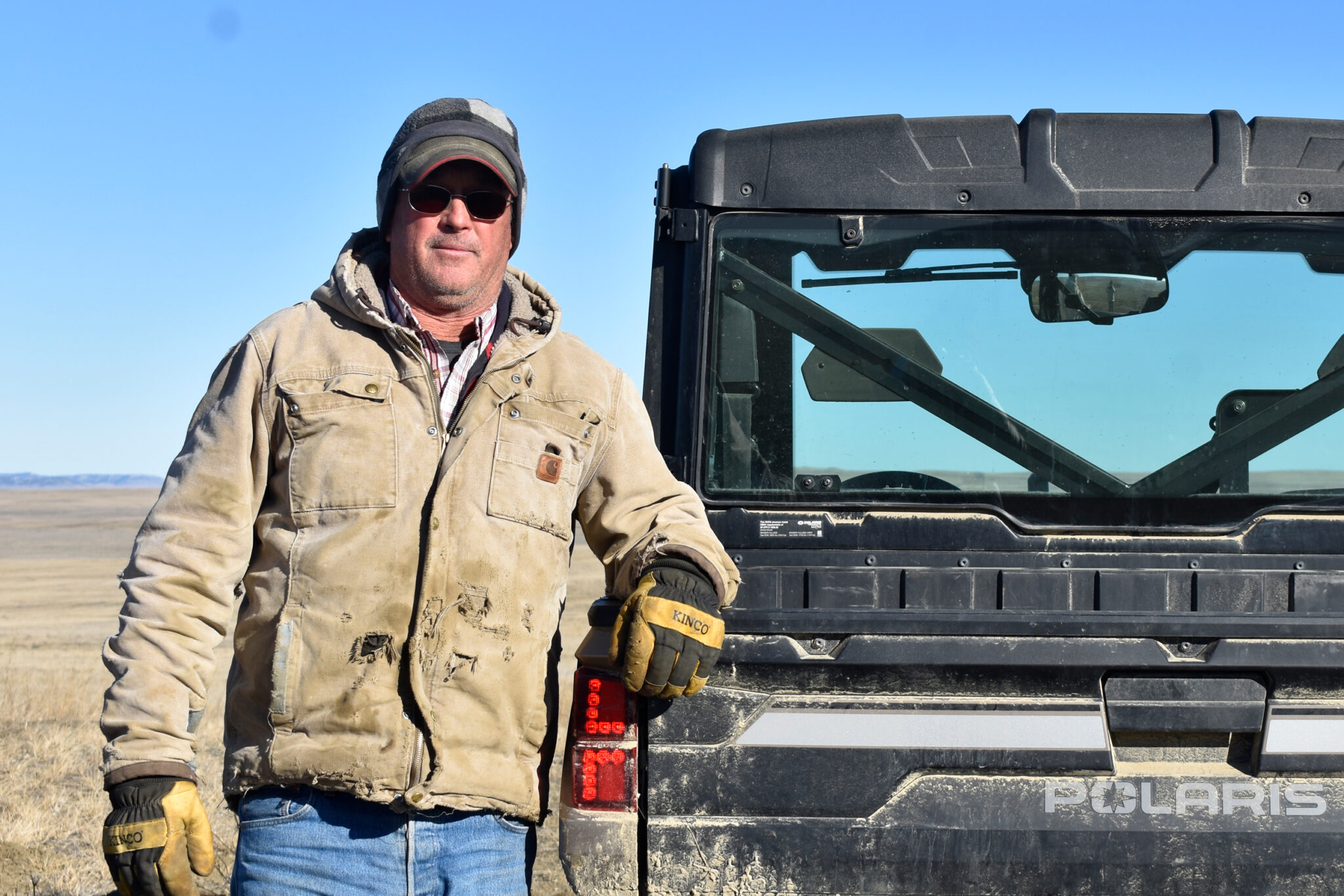
Denbury plans to construct 15 injection wells to sequester carbon underground. Four of these wells, a seismographic drill and a testing well to gather geological information about that area are planned on land Hansen leases from the BLM.
He is concerned the impact of drilling will contaminate the surface water. He owns three reservoirs that are vital for cattle watering, two of which are adjacent to proposed drilling sites. “If stuff from underground surfaces, what’s going to happen to my water supply? How am I going to water my cows?” Hansen said.
Another rancher, Jerry Keith, relies solely on groundwater to irrigate his lands and provide water for his cattle through pipelines spanning his ranch. One of his water wells is located 4 miles away from one of the proposed injection sites and he worries Denbury drilling may disrupt his water supply.
“You can’t drill to get water because there is no water down there,” Keith said of the area to which he pipes water. “So, we have to pipeline it to the cattle and the building and everything else. We’ve got almost 15 miles of pipeline on the ranch.”
John LaFave, research division chief of the Montana Bureau of Mines and Geology and a professor at Montana Tech, believes there is little risk of groundwater being seriously impacted by the project. The geologic formation of the proposed project area differs from most of the county, he said, with no bedrock aquifers existing beneath the surface. At the project site, the surface primarily consists of shale formed from compacted mud and clay, which acts as a barrier or seal for water and other fluids.
“These deep injection projects are counting on the impermeable seal rocks to prevent anything from going up,” LaFave said. “From that point, the risk to groundwater resources seems pretty minimal.”
More Pressures on an Already Threatened Bird
It’s not just people who have a problem with the project.
Construction for energy development projects can directly impact sage grouse, an important upland game bird in Montana that’s designated as a sensitive species. To draw carbon off of the existing Cedar Anticline Pipeline, the Snowy River project will construct 40 miles of new pipelines in Carter County, a crucial area for sage grouse habitat conservation.
A 2011 study conducted by researchers from the University of Montana on the effects of energy development on sage-grouse populations found that disturbances during the breeding season, such as noise, vehicle traffic or power lines, can lead sage grouse to abandon their breeding grounds.
After analyzing coal and natural gas extraction infrastructure in the Powder River Basin of Wyoming and Montana between 2001 and 2005, researchers observed a more rapid decline in male sage-grouse populations in areas with energy development compared to those without. In development zones, only 38 percent of sage grouse breeding grounds remained active, in contrast to 84 percent in undeveloped areas.
“I’m worried about all the power lines and construction that would pass through these lands,” said Doug Bomsell, a member of the Carter County Conservation District. “Habitat disruption and noise really bother the birds, especially during nesting season.”
Denbury has pledged to limit activities during sage grouse nesting season, typically from March to June. However, the company acknowledges the challenge of completely avoiding disturbances in sage grouse habitat. Consequently, Denbury has proposed protecting sage grouse habitat elsewhere in Montana to make up for potential impacts related to the Snowy River CCS project, said Therese Hartman, program manager of The Montana Sage Grouse Habitat Conservation Program.
Whether such offsetting programs really work to protect wildlife is another question, but some conservationists see climate change as an even bigger threat to the birds than construction disturbance. They believe that amid the long-standing decline in sage grouse populations, the sage grouse credit system presents an experiment for conserving their habitat in the long term.
“We already have extensive negative impacts occurring to sage grouse habitat from active fossil fuel development,” said Ben Deeble, president of the Big Sky Upland Bird Association, which works to enhance upland bird habitat in Montana. The CCS project in Carter County “is more than likely to damage the habitat further, even though it may have a global climate benefit. I guess if you’re going to damage wildlife habitat, I’d rather do it with something that has a potential global benefit than continuing just on the same pattern of atmospheric destruction.”
Locals are also concerned about potential damage to existing roads or the creation of additional roads around their grazing lands. The project plans to use approximately 25 miles of existing roads and 27 miles of two-track routes over a mix of BLM, county and private lands.
Tom Sieg, a rancher with properties on the northern side of the project, questioned why the BLM is granting rights-of-way for large-scale construction while imposing stricter restrictions on ranchers for wildlife and other environmental considerations.
“I guess if you’re going to damage wildlife habitat, I’d rather do it with something that has a potential global benefit than continuing just on the same pattern of atmospheric destruction.”
“We can’t even drive on it, and they’re going to put roads, wells and pipelines too?” Stieg said “What’s the deal?”
He believes the project will further restrict grazing, potentially leading to conflicts between ranchers and project personnel, and fears that Denbury doesn’t respect the traditional ranching lifestyle.
“If they can pump it in the ground and it wouldn’t cause a problem, why don’t they pump it in Wyoming where it came from?” he asked. “I don’t want them messing around here in the middle of our BLM land.”
A Troubling Legacy
Denbury, which has operations along the Gulf Coast as well as in the Rocky Mountain West, has faced scrutiny for various incidents. In February 2020, a leaking Denbury CO2 pipeline exploded in Satartia, Mississippi, the first such incident officially reported in the country, causing 49 hospitalizations and the evacuation of 300 residents. The U.S. Pipeline and Hazardous Materials Safety Administration fined Denbury $2.8 million, citing its lack of preparedness for hazards, delayed notification of local authorities and inadequate community education regarding the pipeline’s presence.
In April, another leading pipeline in Sulphur, Louisiana leaked more than 2,500 barrels of CO2, triggering an emergency response in the former mining town.
Carter County residents worry about similar hazards.
“I wonder how much pressure will be forced out underground, since they will be putting the CO2 so deep underground,” Keith said. “When that blows out, that could be a major catastrophe.”


Exxon and its subsidiary, Denbury, did not respond to requests for comments regarding the residents’ concerns.
But leaks may not be the most significant risk associated with CCS projects, said Brian McPherson, who directs the Carbon Science and Engineering Research group at the University of Utah. CO2 plumes move slowly even under extreme conditions, he said, which slows the rate at which it can travel to potential leakage points, such as wells or faults, and limits the amount of the gas that can escape.
“If the sites are monitored and the potential leakage points are monitored and tracked, the safety associated with leakage is very tractable,” he said.
Induced seismicity—earthquakes caused by the process of pumping the CO2 underground— poses a more significant threat, he believes. These earthquakes, common in oil and gas fields, result from changes in fluid pressure underground and can be small and undetectable. And, unlike oil fields, CCS projects lack the financial incentive to maintain precise pressure control across their underground storage space, he said.
“In every well and every spot in the reservoir, oil companies spend billions of dollars to maintain that control because it means trillions of dollars across the sector,” McPherson said. But, even with the federal incentives, and the EPA designated to monitor the projects, fossil fuel companies have little motivation to adhere to monitoring and policy regulations without a profitable resource to pull up from underground, rather than something to dispose of there.
“For oil companies tax credits like 45Q are a net liability, not an asset,” he said. “It’s a high-risk endeavor and the first big earthquake that occurs associated with CO2 injection will destroy the entire operation.”
Denbury already faces allegations of irresponsible land stewardship in Montana. Tom Giacometto, a rancher from Broadus in Powder River County, adjacent to Carter County and home to one of Denbury’s enhanced oil recovery units, is suing the company for damages he alleges it caused on his property, which borders the facility. In two lawsuits filed in 2016 he sought financial compensation for the destruction of one of his cattle reservoirs, health hazards and hindrance to property use and residents’ comfort caused by the operation. Another lawsuit filed in 2022 cites 16 pipeline leak incidents, including two near Giacometto’s residence and one in his alfalfa field, which resulted in explosions and the release of CO2.
“The least they could do is contribute some things here for the benefit of the land and community,” Giacometto said. “That’s my biggest gripe; that would not make them a complete asshole.”
After a nine-year courtroom battle, Giacometto settled with Denbury in March 2024, declining to disclose the compensation amount for legal reasons.


But it could be some time before fossil fuel companies have a financial incentive to be better neighbors.
While the new federal CCS rule may change the financial equation for electricity plants in the long run, it does not go into effect until 2032 and only governs new gas-fired plants and existing coal generators.
A separate rule no sooner than 2025 is expected to address existing gas plants, such as the two expected to feed the Carter County CCS project.
A Costly Experiment?
Critics of CCS say the cost and industrial intensity of the technology make it an unlikely climate savior, and it’s debatable whether these projects will bring jobs and big investments to rural areas.
Mark Z. Jacobson, a professor of civil and environmental engineering at Stanford University, published a study in 2019 suggesting that CCS technologies may do more harm than good. His research indicates that over 20 years, a full-fledged carbon capture and storage (CCS) operation captures only 10 to 11 percent of the total emissions of the plant where it’s installed. This figure accounts for cumulative greenhouse gas emissions from outside the project’s direct operations, including the carbon footprint associated with logistics, such as transporting equipment from different parts of the world.
“If the energy is coming from a renewable source and could have been used better in Montana or anywhere else to replace a fossil electricity [plant],” that would do more to reduce emissions than using the power to run a CCS operation, Jacobson said. “In most cases they are still using fossil fuel to run the carbon capture equipment, so that’s even worse.”
This story is funded by readers like you.
Our nonprofit newsroom provides award-winning climate coverage free of charge and advertising. We rely on donations from readers like you to keep going. Please donate now to support our work.
Donate Now
He concluded that the overall costs, including air pollution, potential health issues, economic impacts and contributions to climate change, could be similar to or even higher than those of operating a fossil fuel plant without carbon capture, or not capturing carbon at all.
His study is particularly relevant to Montana’s largest CO2-producing industry, the Colstrip Power Plant. A 2018 study on the power plant considered establishing a CCS plant using the 45Q tax credit to capture and store 63 percent of Colstrip’s CO2 emissions annually. However, the plant eventually abandoned the idea due to high infrastructure costs.
McPherson disagrees with Jacobson’s skepticism. He sees private investment in CCS as a positive step with industry securing funding, shaping policies and advancing the technology. However, he acknowledges the importance of the 45Q tax incentive, which is currently set to expire in 2033, for industry expansion, and believes its renewal is crucial. And CCS companies need to turn a profit during that time, he emphasized.
“Unless carbon markets become a tangible and a significant financial force, the industry won’t stand on its own just with credits,” he said.
Major fossil fuel companies, such as Exxon, are intrigued by large-scale projects like the one in Carter County but are taking a cautious approach, McPherson suggested, and are waiting to gauge the success of early adopters in the marketplace before committing their capital investments.
“The project in Montana will be among the first tangible data sets,” McPherson said. “Before companies jump in with their capital investments.”
Is the Payoff Worth the Risk?
Communities like Carter County that are taking the initial risks on a technology with an uncertain future may not receive the compensation they expect.
Another Mark Jacobsen, who works as a communication officer of BLM Montana-Dakotas, said in an email that the rentals and fees collected from the project would be allocated to the federal treasury as mandated by the Federal Land Policy Management Act. Twenty five percent of the project’s hiring will be sourced locally, and a portion of the lease fees will go to the Montana School Trust Funds.
That’s not how it works with the existing Cedar Anticline and other natural gas pipelines. Federal oil and gas regulations ensure compensation for landowners affected by oil and gas projects. But carbon dioxide is not classified as a mineral, and so industry is not required to pay the affected individuals for the impacts from the pipelines for CCS projects. And while the pipes don’t cross private lands, ranchers with grazing agreements with the BLM may retain mineral rights on those public lands.
While Denbury pays the BLM for surface land use and underground pore space, ranchers do not receive compensation for disruption on the surface, impacts on any mineral rights they might hold or the exploitation of the previously unvalued void beneath the soil.
Jerry Keith feels that’s unfair.
“This is where they would drill the injection well,” he said, pointing towards an empty space on BLM land adjacent to land he leases from the agency. Pipes will travel for miles in various directions from the well over land that Keith leases from the agency. “If we have the mineral rights on it, why shouldn’t we be getting something from that?”
About This Story
Perhaps you noticed: This story, like all the news we publish, is free to read. That’s because Inside Climate News is a 501c3 nonprofit organization. We do not charge a subscription fee, lock our news behind a paywall, or clutter our website with ads. We make our news on climate and the environment freely available to you and anyone who wants it.
That’s not all. We also share our news for free with scores of other media organizations around the country. Many of them can’t afford to do environmental journalism of their own. We’ve built bureaus from coast to coast to report local stories, collaborate with local newsrooms and co-publish articles so that this vital work is shared as widely as possible.
Two of us launched ICN in 2007. Six years later we earned a Pulitzer Prize for National Reporting, and now we run the oldest and largest dedicated climate newsroom in the nation. We tell the story in all its complexity. We hold polluters accountable. We expose environmental injustice. We debunk misinformation. We scrutinize solutions and inspire action.
Donations from readers like you fund every aspect of what we do. If you don’t already, will you support our ongoing work, our reporting on the biggest crisis facing our planet, and help us reach even more readers in more places?
Please take a moment to make a tax-deductible donation. Every one of them makes a difference.
Thank you,


Najifa Farhat
Fellow
Originally from Dhaka, Bangladesh, Najifa has been an environmental journalist for over three years. She graduated in Spring 2024 with a master’s in Environment and Natural Resource Journalism from the University of Montana. During this period, she freelanced for several local outlets and completed reporting internships with the Flathead Lake Biological Station and Montana Public Radio.
Najifa intends to explore issues such as energy transition, public lands, and environmental concerns in rural areas, inspired by her master’s project on a carbon sequestration project in Eastern Montana. Despite lacking formal education in environment or science, she is deeply motivated to pursue environmental journalism due to her homeland’s vulnerability to the impacts of climate change. Najifa aspires to illuminate the stories of individuals worldwide grappling with the extensive effects of climate change, with a special emphasis on South Asia.

Montana
Social media star Montana Tucker to host Maccabiah Games delegation parade | The Jerusalem Post

“Israel has gone through a lot, Israelis have gone through a lot, Jews have gone through a lot around the world,” Tucker told The Jerusalem Post on Tuesday. “What’s going on is not just happening in Israel; it’s really happening all around the world with our Jewish community. So, an event like the Maccabiah Games is showing the world that we are strong, we are united, and we don’t give up, and we keep fighting.”
According to Maccabiah, the games bring together more than 10,000 athletes from at least 80 countries in Israel every four years to compete in over 45 sports. The Maccabi World Union says the games are the second-largest sporting event in the world after the Olympics.
The 2026 Maccabiah Games, the 22nd of their kind, were initially scheduled for last year but were postponed due to the security situation involving Iran and its regional proxies.
“This was supposed to happen last year, and about a month away, we had to cancel it due to the war,” Tucker recalled. “And so I am so grateful that it is happening this year, because we truly do need this now more than ever.”
She also said she was excited to debut her new song “We’re Not Strangers” at the event.
“It’s all about unity and building bridges and bringing people together. And some of the lyrics say ‘we may pray to different saviors, but we’re not strangers,’” she told the Post. “Our world is so divided right now. I think that we really just need to come together and have more unity and compassion and understanding of one another. And if we really talk to people who look differently than us, act differently than us, have a different religion than us, we’ll realize we’re actually more similar than we think.”
Montana Tucker: Sport ‘truly unites the world’
Sports, she said, was an ideal method to build these bridges, adding she viewed it as something that “truly unites the world.”
The Maccabiah Games this year, though, will be the first since the Hamas-led massacres in southern Israel on October 7, 2023. The attacks sparked a regional eruption with Israel fighting wars against Hamas in Gaza, Hezbollah in Lebanon, and the Islamic regime in Iran.
“We always have to talk about what happened on October 7,” Tucker said. “We should never stop talking about it. And I think it is so important that Maccabiah is utilizing this platform to talk about it. I know they actually have a former hostage, Daniella Gilboa, who’s going to be performing, which is so powerful.”
Tucker also highlighted the value of the games, saying they were a powerful tool to dispel disinformation about the Jewish state.
“What’s shown on the news nowadays is just all the negativity. Most of it is just propaganda and lies about what Israel is, and I think the Maccabiah just debunks every possible propaganda and lie about Israel,” she said. “When people say the word ‘Israel,’ it comes with so many different connotations, and I think we can show them this. This is Israel. This is what being Jewish means.”
A key element in showing the world what Israel and being Jewish mean, she reiterated, meant showcasing Jewish unity at a time when, in the wake of the October 7, the global Jewish community has faced a worldwide rise in antisemitism.
The games themselves are being held under the slogan, “More Than Ever,” according to Maccabiah, to emphasize “the importance of strengthening the bond between [Jewish] communities worldwide and the State of Israel.”
The Montana Lottery offers multiple draw games for those aiming to win big.
Here’s a look at June 23, 2026, results for each game:
Winning Mega Millions numbers from June 23 drawing
48-51-60-63-66, Mega Ball: 20
Check Mega Millions payouts and previous drawings here.
Winning Big Sky Bonus numbers from June 23 drawing
06-21-22-31, Bonus: 13
Check Big Sky Bonus payouts and previous drawings here.
Feeling lucky? Explore the latest lottery news & results
When are the Montana Lottery drawings held?
- Powerball: 8:59 p.m. MT on Monday, Wednesday, and Saturday.
- Mega Millions: 9 p.m. MT on Tuesday and Friday.
- Lucky For Life: 8:38 p.m. MT daily.
- Lotto America: 9 p.m. MT on Monday, Wednesday and Saturday.
- Big Sky Bonus: 7:30 p.m. MT daily.
- Powerball Double Play: 8:59 p.m. MT on Monday, Wednesday, and Saturday.
- Montana Cash: 8 p.m. MT on Wednesday and Saturday.
- Millionaire for Life: 9:15 p.m. MT daily.
Missed a draw? Peek at the past week’s winning numbers.
This results page was generated automatically using information from TinBu and a template written and reviewed by a Great Falls Tribune editor. You can send feedback using this form.

We cover lots of hard news here at The Drive. Y’know, the stuff that keeps you updated on the automotive industry and enthusiast scene. Other times, we don’t. Other times, we write silly car-related stuff because it’s fun. This is one of those times. A giant banana recently got pulled over in Montana, and as the Cowboy State Daily put it, it wasn’t its first time.
According to the Montana State Police, the giant banana car and its driver, Steve Braithwaite, were pulled over near Billings because part of the license plate was blocked. He did not receive a ticket. Also, the plate reads “SPLIT.”
“We’ve stopped speeders, distracted drivers, and even a few unusual vehicles… but this one definitely stands out.
The Big Banana Car was stopped cruising near Billings today. While it may be apPEALing, traffic laws still apply to fruit. 😎 🍌
Safe travels, Montana,” said the Montana State Police’s Facebook page.
According to the report, Braithwaite has been pulled over hundreds of times over the decade he’s been driving his banana car across the country. In fact, he believes that during the first few years he had the thing, he was one of the most frequently pulled-over men in America.
“Driving around in a banana and having all these people, all these smiles and waves, affects me. It actually does something fantastic,” he told the outlet.
He even claims to have been pulled over once for “peeling out,” which was, of course, a joke.
Another report claims that Braithwaite began working on the fiberglass banana in 2008 and finished it in 2011. It’s based on a 1993 Ford F-150 and is a bout 23 feet from tip to tip.
Keep on keepin’ on, Steve.
Got a tip? Email us at tips@thedrive.com
-

 New Hampshire2 minutes ago
Charlevoix County farm arson suspect arrested in New Hampshire after January blaze
-

 New Jersey9 minutes ago
Minnesota woman struck by worker while protesting outside of New Jersey ICE facility
-

 New Mexico12 minutes ago
Canyon Venado Fire near Clines Corners grows to 852 acres, I-40 reopened
-

 North Carolina24 minutes ago
Great horned owl kills 1 of NC Wildlife’s famous barn owlets: officials
-

 North Dakota27 minutes ago
NCAA Set to Change Unpopular Football Rule Just in Time for North Dakota State’s FBS Jump
-

 Ohio32 minutes ago
Ohio lawsuit alleges new NCAA rule unfairly denies high school Class of ’22 athletes a 5th season
-

 Oklahoma39 minutes ago
Fire Crews respond to commercial fire in SW Oklahoma City Wednesday afternoon
-

 Oregon42 minutes ago
Liu makes two! 2nd red panda joins Oregon Zoo family

