Lifestyle
L.A.’s latest viral party spot is … Seafood City. Yes, you read that right


Under the glow of fluorescent lights at Seafood City market in North Hills, packages of pre-made adobo, salted shrimp fry and and dried anchovies glisten in meat coolers.
A DJ, dressed in a traditional barong, blasts a dance remix of Whitney Houston’s “I Wanna Dance with Somebody” as a crowd gathers to take a shot of fish sauce together.
“That was disgusting!” a man shouts into the mic, flashing a grimacing expression.

At Seafood City, DJs 1OAK, left, EVER ED-E and AYMO spin in barongs, the Philippines’ national formal shirt.
The smells of lechon and lumpia float through the air. Smiling children munch on halo-halo (a Philippine dessert made with ube ice cream, leche flan and shaved ice). Flags of the Philippines wave in the air as a man in UCLA Health scrubs hops into the center of an energetic dance circle. Employees shoot store coupons out of a money gun and toss bags of Leslie’s Clover Chips into the crowd. Fathers hold their children on their shoulders as a group of college students perform a Tinikling routine, a traditional Philippine dance in which performers step and hop over and between bamboo poles.
“This is so Filipino,” a woman says, in awe of the scene.

Sabria Joaquin, 26, of Los Angeles, left, and Kayla Covington, 19, of Rancho Cucamonga hit the dance floor at “Late Night Madness” in North Hills.
“I came here for groceries,” explains an elderly man, adding that he decided to stay for the party.
Seafood City, the largest Philippine grocery store chain in North America, typically closes at 9 p.m. But on certain Friday and Saturday nights, its produce or seafood aisle turns into a lively dance floor for “Late Night Madness.” On social media, where the gathering has exploded, it looks like a multigenerational nightclub that could use dimmer lighting. But for attendees who frequent the store, it’s more than that. It’s a space for them to celebrate their Filipino heritage through food, music and dance in a familiar setting.
“This is something that you would never expect to happen — it’s a grocery store,” says Renson Blanco, one of five DJs spinning that night. He grew up going to the store with his family. “My mom would [put] us all in the minivan and come here, and she’d let us run free,” he adds. “It’s comfortable here. It’s safe here.”
1

2

3

1. Rhianne Alimboyoguen, 23, of Los Angeles follows an employee through the produce section. 2. Allison Dove, 29, left, and Andrea Edoria, 33, both of Pasadena, enjoy Philippine street food. 3. Katie Nacino, 20, left, Daniel Adrayan, 21, and Sean Espiritu, 21, of the Filipino American Student Assn. at Cal State Northridge, practice tinikling, a traditional Philippine folk dance, in an aisle.
The first Seafood City location opened in 1989 in National City, a suburb of San Diego, which has a nearly 20% Asian population including a rich Filipino community. For its founders, the Go family, the mission was simple: to provide a market where Filipinos and people within the diaspora could comfortably speak their native language and buy familiar products. It’s since become a community anchor. Of the nearly 40 locations in Northern America, at least half of them are based in California, which has the highest population of Asian Americans in the United States.

-
Share via
The first “Late Night Madness” event happened in September in Daly City, Seafood City’s newest location. The company wanted to launch a street food program at the store’s food hall in a fun and creative way.
The DJ played a selection of hip-hop, pop, soul and classic Pinoy records like VST & Company’s “Awitin Mo, Isasayaw Ko.” Hundreds of people showed up, and videos of people of all ages turning up in the popular supermarket spread like wildfire. So the company decided to continue hosting the event in October during Filipino American History Month and for the rest of the year. It’s since expanded to more locations around the country and in L.A., including Eagle Rock.
By 10 p.m. at the Seafood City in North Hills, at least 500 people are dancing in the produce section, next to rows of saba bananas, fresh taro leaves and bok choy. The lively crowd forms dance circles throughout the night, taking turns jumping in the center to show off their moves to songs like Earth, Wind & Fire’s “Let’s Groove,” “Nokia” by Drake and Justin Bieber’s “I Just Need Somebody to Love.” At one point, TikToker and artist Adamn Killa hops on the mic and says “If you a Filipino baddie, this is for you,” before doing his viral dance.

Among the Philippine street food offerings were pandesal sliders, lumpia-style nachos, lobster balls and various skewers.
A group of employees dance behind the counter as they serve hungry patrons who fill their trays with various Filipino street food including pandesal sliders (soft Philippine bread filled with adobo, lechon or longganisa) and Lumpia Overload (think nachos, but a bed of lumpia instead of tortilla chips), lobster balls and barbecue chicken skewers. (No alcohol is served.) Meanwhile, a few lone shoppers sprinkle into the store to get their weekly groceries as music blasts through the speakers.
First-generation Filipino American Andrea Edoria of Pasadena says “Late Night Madness” reminded her of the family parties she attended as a child in L.A. and in Manila, where her parents are from.
“Growing up as a child of immigrants, I was kind of self conscious about displaying too much of my culture,” she says between bites of spiral fried potato. She went to the Eagle Rock event with her mother last month as well. “So it kind of fed my inner child to see so many people celebrating this shared culture and experience that we each grew up [with].”

A multi-generational crowd is drawn to the dance floor. At center is Jade Cavan, 44, of Chatsworth.

Members of the Filipino American Student Assn. at Cal State Northridge perform a tinikling performance.
She adds, “I think it’s so important especially now at a time where our country is so divisive and culture is kind of being weaponized, I think it’s a beautiful reminder that we can come together and find something that unites us.”
About 10 minutes before midnight, the grocery store is still bustling with activity. A dance battle breaks out and people begin hyping up the young women. The DJ transitions into slower tracks like Beyoncé’s “Love on Top” and Mariah Carey’s “All I Want for Christmas is You.” The remaining folks sing along loudly as they walk toward the exit, smiles imprinted on their faces. Staff rush to clean up, then huddle together for group photos to memorialize the evening.

After the final song is played, employees rush to clean up the supermarket.
Patrick Bernardo, 34, of Van Nuys looks at the counter, where a man had been chopping lechon, before stepping outside.
“There’s barely anything left on that pig,” he says, pointing to it as proof that the night was a success.


Can you say no to a friend’s wedding?
Getty Images/Getty images
hide caption
toggle caption
Getty Images/Getty images
Are we spending too much on other people’s weddings?
Going to a friend’s weddings can be so fun and meaningful… but it can also really hurt your wallet. A survey by LendingTree found that 31% of people who had been to a wedding in the past five years had accrued debt to attend. So what’s driving up the cost of weddings for guests? And what makes it so hard to say no to these expenses?
Brittany breaks it down with Allyson Rees, senior analyst at trend forecasting firm WGSN, and Annie Joy Williams, assistant editor at The Atlantic.
This episode was produced by Liam McBain, with additional support from Corey Antonio Rose. It was edited by Neena Pathak. Our Supervising Producer is Cher Vincent. Our Executive Producer is Barton Girdwood. Our VP of Programming is Yolanda Sangweni.
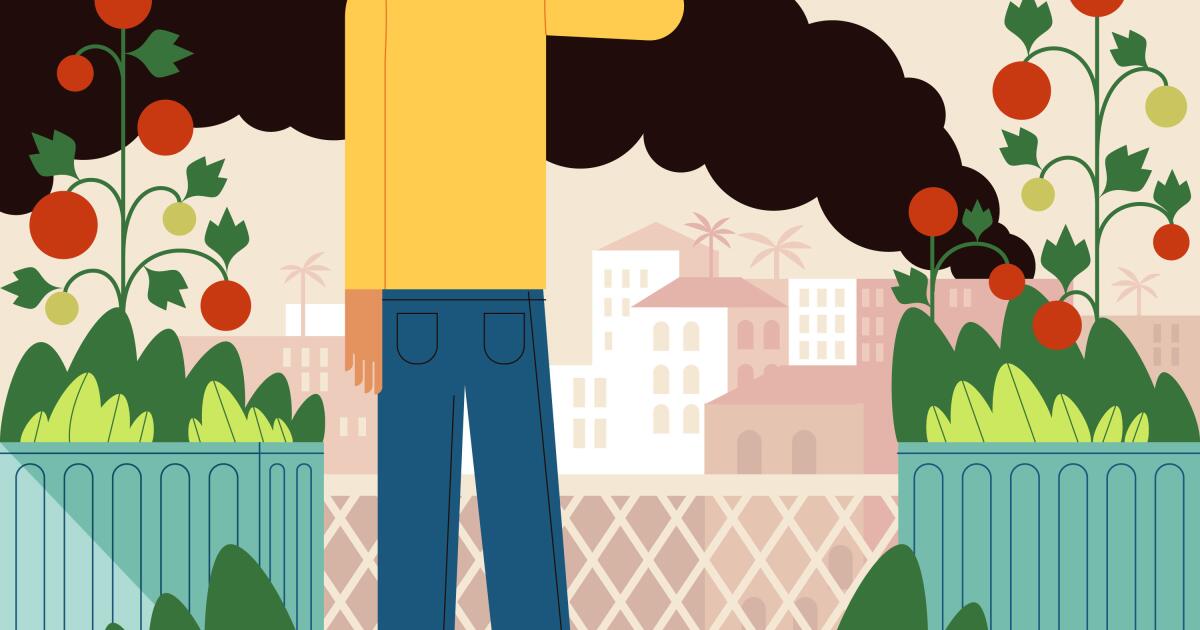
After the eight-day-long fire in a 500,000-square-foot Boyle Heights warehouse, eastern Los Angeles residents are contending with putrid smells, soot and potentially hazardous airborne chemicals after heavy plumes of smoke spread throughout the city. But those who grow food in nearby neighborhoods may also be wondering: How will the fires affect the plants and produce in my garden?
The Boyle Heights warehouse, owned by Lineage — a global temperature-controlled storage facility operator — housed 85 million pounds of frozen food and other products. In the days since the fire, local emergency visits for smoke inhalation and throat pain spiked while agencies still scramble to measure the amount of PM 2.5 — harmful fine particles — and heavy metals, like lead and arsenic, in the air.
According to researchers, any toxic airborne chemicals would likely stem from the charred foam insulation, metal exterior, burned solar panels and any lithium batteries that might have been present inside the warehouse.
After a fire, heavy metal particles can spread through ash and smoke over gardens and inhibit growth, said Olukayode Jegede, an agricultural toxicologist and assistant professor at UC Davis. Since the warehouse fire is so recent and cleanup has just begun, Jegede said the precise impact on gardens can’t be measured until comprehensive soil tests are conducted in the area.
While the L.A. city government hasn’t announced plans for soil testing, the Contaminant Level Evaluation and Analysis for Neighborhoods project at USC is offering free contaminant testing for Boyle Heights and East L.A. residents. Residents can collect soil samples and deliver them to Boyle Heights City Hall and other locations for an evaluation of lead, arsenic, chromium and mercury levels.
The good news is produce, plants and roots can still be preserved. According to Jegede, many of the soil tests conducted last year in the Altadena area after the Eaton fire showed that gardens and poultry were not as contaminated as one might expect.
“Quite a number of the soils we tested [in Altadena] were not really contaminated,” Jegede said. “We weren’t seeing many soils with concerning elevated levels of metal, so gardeners should not be too alarmed when these things happen.”
Nevertheless, there are several measures that gardeners can take to keep themselves, their children, plants and produce safe from potentially harmful contaminants stemming from the fire. Researchers, gardening experts and horticulturists offered some guidance on the handling, recultivation and cleanup that can keep you and your garden in good health.
How do I remove ash and contaminants from my garden?
Altadena horticulturist Leigh Adams said Boyle Heights plants and produce already live in a difficult environment, surrounded by industrial warehouses that spread contaminants daily.
“That area has been used industrially for 100 years, and the soil is impacted by many, many, many things,” Adams said. “Low-income neighborhoods and gardens usually don’t have a lot of resistance against dominant manufacturing.”
This means that the contamination of gardens in eastern L.A. won’t be as catastrophic as compared with those in Altadena, a more suburban environment, Adams said. But fallen ash still poses major health risks if ingested or inhaled.
An advisory from University of California Agricultural and Natural Resources last year recommended suiting up in an N95/KN95 mask, long sleeves, pants, close-toed shoes and gloves before attempting to deal with ash in the garden to limit exposure to potentially toxic contaminants. The advisory added that individuals should make sure all of this gear is cleaned thoroughly before bringing it back inside.
Once in the proper gear, Adams recommends removing the top two inches of topsoil from gardens, where the highest concentration of contaminants will settle after a fire. Using a plastic bag to collect the soil and disposing of it in the garbage — not green yard waste bins — will help to reduce the spread of airborne chemicals.
Gardeners with raised beds are advised to remove approximately six inches of soil, because excess ash can raise the pH level and prevent nutrients from soaking into the soil bed.
After this, watering the garden gently but plentifully will help to promote soil health and get rid of most of the ash present on plant leaves and stems. Adams said replacing the top two inches of soil with store-bought mulch or straw will help to contain any remaining ash and prevent it from spreading any further.
Experts say to avoid using leaf blowers if ash is present in the garden because they can send particles airborne. Doing so will increase the likelihood of heavy metal particles, which can carry lung irritants and carcinogens, being spread and inhaled.
A Boyle Heights resident keep a watchful eye on the fire at the 5,000-square-foot commercial building, which stores 85 million pounds of frozen food.
(Genaro Molina / Los Angeles Times)
Is it safe for me to eat produce from my garden?
Several studies, including one from the UC Cooperative Extension of Sonoma County, have shown that consuming produce in a fire-affected area poses minimal health risks.
Jegede said most root vegetables like potatoes and carrots, along with any fruit that has an outer layer, can be washed to remove potential contaminants, even if they were covered in ash. Peeling the outer layer of your produce can also help to reduce potential risks, he said.
Lettuce and other leafy foods with multiple layers pose a higher risk of contamination, but with a vigorous wash and peeling the outer layers, even the greens can be saved. The County of Los Angeles Department of Public Health recommends soaking leafy produce and fuzzy fruits like peaches in a 10% white vinegar and 90% water mixture.
Jegede said if the leaves or fruit are too delicate to wash or ash is still visible, it would be best to dispose of the produce.
How can I tell if my soil is contaminated?
After ridding your garden of visible ash, you might wonder how to tell if your plants will still thrive in the soil.
At-home soil tests that measure for alkaline, fertility and pH levels are widely available and can be purchased for $15 to $100 (for more detailed results) online. But Jegede said these tests can’t tell the full story of soil health.
Comprehensive soil testing is “something you can’t do properly at home,” Jegede said. “In labs, we are testing for metals like lithium and zinc, stuff that an at-home test will not show … If it comes to the point that you’re worried about your soil, I would just send it out to a lab.”
Wallace Laboratories in El Segundo, Babcock Laboratories in Riverside, Waypoint Analytical in Anaheim and other labs offer more detailed soil tests that measure heavy metal particles in addition to other fertility factors. Prices at Wallace Laboratories can range from $115 to $295 for a complete compost test.
The soil below two inches should be unharmed, Adams said, so long as new compost is set and plants are watered plentifully, which will promote natural biological cycles.
“What you’re doing is capping the soil, so that moisture stays in there, and instead of being dirt, it’s a living system called soil,” Adams said. “The more carbon we can get into our soil, the better.”
What can I do to help my soil recover?
For the last 12 years, Adams has been working with Metabolic Studio, a Los Angeles-based art and research hub focused on environmentalism, on methods for bioremediation, the practice of using additional fungi, plants and compost to decontaminate ash and break down contaminants.
Adams said straw, mushrooms, corn, rye and sunflowers are great bioremediators that can help to repair damage to soils. She said certain samples she’s worked on with Metabolic Studio have gone from testing at high heavy metal levels to nearly contaminant-free.
But for a more immediate fix, wash your produce, water your plants and have a little patience during ash cleanups. Your garden should look better in no time, Adams and Jegede said.

Inde Navarrette and Michael Johnston in Obsession.
Focus Features
hide caption
toggle caption
Focus Features
Two big horror films, Obsession and Backrooms, just smashed all box office expectations. So much of their success has been driven by Gen Z, which is now the biggest moviegoing demographic. But what makes a movie a Gen Z movie? Today we’re bringing you an episode of NPR’s It’s Been a Minute. Host Brittany Luse talks about this trend with Sam Adams and Reanna Cruz.
If you want to hear more about these movies, check out these episodes:
In ‘Obsession,’ love hurts. It really, really, really hurts.
‘Backrooms’ brings YouTube horror to the big screen
Zendaya brings ‘The Drama,’ we bring the spoilers
Connect with Pop Culture Happy Hour:
Letterboxd / Facebook
Our weekly newsletter
Support Pop Culture Happy Hour+
-

 New Hampshire5 minutes ago
New hampshire set to approve world’s first $100 million bitcoin-backed municipal bond
-

 New Jersey8 minutes ago
Police conclude investigation at Walmart in Cherry Hill, officials say
-

 New Mexico13 minutes ago
Monsoon high shifts slightly west but rain is still possible Wednesday in New Mexico
-

 North Carolina20 minutes ago
North Carolina Republican operative shaping the state’s early voting plans is reassigned
-

 North Dakota23 minutes ago
West Fargo Attorney Chosen for North Dakota Ethics Commission Position
-

 Ohio28 minutes ago
Jeff’s Donuts opens first Ohio location, open 24 hours
-

 Oklahoma35 minutes ago
5 Things To Know: Oklahoma County inmate death, deadly OKC hit-and-run
-

 Oregon38 minutes ago
Oregon to ask court to delay Paramount deal for 60 days while it reviews records

