Montana
Broadband access is expanding in Montana, but rural areas still lag behind


In the southeastern Montana town of Belfry, 65-year-old resident Mary Boyer reflects on her relationship with technology.
“I’m a green-ledger girl,” Boyer said. “I can handwrite. I don’t like calculators. I never owned a television, I have a crank Victrola for music.”
Boyer’s home is about an hour south of Billings. The Beartooth and Pryor Mountains flank Belfry, as the Clarks Fork of the Yellowstone River meanders through it.
She said technology has always been slow to come to their town.
“We had a heck of a time getting songs – because we have to do it over the internet – for the karaoke machine,” she said. “And all of a sudden halfway through a song there’s no words or there’s no karaoke whatsoever.”
Boyer knows connectivity goes beyond a karaoke machine.
Before this year, she said their internet service couldn’t meet the community’s needs. Her neighbors rely on it for telehealth appointments, education and commerce.
“I think it’s all about the community and keeping them in touch with the outside world,” she said.
Montana ranks among the lowest in the country when it comes to internet access. And rural places disproportionately lack access to high speed connectivity compared to urban.
Montana ranks among the lowest in the country when it comes to internet access. Broadband Now, an independent research organization, ranked Montana second to last in the nation for internet speeds and affordability. And rural places disproportionately lack access to high speed connectivity compared to urban; this is known as the digital divide.
State officials and telecommunications companies have been trying to change that. Over the last few years, just shy of a billion dollars in federal funding aimed at tackling this issue came into the state. The goal is to use it to close the digital divide for good.
In the southern end of Belfry, Jay Velez stands in front of his restaurant, the Silvertip, admiring the scenery.
“What a view, man!” he said, looking toward the Beartooth Mountains. “It doesn’t suck here.”
His restaurant serves as a local watering hole. It offers the karaoke night coveted by Boyer. And this summer, the Silvertip’s internet got better.
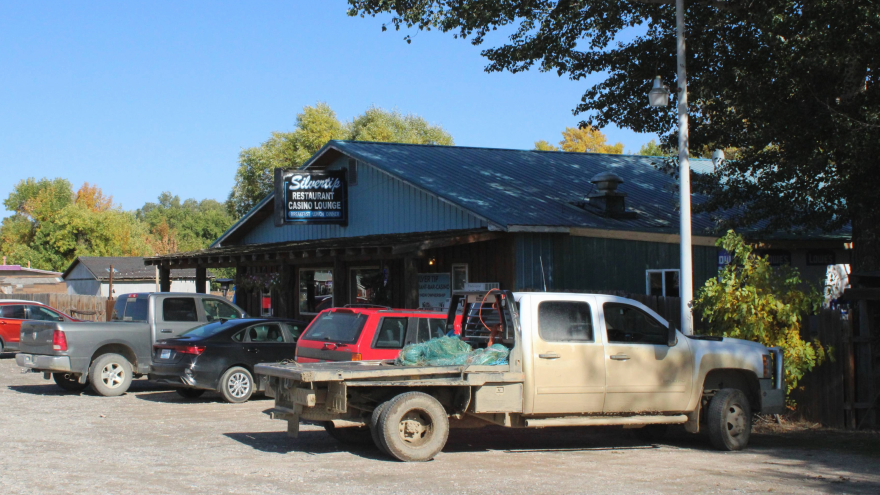
“We just rely on it for our point of sale systems, and so far, it’s been working great,” he said.
His improved internet is due to newly installed fixed fiber optic lines. These are thick cables laid in the ground. They’re considered the “gold standard” for broadband connectivity.
But this technology is expensive to install, and it’s been slow to reach towns like Belfry.
“We’re way behind, in looking at the grander sphere of the problem,” said Misty Ann Giles, the head of the state’s broadband office ConnectMT. “We are farther behind our sister states. Montana does have a lot of challenges when it comes to thinking about internet access.”
Government-led efforts to close the digital divide have been underway for decades. The federal government established the Universal Service Fund in 1996, prescribing that “all Americans” should have access to basic connectivity. The fund subsidizes fiber installation and maintenance in remote areas.
But it wasn’t enough. So, another project emerged in 2018. The U.S. Department of Agriculture’s ReConnect program offers federal funds and loans to expand internet access.
Giles helped stand-up the program as former Chief of Staff at the agency’s Rural Development office.
“A lot of the work we did when we were at USDA when we first came into office was trying to look at the bigger Rubik’s Cube of, why are rural communities lacking some core services when it comes to education, telehealth, things like that in their communities,” Giles said. “And what it all came down to was connectivity.”
This connectivity became even more imperative during the pandemic. Business, community, health care and education all required a stable internet.

According to the Federal Communications Commission, broadband expansion timelines considered reasonable pre-COVID-19 became “unworkable,” and the Commission pushed to get rural communities connected faster. So the federal government launched several new programs.
Since 2019, around $900 million from four federal programs for rural broadband expansion has flowed into the state.
Since 2019, around $900 million from four federal programs for rural broadband expansion has flowed into the state.
The main sources include funds from the ReConnect Program, which go to telecom companies through grants and loans. Those total around $144 million for Montana-focused projects. Then there’s the American Rescue Plan Act, which provided $310 million; The Broadband Equity Access and Development program, which allotted around $308 million; Lastly, there’s the FCC’s Rural Digital Opportunity Fund, which provided Montana $126 million for a 10-year period during its Phase I auction.
And it’s through these programs that Belfry’s internet just got a little better.
Back in southeastern Montana, Nemont Communications Chief Operating Officer Scott Paul drives through the 250-resident town on a sunny October afternoon.
“You probably didn’t see it, but look for an orange capped plastic pole,” he said, pointing out markers of their recent efforts. “Beneath that orange-capped plastic pole, there is gonna be a handhole. And then between those plastic poles, there’s fiber that’s buried underground.”

Nemont just replaced Belfry’s copper wire laid around the 1970s. Paul said copper was great for dial-up internet, but fails at providing the internet speeds we expect today. But installing fiber in Montana is expensive. It can cost up to $300,000 to reach a single home or business, according to Giles.
“If you’re trying to put all of this fiber into an area that’s all rock, then it becomes a lot more expensive because rock’s a lot harder to get through than the dirt,” he said.
For Belfry’s project, Nemont received $10 million ReConnect dollars to build fiber for around 1,000 households in 500 square miles. That’s an area the size of Los Angeles. Paul said they installed 80 miles of fiber just to reach Belfry.
Most companies rely on their customer base to cover the costs of installing internet infrastructure. But in low population states like Montana, that model does not always work. Paul said that’s why these funds are so important.
“It’s allowing us to escalate the speed of doing that,” he said. “We’re doing a little bit more now than we have done in the past, for that reason.”
Dozens of companies like Nemont have leveraged these federal programs to try and reach more residents. Sometimes the costs still exceed what they can afford, and they default.
According to the FCC, Montana’s broadband coverage increased 10 percent between 2023 and 2024. But there’s more work to be done. 70,000 homes and businesses across Montana still need better internet.
Some progress has been made. According to the FCC, Montana’s broadband coverage increased 10 percent between 2023 and 2024. But there’s more work to be done. 70,000 homes and businesses across Montana still need better internet.
And rural residents like Mary Boyer know how necessary it is to be connected.
“If we didn’t have the access to the good communications, we could be in a world of horse pucky,” she said.
State officials hope to bridge the digital divide by the end of the decade.


Where Khloe Kardashian Stands With Ex French Montana More Than 10 Years After Breakup
French Montana is done keeping up with reality TV.
In fact, he only agreed to appear on Keeping Up With The Kardashians and Kourtney & Khloé Take the Hamptons over a decade ago as a favor to then-girlfriend Khloe Kardashian.
“She said to get on the show,” he exclusively told E! News at the BET Awards on June 28. “And I got on the show. Shout out to Khloe.”
The “Ever Since U Left Me” rapper, who split with Kardashian in December 2014 after eight months of dating, said the experience was “fun” because her family kept it real.
“They filmed their real life,” he continued. “And we were part of something together that one time. So it felt great. It didn’t feel like work because they film what they do everyday.”
As for his future in reality TV, the 41-year-old said those days are over, shutting down any prospective offers with a simple, “Negative.”
Although the “Unforgettable” artist—whose real name is Karim Kharbouch—may not be returning to television anytime soon, he has no problem hanging out with his ex-girlfriend these days.

French Montana, Rick Ross & Max B Turn the BET Awards Into “
06/28/2026
More

GREAT FALLS — For Staff Sgt. Brianna St. Lawrence-Brody, service does not only happen in uniform.
Outside the gates of the base, she works at Benefis as a nurse, Great Falls Public Schools as a school nurse, and comes home as a wife and mom of four. For the Montana Air National Guard, she serves as a command post controller with the 120th Airlift Wing in Great Falls.
(WATCH: Montana nurse and Guard member earns national Air Force recognition)
Montana nurse and Guard member earns national Air Force recognition
This year, St. Lawrence-Brody was named the U.S. Air National Guard’s Outstanding Airman of the Year in the Non-Commissioned Officer category.
She said the recognition came as a surprise, especially because her path into the Guard started later than others.
“I joined very late in life,” St. Lawrence-Brody said. “I joined the Guard right before I turned 40. So for me, every opportunity that’s presented, I want to take the bull by the horns and just run with it and do the best of my ability.”
During the COVID-19 pandemic, she joined the Guard after finishing nursing school. She said she went straight from nursing school into helping open a COVID unit, while also working at Benefis.
She said that experience was the start of one journey, but not the whole of what she wanted to accomplish.
St. Lawrence-Brody joined the Guard for the opportunities, the challenge and to help build a future for her four children.
“It’s a little bit of a competition for myself,” she said. “Like, if I can do it, why not try my best to achieve it?”
120th Airlift Wing Public Affairs
As a command post controller, she assists in helping move information during emergencies and major events.
“Outside, obviously, I’m a nurse. Inside the Guard, I have nothing to do with the medical field, which is kind of amazing,” St. Lawrence-Brody said. “It keeps me on my toes.”
She explained balancing the Guard, two civilian jobs and four children takes support from her family, her employers and her unit. She said Benefis and GFPS have been supportive of her military service.
Her nomination included her deployment experience, training work overseas and involvement across the wing. St. Lawrence-Brody said she deployed to Ramstein Air Base in Germany, where she worked with an operations center supporting entities connected to Africa.
But, she says this recognition is not the finish line.
“This award, it’s not necessarily a landing pad for me,” St. Lawrence-Brody said. “I want to use it as a springboard.”
120th Airlift Wing Public Affairs

St. Lawrence-Brody hopes her story encourages others to keep taking on new opportunities, even when they feel uncertain.
“Get comfortable with being uncomfortable and be okay with doing things afraid,” she said. “I think when you get to be okay with doing things afraid, that’s where you’re going to find the growth.”
She has already won at the Air National Guard level, but she recently traveled to Washington, D.C., as part of the broader Air Force Outstanding Airman of the Year process, which includes nominees from the Guard, Reserve and major commands across the Air Force.
-
Politics2 minutes ago
Supreme Court Expands Presidential Powers to Fire Independent Regulators
-

 Culture27 minutes ago
Test Your Knowledge of New York’s Algonquin Round Table
-
 Lifestyle32 minutes ago
They were world-class tennis rivals. Now friends, they’ve teamed up against cancer
-

 Technology42 minutes ago
T-Mobile is booting customers from its oldest plans
-

 World47 minutes ago
Gunman kills 6 at youth welfare facility in suspected child custody dispute: reports
-

 Politics54 minutes ago
Emotion and feelings: How Democratic Socialists’ congressional insurgency could come back to bite them
-

 Health57 minutes ago
Rare tick-borne virus turns deadly fast as US cases reach record high, experts warn
-

 Sports1 hour ago
Lions release Terrion Arnold after bond set at $1 million in armed robbery, kidnapping case

