West
Matthew McConaughey teases possible run for office at governors meeting, weighs in on 2024 presidential race

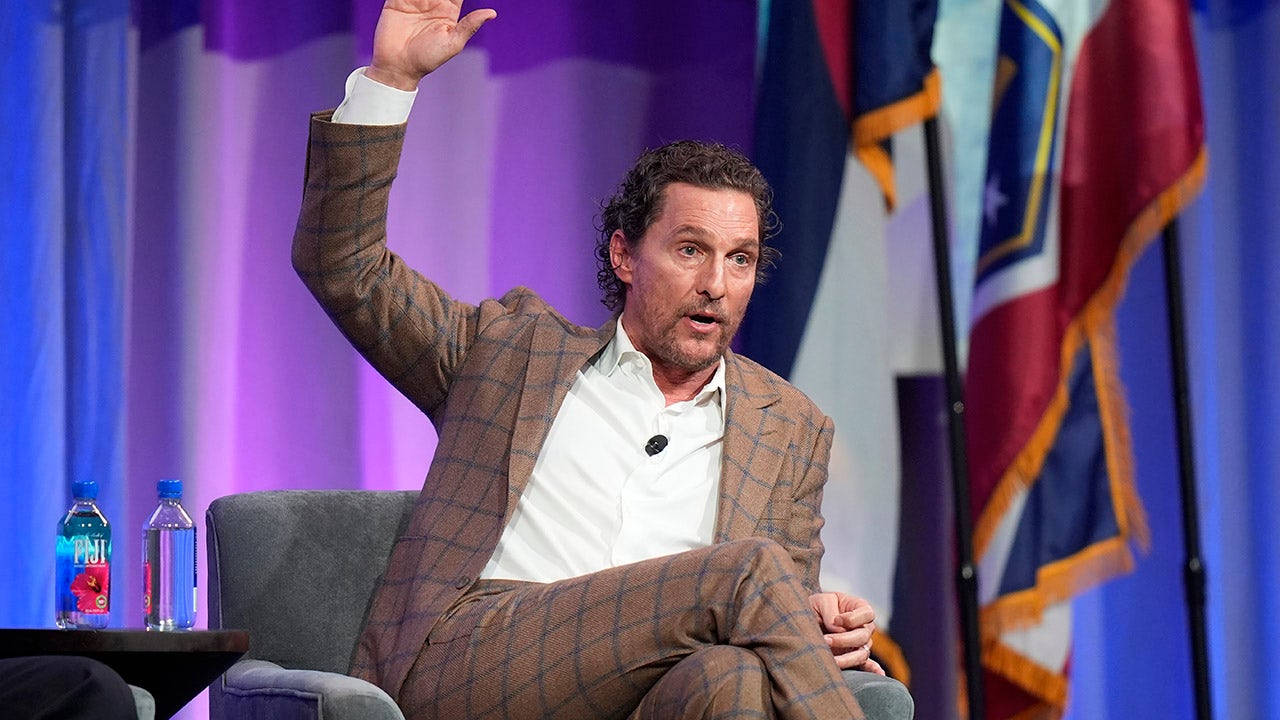
Actor and author Matthew McConaughey teased a possible political run during the National Governor’s Association summer meeting in Salt Lake City, Utah, Friday, where he weighed in broadly on the 2024 presidential race.
Participating in a discussion on the role of culture in polarization, McConaughey joked with governors about indulging in the Hollywood heavyweight’s tequila brand the night before, while also taking a more serious tone regarding the “entertainment” factor in American politics. He argued that the “extremes seem to be going further left and further right” and “decency doesn’t seem to be on the table.”
“I understand it’s hard to market and sell success in how people negotiate, because it’s not as fun, it’s not as sexy, it’s not as exciting as the car wreck. We’re a nation of rubberneckers,” McConaughey said. “I think right now we’re all caught up in short-term, short-money wins. And so we come to the table, we argue, we call each other names, and America sees a lot of us when we do that — This is entertainment. I’m in the entertainment business. Our leadership and our leaders don’t need to be in the entertainment business.”
“The extremes on the right and left, they have the microphone. It’s more entertaining,” he added.
McConaughey took the stage with Utah Gov. Spencer Cox, a Republican and outgoing NGA chair, and Colorado Gov. Jared Polis, a Democrat and the newly elected chair of the association for 2024-2025.
MATTHEW MCCONAUGHEY SHARES SHOCKING IMAGE OF SWOLLEN EYE: ‘BEE SWELL’
Actor Matthew McConaughey speaks at the 2024 summer meeting of the National Governors Association on Friday, July 12, 2024, in Salt Lake City. (AP Photo/Rick Bowmer)
New Jersey Gov. Phil Murphy, a Democrat, joked that he was “told” that he and his wife enjoyed McConaughey’s tequila the night before, though “I can’t recall any of it,” garnering laughter from attendees before asking the actor whether elected office, which he considered before, was still on his “dance card.”
“Yes. I have thought about running for office, getting into this category,” McConaughey said. “I’m on a learning tour and have been for probably the last six years of understanding what this category means.”
“Do I have instincts, intellect that it would be a good fit for me and I would be a good fit for it. That would be useful. I’m still on that learning tour, and, you know, days like this. I’m learning a lot. Last night, I learned a lot. I learned a lot from you last night. Through those tequila, through that tequila, sir,” he told Murphy.
McConaughey, a Texas native, years ago mulled a run for governor of the Lone Star State, and was rumored to have also considered a potential presidential bid.
To Murphy’s second question about who his favorite director was, McConaughey answered Richard Linklater, who gave him his break-out role in the 1993 coming of age film Dazed and Confused.
Utah Gov. Spencer Cox greets actor Matthew McConaughey at the National Governors Association summer meeting on Friday, July 12, 2024, in Salt Lake City. (AP Photo/Rick Bowmer)
“Alright, alright, alright,” McConaughey said, citing his famous line, evoking cheers from the crowd.
“The first three words I ever said on film. People go all the time, doesn’t it upset you? Aren’t you tired of being introduced with that? And I said, no. I know the author,” McConaughey added.
Hawaii Gov. Josh Green encouraged McConaughey to run for office – and to not cede to pressure on choosing a certain party affiliation, whether it be Republican or Democrat.
MATTHEW MCCONAUGHEY ALMOST QUIT HOLLYWOOD DURING ROM-COM YEARS, CONSIDERED BEING WILDLIFE GUIDE
“Please don’t fall into the trap to think that you have to be just one thing, because I think you’re so, you know, warm and likable. A lot of Republicans who want you to be Republican, a lot of Democrats who want you to be a Democrat, just be you, because that might be something special for all of us,” Green said.
Actor Matthew McConaughey speaks at the 2024 summer meeting of the National Governors Association, Friday, July 12, 2024, in Salt Lake City. (AP Photo/Rick Bowmer)
McConaughey argued that politicians, driven in part by attention on social media, are not engaging in “real competition” through thoughtful debate anymore, making the case that American leaders need to become “better marketers” and salespeople in demonstrating the return on investment into “hope and belief.”
“If I invalidate your position off the bat, that’s a lack of courage on my part. Right out of the gate, that’s not real confrontation,” he said, acknowledging that some of that comes with “party preservation.”
“I want to hear more vision from our leaders rather than just, ‘I want to do the opposite of what they want to do.’ Well, no,” McConaughey added. “How do you see the way forward? Instead of just saying, ‘no, all I know is I don’t want to do it that way or that’s the wrong way.’ We see it right now – It’s with two presidential candidates. Fear. Let’s admit fear’s easier to sell than hope. It’s more measurable.”
The actor admitted, though, that “good negotiation” is harder to sell.
“The train wreck is front page bold print,” he said. “How can you sell belief, which I think is what we really need more of in our country right now is belief, whether it’s literal belief in the prime mover or God, or whether it’s belief more in ourselves and our neighbors in what America can be, we need more belief.”
“I mean, you’ve hit on so many important themes,” Cox responded. “I’m just trying to imagine a presidential candidate like this, talking about belief in something bigger than ourselves, in each other, in our neighbors, laying out a positive vision for the country… We just don’t see that anymore because fear does sell.”
Read the full article from Here


San Francisco Supervisor Jackie Fielder will resume her duties next week after taking a three-month leave of absence due to mental health.
“I’m coming clear-eyed and grounded and eager to serve in this role again,” Fielder said in a video posted to social media Tuesday.
Fielder was first elected in 2024 to serve District 9, which includes the Mission District and Bernal Heights and Portola neighborhoods. In late March of this year, her staffers announced she was taking a leave of absence to address an “acute personal health crisis” after missing a few weeks of Board of Supervisors meetings.
“I left the work that I love so much, not because I wanted to, but because my mental health demanded it, and I say that with no shame,” she said.
In the video statement, Fielder mentioned that the pressure of serving as a supervisor took a toll on her mental health.
“I’ve often felt like the weight of this district and city is on my shoulders, and I, through this leave, have had the silver lining of understanding that it never has,” she said. “I was going 100 miles an hour since early 2023 when I started the campaign for supervisor, and being a grassroots candidate is a lot of elbow grease.”
Fielder’s staff continued some of the work in her district while she was gone. She thanked her colleagues and Mayor Daniel Lurie for their support and allowing her to be excused from meetings.
Fielder will return to work Monday and appear at the June 30 board meeting. She is also expected to host listening sessions in her district through July.
“I am an example that it is possible to come back and heal,” she said. “I could not be more honored to serve and more ready to serve.”

The NBA Draft kicks off Tuesday night at the Barclays Center in New York.
The Nuggets, who own the 26th overall pick, are looking to improve a team that was eliminated in the first round of the playoffs for the first time since the 2021-22 season.
Here’s a look at who national draftniks are thinking will land in Denver.
The Athletic | Zach Harper | Updated June 23
Sergio de Larrea, guard, 6-6, Valencia
“It’s hard to say whether the Nuggets will have the roster flexibility to use this pick or if they kick it down the road by trading it. This team needs offensive creation outside of what Nikola Jokić does. Jamal Murray is more of a scorer than a creator, and they’ve been missing that guard off the bench to run some offense through. With de Larrea in the mix, they’ll have good size at the guard position and someone who can orchestrate more.” See the full mock draft.
Sports Illustrated | Kevin Sweeney | Updated June 23

Isaiah Evans, F, Duke
“Evans is a polarizing prospect after two years at Duke. At his best, he’s one of the most dynamic shooters in this draft, capable of getting his shot off with next-to-no separation and regularly going on streaks of multiple threes in short spurts. His overall impact on the game can be muted at times though, especially when threes aren’t falling. He’s a below-average athlete and mediocre defensively.” See the full mock draft.
Other picks:
- Second round, 49th overall pick: Aaron Nkrumah, G, Tennessee State
The Sporting News | Stephen Noh | Updated June 23
Isaiah Evans, F, Duke
“Denver has built a great offense without relying much on 3-pointers. What if they could take an even bigger step on that end of the floor?
“Evans could provide that extra oomph. He’s a good shooter who should be able to drill wide open looks while playing off Nikola Jokic. He has the size to defend capably. And he’s a decent athlete who can attack closeouts well.” See the full mock draft.
CBS Sports | Adam Finkelstein | Updated June 22

Ebuka Okorie, G, Stanford
“The Pistons, Grizzlies, and Wolves have done the most work on Okorie, but Denver has a real need for a paint touch point guard, especially as Nikola Jokic begins to age and they are forced to explore other ways of creating offense. Ejiofor has reportedly been to Denver as well. Veesaar would fit their system; Reed would be another potential backup five if he were available, and Isaiah Evans and Meleek Thomas could provide floor spacing.” See the full mock draft.
Yahoo Sports | Kevin O’Connor | Updated June 22
Ebuka Okorie, G, Stanford
“The Nuggets need some variety to their half-court offense aside from having Nikola Jokić initiate everything. Well, here’s a guy who could help. Okorie is the best driving guard in the class, a 6-1 jitterbug who manipulates defenders with a tight handle, sudden changes of speed, and an advanced feel for the game. He’s not an above-the-rim athlete, though, and not long ago he was a kid from New Hampshire who ranked outside the top 100 and committed to Harvard. Then Stanford found him, he flipped his commitment, and he proceeded to lead the ACC in scoring with eight 30-point games and a habit for hitting clutch shots. NBA teams will have to decide whether what carved up the ACC will survive against bigger, longer defenders.” See the full mock draft.
Other picks:
- Second round, 49th overall pick: Tobe Awaka, F, Arizona
CBS Sports | Gary Parrish | Updated June 23

Koa Peat, F, Arizona
“Peat impacts winning in a variety of ways and was among the reasons Arizona won the Big 12’s regular-season championship before advancing to the Final Four. Good size. Good body. Intriguing prospect. The issue is that he’s a 6-7 wing who doesn’t really shoot, evidence being that Peat only took 20 3-pointers in 36 games with the Wildcats. That’s not ideal for the modern-NBA and why Peat’s draft-range seems vast.” See the full mock draft.
SB Nation | Ricky O’Donnell | Updated June 23
Koa Peat, F, Arizona
No writeup available. See the full mock draft.
ESPN | Jeremy Woo | Updated June 23

Labaron Philon Jr., G, Alabama
“This would be quite a fall for Philon, who has interest in the late lottery from the Bucks if they opt for a guard at No. 13. But it seems likely that one of the point guards falls toward the back of the first round with the way the board has shaped up — particularly in this scenario, where the Pistons don’t take one.
“Philon’s range has seemed particularly wide of late, and teams have speculated that he could slip, with his recent workout for the Timberwolves (who have since traded out of the first round) raising some eyebrows.” See the full mock draft.
Other picks:
- Second round, 49th overall pick: Jaden Bradley, G, Arizona
Bleacher Report | Jonathan Wasserman | Updated June 22

Tarris Reed Jr., C, UConn
“Tarris Reed Jr. has been receiving strong reviews from workouts after putting together a rare statistical season, posting a 9.0 block percentage, 13.0 offensive rebounding percentage and 15.0 assist percentage.
“His combination of strength, paint touch, passing and rim protection should put him in first-round conversations for teams that want bigs.” See the full mock draft.
Other picks:
- Second round, 49th overall pick: Dillon Mitchell, F, St. John’s
USA Today | Bryan Kalbrosky | Updated June 23

Meleek Thomas, G, Arkansas
“The Denver Nuggets tend to look for players with a strong assist-to-usage ratio because they rely on high-efficiency passing and off-ball movement. Arkansas freshman Meleek Thomas averaged 16.0 points, 4.4 rebounds, 2.5 assists and 1.5 steals per game while shooting 43.2 percent on 3-pointers during his 21 games as a starter last season.
“He was efficient using off-ball screens and handoffs and occasionally showed some on-ball flashes as a pick-and-roll ball handler as well. He led the SEC in corner 3-pointers made (32) last season, per CBB Analytics, and his plus-four wingspan gives him solid length as a young guard who is still improving on both sides of the court. Thomas answered one of the biggest questions in college basketball when he decided to turn pro rather than return to the NCAA.” See the full mock draft.
Other picks:
- Second round, 49th overall pick: Dillon Mitchell, F, St. John’s
Want more Nuggets news? Sign up for the Nuggets Insider to get all our NBA analysis.


World Cup fans land in Seattle for first Belgium-Egypt game
Fans from around the globe arrived in Seattle for the FIFA World Cup matchup between Belgium and Egypt Monday, June 15 — the first of six games to be played at the downtown Seattle Stadium.
Soccer fans waiting for affordable World Cup tickets might be in luck this week.
Two games in Seattle — Bosnia and Herzegovina vs Qatar (12 p.m. PT), Egypt vs. Iran (8 p.m. PT) — are dipping well below the $1,000 minimum price for Seattle’s first two games.
After an opening tie between Egypt and Belgium and a dominant 2-0 USA win over Australia, the city welcomes four more teams this week to finish out group play at the 2026 World Cup in Seattle.
Here’s everything you need to know ahead of the final group stage matches.
How much are tickets for the Bosnia vs. Qatar game in Seattle?
Tickets for the next World Cup match in Seattle start at $380, and $276 via FIFA.
How can I watch the Bosnia vs. Qatar game?
- Location: Seattle, WA
- Date: June 24, 2026
- Kickoff: 12 p.m. PT
- TV: FS1
- Streaming: FOX One, Peacock
When are the remaining World Cup games in Seattle?
- Wednesday, June 24, 12 p.m. PT (Bosnia and Herzegovina vs. Qatar) – Shop tickets
- Friday, June 26, 8 p.m. PT (Egypt vs. Iran) – Shop tickets
- Wednesday, July 1 (Round of 32 match) – Shop tickets
- Monday, July 6 (Round of 16 match) – Shop tickets
Seattle ticket prices by game
- Bosnia and Herzegovina vs. Qatar (June 24, 12 p.m. PT): starting at $380, $276 via FIFA
- Egypt vs. Iran (June 26, 8 p.m. PT): starting at $630, $529 via FIFA
- Round of 32 match (July 1): starting at $1,119, $977.04 via FIFA
- Round of 16 match (July 6): starting at $3,011, $3,393 via FIFA
Where can I buy FIFA World Cup tickets?
Zachary Fletcher is a trending news reporter with USA TODAY Network’s Washington state team. Keep up with him on X (@zdfletch), BlueSky (@zfletcher.bsky.social) or reach him at zfletcher@usatodayco.com.
-

 Health6 minutes ago
Video: Why Milder Symptoms Could Make This Ebola Outbreak More Dangerous
-
 Lifestyle21 minutes ago
Working hard as ever, Wendell Pierce aims for an annual trifecta: TV, film and theater
-

 Education28 minutes ago
The Patriot Housewife Whose Plays Helped Push America Toward Revolution
-

 Technology31 minutes ago
The best robot vacuum deals available during Prime Day
-

 World36 minutes ago
Turkey detains over 200 suspects, including alleged ISIS militants, in sweeping raid ahead of NATO summit
-

 Politics43 minutes ago
Trump foe wins crucial Dem primary as 2028 presidential speculation swirls
-

 Sports51 minutes ago
Wizards select AJ Dybantsa first overall in 2026 NBA Draft
-
Business1 hour ago
SpaceX stock returns to Earth after record IPO


