Idaho
Idaho Antimony Mine Finally Receives Final Permit


US President Joe Biden (L) speaks with Chinese President Xi Jinping on the sidelines of the … [+]
As President Joe Biden’s remaining days in office count down with many of his top energy and environmental priorities remaining unfulfilled, his regulators managed to publish a final record of decision (ROD) related to a major Idaho mining operation targeting the production of antimony, a key mineral integral to batteries and other aspects of green energy. The decision comes amid a rising trade war between the United States and China as the Biden Administration prepares to leave office.
On Friday, the U.S. Forest Service approved the final permit necessary for the Stibnite Mine, operated by Perpetua Resources, to proceed to production after a permitting process that consumed well over a decade. “I have taken into consideration the degree to which the (mine’s) environmental design features, monitoring, and mitigation measures will, where feasible, minimize adverse environmental impacts on (federal lands),” the Forest Service’s Matthew Davis said in a report published along with the permitting decision.
The Conclusion Of A Long, Complex Permitting Process
Perpetua estimates the mine will be able to provide as much as 35% of the nation’s antimony needs once it becomes fully operational in 2028. The mine will also produce a substantial amount of gold, which was the original target of the Stibnite mine when it was first opened in 1927. The mine was later re-tooled and was able to produce about 90% of U.S. antimony needs during World War II.
The additional gold production will serve to enhance the mine’s revenue stream, but in today’s world, antimony is the main prize being sought by Perpetua in its efforts to reopen a mine that has been inactive since it was shut down in 1996. In addition to its applications related to renewable energy, antimony is also integral to the production of tungsten steel and is used in a wide variety of other military applications.
The military considers access to domestic stores of antimony such a critical need that it contributed $60 million to help fund the permitting effort of the Stibnite Mine, the total cost of which was estimated to come in at a whopping $1.3 billion in 2020. That number will have likely risen substantially due to the high rates of inflation and supply chain issues that have run epidemic over the last four years.
The project was opposed by Idaho’s Nez Perce Tribe, which expressed concerns the mine could impact the state’s salmon population. The mitigation plans for the mine were modified at several points in response to Nez Perce concerns.
China’s Antimony Export Restrictions
The last-minute approval of the final ROD by the Biden Forest Service comes a month after China’s government invoked restrictions on the export of antimony and two additional critical energy minerals, gallium and germanium, in response to enhanced U.S. semiconductor export controls specific to China. It was the third such crackdown by the Biden government in the past three years. The timing is critical given that the U.S. relies on imports for the vast majority of its antimony needs.
Anticipating a positive outcome to this permitting process, Perpetua Resources announced in December the execution of a non-binding agreement with Sunshine Silver Mining & Refining to explore the potential for the domestic processing of the antimony recovered from the Stibnite mine.
“We are thrilled to receive our Final Record of Decision from the Forest Service,” said Jon Cherry, President and CEO of Perpetua Resources said Monday in a release. “This approval elevates the Stibnite Gold Project to an elite class of projects in America that have cleared NEPA. The Stibnite Gold Project can deliver decisive wins for our communities, the environment, the economy, and our national security.”
Judy Nissula, Mayor of nearby Cascade, Idaho, said she was pleased by the final decision. “Perpetua Resources has been part of our community for more than a decade. During this time, they’ve shown us the type of company they are. They’ve invited us to provide feedback, answered our questions, supported causes that matter to our community and looked for ways to partner with local businesses and provide well-paying jobs for Valley County residents.”
Perpetua estimates the mining operation will provide “substantial environmental and economic benefits to the region,” including “more than one billion investment dollars and an average of 550 jobs.”
The Bottom Line
In light of the growing trade war with China related to energy minerals, it is difficult to overestimate the importance of this final permitting decision. The successful outcome for Perpetua Resources is especially impressive given the complex nature of the federal, state, and local permitting process, as well as the work involved in satisfying the concerns of local communities and the Nez Perz Tribe.
The federal government has for more than 40 years been very reluctant to permit the opening of domestic mining operations. It will need to permit many more such mines if this energy transition is going to continue to move forward.



Joyce Saurey, 95, passed away peacefully on April 6, 2026 at her home in Rexburg surrounded by loved ones.
Joyce was born on September 8 of 1930 to Joe and Ina Thomson Ball. She attended and graduated school at Sugar-Salem at 17 years old. She then worked for the ASC office, which fit her love of secretariat work, carrying that with her for the rest of her life. She simply loved bookkeeping.
Joyce married the love of her life Grant Saurey on March 1, 1950 in the Idaho Falls LDS temple. They added 6 kids to this beautiful union.
Joyce and Grant were inseparable. They enjoyed camping, allowing them to spend many happy days together in the mountains. They raised a beautiful farm with a herd of cattle. They grew a big beautiful garden. Joyce would often feed farm hands, friends, and even strangers who would stop by using the produce they’d worked so hard to grow.
Joyce loved quilting, crocheting, embroidery work, and puzzles.
Joyce was a very faithful member of the Church of Jesus Christ of Latter-Day Saints. She held many callings in the church, spent 17 years in the primary, and sincerely enjoyed working in both the ward and the stake Relief Society presidency as a secretary. She had a deep love for God and her Savior.
Joyce had beautiful blue eyes and a ready smile as well as showering compliments on everyone that she ever met. Joyce loved people and people loved Joyce.
Joyce was a very healthy and strong woman and lived independently at 95, and people would often remark to her that they couldn’t believe she was 95. She loved that.
Joyce was preceded in death by her loving parents, three sisters, and her eternal companion Grant.
Joyce leaves behind a long legacy of love, including her six children Jody (Kelly) Huth, San Francisco, CA; Rosie (Layne) Turner, Big Piney, WY; Floyd (Rita) Saurey Hibbard, ID; Tom (Stacy) Saurey, Denver, CO; Kelly (Debbie) Saurey, Melba, ID; Peggy (Glen) Jeppesen, Salem, ID.
She has 17 grandchildren and many great-grandchildren.
A viewing will be held Saturday from 12-12:45 p.m. at Flamm Funeral Home in Rexburg. A graveside service will be held at 1 p.m. at the Rexburg Cemetery.
Our family would like to thank Rexburg Homestead, Assisted Living, and Rexburg Homestead & Hospice.
We love you, Mom.
Idaho
Volunteer organizes massive cleanup effort to remove huge piles of garbage from the Idaho high desert
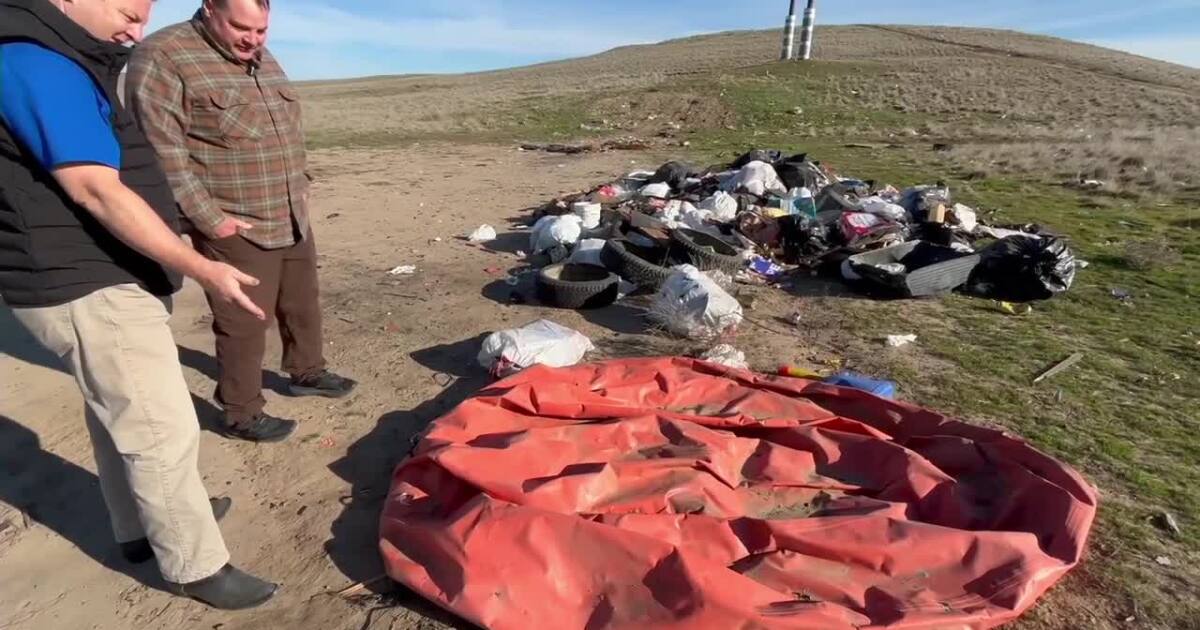
PAYETTE COUNTY, Idaho — Huge piles of garbage are littering the high desert west of the Treasure Valley, and one Idaho man is organizing a massive volunteer effort to clean up the 20,000-acre area.
Mike Long started the Facebook group 208Cleanup to organize volunteer cleanups across the state. He is hoping to get volunteers to join him on Saturday, April 11, to help remove the trash.
“This one is huge, it’s 20,000 acres,” Long said.
One man’s mission to clean up the Idaho desert
No one hired Long to clean up the desert. He took on the mission because he could not stand to see his home state desecrated.
“There’s more trash in this area than I have picked up in the two years that I’ve been doing this as 208Cleanup,” Long said.
The debris includes mysterious items, like an inflatable, and ordinary household trash.
“This is a bunch of household trash. This was someone’s house that got cleaned up. Clearly, you can see that someone dumped out here thinking no one cares about this land,” Long said.
Some of the garbage contains names, which has prompted an investigation.
“This pile’s been picked over by the BLM law enforcement. They’ve pulled out names and addresses from pieces of mail, so they’re investigating,” Long said.
Long believes community involvement is the key to keeping public lands pristine.
“If we as the community as the actual owners of this land, take care of it, it’s a lot cheaper, plus we’re invested in it, so when people come out to abuse it, it’s us, it’s the people that are seeing them and correcting each other and ourselves,” Long said.
Again, the cleanup is set for Saturday. Long has secured donations of garbage bags and huge dumpsters. He says the landfill has waived its drop-off fee for whatever is collected.
He adds that there are a lot of old, used tires in the area. The landfill will not waive the fees for them, so any donations are welcome. Otherwise, the tires will have to be gathered to one spot until the funds can be raised.
If you plan to volunteer, go to 208Cleanup on Facebook to sign up and learn more. Also, make sure to wear thick gloves and heavy-duty shoes.
This story was initially reported by a journalist and has been, in part, converted to this platform with the assistance of AI. Our editorial team verifies all reporting on all platforms for fairness and accuracy.


Another Minnesota city moves toward displaying old state flag

News and Events – Morgan Luebbering earns teaching award

Montana Woman Becomes First to Orbit the Moon – Livingston Today

Nebraska Humane Society asking for help after abandoned dog found severely starved in Omaha

High-profile Las Vegas attorney tapped to join Nevada Gaming Commission

Florida High School Football Rankings: Top 25 teams – Oct. 21

How old is Bo Nix? What to know about Oregon quarterback ahead of 2024 NFL Draft

Cleary's 21 help Le Moyne down Central Connecticut State 69-64 in OT

99th annual Pony Swim held in Virginia

Indiana Members Credit Union announced as new anchor tenant at Bottleworks District

AOC doubles down on call for Trump’s ouster even after ceasefire announcement

EU made ‘no diplomatic effort’ to end Iran war, says MEP Botenga

U.S. and Iran agree to 2-week ceasefire

Democrat swing candidate called Biden’s border handling ‘a huge misstep’ after backing his approach as mayor

‘Policy of abuse’: Women march in Cuba against US energy blockade
-

 Atlanta, GA3 days ago
1 teenage girl killed, another injured in shooting at Piedmont Park, police say
-

 Movie Reviews6 days ago
Vaazha 2 first half review: Hashir anchors a lively, chaos-filled teen tale
-

 Culture1 week ago
Do You Know Where These Famous Authors Are Buried?
-

 Atlanta, GA1 week ago
Fetishist ‘No Kings’ protester in mask drags ‘Trump’ and ‘JD Vance’ behind her wheelchair
-
 Entertainment6 days ago
Inside Ye’s first comeback show at SoFi Stadium
-
 Milwaukee, WI2 days ago
Potawatomi Casino Hotel evacuated after fire breaks out in rooftop HVAC system
-

 Pennsylvania2 days ago
Parents charged after toddler injured by wolf at Pennsylvania zoo
-

 Georgia23 hours ago
Georgia House Special Runoff Election 2026 Live Results