Idaho
Architect of Idaho's Closed Republican Primary: 'It's worked out exactly the way it was intended to work out'


Idaho’s primary elections have been allowed to be closed since 2011, when a federal court ruled Republicans had the right to disassociate from non-Republicans. Current Ada County Commission chairman Rod Beck was a driving force behind the effort, after two primary losses by less than 400 votes in the mid-2000s.
All Things Considered host Troy Oppie sat down with Beck, who is not up for election this year, to talk about issues in the county and about Proposition 1, which would allow voters to undo his work from more than a decade ago.
Read the full transcript below.
TROY OPPIE: Idaho’s primary elections have been allowed to be closed since a federal court ruled in 2011 republicans had the right to disassociate from non-republicans, just as the constitution guarantees the right to free association. Current Ada County Commission Chairman Rod Beck was a driving force behind the effort to close republican primaries after two primary losses by fewer than 400 hundred votes in the mid-2000s.
ROD BECK: I was out knocking on doors and I came across a couple. And I said, I’m Rod Beck. I’m running for the state Senate. And he said, We know who you are. We’re going to vote for your opponent.
OPPIE: Beck told me he kept talking to those voters, discovering they were teachers, and members of the teacher’s union.
BECK: I said, “well, correct me if I’m wrong, but I thought most members of the teachers union are Democrats, particularly the leadership of the teachers.”
They said “absolutely. We’re proud Democrats.” So why would you be voting in a Republican primary? ‘Because we don’t want you to win. That’s why.’
[laughs]
That’s when I started working on the closed primary.
OPPIE: This week, I sat down with chairman Beck, who is not up for election this year, to talk about issues in the county, and about proposition 1, which would allow voters to undo his work from more than a decade ago.
OPPIE: As you’ve seen that play out here over the last now 13 years, has it worked out the way that you intended?
BECK: Yes, it has. It’s worked out exactly the way it was intended to work out. And all the naysayers at the time, because there were some naysayers that didn’t want it within the Republican Party. And they were asserting that it would make independents mad and they wouldn’t vote for Republicans. None of that happened. In fact, we’ve strengthened our position in the legislature. There’s more Republicans now than there was (sic) in 2012. And so we strengthened our position. And one of the arguments that that’s coming forth with this proposition one is a bogus argument because they claim that, it’s moved the needle farther to the right, which isn’t true at all, because then I posed the question to the spokesmen, a spokesperson for the for the Prop one: If the needle has moved too far, the right. Because after all, ultimately an election is about policy. What policy do you think has been moved too far to the right? They wouldn’t say.
OPPIE: The exchange Beck is describing happened on the The Ranch podcast, hosted by Matt Todd. Here’s how Republican Hyram Erickson, who supports proposition one, replied during a debate with Beck.
ERICKSON: “But it’s not a question of a particular legislative outcome. Our legislators deal with hundreds of bills that deal with hundreds of issues, and they are supposed to be representative of their individual districts. And, and and right now, often they are not. And and that is not a healthy place for the state to be.”
OPPIE: I think you can make an argument, though, for a gradual shift that, those policies may not have been signed into law, may not have been passed, but incrementally they’re getting closer to passing with every legislative session. And you look at the issue of school choice or vouchers in schools, whatever you want to call it. That’s one that I think fits into that bill, where it has gotten incrementally closer With each bill.
BECK: And it should be getting enrollment incrementally closer, because that’s the official policy position of the Idaho Republican Party that’s got nothing to do with closed primaries. That’s what the Idaho Republican Party has always been, been in favor of school choice. But it’s not it’s not a policy drift that has occurred. What hasn’t occurred is it hasn’t passed.
OPPIE: Republicans have in recent years passed bills restricting libraries, banning abortion, banning trans girls and women from women’s sports as well. Some of those bills are still being challenged in court.
Beck criticized the moniker open primary, saying Prop 1 also includes rank-choice voting and is not a return to the same system used before Republicans closed their primary in 2012.
BECK: Your jungle primary, you have four people emerge from the primary and then it goes on to do it to a general election. If you have 16 to 18 offices on the ballot, you’re going to have anywhere from 60 to 70 people. It’ll be worth it. It’ll be worse than your S.A.T. tests. It’s going to take you an hour to get through your ballot. And then it’s confusing. What is this ranked choice? What does that actually do? I mean, Will my vote not count? because here’s what I … Your first place vote might get discounted because if they don’t have the, if they don’t have the majority on the first go around. Then they’ll drop one and it’s all an algorithm.
OPPIE: Well, it’s math.
BECK: It’s all math.
OPPIE: I don’t know about algorithm, but it’s math.
BECK: It’s math. Well, that’s what algorithm is. It’s mathematic computation, and that’s what it will be.
OPPIE: The argument that ranked choice is too confusing, I found interesting. Because essentially you’re saying, ‘the constituents that I’m talking about can’t be trained, can’t be educated, can’t be brought along to this.
BECK: I’m not saying that at all. I’m saying that even today, when you only have two people on the ballot – you go take a poll, ‘do you know who your senator is, your state senator?’ Nine times out of ten, they won’t. Just average ordinary people. They worry about their work, their family. And maybe a week or two before the election, they might start paying a little attention to it. They don’t really get into the details. Well, if it’s that way with just two people on a ballot, how’s it going to be with four? I think it’s going to be confusing.
OPPIE: Do you think it’ll pass?
BECK: No, I don’t think it will pass, because I’m seeing some movement and it’s because more people are starting to understand it. I think the more people understand it, the more people will vote no.
OPPIE: Let’s shift to the topic of growth. The commission got an impact fee structure passed and put into place now that’s been underway through several variations of this commission started back as far as I could tell in 2019 and a conversation that at least may have gone back first.
BECK: Started and then that was before my time. And When we first got here, we had anticipated that these impact fees would be forthcoming. I don’t quite know what happened, but the impact fee, it got beyond the study period. So we had to do that over again, which we did. We did the impact study over again. And that just takes time to do that. Now we have adopted the impact fee, but in order to properly collect it, you have to give it to all the cities or six cities in any county. They all have to adopt an ordinance that allows them to collect it for us.
OPPIE: A process that was expected to go smoothly. It’s i’s and t’s and a lot of…
BECK: But it has to meet all these cities’ objections and it has to make sure that it follows, because this is an interlocutor agreement. Because most of the new construction is in the cities. Now we don’t have to do that with unincorporated areas, there’s still 65,000 people live in unincorporated Ada County.
OPPIE: Impact fees will support first responders and county services, like the sheriff’s office, Emergency medical service and the coroner’s office. Once in place, the income is only allowed to be used for infrastructure, which could take some pressure off property tax payers. But Beck says bonds aren’t going away, in particular, the proposed bond funding to expand the county jail.
BECK: We’re not going to allow our jail to be not safe. That’s our top priority. And so and we’re we’re pushing up against the top end of the jail capacity currently. And part of that, by the way, is because the state of Idaho, they haven’t they don’t come and get their prisoners as soon as they should, because we have anywhere from 70 to 140 state inmates and if we didn’t have those state inmates, we wouldn’t be jumping to bump up against the capacity.
OPPIE: Yeah, you’d be at 85, 90% of capacity.
BECK: Right. We’d still need to expand the jail because that jail hasn’t been expanded for a long time. And we’ll just have to have to see how the revenue comes in because you can’t build a building on anticipated revenue. I think we’re we’re about ready to take off again, there’s there’s an uptick in building permits, an uptick in at least four subdivisions. So that might, that might make a difference.
OPPIE: Shifting to this November, you’re not on the ballot. Your colleagues are. What are your priorities if this commission remains intact for another two years?
BECK: Well, my priorities have not changed. And they and they won’t change. My priorities have always been I want to provide the best government possible for the least amount of tax dollars. And I think we’re doing that. We’re we’re doing a lot of really good things in Ada County. And I want to continue to do those good things because I think it benefits the community.
OPPIE: Two years from now, do you expect to be back on the ballot?
BECK: I would say it’s more than likely, yeah. Of course. You know, it’s … I enjoy the work. I think that the work that we’re doing here is really good. I think we’re in the best position that the county’s been in for a long time.
OPPIE: Thank you for being so generous with your time.
BECK: I appreciate the good talk. Good talking to you. Yeah. It’s time that some of us Republicans get a little more space on your, on public radio.
OPPIE: Fair enough.
[laughs]
Rod Beck thank you for Joining us on Boise State Public Radio.



ADRIAN, Oregon — The Friends of the Owyhee organized a clean-up in Malheur County in Oregon, and volunteers came out to pick up trash and get rid of abandoned campers.
“We had two abandoned RV’S and a camper that were abandoned out on public lands,” said Tim Davis, who runs the Friends of the Owyhee. “They were sitting there for upwards of a year, and it is really clear that it is hard to get rid of these.”
WATCH| Check out the video to see volunteers demolish a camper—
Volunteers camp out for the Succor Creek Clean-Up in the Owyhees
Davis worked with the local sheriff’s office and the BLM to remove the campers, but he found it difficult because there was no place to take these recreational vehicles. The Gambler 500, an off-road group, brought out some people to demolish a camper with an excavator.
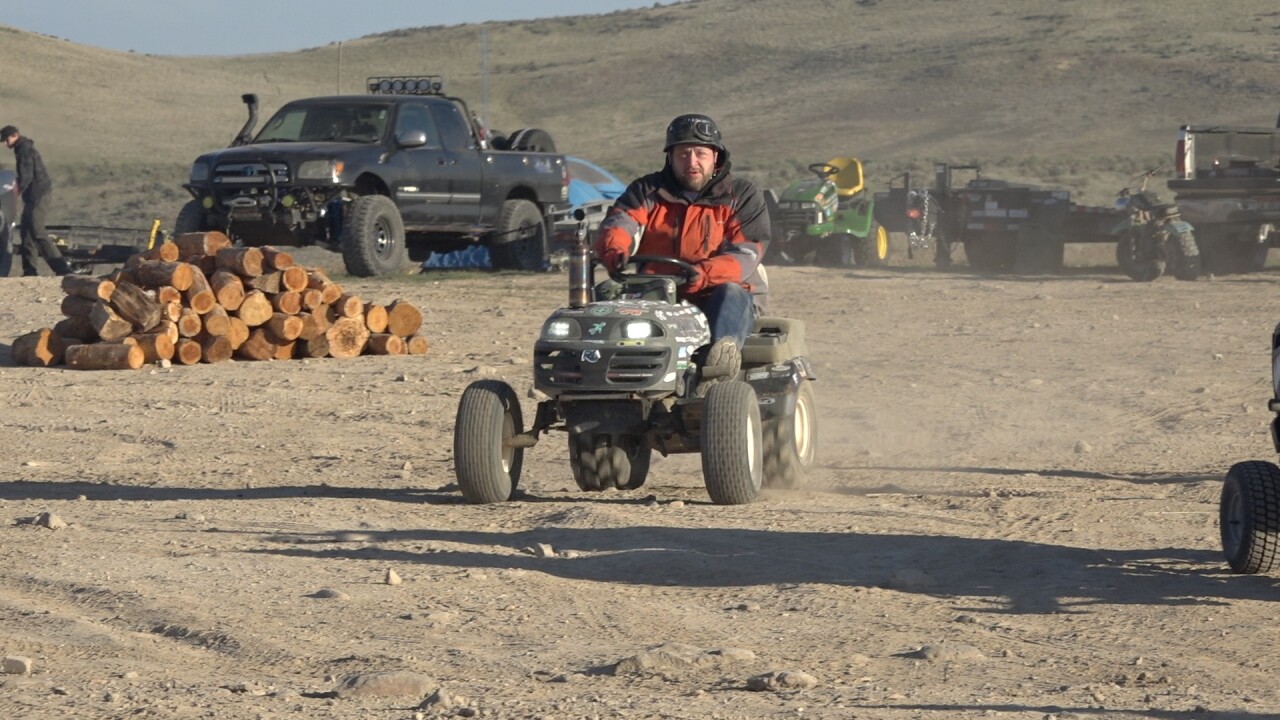
“That is awesome to see the turnout with the army of volunteers we have today,” said Brian Arndt of the Gambler 500 group. “We are going to be able to get the camper all in the dumpster, get it cleaned down to the frame, and then everything that can be recycled will be recycled.”
Volunteers camped out on Succor Creek Road on Friday night so they could get an early start on Saturday. Many volunteers will camp out again on Saturday night and finish the clean-up on Sunday.
“Malheur is the 12th largest county in the United States, and it’s 74 percent public land,” said Davis. “We have very few resources with the BLM; they are understaffed, they have one rec planner right now, so us, as public land owners, should be able to step up and keep this place clean.”
Lela Blizzard works as the lone recreational planner for the Vail District of the BLM, who says most sites have signs that say pack it in and pack it out. She says the BLM really needs the cooperation of the public because of how large it is, and she was happy to see how many volunteers showed up.
“I just want to tell them thank you because I know they are taking time out of their weekend to come out here to help us make sure the land continues to look nice for everyone who comes out to enjoy it,” said Blizzard.

Griz Ward is one of the volunteers, and he enjoyed camping out, but he also would like to see people pick up after themselves. When it comes to outdoor recreation, it is so important to be part of the solution and not part of the problem.
“If you come out here and play in the area, be respectful,” said Ward. “Pack it in and pack it out, leave no trace and do the right thing, or frankly, stay home.”
The Succor Creek Clean-Up also received a lot of support from the Treasure Valley, as they got donations from the Ontario Sanitation Service with the dumpsters, Tates Rents with the excavator, and United with porta-potties for the campsite.
Send tips to Idaho Backroads neighborhood reporter Steve Dent
Have an Idaho Backroads story idea? Share it with Steve below —

IDAHO — ‘No Kings 3’ protests will take place throughout Idaho on March 28, including in Boise and Twin Falls.
According to the Idaho 50501 Facebook page, there will be speakers & musicians playing at protests across the Treasure Valley.
Protests will take place in Boise, Caldwell, Nampa, Mountain Home, Twin Falls, and other Idaho cities.
NoKings.org
On March 28, Neighborhood Reporters Allie Triepke & Lorien Nettleton will bring coverage of the Boise & Twin Falls protests on Idaho News 6 at 10.
Idaho
Idaho Senate introduces new bill to give local municipalities authority to control rat populations

BOISE, Idaho — A new bill in the Idaho Senate aims to let local municipalities take action to control rat populations. This, after a previous bill to combat rat infestations across Idaho, died in the House.
Rats have been spreading throughout the Treasure Valley in recent years, but previous attempts at legislation to deal with the problem have failed.
WATCH: Senior Reporter Roland Beres provides an update on the new rat bill
New bill would allow local governments to combat rats
Residents in Eagle and Boise have been tracking an alarming rise in rat populations recently.
Rep. John Gannon (D – District 17) introduced new legislation today that would essentially permit local governments to act in order to control rat populations if they want to, without creating a mandate.
Gannon said some cities complained that they did not have the authority to do the job themselves.
The bill was introduced with a dose of humor.
“I’m going to support this. It’s very late in the session, but I think this might just squeak through,” said Sen. Ben Adams (R – District 12). “Well. Unless it encounters a trap along the way.”
ALSO READ | ‘I’ve never seen something that big’: Boise neighbors finding rats in their backyards
This story was initially reported by a journalist and has been, in part, converted to this platform with the assistance of AI. Our editorial team verifies all reporting on all platforms for fairness and accuracy.
Send tips to neighborhood reporter Riley Shoemaker
Have a story idea from Downtown Boise, the North End or Garden City ? Share it with Riley below —

Sunday Puzzle: Vowel Renewals

Red Rooms makes online poker as thrilling as its serial killer

Over 2 dozen children among 33 bodies pulled from Kenyan mass grave: authorities

Scathing report claims nation’s oldest labor union ‘betrayed’ MAGA members through ‘shocking’ spending

Cases of ‘white plague’ rising in US as doctors warn of ‘rebound effect’

Florida High School Football Rankings: Top 25 teams – Oct. 21

How old is Bo Nix? What to know about Oregon quarterback ahead of 2024 NFL Draft

Cleary's 21 help Le Moyne down Central Connecticut State 69-64 in OT

99th annual Pony Swim held in Virginia

Indiana Members Credit Union announced as new anchor tenant at Bottleworks District
Scathing report claims nation’s oldest labor union ‘betrayed’ MAGA members through ‘shocking’ spending

Republican US lawmaker demands Congress vote on any Iran troop deployment

So you went to a No Kings protest. Now what?

JD Vance says he was ‘obsessed’ with UFOs, believes aliens are actually ‘demons’
The EU's recipe for trade deals : easy on beef, tough on wine
-

 Sports1 week ago
IOC addresses execution of 19-year-old Iranian wrestler Saleh Mohammadi
-

 New Mexico7 days ago
Clovis shooting leaves one dead, four injured
-

 Miami, FL3 days ago
Jannik Sinner’s Girlfriend Laila Hasanovic Stuns in Ab-Revealing Post Amid Miami Open
-

 Tennessee6 days ago
Tennessee Police Investigating Alleged Assault Involving ‘Reacher’ Star Alan Ritchson
-

 Minneapolis, MN3 days ago
Boy who shielded classmate during school shooting receives Medal of Honor
-

 Technology1 week ago
YouTube job scam text: How to spot it fast
-

 Politics1 week ago
Schumer gambit fails as DHS shutdown hits 36 days and airport lines grow
-

 Science1 week ago
Record Heat Meets a Major Snow Drought Across the West