West
Father of girl injured by illegal migrant truck driver slams ‘insensitive’ rhetoric during Noem hearing

NEWYou can now listen to Fox News articles!
The father of a California girl who sustained a traumatic brain injury when an illegal immigrant commercial truck driver slammed into a vehicle she was riding in urged congressional lawmakers to prioritize the safety of American citizens amid the back-and-forth rhetoric over the Trump administration’s mass deportation campaign.
Marcus Coleman was in attendance during this week’s House Judiciary Committee hearing in which then-Homeland Security Kristi Noem answered questions about the agency’s immigration enforcement actions.
“At this point right now, what they’re doing is extremely disrespectful. It’s insensitive,” Coleman told Fox News Digital, referring to elected officials who oppose illegal immigrant enforcement. “Until it happens to them, that’s the point of view they’re going to have.”
On Wednesday, Rep. Steve Cohen, D-Tenn., a vocal critic of the Trump administration, apologized to the families in attendance who have lost loved ones to the actions of illegal immigrants, before remarking on migrant crime statistics during his interaction with Noem.
BLUE STATE INVESTIGATES HOW ILLEGAL IMMIGRANT TRUCKER GOT LICENSE BEFORE DEADLY FLORIDA CRASH
Kristi Noem, secretary of the Department of Homeland Security (DHS), during a House Judiciary Committee hearing in Washington, D.C., on Wednesday. (Graeme Sloan/Bloomberg via Getty Images)
“For the folks that are here and your families, I’m sorry,” Cohen said, holding his hand over his heart. “It’s terrible what happened to you, to your children or your family members, but they are more likely… citizens are more likely to be attacked by United States citizens who are not undocumented.”
Noem, who has since been reassigned as the Special Envoy for The Shield of the Americas, shot back, calling Cohen’s remark offensive to the Angel Families, which refers to relatives of Americans killed by individuals in the United States unlawfully.
“The vast majority of the people sitting behind me have lost their children due to drugs, overdoses from drugs that came over the southern border,” she said. “They died from their kids being hit in accidents on the roads where illegal drivers were driving a truck. Marcus Coleman, Delilah’s father, has told the story over and over again.”
On June 20, 2024, a multi-car crash in California was allegedly caused by a commercial 18-wheeler driven by Partap Singh, according to authorities. (DHS)
In 2024, Dalilah Coleman was critically injured in Southern California when the driver of an 18-wheel tractor-trailer moving at 60 mph slammed into a vehicle she was traveling in. She sustained a fractured skull, broken femur and a traumatic brain injury.
Partap Singh, an illegal immigrant from India, was identified as the driver who obtained a commercial driver’s license in California, authorities said. Singh was driving at an unsafe speed and failed to stop for traffic in a construction zone just before the crash.
TRUMP UNLOADS ON ‘RADICAL LEFT’ AS HE STANDS BY KRISTI NOEM AMID IMMIGRATION ENFORCEMENT UNREST
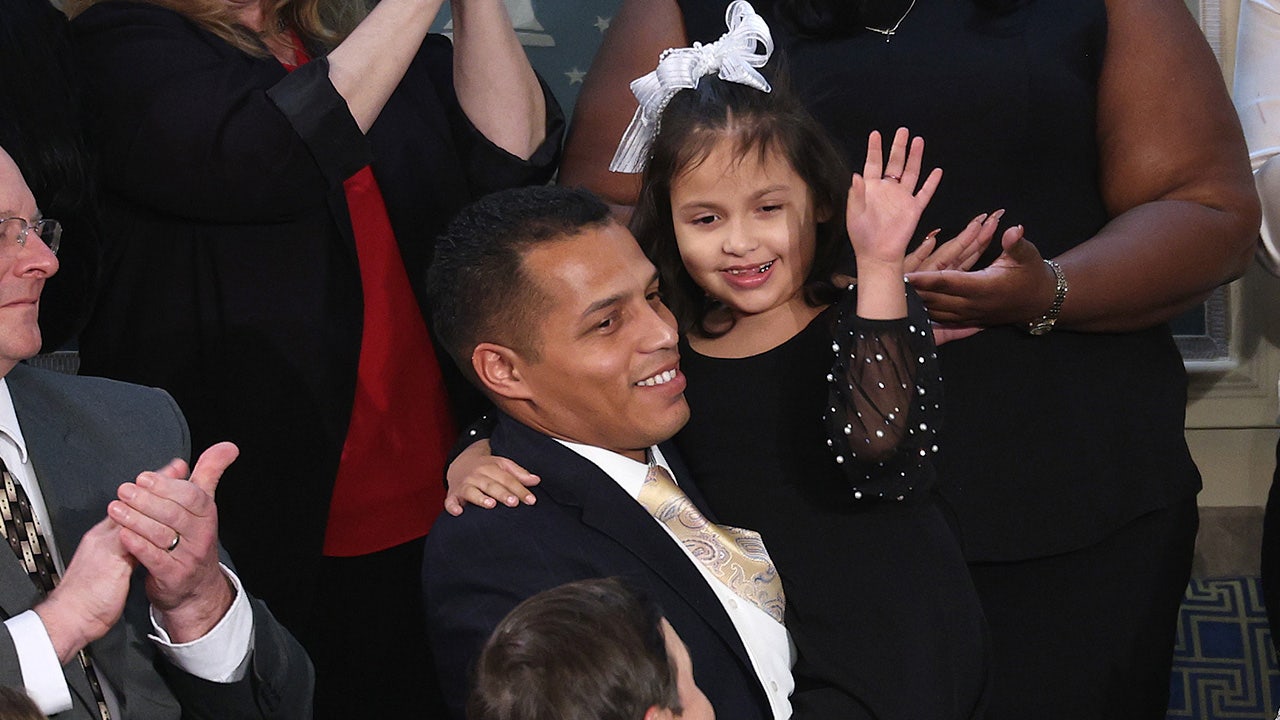
Marcus Coleman holds his daughter Dalilah Coleman as President Donald Trump delivers his State of the Union address during a Joint Session of Congress on Feb. 24. Coleman criticized Rep. Steve Cohen, D-Tenn., and other lawmakers who oppose efforts to arrest and deport illegal immigrants. (Win McNamee/Getty Images)
“They go back home, like my daughter’s driver,” Coleman added. “He went back to India and he’s living life free. And my daughter said, you’re dealing with this. Had that been a U.S. citizen, he’d have been in jail right now.”
President Donald Trump honored Dalilah during his State of the Union address, drawing applause in the chamber as she attended with her father.
“Dalilah Coleman was only five years old in June 2024 when an eighteen-wheeler tractor-trailer plowed into her stopped car at sixty miles an hour or more,” Trump said. “The driver was an illegal alien let in by Joe Biden and given a commercial driver’s license by open borders politicians in California.”
CALIFORNIA FATHER SAYS NEWSOM IGNORED HIM AFTER ILLEGAL IMMIGRANT TRUCKER LEFT DAUGHTER UNABLE TO WALK
Partap Singh, an illegal immigrant from India, was arrested after the crash that injured Dalilah Coleman. (DHS)
Trump and Noem have come under criticism from Democrats who view actions taken to arrest illegal migrants as harmful. Meanwhile, Republicans have cited multiple instances in which American citizens have been killed, injured and harmed by people living in the U.S. illegally.
“They shouldn’t be here to begin with,” Coleman said. “So for every one of those families that’s out there, just the fact that it was an illegal person who did it, it shouldn’t have happened.”
During Wednesday’s hearing, Cohen alluded to a 2024 Justice Department study using data from Texas that shows that illegal immigrants are less than half as likely as native-born Americans to be arrested for homicide.
The same pattern holds for assault, sexual assault, robbery, burglary, theft and arson,” Cohen added. “And they’re half as likely to be arrested for drug offenses,” he said.
Dalilah Coleman was seriously injured in a crash allegedly caused by an illegal immigrant. (DHS)
CLICK HERE TO DOWNLOAD THE FOX NEWS APP
“The facts show that most of the people that you have stopped and tried to deport have not committed any of those crimes,” he said. “In fact, they’ve committed no crimes at all.”
Coleman said he disagreed with nearly everything Cohen said during the hearing.
“It’s very concerning, it’s very disruptive for me,” he said. “I disagree wholeheartedly with pretty much everything he said. “People that sit there and believe in open borders are the very people that make sure that their doors are double locked and make sure that their gun rights are on par.”
Like many who support the Trump administration’s deportation efforts, he said the migrant crime statistics mean very little to victims’ families.
“To that family, it’s huge, but to the person it doesn’t happen to, it’s a small number,” he said.
Fox News Digital has reached out to Cohen’s office.
Read the full article from Here



HONOLULU (HawaiiNewsNow) – A woman has died after a crash that shut down the H-1 Freeway westbound in Honolulu Saturday.
According to the Honolulu Police Department, officers responded to a single-vehicle crash just before 6 p.m. near the Aala Street overpass.
Sources said a woman in her late 20s was pronounced dead at the scene.
First responders remain on scene, and the investigation is ongoing.
The city said via HNL Alert that all westbound lanes of the freeway near the Aala Street overpass are closed and access is restricted to emergency vehicles only.
Officials said those on the H-1 West are being diverted off the freeway at the North School Street cutoff.
Drivers are asked to avoid the area.
Copyright 2026 Hawaii News Now. All rights reserved.

IDAHO FALLS — After nearly two days of traveling, McKenna Christensen walked through the Chișinău International Airport in Moldova ready to change her life forever.
About six months before, Christensen, who was born in Moldova and adopted by an Idaho Falls couple, discovered shocking information about her adoption. She was never supposed to be adopted.
“There were a lot of illegal things going on (in Moldova) at the time with children. Children were very much a source of money,” Christensen told EastIdahoNews.com in December. “Pediatricians would tell parents, ‘Sorry, your child died, it was very sick.’ And then they would not release a body. This was a very common thing that happened over in the ’90s.”
For Christensen, she learned that her mother had been diagnosed with cancer while she was pregnant with her. She was very sick at the time of her birth, so the family was told that Christensen would be placed in a care facility while her mother regained her health.
But Christensen, who was originally named Marcela Ibrian, never saw her family again. Instead, she was apparently trafficked by the hospital, ending up at an orphanage and then adopted.
“I was targeted before I was even born. My mom checked into the hospital about a month before I was born, and the social services lady told her that she could leave me at the maternity ward to get some resources and to have some help while they navigated this diagnosis for her,” says Christensen. “At that moment, they actually put me into the system and said, ‘This baby is going to be available in February.’”
After discovering this life-changing information through her biological sister, whom she miraculously found through a Facebook group dedicated to reuniting separated Romanian families, Christensen traveled 5,750 miles across the world to find the people who had been looking for her for over 30 years.
“I was standing in the airport looking for a sign and my two sisters, literally out of nowhere, just clamored me,” says Christensen. “We stood there, and we were all, obviously, bawling. But then they walked me out, and there were probably like seven or eight other people waiting for me in the lobby. (They) had had balloons and flowers — all the guys had bouquets of flowers for me — and all of them were bawling … it was a lot, but it was so good.”
Christensen says it was overwhelming in the best way to finally meet people who shared her DNA, even though they had met many times on video calls.
“It’s different when you meet in person, it’s so different,” says Christensen.
During her stay, Christensen said she was taken care of by her biological family as if they’d known her forever, going to family dinners, getting ready with her sisters, dancing with the neighbors, and even watching home videos of her biological parents, who have passed away.
“It’s just like, (they) want to do everything for you. There is this added level because they’ve wanted to do all of these things for me for 30-plus years,” Christensen says.
Christensen’s family all live on the same street in the same village, making it a very tight-knit community. When she first arrived, Christensen says she was getting ready for dinner when her sisters began giving her gifts and helping her with her hair and dress, something she was not accustomed to.
“I had picked out a dress, and I showered and got out, and my one sister hands me a completely different dress that she had bought me,” says Christensen. “Then one sister proceeds to blow dry my hair, and the other one is putting slippers on my feet, and the other is trying to feed me a sandwich. It was so sweet, they just wanted to do all the things for me.”
The feeling of being pampered and fawned over was staggering for Christensen, though she knew much of it stemmed from her biological family not knowing what happened to her for so long and wanting to make up for lost time.
“I feel like you could really tangibly tell — or like feel in the air, and grab it — how badly they wanted this, which I was so happy to let them do all of that,” says Christensen. “I feel like a lot of this trip was so much for them, like more so for them than me, honestly, in some way. I’m just so glad that they got to have that.”
During the trip, Christensen says she noticed many similarities and shared traits between herself and her siblings, traits she never knew might be hereditary.
“For the Easter feast, I went over to my sister’s house just to kind of get away from people, and she was kind of setting up her feast. I remember she hopped on the counter to grab a dish that was on top of her fridge, and I remember thinking, ‘Oh my gosh, I do that!’” says Christensen. “We’re both really short, and we both get on the counter; it was little things like that. I was like, “Oh, I’m like these people.”
Throughout the trip, Christensen used AI headphones that translated Romanian, the main language in Moldova, into English so she could easily have conversations with locals.
“I had learned Romanian going into the trip, but they speak Russian Romanian, and there’s a Romani language that they speak as well,” Christensen says. “Amongst each other, they speak Romani, but if they’re speaking to a friend about something, they speak Russian. They would speak Romanian if they were talking directly to me, which I knew enough to get by.”
Through the technology and her own knowledge of the languages, Christensen was able to have conversations with people who knew her parents and were around when they lost her as a baby.
“People would just come up to me and cry when they saw me, because I think, some people told me on a translator, that I remind them of my mother, or I remind them of my father,” Christensen said. “They had heard so much about what happened to me, or people in the village and people that were related to me … people would just cry when they saw me, which was beautiful but also very overwhelming at the same time.”
After the first night, Christensen said she was overwhelmed with emotions of love and connection, needing to debrief and get lots of sleep before the rest of her incredible journey.
“I went back to the bedroom, called my husband, and bawled. I was just like, I don’t know, there is so much love with these people, and I have no idea how to give it back,” says Christensen. “I had never been taught how to receive so much love, and I was never told how to give it back. And that was both frustrating, but also I was just so grateful to them.”
Because she was in Moldova during Orthodox Easter, or Paștele Blajinilor (Easter of the Dead), as they call it there, Christensen got to experience her heritage and culture in ways she could’ve never imagined.
In what is often called the “most Moldovan tradition,” community members will gather at the cemeteries on the holiday to share large meals, clean graves, and exchange presents in honor of their deceased loved ones.
“Everyone in the village takes all these gifts, and you go to the cemetery with food and all these gifts, and you put them on the grave of your loved one. Then the father comes around, and he blesses all the graves like he did when they passed,” says Christensen. “You exchange gifts with people, but you do it in memory of the person that passed. So, people gave me T-shirts, cups, candy or dresses, and they’d be like, ‘This is in the loving memory of your mother.’ It’s so cool. It’s almost like the gifts are coming from your deceased loved one.”
At the cemetery one day, Christensen says she felt an overwhelming sense of calm as she studied her parents’ grave and thought about her ancestors.
“I recall this one moment that was really interesting. It may have only lasted a minute or so, but I stood there in front of (my parents’) graves, and I looked at my dad, and I feel like we look very similar. We have the same forehead, we have the same eyes. It’s like I was kind of noticing how we look alike. And then I panned over and looked at my mother, and I had this feeling like I knew who she was — not like from pictures, but almost like I had known her in a different time in my life, and I remembered it.”
Later in the trip, Christensen says her family showed her a video of her parents, which she says was fascinating to watch, as she had no memory of them.
“I look up at the screen, and they’re watching this video of my mom and dad, and everyone in the family hadn’t seen this video in years,” Christensen said. “It was just one of the big moments that was like, ‘Oh, we’re together as a family.”
Leaving Moldova was difficult, says Christensen, as she realized throughout her stay how different her life could’ve been if she had not been trafficked after birth.
“We all experienced our parents dying, and our outcomes were drastically different. My parents died, and I came to America and got an education, and I have a family,” says Christensen. “I never had to not know where my next meal was coming from. For them, their parents died, and their whole life fell apart for a while, and they really had to rebuild it.”
Though she says she deals with guilt over the differences in their situations, Christensen says she is focusing on returning to Moldova in the future, bringing her husband and children to meet her biological family.
“For a couple of days after I got home, I felt really guilty, almost, that I was able to have a good life, and they had to work so hard to have the life they have,” says Christensen. “I think I saw firsthand how hard their lives were, and I will never have a life that hard. And while I’m so grateful, I almost don’t know what to do with that information.”
As for now, Christensen says she feels a pull towards giving part of her life to helping trafficked adoptees connect with their families.
“I decided that the thing I want to do with the information that I have is dedicate a piece of my life to advocating for adoptees,” Christensen says. “These adoptees — whether their experience was good or bad, whether they’ve found their family or they haven’t — I always want to make sure that I’m a person who holds space for them in one way or another so they feel heard and understood. I don’t know what that will look like yet.”
The Key Takeaways for this article were generated with the assistance of large language models and reviewed by our editorial team. The article, itself, is solely human-written.
The Montana Lottery offers multiple draw games for those aiming to win big.
Here’s a look at July 4, 2026, results for each game:
Winning Powerball numbers from July 4 drawing
17-38-46-50-69, Powerball: 20, Power Play: 2
Check Powerball payouts and previous drawings here.
Winning Lotto America numbers from July 4 drawing
09-17-22-35-37, Star Ball: 05, ASB: 02
Check Lotto America payouts and previous drawings here.
Winning Big Sky Bonus numbers from July 4 drawing
04-13-19-26, Bonus: 07
Check Big Sky Bonus payouts and previous drawings here.
Winning Montana Cash numbers from July 4 drawing
09-13-17-27-33
Check Montana Cash payouts and previous drawings here.
Feeling lucky? Explore the latest lottery news & results
When are the Montana Lottery drawings held?
- Powerball: 8:59 p.m. MT on Monday, Wednesday, and Saturday.
- Mega Millions: 9 p.m. MT on Tuesday and Friday.
- Lucky For Life: 8:38 p.m. MT daily.
- Lotto America: 9 p.m. MT on Monday, Wednesday and Saturday.
- Big Sky Bonus: 7:30 p.m. MT daily.
- Powerball Double Play: 8:59 p.m. MT on Monday, Wednesday, and Saturday.
- Montana Cash: 8 p.m. MT on Wednesday and Saturday.
- Millionaire for Life: 9:15 p.m. MT daily.
Missed a draw? Peek at the past week’s winning numbers.
This results page was generated automatically using information from TinBu and a template written and reviewed by a Great Falls Tribune editor. You can send feedback using this form.
-

 Hawaii5 minutes ago
Fatal crash closes H-1 West near Aala St. overpass
-

 Idaho8 minutes ago
Idaho woman reunites with biological family in Moldova after being kidnapped at birth
-

 Illinois20 minutes ago
Georgia man saved rare 1998 Lamborghini Diablo SV from Illinois just in time before it was destroyed
-

 Indiana23 minutes ago
Indy Fourth Fest delayed due to severe weather
-

 Iowa28 minutes ago
Iowa DNR pushes ‘Operation Dry Water’ to promote boater safety during holiday weekend
-

 Kentucky38 minutes ago
Former Kentucky guard Kerr Kriisa arrested by FBI in multi-million dollar fraud scheme
-

 Louisiana43 minutes ago
Louisiana Purchase & Gardens Zoo holds “Red, White and Blue Day”
-

 Maine50 minutes ago
Maine lumber mill co-owner dies, bringing explosion death toll to 3

