Denver, CO
Nature gets a slick, high-tech treatment at the Denver Art Museum


The Denver Art Museum’s new “Biophilia” gives people what they want in an art exhibition these days: multi-sensory objects that come in blazing colors, that light up before the eyes, that change shape and stature in response to the movement of whatever body is in the room.
It is an interactive and high-tech affair, and about as far away from a traditional display of pretty pictures hanging on a gallery wall as you can get. “Biophilia” is a cool show that might make for a swell outing on a hot summer day.
Consider the installation “Meadow,” created by the Dutch design team Drift, for which “advanced robotics and complex software create a field of blooms in perpetual motion.” The piece consists of a few dozen pendant lamps, shaped like fluffy flowers, whose fabric petals open and close in a speeded-up rhythm meant to mirror the change from day to night.
Low, flat sofas are placed strategically on the gallery floor, directly beneath the piece, and visitors can lie on their backs and stare up at the light show hanging from the ceiling.
The point: to reflect and reconnect with nature, according to the museum’s signage. Thus, “Meadow” is right in line with “Biophilia’s” overall theme of demonstrating how designers and artists respond to nature.
As a concept for an exhibition, that is not deep and it is not new. Nature has always been a dominant theme in design, probably the most persistent source of inspiration that ever existed, and there is millennia-long tour through the history of art, textiles, fashion and furniture to prove the point.
We could start, late in the game, with the flowery patterns of medieval tapestries; stop randomly at the flowery patterns of wallpaper created by still-adored British designer William Morris in the 19th century; and complete the trip right where “Biophilia” picks it up, with the display of a pair of flowery, runway-ready gowns by Iris van Herpen, one of the brightest stars of the fashion world right now.
What is closer to new is the use of technology in the creation and display of many works. Clothing designers used to rely on silk and wool, products manufactured by animals themselves. Van Herpen’s dresses are made from laser-cut Mylar and cotton that has been “heat-bonded onto organza.” The dresses are a marvel — bouncy, sexy, comfy and lighter-than-air. This show could use more of them.
“Biophilia,” organized by the museum’s design curator Darrin Alfred, has a variety of objects on its checklist. There are bowls, tables, sofas and chandeliers in the mix. Fans of what museums used to commonly call decorative arts will find plenty to like, as well as familiar materials, in the show’s inclusion of delicate marble “Tau” vases, by the late Iraqi-British architect Zaha Hadid; or in Czech designer David Valner’s “Fungus” vases, made from glass.

There are also wool rugs from Argentinian weaver Alexandra Kehayoglou that resemble topographical maps of threatened land in the Amazon forest; and a bight, red leather “Bulbo” chair, formed into a flower bud, from Brazilian brothers Humberto and Fernando Campana.
But visitors are more likely to fixate on the digital, or interactive, attractions, and those are the stars of this show. That includes the 2020 piece “Flowers and People — A Whole Year Per Hour,” by the art collective TeamLab, which formed in Tokyo. The work is a six-channel, digital projection of an animated field of pink and yellow petals that float across the gallery wall. It comes with instructions for viewers: “Stand still at a certain distance and the flowers grow more abundantly — move around, and they fade.”
Again, the purpose is quite simple, and even hackneyed, suggesting that humans and nature are inseparable. The piece does not break any artistic or intellectual ground, but it is thrilling to look at, and to play with.
Where “Biophilia” succeeds best is in ambition. Curator Alfred has a handle on the international design scene and brought in some of the most respected, and in-demand, global names. In addition to van Herpen and Drift, there are “Remolten” stools and tables, from the Chilean design firm gt2P, made from local volcanic rock that has been pulverized and used as a ceramic glaze.

There is Spanish designer Nacho Carbonell’s “One-seater Concrete Tree,” a table-lamp combo that visitors can actually sit in (and take photos); a petal-covered “Hortensia” armchair by Argentine artist Andrés Reisinger, who is known best for his digital works; and a model of Beijing-based MAD Architects’ urban design masterpiece, the Nanjing Zendai Himalayas Center, a set of sky-scraping buildings whose silhouettes come together to resemble a mountain landscape.
MAD is the same firm that designed One River North, the new residential building — with the giant canyon cut into its facade — that just opened in Denver’s RiNo neighborhood, and that gives the exhibition a local hook.
In the same vein, there is an impressive architectural model of Populus, the building — designed by Chicago’s Studio Gang — that is currently going up next to Denver’s Civic Center, that resembles the trunk of an aspen tree. The model offers new insight to anyone who is curious about the thinking behind the structure.
Art exhibitions that attempt to show new technologies are difficult to pull off. Technology changes so quickly now that even relatively new works lack an edge. The pendant light-based “Meadow,” for example, was made way back in 2017 and it already feels like an old-school classic, rather than something new.
In that way, new is a lot to ask for here — maybe too much, if you want to be fair. But “Biophilia” delivers in other ways.
Design shows that cover so much ground rely on good taste to come together, and this outing has a lot of that on display — for example, Mathieu Lehanneur’s “50 Seas” ceramic plates, whose blue-ish color palette borrows from the world’s great oceans; or Marc Fish’s “Ethereal Double Console” table, which lives up to its name by appearing practical but lighter than air.
It comes together as a grand effort, a treat for local audiences who want to beat the heat and be around some cool stuff.
IF YOU GO
“Biophilia: Nature Reimagined” continues through Aug. 11 at the Denver Art Museum. Info: 720-865-5000 or denverartmuseum.org.
Subscribe to our weekly newsletter, In The Know, to get entertainment news sent straight to your inbox.



If you use Santa Fe Drive as a part of your daily commute, you will notice full closures this weekend on a popular section, from Florida Avenue to Evans Avenue, for the installation of a pedestrian bridge.
Once the 370-foot pedestrian bridge is completed, it will connect the east and west portions of Denver’s Overland neighborhood. This bridge will be used by pedestrians and bicyclists.
The Denver Department of Transportation and Infrastructure says this closure is needed to keep the traveling public safe. Large cranes will be used to set the two spans in place. Each one weighs about 215,000 pounds and is 180 feet long.
Once the bridge is completed in 2027, it will create a safer connection for pedestrians and bicyclists. It will link neighborhoods to trails, transit, parks, and local businesses without requiring residents to cross heavy traffic.
“Our neighborhood is quartered by transportation routes, so having a safe pedestrian bridge that can take people from one side to the other is an amazing development that neighbors have been asking for for years,” Jenn Greiving, President, Overland Park Neighborhood Association, said.
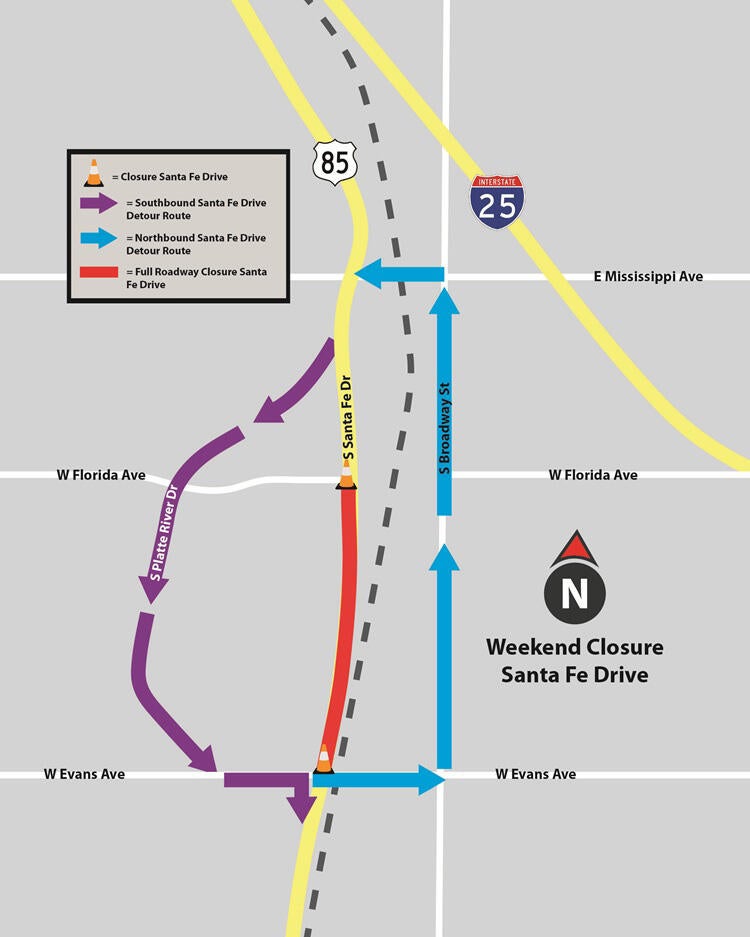
The Santa Fe Drive closure will begin at midnight on Saturday, July 11, and end on Monday, July 13, at 5 a.m. There will be detours in place. This includes:
- Southbound Santa Fe Drive Detour: Traffic will be routed to Platte River Drive to reenter southbound Santa Fe Drive at the West Evans Avenue on-ramp.
- Northbound Santa Fe Drive Detour: Access to northbound Santa Fe Drive will be at Mississippi Avenue via South Broadway Street.
- On-Ramp Closure: The West Evans Avenue on-ramp to northbound Santa Fe Drive will close at noon on Friday, July 10, to prepare for the full weekend closure and will remain closed until 5 a.m. on Monday, July 13. Traffic will be detoured to South Broadway Street to re-enter northbound Santa Fe Drive via Mississippi Avenue.
- Off-Ramp Closure: The southbound Santa Fe Drive off-ramp to West Evans Avenue will close for the full weekend period and remain closed until Friday, Sept. 11, while crews build new sidewalks and perform other concrete work at the southwest corner of the project. Detours will be posted to West Florida Avenue, West Dartmouth Avenue or West Hampden Avenue to bypass the ramp closure
During this closure, DOTI will reopen the underpass on Iowa Avenue. This is a new ADA accessible pathway that will be available between Santa Fe Drive and Acoma Street.

DENVER (KDVR) — Two officers, one now formerly of the Denver Police Department, face multiple charges relating to separate incidents in the past two months.
According to a release, now-former Denver Police Officer Gabriel Lucero was issued a citation for third-degree assault, official misconduct and false reporting, while Officer Javon Leach was cited for reckless driving and eluding.
The incident involving Lucero reportedly occurred on May 22 just before 1 a.m. in the 500 block of 16th Street. According to a release, Lucero was involved in an assault at a business, as he allegedly assaulted a person and walked away as others continued to assault the victim.
Security guards and an off-duty officer escorted him and the group out; however, Lucero reportedly identified himself as a Denver police officer and attempted to re-enter by using his police badge.
Lucero reportedly provided a false name without any other information, and further investigation verified Lucero as the person involved. Lucero was hired in 2025 and, due to his current probationary status, was fired as of Wednesday.
The incident involving Leach occurred around 1:41 a.m. on June 21, when Leach was reportedly pulling out of a parking lot on Larimer Street, attempting to drive against traffic.
Leach reportedly refused commands to stop as he left the area. Officials said he was found just seven minutes later, traveling at high speeds northbound on Park Avenue West.
He reportedly fled a traffic stop and continued to drive away, and officials deemed Leach to be the suspect following an investigation. He was placed in an off-line assignment while the case progresses, as they are considered misdemeanors.
“The Denver Police Department’s administrative review of Leach’s incident will begin once the criminal case is adjudicated, and that process includes the Denver Department of Safety and the Office of the Independent Monitor, a civilian oversight agency,” the release said.

Denver Nuggets standout forward Peyton Watson could find himself on another team before you know it.
With the Nuggets reportedly open to a sign-and-trade of Watson, could Denver really lose a core piece to their rotation?
It’s hard to imagine many teams being able to shoulder the financial weight of a Watson contract at this point because of the aprons and such, but he’s absolutely an asset to any contending team.
We’ve gone through and identified a few teams that make sense for Watson in the fall… including the one he’s already on at the moment. Hey, he might stay home, you never know!
The Clippers have been linked to Watson as a possible destination; he could help them immensely.
The Pistons have also been linked to Watson, which would help them a lot to contend for an NBA title.
Look, HYPOTHETICALLY, the Nets could move around some cap space with some player trades and such and get a deal done. They are one of the only teams in the NBA right now not in the negative with cap space.
The Grizzlies are the team with the least amount of negative cap space right now, per Spotrac. If they really wanted to pull off a Watson sign-and-trade… it would be hypothetically possible from a money standpoint.
Denver Nuggts
Look, it’s very possible Watson just stays in Denver on a brand-new deal. Who knows at this point?
-

 Massachusetts5 minutes ago
Healey administration vows to appeal as Trump rejects Massachusetts blizzard aid request – The Boston Globe
-

 Minnesota8 minutes ago
Minnesota Looks to Add 1,100 Child Care Slots, With Melrose Among the 11 Funded Communities
-

 Mississippi13 minutes ago
Death of Mississippi teen Nolan Wells under investigation
-

 Missouri20 minutes ago
Missouri realtors hold statewide rally to vote no on Amendments 4 & 5
-

 Montana23 minutes ago
District court judge blocks new Montana GOP bylaws – WTOP News
-

 Nebraska28 minutes ago
Nebraska ag experts say early detection for livestock parasites, illnesses will be important during summer show season
-

 Nevada35 minutes ago
Local artists on Northern Nevada stages, now through Labor Day weekend
-

 New Hampshire38 minutes ago
Trans athletes drop lawsuit to gain access to girls’ sports in New Hampshire after SCOTUS ruling

