Sports
Mookie Betts to miss several weeks after sustaining hand fracture in Dodgers' win

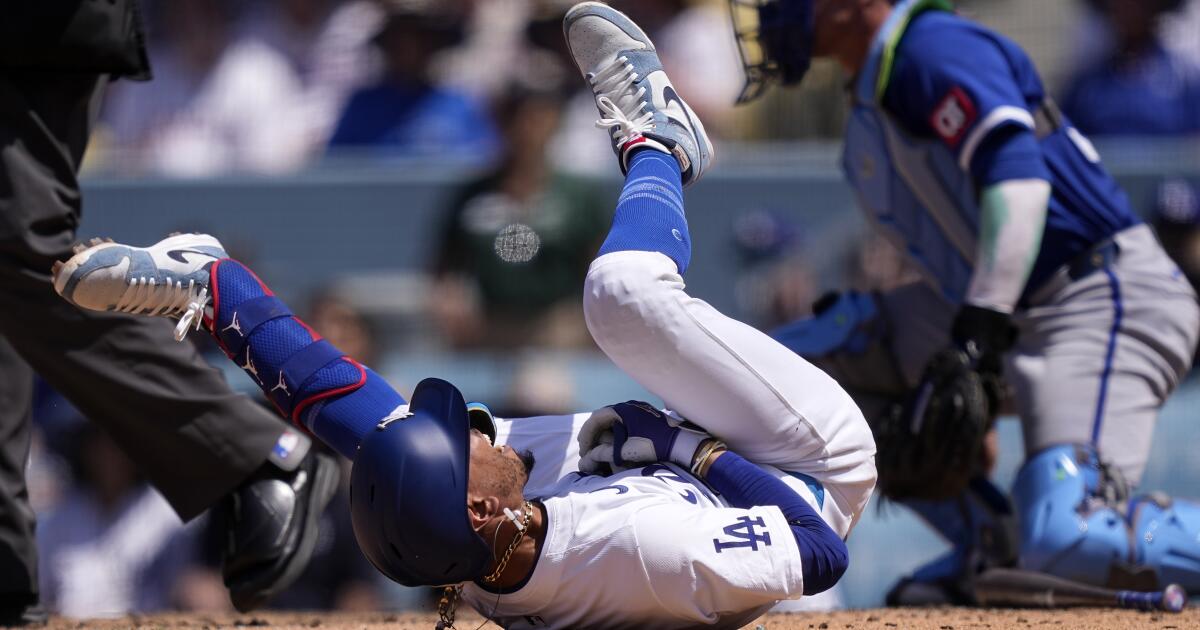
The good vibes derived from Tyler Glasnow’s dominant seven-inning start and Shohei Ohtani’s two-homer game were shattered in the seventh inning on Sunday when a 98-mph fastball struck the back of the left hand of Dodgers shortstop Mookie Betts, who writhed on the ground for a few minutes before coming out of the game.
The Dodgers went on to defeat the Kansas City Royals 3-0 in front of a sellout crowd of 52,789 at Dodger Stadium, but they lost their dynamic leadoff man in the process — X-rays showed that Betts suffered a broken bone in his left hand, and though he won’t need surgery, he will be sidelined for several weeks, if not months.
“It’s a big blow, it is,” manager Dave Roberts said. “I feel really bad for Mookie. He was having an MVP season. It’s very unfortunate, but you’ve got to move on, and that’s what we’re going to do. We’re going to be fine. We have really good players.”
Mookie Betts is hit by a pitch during the seventh inning Sunday against the Royals at Dodger Stadium.
(Mark J. Terrill / Associated Press)
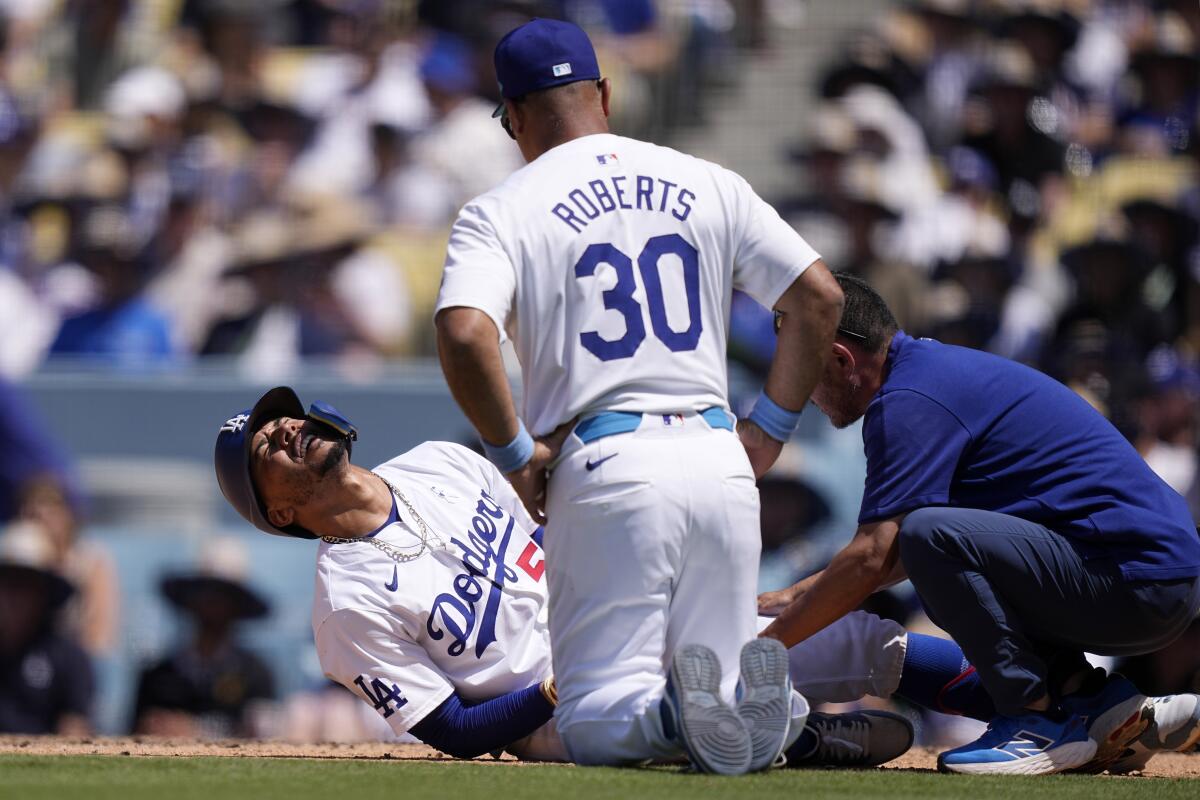
Mookie Betts, left, writhes on the ground after being hit by a pitch as manager Dave Roberts and a team trainer tend to him during the seventh inning Sunday.
(Mark J. Terrill / Associated Press)
Betts, who is batting .304 with an .893 on-base-plus-slugging percentage, 10 homers, 16 doubles, 40 RBIs and 50 runs, had a 1-and-2 count when he could not get out of the way of Royals reliever Dan Altavilla’s up-and-in heater. The ball hit Betts on the back of the left hand, which Betts clutched as he fell to the ground.
“I think that’s the first time I got hit in the hand, so I wasn’t sure [how bad it was],” Betts said after the game, his left hand wrapped. “I just went numb, and it hurt. Unfortunately, it’s broken. There’s nothing we can really do now.”
Betts did not travel with the team to Denver on Sunday night. He will be examined by Dr. Steven Shin, a hand specialist, on Monday.
“What’s next? I’m honestly not sure,” Betts said. “Obviously, I’ll be watching the boys, cheering them on, but other than that, it’s just rest, maybe use it as a mental break, be ready to go whenever it heals up.”
Betts moved from right field to second base over the winter and from second base to shortstop because of Gavin Lux’s throwing woes in early March.
The Dodgers have an excellent defensive option at shortstop in Miguel Rojas, but Rojas is nowhere near the hitter Betts is, and he has been slowed this season by leg injuries that prevent him from playing every day.
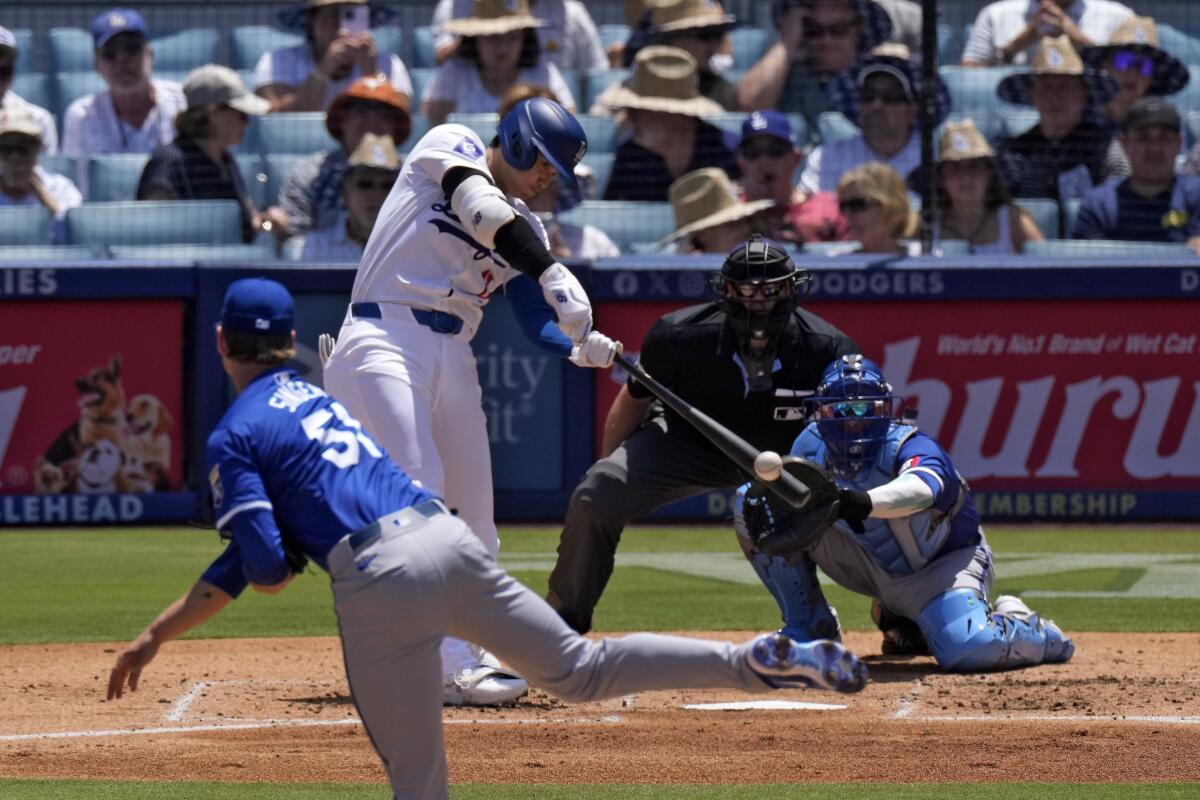
Shohei Ohtani hits a solo home run off Royals pitcher Brady Singer in the third inning Sunday at Dodger Stadium.
(Mark J. Terrill / Associated Press)
Roberts said utility man Kiké Hernández will also be used at shortstop. The team will recall left fielder Miguel Vargas from triple-A Oklahoma City to replace Betts on the roster. Ohtani will likely be moved to the leadoff spot in the order.
“It’s very tough to see as a teammate,” Ohtani, speaking through an interpreter, said of Betts. “He’s obviously a very important part of the team. If he’s out for some time, it’s really up to the rest of the team to pick him up.”
The Betts injury, which came on the same day the Dodgers put pitcher Yoshinobu Yamamoto on the 15-day injured list because of a rotator-cuff strain, put a damper on an otherwise successful afternoon for the Dodgers.
Glasnow allowed three hits, striking out nine and walking one, over seven scoreless innings, and Ohtani and Freddie Freeman powered the offense with solo home runs.
Setup man Daniel Hudson struck out two of three batters in a scoreless eighth inning, and closer Evan Phillips threw a scoreless ninth for his 10th save.
Glasnow gave the Dodgers much-needed length after the team employed a “bullpen game” on Thursday night against the Texas Rangers and were forced into another bullpen game when Yamamoto left Saturday night’s start against the Royals after two innings because of injury.
“I definitely knew I had to be efficient and try to fill up the zone,” said Glasnow, who improved to 7-5 with a 3.00 ERA in 15 starts. “I just tried to get ahead, mix up my pitches a bit more, not be so heavily reliant on the fastball, mix in the two-seamer, and it worked out today.”
Glasnow’s only real trouble came in the fourth, when Bobby Witt Jr. reached on a one-out infield single and Vinnie Pasquantino walked. He escaped the jam by striking out Salvador Perez with an 83-mph curve in the dirt and getting Adam Frazier to ground out to Betts, who ranged to the second-base side of the bag for Frazier’s grounder.
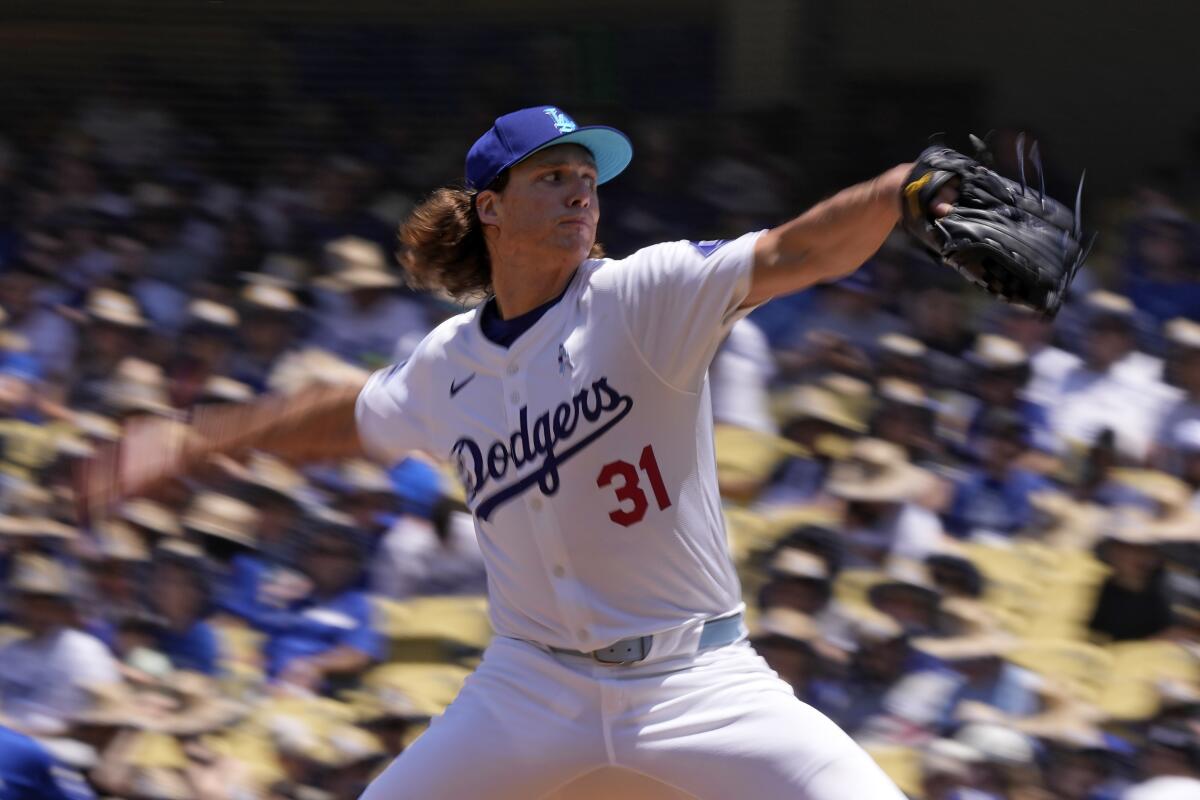
Dodgers starting pitcher Tyler Glasnow delivers during the first inning Sunday.
(Mark J. Terrill / Associated Press)
“He was absolutely fantastic,” Ohtani said of Glasnow. “Really, no threats throughout the game.”
Glasnow needed only 85 pitches, 62 of them strikes, to complete seven innings. He leaned heavily on his four-seam fastball, which averaged 96.0 mph, and an 83-mph curve that he used to induce eight of his 15 swinging strikes. He also got five called strikes with the curve.
“I’ve been able to land it for strikes the last couple of starts,” Glasnow said of his big breaking ball. “I’ve made some mechanical adjustments to try to keep it in the zone as opposed to just always trying to strike out guys with it.”
Glasnow’s third pitch is usually an 89-mph slider that he threw 15 times on Sunday, but he also threw a 96.8-mph two-seam sinker 15 times on Sunday after throwing it only 64 times in his first 14 starts.
“It’s basically just a heater, so it’s not like you have to learn a new pitch, and I think it gets me behind my four-seamer, too,” Glasnow said. “I’ve been a lot more comfortable throwing it kind of up and in to righties, and today to a lefty. I’m just trying to mix it in a little bit more to not be so predictable.”
Ohtani gave the Dodgers a 1-0 lead when he “used the big part of the field,” as Roberts likes to say, crushing a 451-foot solo home run — his second-longest of the season — to left-center field off Royals right-hander Brady Singer in the third inning.
Ohtani had been “getting a little too rotational” in his swing over the past week, Roberts said, causing him to pull off pitches early and hit too many ground balls to the right side, but he stayed on Singer’s 93-mph sinker for his 18th homer of the season, a laser that left his bat at 114.3 mph.
“That swing he took for that homer to left-center, that’s as good a swing as I’ve ever seen,” Roberts said. “When he does things the right way, gets his pitch, uses the big part of the field, it’s pretty special.”

Ohtani then crushed an 80-mph first-pitch slider from Singer over the right-field wall to lead off the sixth inning for his 19th homer of the season and 18th multiple-homer game of his career, this shot leaving his bat at 110.7 mph and traveling 400 feet.
Freeman followed with his 10th homer of the season, driving a 2-and-0 slider from Singer 401 feet to right-center field for a 3-0 Dodgers lead.
“That last homer was a slider down below,” Roberts said of Ohtani, “and for him to hit it like that instead of pulling it foul or hitting on the ground speaks to him seeing the ball better.”

Sports
Justin Verlander announces he will retire after this season: ‘I’ve realized that time has come’

NEWYou can now listen to Fox News articles!
One of the greatest pitchers in the history of baseball will be hanging up his cleats after this season.
Three-time Cy Young Award winner Justin Verlander announced on Wednesday that the 2026 season will be his last.
Amid an injury-riddled season with the Detroit Tigers, Verlander decided it’s time to go.
Detroit Tigers pitcher Justin Verlander watches from the dugout during a game against the Chicago White Sox at Comerica Park in Detroit June 21, 2026. (David Rodriguez-Munoz/USA Today Network via Imagn Images)
“This season has challenged me in ways I haven’t experienced before, both physically and mentally. I’ve always believed that as long as I could compete at the level I expect of myself, I’d keep playing. I never wanted to retire because of a milestone, a number, or a date on the calendar. I wanted the game to tell me when it was time. Over the last several months, I’ve realized that time has come,” Verlander said in a social media post.
“While I’m fully committed to giving my team everything I have for the rest of this season, I’ve decided this will be my last. It’s fitting that I get to finish where it all started – with the Detroit Tigers, the organization that drafted me and gave me my first opportunity.”
Verlander inked a one-year deal with the Tigers, with whom he spent his first 12½ seasons before being traded to the Houston Astros, in the offseason. In Houston, he returned to dominance, winning both of his World Series titles and two of his Cy Young Awards.
“Baseball has given me more than I could have imagined. It taught me discipline, resilience, and the value of continuing to adapt and evolve. I’ve been fortunate to play with and against incredible players, for outstanding organizations, and compete in-front of fans who deeply appreciate the game,” Verlander added in his announcement.
Justin Verlander of the Houston Astros celebrates after the Astros defeated the Philadelphia Phillies in Game 6 of the 2022 World Series at Minute Maid Park Nov. 5, 2022, in Houston, Texas. (Mary DeCicco/MLB Photos via Getty Images)
PHILLIES STAR SAYS ‘BS RULE’ IS KEEPING HIM FROM BEING NAMED ALL-STAR IN FRONT OF HOME CROWD
“To every teammate, coach, player, clubhouse attendant, and fan who has been part of this journey – thank you. It’s been a privilege to share the field with you. To my family, especially my wife Kate, thank you for standing beside me through every season, every rehab, and every high and low. I couldn’t have done this without you. It’s time for the next chapter. But first, I’m excited to finish this season the only way I know how – with everything I’ve got.”
Verlander is the active leader with 3,554 strikeouts, which is good for eighth all-time. He needs 21 to surpass Don Sutton and 87 to pass Tom Seaver.
The 43-year-old made his MLB debut in 2005 and won the American League Rookie of the Year Award the following season in what was just a small glimpse of what was to come.
Verlander was a Cy Young Award finalist on four other occasions, consistently near the top of the leaderboard in just about every pitching stat. MLB Commissioner Rob Manfred gave Verlander a legend’s exemption to this year’s Midsummer Classic, making him a 10-time All-Star.
One could argue that Verlander should have at least one more Cy Young Award on his mantle, but he is on the fast track to Cooperstown and very much in the conversation to join Mariano Rivera as the only player unanimously elected to the Hall of Fame.
Verlander’s best season came in 2022, when he pitched to a career-best 1.75 ERA along with a 0.829 WHIP. However, that came after he missed the entire 2021 season due to Tommy John surgery for an injury he suffered after pitching just one inning in the abbreviated 2020 season.
Houston Astros starting pitcher Justin Verlander throws against the Boston Red Sox during the first inning Aug. 22, 2023, in Houston. (AP Photo/Michael Wyke)
CLICK HERE TO DOWNLOAD THE FOX NEWS APP
He won his first Cy Young Award in 2011, when he was also awarded the MVP Award, and his second in 2019. Verlander’s 11 seasons between his first and final Cy Young Awards are the second-most behind Roger Clemens, who had 18 seasons between his first and seventh.
Verlander led the majors in innings and WHIP four times while recording the most strikeouts in three seasons.
Follow Fox News Digital’s sports coverage on X, and subscribe to the Fox News Sports Huddle newsletter.

The LAPD is considering whether to shut down its police academy for part of 2028 in order to put hundreds of officers back to work on the streets in time for the Olympic and Paralympic Games, according to four department sources.
The sources, who requested anonymity because they were not authorized to publicly discuss internal matters, said the proposal was floated at a senior staff meeting last week. The idea has sparked debate, the sources said, with some officials worried that a pause would set back the department’s efforts to hire more police officers and replenish its dwindling ranks.
The LAPD declined to make any official available for an interview about the proposal. In response to an inquiry from The Times, the department released a short statement that said: “The Olympic Games are two years away. The LAPD will be prepared as always to keep the citizens and visitors of Los Angeles safe. We look forward to a memorable event.”
Much could still change between now and the start of the Olympics. The size of recruit classes are dictated by the department’s annual budget, which is approved by the City Council before each fiscal year.
Recently, the council signed off on a $15-billion city budget for 2026-27, preserving Mayor Karen Bass’ plan to hire 510 officers — only enough cops to replace those who are expected to leave over the next fiscal year.
It’s not uncommon during large events for the department to mobilize officers from specialized units and others who don’t normally work in the field. But the potential cancellation of more than half of the 13 academy classes that the LAPD typically graduates in a given year came as a surprise to some.
Under the proposal, the academy could cease operations for roughly seven months after the January 2028 class, which would let the department temporarily reassign more than 300 officers from its training division. These include instructors who would normally be spending their days teaching the basics of how to handle firearms, pull over speeding motorists, collect evidence at a crime scene and interview victims and suspects.
Sources said the proposed plan calls for increasing academy class sizes before and after the Olympics and Paralympics in order to offset resignations and retirements.
The plan has still been met with deep skepticism in some quarters, with officials pointing to the department’s well-documented recruitment struggles in recent years. Any interruptions in recruiting officers could set the department back, the skeptics argue.
L.A. City Councilmember Tim McOsker said he understood the need for the department to continue its recruitment efforts, but said that putting training officers back to the field felt like a necessary “sacrifice to be able to host the Olympics.”
Late last month, L.A. officials reached a tentative deal with Olympic organizers laying out the process for reimbursing the city for potentially hundreds of millions of dollars for public services, ranging from traffic control to trash pickup. But the question of how the city will pay for police protection remains largely unsettled.
The costs could theoretically be covered by the $1 billion in funding the federal government has allocated for the Games’ costs. However, some elected officials have expressed concern that the money might not materialize once the Games are over. Another funding option is a $270-million contingency fund maintained by LA28 that can be distributed as a surplus if the Games make money or be used to cover any losses in the event of a shortfall.
For months, LAPD Chief Jim McDonnell has warned that public safety will suffer if the city doesn’t hire more officers to not only safeguard Olympic venues, but also continue normal operations over the 66 days between the July 14 start of the Olympic Games and the end of the Paralympic Games. At a budget hearing last year, McDonnell called on the council to fund new hires — while arguing against creating any delays in recruiting and on-boarding more officers.
Some City Council members have pushed back, saying overspending at the LAPD could force city leaders to contemplate cuts to other city jobs, which they oppose.
The Olympics will also be staffed by thousands of officers from agencies from across the state. A bill currently under consideration in the California Legislature would pave the way for the hundreds of officers from other states to help police the 2028 Games. The proposed legislation is opposed by the Peace Officers Research Association of California, the state’s largest law enforcement labor organization, which has argued that bringing in officers who don’t meet statewide training standards could spell disaster.

NEWYou can now listen to Fox News articles!
Pro wrestling is often known for its storyline-driven entertainment coupled with hard-hitting and high-flying action in the ring that leads to a crescendo that makes fans feel some kind of emotion. The major companies each try to drive to that moment.
Sometimes, a unique venue adds to the excitement of a show, especially for smaller independent pro wrestling companies who are trying to engage an audience for a few hours at a time. On July 14, Fight Factory Wrestling is going back to the beach for The War on the Shore 3.
COMPLETE PRO WRESTLING COVERAGE ON FOX NEWS DIGITAL
Fight Factory Wrestling hosted The War on the Shore 2 in Point Pleasant Beach, New Jersey, last year. (Provided to Fox News Digital)
The event will take place near Martell’s Tiki Bar in Point Pleasant Beach, New Jersey, bringing professional wrestling to the beach. Joey Janela, Ben Bishop, Jack Vaughn, Richard Holliday, Steve Maclin, Jay Lethal, Sent 2 Slauter, Lady Frost, Allie Katch, Steph De Lander and others are among those billed to be in matches for the event.
Dave Sturchio, one of the minds behind Fight Factory Wrestling with Chris Payne, talked to Fox News Digital about getting started in the sport. He said him and Payne initially got started wrestling in 2012 but as time went on, the two went their own way. The two came back together in 2024 to do the “Fight Factory Podcast.” He said Payne had aspirations to do a wrestling show on the beach – akin to World Championship Wrestling’s Bash at the Beach.
Sturchio said he called Payne to follow through on doing a beach show despite some apprehension about getting involved into the creative side of the sport. Sturchio said when he first approached the venue about the event, there was a little hesitation, but when he came back with a plan, the venue agreed.
“As the buzz started to develop and build over prepping for the show, I said to Payne, ‘I don’t know if this is a one off. I think that we have something here,’” Sturchio said. “And Payne and I, we’ve been in the industry since 2012, we’re life-long fans, I’m already an entrepreneur at heart, so how can I take my entrepreneurial stuff for the last three-four years of being my own boss, how do I spin this into becoming a pro wrestling promoter?”
Sturchio said that teaming with Payne allowed for the stars to align and to give each other a shot at building something great. He said the response from the first War on the Shore in 2024 was “overwhelming.”
Fight Factory Wrestling’s Dave Sturchio on the microphone at The War on the Shore 2. (Provided to Fox News Digital)
“We were like, this is actually kind of crazy. People are actually jones-ing for some wrestling in the summer. Typically, when you go to a VFW or your gymnasiums, independent wrestling kind of takes off and they don’t run as much in the summer because it’s hot. So, I said, if anything, nobody is going to run against us and unfortunately for us, we were put on a Tuesday night and we were like, ‘Jesus Christ, there’s no way anybody is going to show up on a Tuesday.’
“Turns out, nobody is really doing anything on a Tuesday. It was very easy to book the wrestlers in that regard because nobody else had anything going on. … First year was great. I think the best testament that we got was we booked Matt Cardona to be one of our featured guests on the first one and that’s when he tore his pec. So, he was out of action for a little while but he promised us that he would still show up.”
Sturchio said Cardona was blown away and thought he and Payne had been running shows for a while.
“If you’re going to blow away Matt Cardona, I think we got something. It was off to the races, man,” he added.
Now, Sturchio and Payne are set to put on their third War on the Shore in New Jersey and the card couldn’t be more interesting.
“This year, we really stacked the deck,” he told Fox News Digital. “Some professional wrestling shows you go to on the independents, there are those lulls. Matches where you’re like, ‘Oh, they’re giving this guy a chance over here and they’re gonna give this guy a chance over there.’
“This year, I told Payne, look, based off of everybody that we’ve booked so far, for me, and some independent wrestlers don’t want to hear this, we’re trying to build a roster, build a core roster. Meaning, if we used you before and you’ve done good work, we’re gonna use you again. Instead of saying, hey, random guy over here, who I don’t know who you are, but let’s give you a shot. So we’re trying to build stories and there are a lot of stories that are culminating.”
Sturchio pointed to a number of matches that fans should be eager to see. One specifically is the reformation of The Heavenly Bodies tag team with Justin and Mark Corino.
Pro wrestling fans back Point Pleasant, New Jersey, for The War on the Shore 2. (Provided to Fox News Digital)
“Those guys are reuniting for the first time in seven years,” he said. “They’re friends of mine, I came up with them. They were my first tag team opponents and I’ve known these guys forever and they’re near and dear to my heart.”
CLICK HERE TO DOWNLOAD THE FOX NEWS APP
Lady Frost will be in action against De Lander and Katch. Bishop defends the Fight Factory Premier Championship against Holliday and Vaughn. Janela will take on Jay Lethal for the first time ever and the event will feature a rumble and a tiki totem on a pole, which will act as Fight Factory Wrestling’s “Money in the Bank” type of gimmick.
“The card is stacked. I’m very excited about all of it. There’s not one lull,” Sturchio said. “We’re just going to roll right through and I think it’s going to be one of those nights that we remember for a very, very long time.”
-

 Los Angeles, Ca1 hour ago
Loved ones search for missing 34-year-old Southern California woman
-

 Detroit, MI2 hours ago
Chickens, geese found at vacant home after nonprofit reports them stolen
-

 San Francisco, CA2 hours ago
What’s next for San Francisco Giants as MLB trade deadline approaches?
-
 Dallas, TX2 hours ago
Dallas millionaire files lawsuit against groundwater district
-

 Miami, FL2 hours ago
7 more women arrested at southwest Miami-Dade massage parlors, accused of prostitution in undercover sting
-

 Boston, MA2 hours ago
‘They’re my buddies’: 96-year-old Back Bay woman befriends French soccer team
-

 Denver, CO2 hours ago
Denver officers cited for separate incidents, 1 fired
-

 Seattle, WA2 hours ago
Study finds dangerous chemicals in the breast milk of Seattle moms

