Colorado
What’s Working: Robocalls are declining in Colorado but still number in the millions


Quick links: Comcast layoffs | Local fed workers update | Take the reader poll | More!
Coloradans fare better than most Americans when it comes to pesky robocallers, according to the latest data from YouMail, which has a free call-blocking app.
But at nine calls per capita last month — below the nation’s average of 12.3 — Colorado phones received an estimated 51.6 million robocalls in September. That per capita figure includes babies.
The problem is, said Danny Katz, executive director of Colorado Public Interest Research Group, many of us are getting way more annoying calls. And the number of robocalls in the state has doubled since 2016 despite laws requiring phone companies to adopt technology that authenticates a voice caller’s identity to prevent spoofing and scams.
While the technology doesn’t authenticate text messages, the FCC has other rules banning text messages sent by an autodialer.

The Federal Communications Commission has taken action. In August, the FCC kicked out 1,200 noncompliant voice service companies “effectively disconnecting them from (the) U.S. phone network.”
But in a new analysis of federal data, PIRG found that only 44% of more than 9,000 phone companies had fully installed the technology. Another 18% have it partially installed. And 31% haven’t installed it.
“Unfortunately, protecting consumers is a marathon and every time that we get to the next benchmark, oftentimes the scam artists are thinking, OK, what’s the new technology or new way that we can get around the rules and regulations?” Katz said. “But I do think every benchmark we hit is a higher bar for scam artists to have to pass. Even though it’s not working perfectly yet, I think there’s plenty of us who have seen a decrease in the number of robocalls and spam texts we have gotten over the last few years.”
Katz is talking about the phone companies in compliance, like T-Mobile, Verizon and other familiar consumer mobile services. Verizon has its Spam Alerts and Call Filter tools for landlines and wireless to help users identify suspicious callers and block them. T-Mobile has ScamShield. AT&T has ActiveArmor.
According to the broadband trade association US Telecom, on behalf of AT&T, the number of robocalls is actually going down. Even YouMail’s data shows that numbers have been in decline this year.
Still, “we recognize that illegal robocalls and scams do continue to be a scourge on our networks, which is why carriers have implemented security protocols,” the trade group said in a statement.
More to come on this topic. Are spam calls getting worse, better or have you even noticed? Take the reader poll to help us better understand the impact on Coloradans.

➔ cosun.co/WWrobocalls
Why Comcast is closing its Centennial HQ and laying off 302
Comcast this week told the state’s labor department that it will close its West Division headquarters in Centennial and layoff 302 employees as part of a major restructuring.
In a memo from Sept. 18, company leaders told employees they need to realign the company for growth. And something that’s not growing? Legacy cable TV and broadband businesses.
The company doesn’t even call it cable TV anymore, but rather, “residential connectivity and platforms.” In its second-quarter earnings report, Comcast lost 11% of its domestic video customers in a year, down by 1.4 million to 11.8 million customers. A decade ago, it had 22.3 million video customers.

Over the same decade, its broadband subscribers grew 40% to 31.5 million, as of June. But that is falling, too, and was down 1.6% in June, compared with a year ago, for a loss of 528,000 internet customers.
But Comcast’s revenues are growing, up 2.1% in the second quarter from a year earlier, thanks to its Universal theme parks and its mobile phone service. Net income nearly tripled to $11 billion, though that was largely due to selling its interest in Hulu to Disney for $9.4 billion.
The restructuring gets rid of divisions in order to focus on regions. If that sounds a little confusing, a Comcast spokesperson clarified Thursday that the company has three divisions: Central, West and Northeast.
The Centennial office, located at 9401 E. Panorama Circle, is the West Division headquarters. But all three divisions are closing. The Central division in Atlanta, is laying off 240 employees. The Northeast division in New Hampshire layoff total has not been confirmed.
But regions, which include other offices and Comcast operations in the U.S., will remain.
The city of Centennial is still home to several Comcast facilities, including an older building at 4100 E. Dry Creek. The aging facility, which existed before Centennial was incorporated in 2001, is the local headend where large satellite dishes help distribute video and is the metro Denver home of Comcast Technology Solutions.
Centennial city officials said in a statement that it “feels for those impacted workers,” but also understands “the need for our companies to restructure and recalibrate in order to remain competitive in a challenging economic environment.”
Neil Marciniak, Centennial’s director of Economic Development, said Comcast will still be the city’s largest private employer. Based on 2024 data, Comcast employed 2,500 people in Centennial, he said.
Colorado federal workers unemployment claims up 81% in a week
The federal shutdown continued to impact federal workers in Colorado with the numbers filing for unemployment growing 81% since last week to 1,119 since Oct. 1, according to the state labor department.
That includes folks who took deferred resignation earlier in the year and had their last day Sept. 30. But current employees, who haven’t been paid since the shutdown began, are now 18 days into the shutdown.
Companies are sharing information on what they’re doing to ease the financial burden, including:
Speaking of the government shutdown, here’s how What’s Working readers responded to last week’s poll on how the shutdown has affected your life. Check it out 🡻🡻
Sun economy stories you may have missed

➔ Dark money group that spent big in Colorado’s Democratic primaries approved funding for Vail retreat for state lawmakers, lobbyists. The Colorado Sun has learned that One Main Street Colorado signed off on a request for $25,000 from the Colorado Opportunity Caucus to fund hotel rooms. >> Read story
➔ Michael Bennet, Phil Weiser are amassing millions of dollars for their Democratic gubernatorial primary fight. The candidates had about $4.6 million in combined campaign cash to begin October. >> Read story
➔ Nederland fire erased a third of local businesses and with it 30% of town sales tax revenue. U.S. Rep. Joe Neguse, Gov. Jared Polis visited Caribou Village Shopping Center and promised help navigating access to government help >> Read story

➔ Colorado plans to fully digitize paper and analog land records, some dating back to the 1860s, by next year. A $2 fee from every property filing since 2016 has helped fund the state’s $21M effort to preserve paper and analog records for digital eternity >> Read story
➔ Subsidized flights to small Colorado communities will continue during shutdown — for now. Denver International Airport has the most federally subsidized essential air service routes of anywhere in the nation. That includes flights to Cortez, Alamosa and Pueblo. >> Read story
➔ From Brooklyn to Beulah, hippie beginnings to golden years, a retired couple returns to van life. Part of Colorado’s rapidly aging demographic, Dave and Helene Van Manen left their mountain home for a more practical future — on their own terms >> Read story
Other working bits

➔ Dollar General agrees to pay $400,000 fine for pricing inaccuracies. The settlement comes after the state attorney general’s office sent investigators to stores in Milliken and Loveland in 2023 and found that more than 2% of item prices advertised on shelves rang in differently at the cash register. The AG’s office continued to inspect stores all over the state and found that 12 of 18 inspections charged a higher price at the register.
Dollar General, which has 70 stores in Colorado, denied the allegations but agreed to the settlement, which also requires the retailer to do price audits at each store for the next three years, according to terms. >> View settlement
➔ There are 157,819 job openings on state’s job board. But of those, nearly one-third are remote or out of state, according to the state labor department. As of Oct. 15, 45,880 were out of state and 5,522 were remote. The top company posting jobs? Oracle, with 10,153 openings. Registration to the state’s job board, at connectingcolorado.gov, is required for those collecting unemployment checks. >> Hunt for a job
➔ Pueblo recycler named to Cleantech 50 watch list. That’s a notable honor for Driven Plastics, which takes unwanted plastic bags or that shrink wrap that companies excessively use and turns it into an additive to make asphalt roads last longer. For each mile of one lane, the Pueblo manufacturer recycles up to 10 tons of that thin plastic. >> Earlier story
Got some economic news or business bits Coloradans should know? Tell us: cosun.co/heyww
Thanks for sticking with me for this week’s report. As always, share your 2 cents on how the economy is keeping you down or helping you up at cosun.co/heyww. ~ tamara
Miss a column? Catch up:
What’s Working is a Colorado Sun column about surviving in today’s economy. Email tamara@coloradosun.com with stories, tips or questions. Read the archive, ask a question at cosun.co/heyww and don’t miss the next one by signing up at coloradosun.com/getww.
Support this free newsletter and become a Colorado Sun member: coloradosun.com/join
Corrections & Clarifications
Notice something wrong? The Colorado Sun has an ethical responsibility to fix all factual errors. Request a correction by emailing corrections@coloradosun.com.



As a result of a snow drought and a heat wave that have both set records, some Colorado residents face the earliest restrictions on their water use ever imposed.
Denver Water announced Wednesday that it is seeking a 20% cut in water use, asking people to turn off automatic watering systems until mid-May and restricting the watering of trees and shrubs to twice a week.
“The situation is quite serious,” said Todd Hartman, a spokesperson for the utility. “We’re in such a dire situation that we could be coming back to the public in two or three months and saying you’re limited to one day a week.”
It is the earliest in the year that Denver Water has ever issued a restriction, Hartman said.
Colorado’s snowpack peaked at extremely low levels on March 12 — nearly a month earlier than usual — then cratered during the recent heat wave that cooked nearly every state in the West.
“We already had the lowest snowpack we’ve seen since at least 1981, and now, with the heat wave conditions, we’ve already lost about 40% of the statewide snowpack” since the March 12 peak, said Peter Goble, Colorado’s assistant state climatologist. “Conditions are looking more like late April or early May.”
The water restrictions are a harbinger of what’s to come in many Western states as officials try to manage widespread drought concerns. Nearly every snow basin in the Mountain West had one of its warmest winters on record and is well behind normal when it comes to water supply, according to the U.S. drought monitor. The dwindling snowpack is likely to raise the risk of severe wildfires, hamper electricity generation at hydropower dams and force water restrictions for farmers.
Hartman said nearly every community east of the Rockies, along Colorado’s front range, is in much the same boat as Denver.
City Council members in Aurora are considering similar water restrictions; reservoirs there stand at about 58%, according to the city’s website. In the town of Erie, officials declared a water shortage emergency on March 20 after they observed a massive spike in consumption.
Gabi Rae, a spokesperson for the town, said Erie was perilously close to having taps run dry because so many residents had started watering their lawns early amid the unseasonable heat.
“We were a day away from running out of water. That’s why it was such an emergency,” she said.
Erie officials demanded that residents stop using irrigation systems altogether.
Goble said this month’s heat wave has set records in every corner of Colorado, sometimes by double digits.
“I can’t remember seeing a single heat wave that broke this many records, and seeing it across such a large portion of the country is certainly eye-popping,” he said, adding: “I’m located in Fort Collins, and we got up to 91 last Saturday. The previous record for March was 81, so we smashed that record. And it wasn’t just one day, either.”
Denver Water, which serves about 1.5 million residents in the city and its surrounding suburbs, gets about half of its water from the Upper Colorado River Basin and the South Platte River Basin. The latter’s snowpack was at about 42% of normal Tuesday, the utility reported. The Upper Colorado River Watershed was at 55%.
Systemwide, Denver Water’s reservoirs are about 80% full, which is only about 5 percentage points lower than in a typical year.
“That sounds pretty good,” Hartman said. “Except that what we’re not going to be able to rely on is that rush of water that will bring those reservoirs back up, because the snowpack is so low.”
In other words, the snowpack — a natural water reservoir — is mostly tapped already and won’t replenish reservoirs later this spring and into summer, when runoff usually peaks.
In Erie, city workers plan to aggressively police water use until sometime next week using smart meters that monitor residential usage. Rae said the city is also sending utility workers to patrol neighborhoods and look for sprinklers that are turned on.
“People have been kind of annoyed with how aggressive we were, and I don’t necessarily think they understand the ramifications if we weren’t,” Rae said. “It is an actual serious emergency situation. We were so close to reaching empty, there would literally be no water coming out of the taps — hospitals, schools, fire hydrants, your home would have no water.”
Although the limits on outdoor watering will be lifted soon, Rae expects more restrictions later this spring and summer.
Colorado
Suddenly hazy skies in Denver prompt some residents concerned about wildfire smoke to call 911

Some people who live in the Denver metro area on Thursday afternoon were making calls to 911 after skies became noticeably hazy and winds kicked up. It was due to smoke from wildfires in Nebraska moving into Colorado. A cold front also was moving through the Front Range, and there is dust in the air.
The poor air conditions led to reduced visibility downtown after 3 p.m. Several of CBS Colorado’s City Cams showed dust or smoke in the air.
Temperatures were expected to drop by as much as 20 to 30 degrees with the cold front.
The suddenly dusty skies prompted at least one fire agency to put out a plea to residents to please only call 911 “if you see flames.” That warning was put out by South Metro Fire Rescue, which shared a photo on X of an office building with haze visible outside.
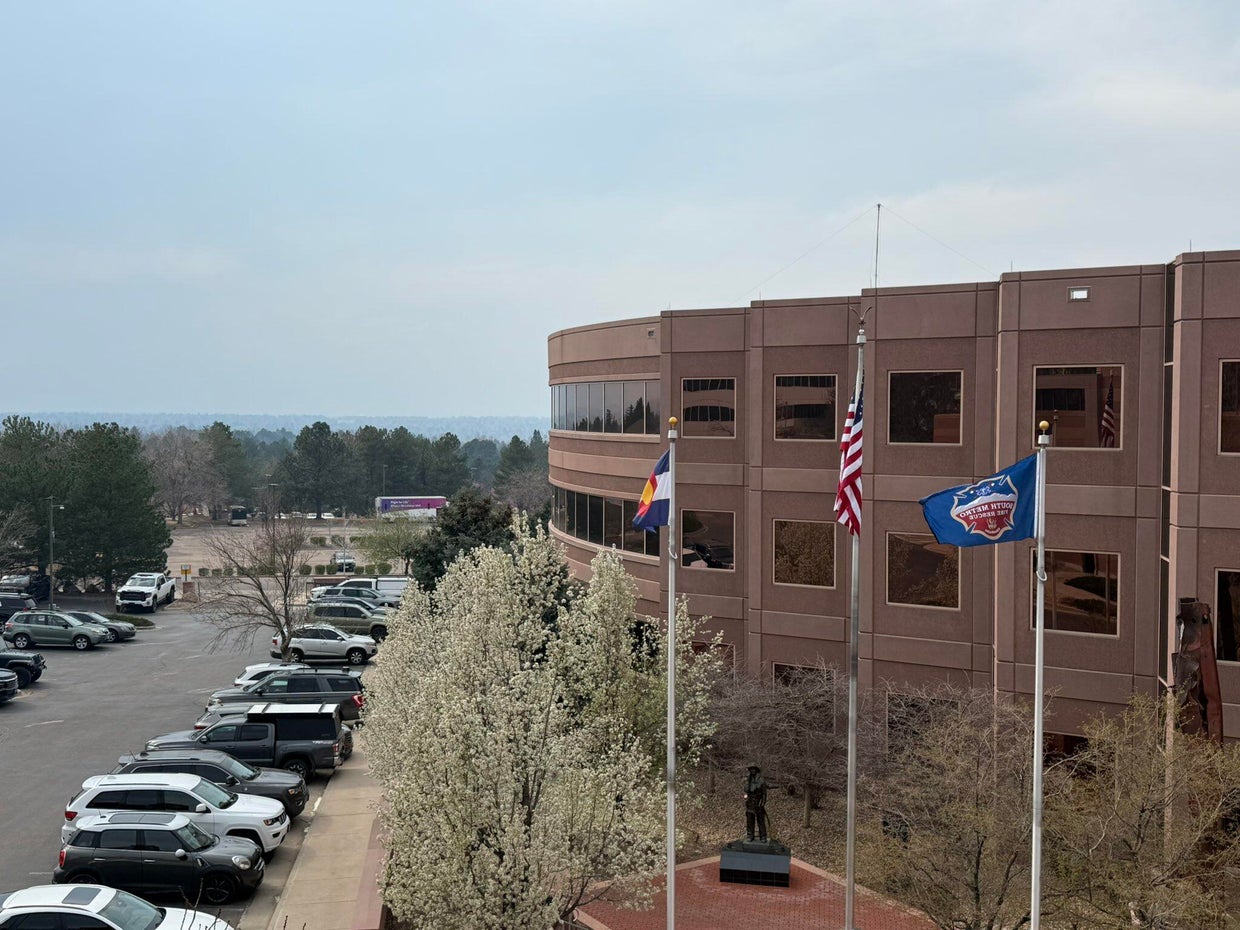
South Metro Fire Rescue said in their post that the smoke is from Colorado’s neighbor to the east. They called it a “significant haze” in the air.
Earlier this month, the Morrill Fire and the Cottonwood Fire burned a significant amount of Nebraska grassland and ranchland. They have mostly been contained by firefighters. Nebraska Gov. Jim Pillen said those two fires combined with several others have burned approximately 800,000 acres of land. On Thursday, Pillen announced that he is signing several executive actions intended to ease the burden caused by the fires.
There were no wildfires burning in the Denver metro area on Thursday afternoon.

ARAPAHOE COUNTY, Colo. (KKTV) – A homicide suspect based out of Colorado, wanted in a fentanyl-related death, is back in the state after being captured in Colombia.
The Arapahoe County Sheriff’s Office (ACSO) said 33-year-old Max Arsenault had been on the run since January 17.
Deputies said this stemmed from an incident in May 2023, where deputies responded to a call for a man named Nicholas Dorotik, who was found unresponsive.
ACSO said the cause of death was a mixed drug overdose involving meth and fentanyl, having about three times the lethal amount of fentanyl in his system.
One year later, Arsenault was arrested. He was scheduled for trial in January 2026 when deputies said he fled the country while on bond three days before the trial was set to start.
He was caught in Medellin, Colombia, on March 4, following a two-month international investigation. He has since been extradited back to Denver, where he is facing charges and awaiting trial.
Copyright 2026 KKTV. All rights reserved.

Retired Detroit sergeant faces new sexual assault charge involving 14-year-old victim from 2002

Trump floats sending federal agents to San Francisco to tackle crime

Dallas ISD will offer free pre-K starting next school year

Norwegian Cruise Line offers a first look at Luna, new cruise ship setting sail from PortMiami – WSVN 7News | Miami News, Weather, Sports | Fort Lauderdale

Boston ‘No Kings’ rally expected to draw 100,000; others planned across Mass.

Florida High School Football Rankings: Top 25 teams – Oct. 21

How old is Bo Nix? What to know about Oregon quarterback ahead of 2024 NFL Draft

Cleary's 21 help Le Moyne down Central Connecticut State 69-64 in OT

99th annual Pony Swim held in Virginia

Indiana Members Credit Union announced as new anchor tenant at Bottleworks District

Video: Will ICE Change Under Its New Leader?

DHS shutdown breakthrough comes at cost for Republicans as funding fights nears end

Rubio joins crucial G7 talks as Iran war set to dominate second day

A surprise resignation could open the door for an independent to win a Montana Senate seat

Video: Savannah Guthrie Says She Believes Her Mother Was Taken for Ransom
-

 Detroit, MI1 week ago
Drummer Brian Pastoria, longtime Detroit music advocate, dies at 68
-

 Science1 week ago
How a Melting Glacier in Antarctica Could Affect Tens of Millions Around the Globe
-
 Science1 week ago
I had to man up and get a mammogram
-

 Movie Reviews1 week ago
‘Youth’ Twitter review: Ken Karunaas impresses audiences; Suraj Venjaramoodu adds charm; music wins praise | – The Times of India
-

 Sports6 days ago
IOC addresses execution of 19-year-old Iranian wrestler Saleh Mohammadi
-

 New Mexico5 days ago
Clovis shooting leaves one dead, four injured
-
 Business1 week ago
Disney’s new CEO says his focus is on storytelling and creativity
-

 Technology5 days ago
YouTube job scam text: How to spot it fast