Colorado
These Colorado school districts want their students back. So they’re adding online classes

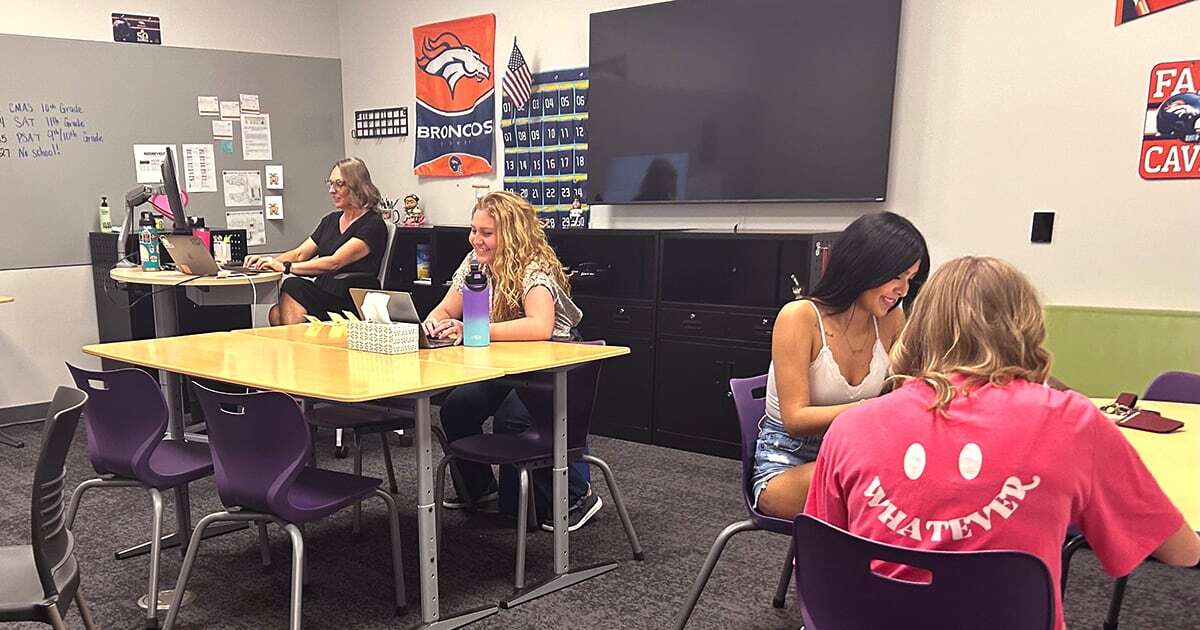
Kurt Clay, assistant superintendent in the Delta County school district, was alarmed last year to learn that 138 students had left his western Colorado district for public online schools. With them went $1.6 million in state education dollars.
“That’s just funding that goes somewhere else,” Clay said. “It’s not staying here local.”
It wasn’t just about the money though. Clay and other district leaders believed they could offer something better: The flexible online classes students wanted with the added benefit of keeping them connected to district staff, school clubs, and special events like prom. That’s how the district’s online program — Empower Online — came to be last fall.
Delta County is among the dozens of Colorado districts that have recently started their own online programs or plan to soon, competing for students at a time when enrollment is declining statewide. Such school districts, which are contending with budget cuts and even school closures, are particularly wary of multi-district online schools, which they say draw students and state funding to districts hundreds of miles away.
Colorado has 44 multi-district online schools serving more than 30,000 students statewide. About half the schools get 90% or more of their students from outside their authorizing district, according to data from the Colorado Department of Education. Just a few entities authorize many of the schools.
More multi-district online schools could be on the way. While the State Board of Education unanimously rejected one in March, it will consider three more proposals on Thursday.
This group helps districts with online programs
Over the past year, a state-supported nonprofit called Colorado Digital Learning Solutions has helped many districts launch or plan new online programs. The group is not an online school. Rather, it provides asynchronous online classes taught by Colorado-licensed teachers to school districts and charter schools. Some of its teachers still teach in-person classes, and others are retired from Colorado classrooms.
The Weld RE-5J district in northern Colorado has used Colorado Digital Learning Solutions courses for years in its online program. Emma, a junior in the district, is taking algebra, English, and world history online through the group, plus four in-person classes at her high school in Johnstown.
Emma, who hopes to graduate a semester early, said she found all in-person classes a struggle because she has ADHD.
“I just have a really hard time focusing in class and being my whole present self,” she said.
“I chose hybrid because it still gives me a social aspect, but it also gives me that flexible aspect.”
Colorado Digital Learning Solutions was selected to provide online classes to Colorado schools after the passage of a 2016 state law that required increased investment in supplemental online courses. The law sought to ensure digital equity by providing assistance to school districts and charter schools that didn’t have the capacity to build their own online offerings.
Colorado Digital Learning Solutions receives about 20% of its budget from the state. Generally, school districts pay the group $250 per student per semester-long class.
About half of Colorado’s 180 school districts use the nonprofit to offer online classes — sometimes a full menu and sometimes a single course. For example, the small Lamar district on the Eastern Plains contracts with the group to provide a Latin class, taught by a Boulder teacher, to one student.
As more school districts seek to win students back from multi-district online schools — or prevent students from leaving in the first place — things have become contentious at times. Some multi-district online schools are pushing back against Colorado Digital Learning Solutions.
In a February letter on behalf of some multi-district online schools, attorney Brad Miller accused the group of causing “reputational harm” to the schools. He said the group’s promotional materials highlight the online schools’ low graduation rates without noting that their students tend to be highly mobile and behind academically.
Dan Morris, co-executive director of Colorado Digital Learning Solutions, said his group was reporting publicly available data.
Miller, who’s been involved in several high-profile lawsuits on behalf of conservative-leaning school districts, did not respond to requests for comment or to clarify which online schools he represents.
The online program pitch
Seventeen Colorado districts, most of them small and rural, started online programs in 2025. Colorado Digital Learning Solutions is working with 25-30 additional districts that want to start online programs next school year, Morris said.
Unlike multi-district online schools, online programs must have fewer than 100 full-time online students and no more than 10 from outside the district.
A key part of Morris’ pitch to districts is data. It’s in the presentation he’s given at state conferences: “Stop the Enrollment Drain: Build a Local Online Program that keeps students in-district.” He also shares detailed spreadsheets his team has compiled showing how many students school districts are losing to multi-district online schools.
That’s what convinced officials in the Durango district in southwestern Colorado to start an online program next year. They learned they’d lost more than 400 students — and about $5 million in state funding — to multi-district online schools.
Robert Aspen, Durango High School’s intervention coordinator, said they’ll start with up to 50 students, with plans to grow long term. The goal is to attract students who enrolled in multi-district online schools back to their home school.
While there are 44 multi-district onlines in Colorado, state data shows that most students are leaving their local districts for a few big names, authorized by just a few entities and often run by for-profit companies located out of state.
Byers Superintendent Tom Turrell, whose district authorizes eight multi-district online charter schools, said it’s no surprise that more districts are starting online options.
“We don’t view district on-line programs as competition,” he said by email. “Like Byers, other districts are innovating to better serve students and that’s great, that’s their job.”
Online learning is popular, not all options created equal
Educators say families seek online options for many reasons, including because students suffer from anxiety, have medical challenges, have experienced bullying, or have jobs or household responsibilities that conflict with a traditional school schedule. Competitive athletes also like the flexibility of online courses.
“I have a rodeo girl,” said Delaine Hudson, a former principal who runs the new online program in Delta County. “She spends her morning doing school work and then she’s either practicing or … she’s somewhere in the state doing rodeo.”
Forty students, mostly high schoolers, are enrolled in Delta County’s online program this semester, taking courses through Colorado Digital Learning Solutions with other students around the state. They take core classes, like English and science, and less common offerings like “History of the Holocaust.”
Hudson likes that there’s a real teacher available to message when students hit roadblocks. She checks in with students weekly, too, by phone, email, or text.
Most students are thrilled with the online program so far, she said. “And it’s rigorous. I don’t feel like we’re just pushing them through.”
Critics of some multi-district online schools question their quality. At 20 of the schools, so few students take state tests that state officials can’t calculate ratings, leaving the public in the dark about how they’re doing.
In addition, some of the biggest multi-district online schools routinely post low graduation rates. For example, the 2,600-student Astravo Academy Online High School, which is authorized by the Byers district, has a four-year graduation rate of 44%. At District 49’s GOAL High School, it’s 49%. The state average is about 86%, according to state data.
Supporters say the some multi-district online schools are helping at-risk students who’ve faced educational and personal challenges.
“We’ve taken on all of the kids who needed second and third and fourth and fifth chances in GOAL from the entire state,” said District 49 school board member Marie LaVere-Wright at a board meeting last June.
While GOAL is classified by the state as an “alternative education campus” — schools designed to serve high-risk students — more than 90 other Colorado schools, including many bricks and mortar schools, have the same designation.
District 49 officials declined to comment for this story.
This story was made available via the Colorado News Collaborative. Learn more at:

Colorado
Keeler: Colorado’s best prep distance runner? Niwot’s Addison Ritzenhein makes case with 4A record

LAKEWOOD — Her gold was in the bag.
They all were, technically. The night before she rewrote Colorado’s record book, Addison Ritzenhein, the Niwot senior who’s run like almost no teen distance runner ever has, went into her closet and pulled out a dozen state medals. As she laid them out side-by-side, all the miles started talking back.
Addy and her dad had found themselves waxing about the moments and the memories during a Friday night drive. It was the eve of her final CHSAA state track meet. The last ride.
“I want you to bring them (Saturday) morning,” Dathan Ritzenhein, head coach at On Athletics Club in Boulder, told his daughter when he saw the medals. He suggested putting all of them in a big bag and bringing it to Jeffco Stadium on Saturday.
“And then we’ll take them out at the end (of the meet). And we’re going to line them all up. I want to take a picture of you with all of them.”
Dad had a hunch.
Company was coming.
At a record pace, too.
“I wanted to have a perfect ending to my entire high school career,” Addy said after setting a state mark in the 4A girls 1600 meters in her final CHSAA event. “And I just had to remind myself that I’d done everything I could up to this moment.”
Move over, Wendy Koenig. Make some room, Melody Fairchild. The Kaltenbachs? Scooch over. Emma Coburn, Katie Rainsberger and Elise Cranny? You, too. If Ritzenhein isn’t the greatest girls prep distance runner in Colorado history, her closing kick made one heck of a case.
The resume? Ten track titles in four years. Seven as an individual. Two this weekend. Three more golds in cross-country. Mom and dad were two of the best to ever run at CU, and she’s darn near already lapped where they were at her age.
Her last race set another state-meet bar — 4:44.47 in the 1600. A final push in the last 100 meters shot her past Air Academy’s Jordan Banta (4:50.28) and bested Rainsberger’s old 4A state mark of 4:45.27, set in 2016.
“I’m lost for words,” Addy said.
Unrivaled?
Unsurpassed?
Unmatched?
“Feels like a huge wall of relief, honestly,” Ritzenhein told me as the gold around her neck sparkled in Lakewood’s mid-morning sun. “It’s just so many (emotions). A wall of emotions.”
She ran through them, anyway, just as she ran through everything else during her senior season. Addy might’ve been born on first base with mom and dad’s genetics, but she slid into third base on her own hustle, will and want-to. Ritzenhein’s favorite quote is also her mantra: Pain is temporary. Glory is forever.
Which sums up why she’d run at the NXN Nike Cross Nationals this past December with a 104-degree fever and flu-like symptoms. Yet when the Cougars needed her to post up in order to finish second in the nation, Addy saddled up and dragged herself to the end.
“She felt like the team would have won (if she didn’t have) the flu, and she ran with a fever,” Dathan recalled. “She didn’t dwell on it … ‘I have to look forward and I can’t sit here in this moment … you gotta move on.’”
She moves. She proves. She grooves. In a family of elite runners, Addy might be the most competitive in the bunch. And the most cutthroat. Little brother Jude cracked that there’s a video the family took of him, at age 5, being moved to tears when a then-8-year-old Addison kicked his tail in “Monopoly.”

She also knows when to make the grind fun. When to take a title team’s blood pressure down a few notches.
“They’d come in from where it was muddy running, and she’ll wipe the mud off her shoe and she’ll take it and put it underneath the stall of the person next to her,” Dad recalled. “Just funny little harmless things like that.”
Before she ran with a fast crowd, her dad ran with the fastest in the world. Dathan is a three-time Olympian and the American record-holder in the 5K from 2009-10. Her mother, Kalin, was a cross-country All-American at CU. When Addy wasn’t watching dad at London’s 2012 Summer Games, she was watching episodes of “Mickey Mouse Clubhouse” on her mom’s lap.
Now she wants to chase those big dogs down.
“I like to dream big, and being an Olympian would be my big goal,” said Addy, who’s headed to Northern Arizona University. Then she shrugged. “And if I fall short, it’s OK. But yeah, that’s my big goal.”
Hot dog, hot dog, hot diggity-dog.
“You have to dream about that if you want to accomplish it and you have to see yourself do it a 1000 times before you actually do it,” Dathan said. “And so for her to know that she’s coming away from here with probably the best career in high school that I could think of … she’s just been consistent, and that makes me feel like she’s in a really good spot of development.”
Addy’s medals normally reside in her closet. Although, because of all the awards, including three Gatorade Colorado Girls Cross Country Player of the Year trophies, it’s not so much of a walk-in type as it is a crawl-in.
“It’s almost impossible to walk in there,” Jude laughed. “There’s a shelf in there just full of clothes, packed with clothes, and there’s a shelf behind it full of trophies.”
Best make room for one more. Somehow.
“I knew (Saturday’s) game plan, and I thought that she was going to take it right away a little bit faster,” Dathan said of Addy’s final lap. “I then kind of realized (there) was about 200 to go. I was like, ‘Oh, she might run the record.’ And I was like, ‘This is gonna be a sweet way to end.’ And she seemed fully focused, still, with 100 to go. I don’t know at what point she realized it and got to really enjoy it. But I hope she did.”
A collapse into the grass after a run for the ages eventually gave way to a grin for the ages.
“Everyone wants a perfect ending,” Addy said. “But I think I accomplished it.”
With that, Ritzenhein turned west on a white heel, rounded third and headed for home, riding a smile 5,551 feet high and a shadow twice as long.
Want more sports news? Sign up for the Sports Omelette to get all our analysis on Denver’s teams.


Fascinating facts about rattlesnakes
Prairie rattlesnakes are one of three venomous snake species in Colorado. The other two are also rattlesnakes. (This chatter was updated to add the missing species name.)
Guarantee you won’t stick your hand in a rock crevice without first looking while hiking after you watch the Colorado RattleCam livestream of a rattlesnake mega den.
Yikes! Viewing the livestream is like watching a scary movie, equally entertaining and terrifying.
The mega den on undisclosed private property in Larimer County is crawling with the venomous snakes now that sunny weather has returned.
Project RattleCam is a collaboration between Cal Poly, Central Coast Snake Services and Dickinson College that allows viewers to observe rattlesnakes a lot closer than you would ever want to get in an effort to educate the public about these reptiles with a reputation.
A high-definition camera continually scans and zooms in and out on the rocky outcropping, where rattlesnakes slither among the rocks, bask in the sun and will give birth to live babies at this rookery, or communal birthing site, in late August and early September.
Watching the May 12 livestream, which includes a live chat, was fascinating.
The camera zoomed to show the patterns on the snakes that slowly slithered among the lichen-splotched rocks, a rattlesnake resting its head on a rock while soaking in the sun and rattlesnakes hiding in the brush.
The highlight was the camera capturing a rattlesnake muscling along a rock shelf. It zoomed so close you could see the vertical, slit-like pupils; pit organs on the snake’s face used to detect heat from prey; and the black forked tongue probing the air to locate prey and check out its environment.
Unless you want to get some work done, the best way to view the livestream is checking in every so often to scan the stream and see when the camera detects a rattlesnake. Otherwise, the livestream can take you down a rabbit hole, or in this case a rattlesnake den.
Here’s a timeline for your rattlesnake viewing pleasure
- April-May: Rattlesnakes emerge from hibernation.
- Early June: Most of the snakes travel downhill from the den to nearby meadows and shrublands where they spend the summer searching for food.
- Late August-early September: Pregnant rattlesnakes return to the den to give birth.
- Late September-October: The rest of the rattlesnakes return to the den.
Miles Blumhardt covers news and the outdoors for the Coloradoan.

To improve food access and build a healthier community, Boulder County, Colo. Public Health’s Healthy Eating, Active Living (HEAL) team collaborated with the city of Boulder on its comprehensive plan. The HEAL team analyzed best practices in nutritious food access and sustainable agriculture in comparable communities across the nation to help inform its recommendations for city planning, according to Amelia Hulbert, Boulder County Public Health’s Healthy Eating, Active Living (HEAL) lead.
“A comprehensive plan is visionary, it’s long range,” Hulbert said. “It should not just be a document that fits on the shelf and doesn’t get used, so when you have the opportunity to either create something new or update it, how do you make sure it [outlines] goals and policies that are going to support the work that you know needs to happen?
Learn more
Boulder County’s “Improving Food Access and Health for Boulder Residents Through Municipal Comprehensive Planning” initiative was the 2025 NACo Achievement Award “Best in Category” winner in Planning.
“We wanted a place to specifically call out public health priorities, so when it came time to talk about allocating funding or anything like that, we can point to it and say, ‘As a county, we said that food access is important. We said that air quality monitoring is important.’”
When starting the process of creating the city’s comprehensive plan, City of Boulder staff reached out to the state health department looking for subject matter expertise on food access, which is how the HEAL team got involved, Hulbert said.
“I think there’s this through line of ‘planners are planners, and they’re usually not subject matter experts,’” Hulbert said. “And so, when they seek out subject matter expertise, how can we make sure those connections can easily be made to people in their own community who are going to not only know the content, but know the issues? I think it’s a cool process, and others could totally do the same thing.”
The HEAL team analyzed comprehensive plans from a dozen municipalities like Boulder, including Ann Arbor, Mich.; Asheville, N.C.; Burlington, Vt. and Provo, Utah. Factors considered when choosing the municipalities included population size, economic and demographic makeup and communities with a mix of urban, suburban and unincorporated rural land, according to Hulbert.
Olivia Ott, a Centers for Disease Control and Prevention (CDC) Public Health Associate working with the HEAL team, identified 34 model policies from the plans and categorized them into five themes to compare against the City of Boulder’s existing plan: healthy food access, sustainability, built environment, equity/culture and local agriculture.
“We’re usually looking to a couple key cities across the nation that we would consider cutting edge and innovative,” Hulbert said. “So, we just applied that methodology to something very specific, of digging into, ‘How are their plans structured? What are they saying?’ And then thinking about, ‘Does it make sense for our community?’ And then [assessing] ‘What are other things that are really specific to our community?’”
Factoring in the identified best practices, Ott scored the city’s plan into three categories: “Present” in Boulder’s current plan, “Somewhat Present” and “Absent.”
“That kind of grading system actually worked really well, and it really resonated with the planning team,” Hulbert said. “You could tell that they were like, ‘Oh my gosh, we’re doing really well here.’ And then, it was really specific, of ‘Hey, other people are talking about this one thing, and you all aren’t.’ I think it was just put in a way that they could really absorb.”
The HEAL team’s research and recommendations were presented to the Boulder and Broomfield County’s Food Security Network (BBFSN), a community group made up of people with lived experience of food insecurity and organizations that serve food insecure individuals, that were providing input on the city’s comprehensive plan. The HEAL team’s findings helped inform the BBFSN’s recommendations to the planning department.
While the HEAL team had the expertise and staffing to do the research, it was “critically important” to then integrate community engagement with the BBFSN into the work, Hulbert noted. Final recommendations for the city plan from the BBFSN address food access through six different categories: transportation, land use, housing, climate, economic development and food systems.
“We did what was within our wheelhouse, and then we knew that there was another group who has a totally different wheelhouse, so it was how could we then pass off what we’ve done and have them take it a step further?” Hulbert said. “Because I think what they brought is more of that lived experience community storytelling. Olivia can say, ‘It’s important to emphasize culturally relevant foods.’ And then there’s likely a community member that can actually give real voice to that and why that matters.”
-

 Politics8 minutes ago
Video: Cassidy Loses Primary After Drawing Trump’s Ire
-

 Lifestyle44 minutes ago
Sunday Puzzle: Between the lines
-

 Technology56 minutes ago
Revamped Siri will reportedly offer auto-deleting chats
-

 World1 hour ago
NATO ally Poland warns Russia, Belarus pushing illegal migrants toward alliance — and the US
-

 Politics1 hour ago
Trump warns Iran’s ‘clock is ticking’: Move ‘fast’ or ‘there won’t be anything left’
-

 Health1 hour ago
Fitness influencer says one simple habit can help anyone get back in shape
-

 Sports1 hour ago
Pro wrestling star learns what ‘land of opportunity’ means in US as he details journey from Italy to America
-

 Technology1 hour ago
FCC robocall crackdown could change phone privacy

