Colorado
Colorado Sunday | Water’s bad boy


Happy Colorado Sunday, fam.
Sometime back in the middle ‘90s, I had followed entrepreneurial friends to Fort Collins to participate in a full-fledged war among three upstart business publications and was building sources by saying yes to anyone who wanted to share a word about the town, the economy, the community. Accountants. Retailers. Doctors. Realtors. Gary Wockner.
I don’t think Wockner made a business case for protecting the Poudre River that day, but I left our unplanned chat at a coffee shop with clear feelings about how important the ribbon of water running through town was and an invitation to appreciate it, too.
This was before Wockner dug in to fight the massive Glade Reservoir project and rebranded as a river warrior. Before he distributed posters of other defenders standing naked in the river, holding hand-lettered cards over their heads reading “Save the Poudre.”
I changed jobs many times, but wherever I’ve been, Gary Wockner has been a constant character on the environment beat, his defense of the Poudre fiercening over time. This week’s cover story by Jerd Smith gave me a bit more insight into the man who just won’t quit — and the way his work has influenced how we use and regard our rivers.

Meet the water warrior we love to hate

Water agitator Gary Wockner, founder of Save The Poudre and Save the Colorado, is having a bang-up 2025, winning a $100 million settlement from Northern Water in March, and persuading a federal judge in April to stop construction of the partially complete Gross Reservoir Dam project, at least temporarily. Now critical appeals in the case could ultimately lower the amount of water Denver Water, the dam’s owner, will be allowed to divert from the Upper Colorado River system in Grand County.
Wockner is a controversial figure in the water world. He has filed nine major lawsuits against Colorado water projects during his 25-year run as an activist. With this year’s wins, we decided to tell readers a bit more about the man who is loved by fierce river protectors, and who draws few, if any, kind words from the water establishment.
READ THIS WEEK’S COLORADO SUNDAY FEATURE

No need to wait for the Crested Butte Wildflower Festival July 11-20, the viewing season is already in full swing in the Gunnison Valley. Photojournalist Dean Krakel went on a few hikes and returned with some beautiful images and tips for where to find hillsides awash in brilliant pre-peak colors. Drifts of lupine and balsamroot are already blanketing the hillsides of the lower valleys, he said. Red columbine can be found in the shady recesses along the banks of streams and creeks along with wild iris and stands of golden banner. Paintbrush, blue flax and white and lavender phlox carpet the ground alongside many of the lower trails.


Thinking of climbing Longs Peak? Think again.

It was the fall of 2020, and I had survived COVID, so I went looking for the next most dangerous thing I could think of: Climb Longs Peak!
I had been haunted by that prospect since I moved to Colorado and took my car to the emissions testing facility in Fort Collins. I pulled into the bay and there it was, perfectly framed in the doorway: Longs freaking Peak!
It took me a full three years to summon the nerve, the skills, the gear, and oh yeah, the nerve, to tackle Longs. I made it up, and back, so now I’m an expert.
Here’s my step-by-step guide to climbing Longs Peak. Or not.
CHECK OUT PETER MOORE’S TIPS FOR TACKLING COLORADO’S 15TH TALLEST PEAK

“Sonata in Wax” plays haunting piano backdrop to protagonist’s struggles

EXCERPT: A protagonist captivated by a century-old recording drives this debut novel by Edward Hamlin, which explores dual narrative timelines and a theme that hinges on a lie of omission and the consequences of confession. Hamlin, an accomplished musician and composer himself, melded his passion for music with strains of family history to produce this Colorado Book Award finalist for Novel. Remember Chase and Sanborn coffee? Hamlin is the last living descendant from the Sanborn side, Boston social elites who figure into the portion of the story that’s historical fiction.
READ THE SUNLIT EXCERPT
THE SUNLIT INTERVIEW: Hamlin explains how much he enjoyed writing this particular excerpt, which conjures the “ecstatic experience of hearing breathtaking music just when you needed it.” He also tells how the complex plot required some management skills. Here’s a slice of this week’s Q&A:
SunLit: What were the biggest challenges you faced in writing this book?
Hamlin: Managing the sequence of reveals was challenging, as they crossed a wide cast of characters and a hundred years of plot events. Keeping track of who knew what when literally required a spreadsheet. It was also a challenge to make decisions, both micro and macro, about how to treat the historical figures, especially when they were my own ancestors. It would have been so much easier if I could have just shared a meal with them.
READ THE INTERVIEW WITH EDWARD HAMLIN
LISTEN TO A DAILY SUN-UP PODCAST WITH THE AUTHOR

A curated list of what you may have missed from The Colorado Sun this week.

🌞 Is selling millions of acres of U.S. Forest Service and Bureau of Land Management land in 11 Western states the solution to the housing crisis in the region? Details are scant, Jason Blevins, reports, but that’s the concept outlined by Interior Secretary Doug Burgum, who described the properties to be sold as “barren land next to highways with existing billboards that have no recreational value.”
🌞 Young adults just entering the job market face fierce headwinds. Tamara Chung reports on a program aiming to arm new workers with a powerful tool to open doors: social capital.
🌞 Costs to build the controversial 88-mile Uinta Basin Railway have more than doubled since 2020 and backers are looking for $2.4 billion in tax-exempt bonds to cover part of the $3.4 billion tab, Jason Blevins reports. Environmental groups fear that the increased cost of construction will drive more drilling and send more oil tankers rolling on tracks across Colorado.
🌞 U.S. Health and Human Services boss Robert F. Kennedy Jr. used a Wall Street Journal opinion column to fire all 17 members of the U.S. Centers for Disease Control and Prevention’s Advisory Committee on Immunization Practices, including a Denver doctor. John Ingold landed an interview with Dr. Edwin Asturias, an infectious disease specialist, who worries the mass dismissals will undermine the public trust in decisions that come out of the group in the future. Meanwhile, more cases of measles were reported in Colorado last week.
🌞 In other RFK Jr. news, remarks he made about people with autism have stirred up trouble within a nonprofit organization for people with autism that was started by his cousin Anthony Shriver. Jennifer Brown reports on the way Best Buddies board members in Colorado have responded to the refusal of the national organization to call out how damaging the remarks were.
🌞 There are a dozen new gun laws on the books — officially — in Colorado. Jesse Paul explains a bit about each of them.
🌞 Former U.S. Rep. Yadira Caraveo was on stage last week for a Back From Broken Event hosted by Vic Vela. Taylor Dolven was there when Caraveo compared her suicidal thoughts during her unsuccessful campaign to keep her seat to drowning, saying she pulled under those who came to rescue. She also advocated for better understanding of depression and anxiety and more awareness to recognize when someone is struggling. And she said she’s well and ready to take on a large group of challengers in the 8th Congressional District Democratic primary next year.
🌞 This week in gray wolf news, Colorado Parks and Wildlife was pretty mum when a Pitkin County rancher told Tracy Ross there is a den with pups uncomfortably close to his cattle. The day after her story published, the agency announced there are indeed pups in at least one of the four den sites biologists are watching, but would not say where.
🌞 While Coloradans continue to debate the wisdom of wolf reintroduction five years after a public authorization vote, bison that reintroduce themselves to the state by walking across the border from Utah just got the backing of Colorado law that makes it illegal to kill them without a hunting license, Michael Booth explains.
When we meet again next week, it will officially be summer and The Sun store has your back, restocked with gear to help keep you wrinkle-free and well hydrated all season long. Check it all out at store.coloradosun.com
— Dana & the whole staff of The Sun
Corrections & Clarifications
Notice something wrong? The Colorado Sun has an ethical responsibility to fix all factual errors. Request a correction by emailing corrections@coloradosun.com.



As a result of a snow drought and a heat wave that have both set records, some Colorado residents face the earliest restrictions on their water use ever imposed.
Denver Water announced Wednesday that it is seeking a 20% cut in water use, asking people to turn off automatic watering systems until mid-May and restricting the watering of trees and shrubs to twice a week.
“The situation is quite serious,” said Todd Hartman, a spokesperson for the utility. “We’re in such a dire situation that we could be coming back to the public in two or three months and saying you’re limited to one day a week.”
It is the earliest in the year that Denver Water has ever issued a restriction, Hartman said.
Colorado’s snowpack peaked at extremely low levels on March 12 — nearly a month earlier than usual — then cratered during the recent heat wave that cooked nearly every state in the West.
“We already had the lowest snowpack we’ve seen since at least 1981, and now, with the heat wave conditions, we’ve already lost about 40% of the statewide snowpack” since the March 12 peak, said Peter Goble, Colorado’s assistant state climatologist. “Conditions are looking more like late April or early May.”
The water restrictions are a harbinger of what’s to come in many Western states as officials try to manage widespread drought concerns. Nearly every snow basin in the Mountain West had one of its warmest winters on record and is well behind normal when it comes to water supply, according to the U.S. drought monitor. The dwindling snowpack is likely to raise the risk of severe wildfires, hamper electricity generation at hydropower dams and force water restrictions for farmers.
Hartman said nearly every community east of the Rockies, along Colorado’s front range, is in much the same boat as Denver.
City Council members in Aurora are considering similar water restrictions; reservoirs there stand at about 58%, according to the city’s website. In the town of Erie, officials declared a water shortage emergency on March 20 after they observed a massive spike in consumption.
Gabi Rae, a spokesperson for the town, said Erie was perilously close to having taps run dry because so many residents had started watering their lawns early amid the unseasonable heat.
“We were a day away from running out of water. That’s why it was such an emergency,” she said.
Erie officials demanded that residents stop using irrigation systems altogether.
Goble said this month’s heat wave has set records in every corner of Colorado, sometimes by double digits.
“I can’t remember seeing a single heat wave that broke this many records, and seeing it across such a large portion of the country is certainly eye-popping,” he said, adding: “I’m located in Fort Collins, and we got up to 91 last Saturday. The previous record for March was 81, so we smashed that record. And it wasn’t just one day, either.”
Denver Water, which serves about 1.5 million residents in the city and its surrounding suburbs, gets about half of its water from the Upper Colorado River Basin and the South Platte River Basin. The latter’s snowpack was at about 42% of normal Tuesday, the utility reported. The Upper Colorado River Watershed was at 55%.
Systemwide, Denver Water’s reservoirs are about 80% full, which is only about 5 percentage points lower than in a typical year.
“That sounds pretty good,” Hartman said. “Except that what we’re not going to be able to rely on is that rush of water that will bring those reservoirs back up, because the snowpack is so low.”
In other words, the snowpack — a natural water reservoir — is mostly tapped already and won’t replenish reservoirs later this spring and into summer, when runoff usually peaks.
In Erie, city workers plan to aggressively police water use until sometime next week using smart meters that monitor residential usage. Rae said the city is also sending utility workers to patrol neighborhoods and look for sprinklers that are turned on.
“People have been kind of annoyed with how aggressive we were, and I don’t necessarily think they understand the ramifications if we weren’t,” Rae said. “It is an actual serious emergency situation. We were so close to reaching empty, there would literally be no water coming out of the taps — hospitals, schools, fire hydrants, your home would have no water.”
Although the limits on outdoor watering will be lifted soon, Rae expects more restrictions later this spring and summer.
Colorado
Suddenly hazy skies in Denver prompt some residents concerned about wildfire smoke to call 911

Some people who live in the Denver metro area on Thursday afternoon were making calls to 911 after skies became noticeably hazy and winds kicked up. It was due to smoke from wildfires in Nebraska moving into Colorado. A cold front also was moving through the Front Range, and there is dust in the air.
The poor air conditions led to reduced visibility downtown after 3 p.m. Several of CBS Colorado’s City Cams showed dust or smoke in the air.
Temperatures were expected to drop by as much as 20 to 30 degrees with the cold front.
The suddenly dusty skies prompted at least one fire agency to put out a plea to residents to please only call 911 “if you see flames.” That warning was put out by South Metro Fire Rescue, which shared a photo on X of an office building with haze visible outside.
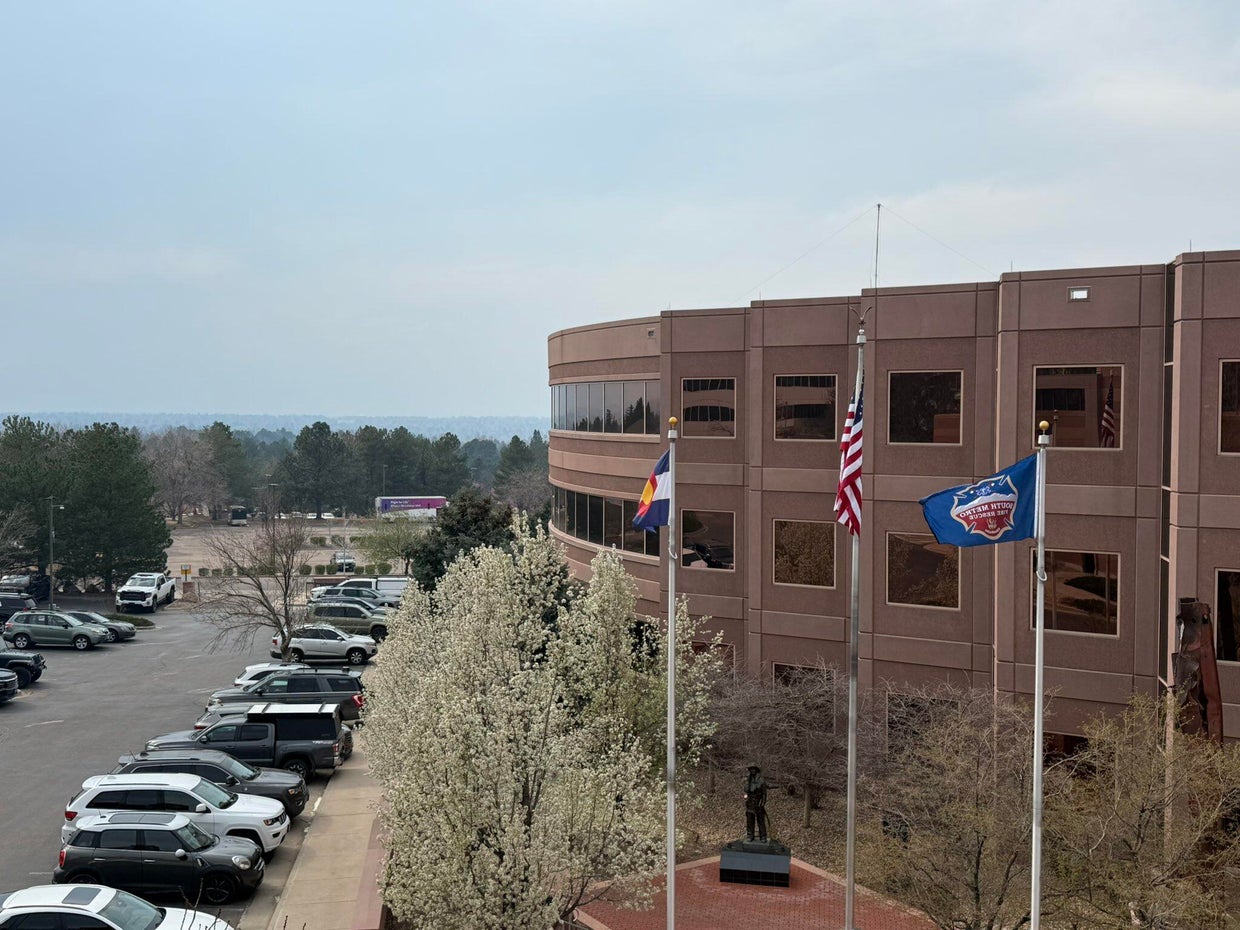
South Metro Fire Rescue said in their post that the smoke is from Colorado’s neighbor to the east. They called it a “significant haze” in the air.
Earlier this month, the Morrill Fire and the Cottonwood Fire burned a significant amount of Nebraska grassland and ranchland. They have mostly been contained by firefighters. Nebraska Gov. Jim Pillen said those two fires combined with several others have burned approximately 800,000 acres of land. On Thursday, Pillen announced that he is signing several executive actions intended to ease the burden caused by the fires.
There were no wildfires burning in the Denver metro area on Thursday afternoon.

ARAPAHOE COUNTY, Colo. (KKTV) – A homicide suspect based out of Colorado, wanted in a fentanyl-related death, is back in the state after being captured in Colombia.
The Arapahoe County Sheriff’s Office (ACSO) said 33-year-old Max Arsenault had been on the run since January 17.
Deputies said this stemmed from an incident in May 2023, where deputies responded to a call for a man named Nicholas Dorotik, who was found unresponsive.
ACSO said the cause of death was a mixed drug overdose involving meth and fentanyl, having about three times the lethal amount of fentanyl in his system.
One year later, Arsenault was arrested. He was scheduled for trial in January 2026 when deputies said he fled the country while on bond three days before the trial was set to start.
He was caught in Medellin, Colombia, on March 4, following a two-month international investigation. He has since been extradited back to Denver, where he is facing charges and awaiting trial.
Copyright 2026 KKTV. All rights reserved.

Coalition urges lawmakers to advance South Carolina Financial Freedom Act

Exercise scientist reveals the strength training mistake many women make, even after lifting for years

Movie Reviews 2026: Ukrainian and World Premieres

Why Netflix Hiked Prices, Explained in One Chart

Toxic Confidence Has Taken Over

Florida High School Football Rankings: Top 25 teams – Oct. 21

How old is Bo Nix? What to know about Oregon quarterback ahead of 2024 NFL Draft

Cleary's 21 help Le Moyne down Central Connecticut State 69-64 in OT

99th annual Pony Swim held in Virginia

Indiana Members Credit Union announced as new anchor tenant at Bottleworks District

WATCH: Senate hearing goes silent after Angel Father confronts top Dem over daughter’s death

US diplomat Marco Rubio denounces settler violence, tolls in Hormuz strait

Iran-linked hackers have breached FBI Director Kash Patel’s personal emails | CNN Politics

Live: CPAC 2026 Day 2

Video: Will ICE Change Under Its New Leader?
-

 Detroit, MI1 week ago
Drummer Brian Pastoria, longtime Detroit music advocate, dies at 68
-

 Movie Reviews1 week ago
‘Youth’ Twitter review: Ken Karunaas impresses audiences; Suraj Venjaramoodu adds charm; music wins praise | – The Times of India
-

 Sports6 days ago
IOC addresses execution of 19-year-old Iranian wrestler Saleh Mohammadi
-

 New Mexico5 days ago
Clovis shooting leaves one dead, four injured
-
 Business1 week ago
Disney’s new CEO says his focus is on storytelling and creativity
-

 Technology5 days ago
YouTube job scam text: How to spot it fast
-

 Tennessee4 days ago
Tennessee Police Investigating Alleged Assault Involving ‘Reacher’ Star Alan Ritchson
-

 Texas1 week ago
How to buy Houston vs. Texas A&M 2026 March Madness tickets