Colorado
Colorado saw 6% dip in overall traffic deaths in 2023 — but a record-high 131 pedestrian fatalities


Colorado reversed a decade-long surge in traffic fatalities with 716 deaths recorded in 2023, a decrease of 6% compared with the record-setting 764 fatalities in 2022.
But Colorado Department of Transportation data reflects a continued shift toward what authorities describe as high-speed reckless driving and increased roadway fatalities involving pedestrians and bicyclists.
Nearly a third of 2023’s traffic fatalities — 31.2% — involved drivers who were impaired due to alcohol or cannabis, CDOT data shows. The latest estimates for “distracted driving” deaths hadn’t been completed but drivers gazing at smartphones and vehicle touchscreen systems have played a role in about 60 deaths a year.
Around the state, drivers crashed with deadly results most often in El Paso County, where authorities recorded 78 deaths, followed by Denver County (71), Arapahoe County (68), Adams County (62), Weld County (55), Jefferson County (48), Larimer County (44), Pueblo County (40), Boulder County (28) and Douglas County (23).
The total miles traveled on Colorado roads has increased due to population growth and people driving more. Colorado’s traffic fatality rate — deaths per 100 million miles traveled in vehicles — has increased rapidly since 2011. The rate since 2021 has hovered around 1.3 fatalities per 100 million vehicle miles traveled. That’s about half the fatality rate in the 1980s when the Colorado population and vehicle miles traveled were much lower.
“We’re cautiously optimistic that we’ve reached the peak and that in the years to come we will continue to see declines,” CDOT spokesman Sam Cole said on Thursday.
“There is a national trend of roadway traffic fatalities increasing. Are people just being more careless? I don’t know. But a lot of this has to do with the variety of roadway users out there,” Cole said. “We see more people walking, biking, and riding e-bikes and scooters. This has a lot to do with the deaths on roads. That’s where the spikes have been the largest — with those vulnerable roadway users. ”
Colorado State Patrol, CDOT and Denver officials were planning to unveil the data Monday and discuss possible new safety measures.
The roadway fatalities included a record-high number of pedestrian deaths — 131, up from the previous record of 115 in 2022. Bicycling deaths on roads numbered 20, up from 15 in 2022, the same as in 2019, and down from 22 in 2018, CDOT records show.
Colorado officials plan to continue safety campaigns aimed at reducing traffic fatalities. These include efforts that focus on pedestrian and bicycle safety in Denver and other urban areas. Roadway improvements, such as the installation of rumble strips and guard rails, have been part of the campaigns.
“The increase in traffic fatalities, particularly those involving pedestrians, is incredibly concerning,” said Jonathan Hughes, a University of Colorado economist exploring impacts of deadly roadways. “There is an important role for new state and federal policies because drivers may not fully appreciate the risks they impose on other drivers, cyclists, and pedestrians.”
Get more Colorado news by signing up for our Mile High Roundup email newsletter.



Members of Colorado’s task force on the Front Range pine beetle infestation met at Chief Hosa Lodge on Wednesday morning amid worries about the expected wide-ranging damage that hangs over hundreds of thousands of acres of Colorado forests.
“This is a wicked problem,” said John Sanderson, director of the Center for Collaborative Conservation.
He outlined some of the goals for local and state leaders: “Who’s going to do what by when?”
Colorado has about 4.2 million acres of pine forest. Approximately 3.4 million acres were affected by the last pine beetle outbreak, which began in the 1990s and faded in 2013. That was primarily in lodgepole pine.
There are 800,000 acres along the Front Range at risk this time, said the Colorado Forest Service’s state entomologist, Dan West. And this time, the pine beetle is showing up in ponderosa pine.
“If you were along the Front Range in 2013, we had the 100-year rain event, or the huge rain event, along the Front Range. And that kind of stopped the beetle in its tracks and allowed these trees to be able to draw up enough resources and start to defend themselves,” said West.
That’s not the case this time, he explained. Climate change has led to warmer temperatures, and Colorado experienced a warm, dry winter.
“Given the alignment with the precipitation, temperature, everything we’re sitting at right now, we will for sure see an increase in intensity and the footprint of the mountain pine beetle moving forward,” he explained.
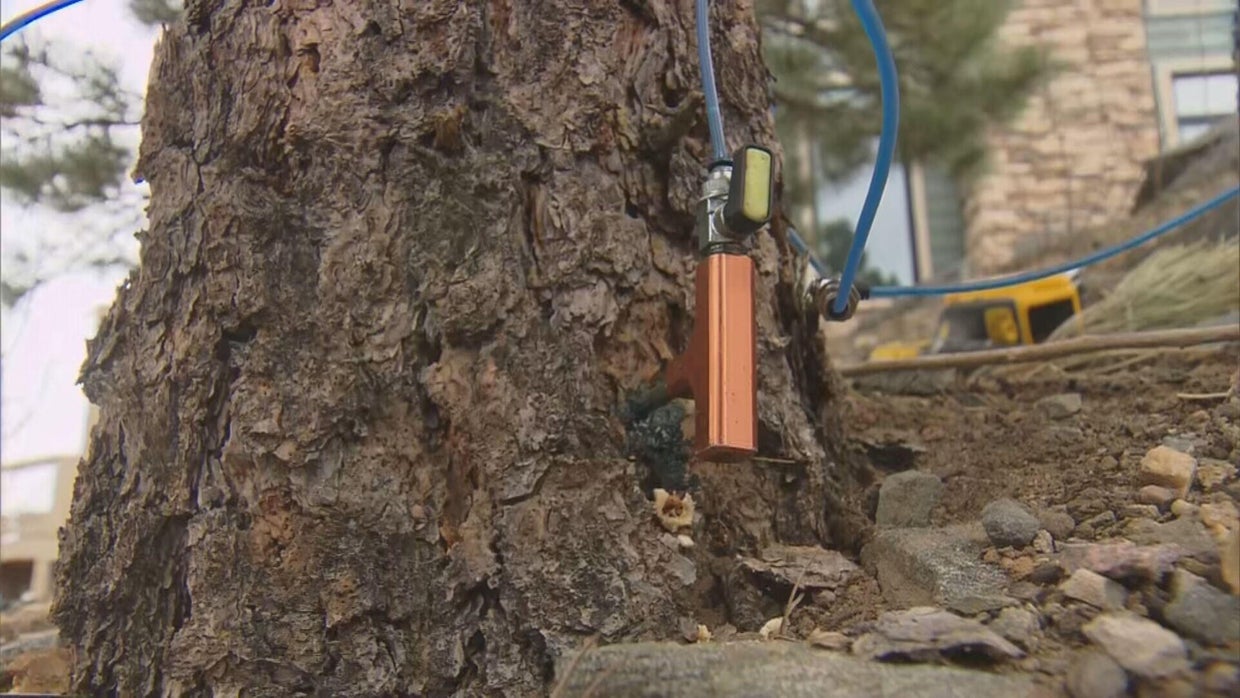
While the acreage at risk may seem smaller, there is potential for very costly damage from the current outbreak. Forests along the Front Range have faced firefighting efforts for 100 years or more, but the affected area may be at greater risk, experts say.
“We’ve got property, life, egress, all the utilities, everything we’ve got along the Front Range that we’ve been protecting. But most of the ponderosa pine in these lower elevation forests are really at-risk because they’ve been there with not much disturbance, and of course, the lack of fire, which creates the mosaic of species and age diversity. And so what we’ve really seen is this kind of ever-increasing larger fuel load and or trees that are along the Front Range, so that’s in large part why I’m more worried about this one than I was in the past,” said West.
“There’s a couple real bad infestations, one along I-70. There’s more in Pine and Conifer and a little bit in between,” explained Brad Huddleston, owner and certified arborist with Splintered Forest Tree Service of Evergreen. On Wednesday, they were working to protect trees in the Ruby Ranch area.
Injecting pesticide into trees helps it uptake into the tree’s vascular system, which can save some trees and protect them longer than an external application, Huddleston explained. He pointed out a goopy pitch on the tree’s exterior as evidence of an attempted invasion. When a tree is stronger, he says it will be better able to resist the infestation. A tree with only a few visible pitch tubes still has a chance to survive.

“That’s what the grant program is trying to address, is trying to get the currently infested trees,” he explained.
That program in Jefferson County is the Mountain Pine Beetle Landowner Assistance Program. It started only a month ago, with $500,000 set aside for homeowners who contract work to fight the pine beetle. Homeowners can apply for reimbursement of 50% of the cost of contracted mitigation services, with priority going to properties of less than 40 acres.
After one month, the program is already planning to pay out $183,000 of that money after receiving 47 applications.
Evergreen resident Scott Porter has been doing work himself after pine beetles wiped out dozens of trees on his property.
“We started having trees die this summer,” he said. “When a tree died, we’d cut it down, and we probably felled close to about 70 trees.”
He bought pheromone packs and a tree injection system for pesticides.
“We have ten acres, and I’ve probably treated over a hundred trees that have not yet been killed by the beetles,” said Porter.
There could be some rough years ahead. Porter said he hopes he’s winning the battle.
Colorado
Did you spot the ‘Doomsday’ and ‘Electronic Attack’ aircraft circling Colorado Springs this week?

COLORADO SPRINGS, Colo. (KOAA) — Social media lit up on Monday after two unique military aircraft were spotted flying laps over and around the Colorado Springs area.
The so-called “Doomsday” plane, or the E-4B “Nightwatch,” took off from Omaha and made its way to Colorado Springs airspace, making several loops before returning to Nebraska, according to its flight data from FlightAware.
The large plane is a militarized version of the four-engine Boeing 747-200, so it’s hard to miss in the sky. Its FlightAware path showed it was on a somewhat low altitude between 6,000 to 9,000 feet during its stay in Colroado Springs.

The aircraft is often referred to as the “Doomsday” plane because it helps ensure continuity of government in the event of a national emergency like a nuclear attack.
Of course, with a plane of that notoriety circling the city, some on social media sites questioned why it was in the area. Residents should rest easy as it appeared to be a typical training and operation flight.
Space Base Delta 1 at Peterson Space Force Base referred questions to the Global Strike Operations Center, which operates out of Barksdale Air Force Base in Louisiana.
“The National Airborne Operations Center has several missions, both operational and training, which require travel to a wide variety of locations, both within the United States and around the world,” said the Global Strike Operations Center in an email. “The E-4B’s visit was part of meeting both the operational and training requirements of the 95th Wing and NAOC mission.”
Around roughly the same time, another noticeable military plane was circling the Colorado Springs area.

The EA-37B took off from the Tuscon area and made its way to central and southern Colorado for laps as well.

This aircraft is known for electronic attacks that disrupt enemy communications.
Neither Space Base Delta 1 nor the Global Strike Operations Center addressed why that plane was in the region at the same time as the E-4B.
If you spotted either aircraft and took photos or video, you can submit them here.
___

This southeast Colorado reservoir completely dried out, taking away one of the best recreation spots
All that’s left of the Two Buttes Reservoir is a scattering of lifeless buoys, a rusty lawn chair, empty beer cans, and a number of fishing lures that have fallen into the water over the years.
This southeast Colorado reservoir completely dried out, taking away one of the best recreation spots
News Tips
What should KOAA5 cover? Is there a story, topic, or issue we should revisit? Have a story you believe should make the light of day? Let our newsroom know with the contact form below.
____
Watch KOAA News5 on your time, anytime with our free streaming app available for your Roku, FireTV, AppleTV and Android TV. Just search KOAA News5, download and start watching.
Colorado
Colorado counselors, parents say Supreme Court ruling on conversion therapy ban will have long-lasting effect on youth

Many Coloradans feel the recent Supreme Court case considering whether Colorado’s law addressing conversion therapy violates free speech will have long-lasting effects on the health and well-being of our children, but disagree on what that outcome will be.
On Tuesday, the court ruled in favor of a Colorado counselor who argued that the law banning conversion therapy for minors violates the First Amendment. The ruling reverses a decision from the U.S. Court of Appeals for the 10th Circuit, which found that the law regulates professional conduct.
Colorado’s Minor Conversion Therapy Law prohibits mental health professionals from any practice or treatment that attempts to change the child’s sexual orientation or gender identity. Tuesday’s ruling doesn’t overturn that law; it requires lower courts to apply strict scrutiny to its constitutionality.
For Steven Haden, a licensed social worker in Colorado who works with LGBTQ youth, the decision is alarming.
“The decision made today by the U.S. Supreme Court is deeply concerning,” Haden said.
“We are not talking about a difference of opinion here,” he said. “Conversion therapy has been associated with increased risk of depression, anxiety and suicide among young people, particularly for LGBTQ adolescents, who already face disproportionate mental health risk. So this decision removes a layer of protection that existed precisely because of the documented harm.”
Haden, founder of the nonprofit Envision, said Colorado’s ban reflected decades of research and the state’s responsibility to regulate licensed mental‑health professionals in the interest of public safety.
“The First Amendment protects a therapist’s right to hold personal beliefs,” Haden said. “It does not create a license to practice discredited medicine. A provider’s recommended prayer instead of an evidence‑based treatment for a broken arm would face malpractice, plain and simple. So we must hold the same standard across all clinical domains.”
Supporters of the ruling, however, argued that the state went too far by limiting the conversations that families and therapists could have during counseling sessions.
“I just think this is a win for the First Amendment,” said Erin Lee, a Northern Colorado mother. “This is a win for free speech and common sense and people in Colorado not being forced to hold a specific viewpoint in their profession.”
Lee said her family became aware of the law when her daughter, then 12, began feeling distressed about her body and identity.
“And so we as parents were thrown for a loop and took her to a therapist, thinking we need help just to talk to her about this,” Lee said. “She wants to be comfortable in her body, in her natal sex, and we learned the hard way that this law even existed.”
Lee said the therapists they encountered felt constrained by the law’s requirements.
“It prevented licensed counselors from being able to do their job,” she said. “It limited their speech in a way that they can only express one ideological viewpoint instead of addressing reality.”
Lee emphasized that the Supreme Court’s ruling does not require therapists to take a particular approach, but instead allows families greater discretion in determining which type of counseling best fits their needs.
“I think this will have real positive outcomes for Colorado families in that now everyone can take the approach that fits their family best,” she said.

NASA launches humans to moon for first time in half-century

Prep sports roundup: No. 2 St. John Bosco beats No. 1 Orange Lutheran in pitchers’ duel
Will the Iran war threaten the EU's green transition?

Appeals court rejects HUD homelessness overhaul saying it would be “disastrous”

Video: Shimmying American Woodcocks Cause a Birding Frenzy in N.Y.C.

Florida High School Football Rankings: Top 25 teams – Oct. 21

How old is Bo Nix? What to know about Oregon quarterback ahead of 2024 NFL Draft

Cleary's 21 help Le Moyne down Central Connecticut State 69-64 in OT

99th annual Pony Swim held in Virginia

Indiana Members Credit Union announced as new anchor tenant at Bottleworks District
Will the Iran war threaten the EU's green transition?
Appeals court rejects HUD homelessness overhaul saying it would be “disastrous”

GOP leaders endorse Trump’s shutdown-proof move to end DHS funding lapse

Palestinians in West Bank protest, strike against Israeli death penalty law

Judge delays Luigi Mangione’s federal trial by about a month but won’t push it to next year | CNN
-

 South-Carolina4 days ago
South Carolina vs TCU predictions for Elite Eight game in March Madness
-

 Miami, FL7 days ago
Jannik Sinner’s Girlfriend Laila Hasanovic Stuns in Ab-Revealing Post Amid Miami Open
-

 Culture1 week ago
Do You Know the Comics That Inspired These TV Adventures?
-

 Education1 week ago
Video: Trader Joe’s Dip Head-to-Head Taste Test
-

 Minneapolis, MN7 days ago
Boy who shielded classmate during school shooting receives Medal of Honor
-

 Culture1 week ago
Wil Wheaton Discusses ‘Stand By Me’ and Narrating ‘The Body’ Audiobook
-

 Tennessee1 week ago
Tennessee Police Investigating Alleged Assault Involving ‘Reacher’ Star Alan Ritchson
-

 Vermont4 days ago
Skier dies after fall at Sugarbush Resort