Lifestyle
L.A. Affairs: We stopped pretending we were just friends. But was it too late?


I still think about the night before I left Los Angeles — the way Matt and I finally stopped pretending we were just friends and how his pit bull, Jesus, slept curled at the edge of the bed while we held each other, fully clothed, knowing we were out of time. It wasn’t a grand ending. There were no fireworks, no cinematic declarations. Just the quiet hum of the city outside and two people trying to stretch a single night into forever.
I had met Matt years earlier, back when I first moved to Los Angeles and the city seemed determined to break me. I’d been apartment hunting for months, a process that had devolved into a series of small humiliations. Landlords’ smiles would fade the instant they saw my brown face. The decent apartments — ones with working showers or a refrigerator — were always “just rented.” The ones I could actually get were dark, smelly or unsafe.
I was starting to think I’d made a mistake leaving New York. Then my friend Shannon sent me a Craigslist listing that looked —miraculously — normal. “Hollywood/Little Armenia,” she read. “Centrally located. Two blocks from the 101.” The rent wasn’t outrageous. The photos didn’t make me shudder. I pulled out my Thomas Guide, traced the route to Lexington Avenue and drove there with more hope than I wanted to admit.
The building exceeded my expectations. It was white, mid-century, with quirky castle-like touches that gave it personality. The street was alive with Armenian markets and mom-and-pop bakeries. For the first time since arriving in L.A., I could picture myself living somewhere that felt like a community.
Then Matt appeared.
He was tall, clean-shaven, reddish-haired, with warm brown eyes that made you feel immediately seen. “You’re here about the apartment?” he asked. I braced myself for the usual letdown. Instead, he smiled and said, “Let me show you around.”
He was the building’s superintendent, but that felt too small a word for him. He was also a documentary filmmaker who’d studied at UCLA, was fluent in three languages and had an easy charisma that drew people in. His dog, Jesus, a striking black-and-white pit bull, followed him everywhere, tail wagging like a punctuation mark.
The apartment itself wasn’t perfect, but it was a palace compared to what I’d been through. It was a studio with a big kitchen and actual sunlight. I signed the lease that week. Shannon warned me, only half-joking, “Don’t fall for your building super.” I promised I wouldn’t.
That promise lasted about two weeks.
The first night I moved in, I realized my bedroom window was broken — not just cracked, but open enough to make me feel unsafe. I knocked on Matt’s door, probably sounding sharper than I meant to. I’d been through too many slumlords to expect much. But he listened patiently, nodded and had it fixed the next day. That small act — his professionalism, his steadiness — disarmed me. It was the first time in months that someone in this city had made me feel cared for.
We were both smokers then. The building had a little patio where residents would gather, and before long, Matt and I started running into each other there. Those encounters turned into conversations about film, queerness, art and the strange loneliness of being transplants in a city obsessed with dreams. He told me about Costa Rica, where he grew up, and about how he loved and resented Los Angeles for its contradictions. I told him about New York, about how it shaped me and why I had to leave it.
Our connection deepened slowly, marked by cigarettes and laughter, and those long, suspended silences when neither of us wanted to say goodnight.
By the time the holidays rolled around, I’d stopped pretending that I didn’t look forward to seeing him. As a thank-you for all his help that first year, I bought him two bottles of Grey Goose: lemon- and orange-flavored because I’d noticed he liked citrus. He invited me to help him drink them on New Year’s Eve.
We spent the night talking about everything and nothing: music, travel, ambition. Midnight came. We hugged. And in that long, lingering embrace, I felt the spark we’d been trying to ignore. But we let go, careful not to cross the boundary that had quietly become sacred between us.
For years, we danced around it. We’d share a beer, a smoke, a late-night talk and retreat again to our corners. I respected his professionalism; he respected my space. But under all that restraint was something undeniably alive.
Then came the accident. A driver T-boned my Volvo on my way home from work at E! Networks, and I was left with two herniated cervical discs and a terrifying warning from my doctor: one wrong move, and I could be paralyzed. I decided to move back to New York to recover.
The night before I left, Matt came by to say goodbye. We knew it was our last chance to stop pretending.
“I love you,” he said quietly.
“I love you too,” I told him.
We kissed, finally, with the kind of tenderness born from years of self-restraint. But we didn’t take it further. We just lay there, spooned together, holding on as if stillness could save us.
After I moved back east, we kept in touch for a while, then drifted apart. He eventually married a Frenchman and moved to Europe to make films. I stayed in New York and wrote my stories.
Sometimes I think about that broken window — the one he fixed the day after my first night in the building — and how it set the tone for everything that followed. Love doesn’t always announce itself with drama. Sometimes it’s in the quiet repair of something broken, the small acts of care that build into something profound.
Matt taught me that. He made a city that once felt hostile finally feel like home. And even now, years later, when I think of Los Angeles, I don’t think of the rejection or the struggle. I think of him.
The author is a freelance writer. He lives in New York City and is working on a memoir. He’s also on Instagram: @thebohemiandork.
L.A. Affairs chronicles the search for romantic love in all its glorious expressions in the L.A. area, and we want to hear your true story. We pay $400 for a published essay. Email LAAffairs@latimes.com. You can find submission guidelines here. You can find past columns here.



Can you say no to a friend’s wedding?
Getty Images/Getty images
hide caption
toggle caption
Getty Images/Getty images
Are we spending too much on other people’s weddings?
Going to a friend’s weddings can be so fun and meaningful… but it can also really hurt your wallet. A survey by LendingTree found that 31% of people who had been to a wedding in the past five years had accrued debt to attend. So what’s driving up the cost of weddings for guests? And what makes it so hard to say no to these expenses?
Brittany breaks it down with Allyson Rees, senior analyst at trend forecasting firm WGSN, and Annie Joy Williams, assistant editor at The Atlantic.
This episode was produced by Liam McBain, with additional support from Corey Antonio Rose. It was edited by Neena Pathak. Our Supervising Producer is Cher Vincent. Our Executive Producer is Barton Girdwood. Our VP of Programming is Yolanda Sangweni.
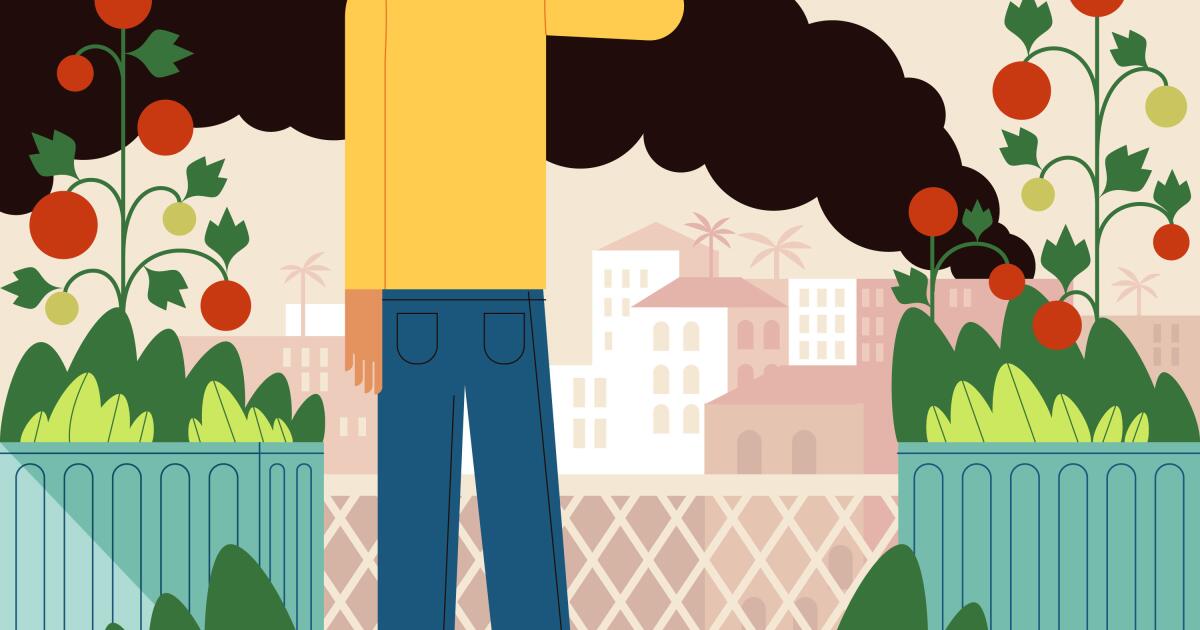
After the eight-day-long fire in a 500,000-square-foot Boyle Heights warehouse, eastern Los Angeles residents are contending with putrid smells, soot and potentially hazardous airborne chemicals after heavy plumes of smoke spread throughout the city. But those who grow food in nearby neighborhoods may also be wondering: How will the fires affect the plants and produce in my garden?
The Boyle Heights warehouse, owned by Lineage — a global temperature-controlled storage facility operator — housed 85 million pounds of frozen food and other products. In the days since the fire, local emergency visits for smoke inhalation and throat pain spiked while agencies still scramble to measure the amount of PM 2.5 — harmful fine particles — and heavy metals, like lead and arsenic, in the air.
According to researchers, any toxic airborne chemicals would likely stem from the charred foam insulation, metal exterior, burned solar panels and any lithium batteries that might have been present inside the warehouse.
After a fire, heavy metal particles can spread through ash and smoke over gardens and inhibit growth, said Olukayode Jegede, an agricultural toxicologist and assistant professor at UC Davis. Since the warehouse fire is so recent and cleanup has just begun, Jegede said the precise impact on gardens can’t be measured until comprehensive soil tests are conducted in the area.
While the L.A. city government hasn’t announced plans for soil testing, the Contaminant Level Evaluation and Analysis for Neighborhoods project at USC is offering free contaminant testing for Boyle Heights and East L.A. residents. Residents can collect soil samples and deliver them to Boyle Heights City Hall and other locations for an evaluation of lead, arsenic, chromium and mercury levels.
The good news is produce, plants and roots can still be preserved. According to Jegede, many of the soil tests conducted last year in the Altadena area after the Eaton fire showed that gardens and poultry were not as contaminated as one might expect.
“Quite a number of the soils we tested [in Altadena] were not really contaminated,” Jegede said. “We weren’t seeing many soils with concerning elevated levels of metal, so gardeners should not be too alarmed when these things happen.”
Nevertheless, there are several measures that gardeners can take to keep themselves, their children, plants and produce safe from potentially harmful contaminants stemming from the fire. Researchers, gardening experts and horticulturists offered some guidance on the handling, recultivation and cleanup that can keep you and your garden in good health.
How do I remove ash and contaminants from my garden?
Altadena horticulturist Leigh Adams said Boyle Heights plants and produce already live in a difficult environment, surrounded by industrial warehouses that spread contaminants daily.
“That area has been used industrially for 100 years, and the soil is impacted by many, many, many things,” Adams said. “Low-income neighborhoods and gardens usually don’t have a lot of resistance against dominant manufacturing.”
This means that the contamination of gardens in eastern L.A. won’t be as catastrophic as compared with those in Altadena, a more suburban environment, Adams said. But fallen ash still poses major health risks if ingested or inhaled.
An advisory from University of California Agricultural and Natural Resources last year recommended suiting up in an N95/KN95 mask, long sleeves, pants, close-toed shoes and gloves before attempting to deal with ash in the garden to limit exposure to potentially toxic contaminants. The advisory added that individuals should make sure all of this gear is cleaned thoroughly before bringing it back inside.
Once in the proper gear, Adams recommends removing the top two inches of topsoil from gardens, where the highest concentration of contaminants will settle after a fire. Using a plastic bag to collect the soil and disposing of it in the garbage — not green yard waste bins — will help to reduce the spread of airborne chemicals.
Gardeners with raised beds are advised to remove approximately six inches of soil, because excess ash can raise the pH level and prevent nutrients from soaking into the soil bed.
After this, watering the garden gently but plentifully will help to promote soil health and get rid of most of the ash present on plant leaves and stems. Adams said replacing the top two inches of soil with store-bought mulch or straw will help to contain any remaining ash and prevent it from spreading any further.
Experts say to avoid using leaf blowers if ash is present in the garden because they can send particles airborne. Doing so will increase the likelihood of heavy metal particles, which can carry lung irritants and carcinogens, being spread and inhaled.
A Boyle Heights resident keep a watchful eye on the fire at the 5,000-square-foot commercial building, which stores 85 million pounds of frozen food.
(Genaro Molina / Los Angeles Times)
Is it safe for me to eat produce from my garden?
Several studies, including one from the UC Cooperative Extension of Sonoma County, have shown that consuming produce in a fire-affected area poses minimal health risks.
Jegede said most root vegetables like potatoes and carrots, along with any fruit that has an outer layer, can be washed to remove potential contaminants, even if they were covered in ash. Peeling the outer layer of your produce can also help to reduce potential risks, he said.
Lettuce and other leafy foods with multiple layers pose a higher risk of contamination, but with a vigorous wash and peeling the outer layers, even the greens can be saved. The County of Los Angeles Department of Public Health recommends soaking leafy produce and fuzzy fruits like peaches in a 10% white vinegar and 90% water mixture.
Jegede said if the leaves or fruit are too delicate to wash or ash is still visible, it would be best to dispose of the produce.
How can I tell if my soil is contaminated?
After ridding your garden of visible ash, you might wonder how to tell if your plants will still thrive in the soil.
At-home soil tests that measure for alkaline, fertility and pH levels are widely available and can be purchased for $15 to $100 (for more detailed results) online. But Jegede said these tests can’t tell the full story of soil health.
Comprehensive soil testing is “something you can’t do properly at home,” Jegede said. “In labs, we are testing for metals like lithium and zinc, stuff that an at-home test will not show … If it comes to the point that you’re worried about your soil, I would just send it out to a lab.”
Wallace Laboratories in El Segundo, Babcock Laboratories in Riverside, Waypoint Analytical in Anaheim and other labs offer more detailed soil tests that measure heavy metal particles in addition to other fertility factors. Prices at Wallace Laboratories can range from $115 to $295 for a complete compost test.
The soil below two inches should be unharmed, Adams said, so long as new compost is set and plants are watered plentifully, which will promote natural biological cycles.
“What you’re doing is capping the soil, so that moisture stays in there, and instead of being dirt, it’s a living system called soil,” Adams said. “The more carbon we can get into our soil, the better.”
What can I do to help my soil recover?
For the last 12 years, Adams has been working with Metabolic Studio, a Los Angeles-based art and research hub focused on environmentalism, on methods for bioremediation, the practice of using additional fungi, plants and compost to decontaminate ash and break down contaminants.
Adams said straw, mushrooms, corn, rye and sunflowers are great bioremediators that can help to repair damage to soils. She said certain samples she’s worked on with Metabolic Studio have gone from testing at high heavy metal levels to nearly contaminant-free.
But for a more immediate fix, wash your produce, water your plants and have a little patience during ash cleanups. Your garden should look better in no time, Adams and Jegede said.

Inde Navarrette and Michael Johnston in Obsession.
Focus Features
hide caption
toggle caption
Focus Features
Two big horror films, Obsession and Backrooms, just smashed all box office expectations. So much of their success has been driven by Gen Z, which is now the biggest moviegoing demographic. But what makes a movie a Gen Z movie? Today we’re bringing you an episode of NPR’s It’s Been a Minute. Host Brittany Luse talks about this trend with Sam Adams and Reanna Cruz.
If you want to hear more about these movies, check out these episodes:
In ‘Obsession,’ love hurts. It really, really, really hurts.
‘Backrooms’ brings YouTube horror to the big screen
Zendaya brings ‘The Drama,’ we bring the spoilers
Connect with Pop Culture Happy Hour:
Letterboxd / Facebook
Our weekly newsletter
Support Pop Culture Happy Hour+
-

 Miami, FL2 minutes ago
2026 Miami Football Early Opponent Preview, Game 8: North Carolina
-

 Boston, MA5 minutes ago
Boston sues social media companies over ‘addictive’ features, joining nationwide litigation
-

 Denver, CO10 minutes ago
Peyton Watson landing spots: Could Nuggets star actually leave Denver?
-

 Seattle, WA17 minutes ago
14-year-old dies in Seattle e-bike crash at Colonnade Park after losing control on steep stairs – MyNorthwest.com
-
 San Diego, CA20 minutes ago
San Diego Humane Society Releases 4 rare western spotted skunks into the wild
-
Milwaukee, WI25 minutes ago
Former Judge Hannah Dugan fined $5,000, won’t serve prison time, judge rules
-

 Atlanta, GA32 minutes ago
Jermaine Dupri sues Sony Music over alleged $18 million royalty dispute involving So So Def artists
-

 Minneapolis, MN35 minutes ago
Traffic shift starts Wednesday on I-394 in Minneapolis

