Colorado
Colorado mountain pine beetle task force getting to work as another outbreak looms


Members of Colorado’s task force on the Front Range pine beetle infestation met at Chief Hosa Lodge on Wednesday morning amid worries about the expected wide-ranging damage that hangs over hundreds of thousands of acres of Colorado forests.
“This is a wicked problem,” said John Sanderson, director of the Center for Collaborative Conservation.
He outlined some of the goals for local and state leaders: “Who’s going to do what by when?”
Colorado has about 4.2 million acres of pine forest. Approximately 3.4 million acres were affected by the last pine beetle outbreak, which began in the 1990s and faded in 2013. That was primarily in lodgepole pine.
There are 800,000 acres along the Front Range at risk this time, said the Colorado Forest Service’s state entomologist, Dan West. And this time, the pine beetle is showing up in ponderosa pine.
“If you were along the Front Range in 2013, we had the 100-year rain event, or the huge rain event, along the Front Range. And that kind of stopped the beetle in its tracks and allowed these trees to be able to draw up enough resources and start to defend themselves,” said West.
That’s not the case this time, he explained. Climate change has led to warmer temperatures, and Colorado experienced a warm, dry winter.
“Given the alignment with the precipitation, temperature, everything we’re sitting at right now, we will for sure see an increase in intensity and the footprint of the mountain pine beetle moving forward,” he explained.
While the acreage at risk may seem smaller, there is potential for very costly damage from the current outbreak. Forests along the Front Range have faced firefighting efforts for 100 years or more, but the affected area may be at greater risk, experts say.
“We’ve got property, life, egress, all the utilities, everything we’ve got along the Front Range that we’ve been protecting. But most of the ponderosa pine in these lower elevation forests are really at-risk because they’ve been there with not much disturbance, and of course, the lack of fire, which creates the mosaic of species and age diversity. And so what we’ve really seen is this kind of ever-increasing larger fuel load and or trees that are along the Front Range, so that’s in large part why I’m more worried about this one than I was in the past,” said West.
“There’s a couple real bad infestations, one along I-70. There’s more in Pine and Conifer and a little bit in between,” explained Brad Huddleston, owner and certified arborist with Splintered Forest Tree Service of Evergreen. On Wednesday, they were working to protect trees in the Ruby Ranch area.
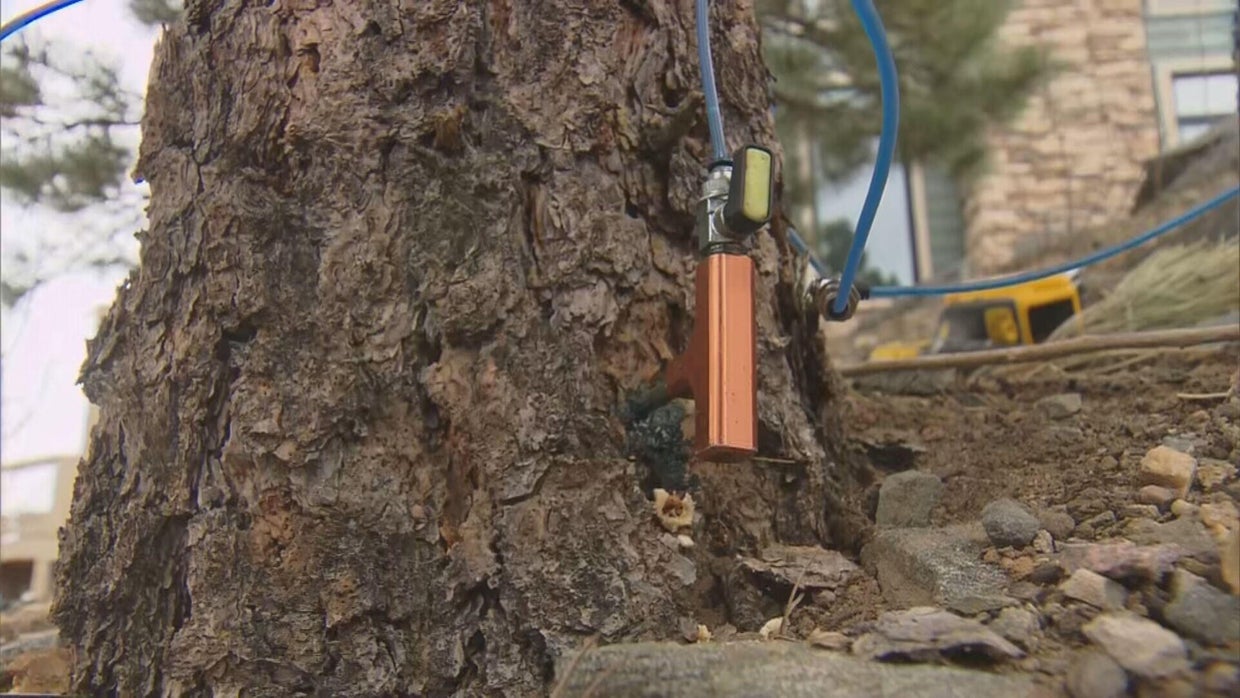
Injecting pesticide into trees helps it uptake into the tree’s vascular system, which can save some trees and protect them longer than an external application, Huddleston explained. He pointed out a goopy pitch on the tree’s exterior as evidence of an attempted invasion. When a tree is stronger, he says it will be better able to resist the infestation. A tree with only a few visible pitch tubes still has a chance to survive.

“That’s what the grant program is trying to address, is trying to get the currently infested trees,” he explained.
That program in Jefferson County is the Mountain Pine Beetle Landowner Assistance Program. It started only a month ago, with $500,000 set aside for homeowners who contract work to fight the pine beetle. Homeowners can apply for reimbursement of 50% of the cost of contracted mitigation services, with priority going to properties of less than 40 acres.
After one month, the program is already planning to pay out $183,000 of that money after receiving 47 applications.
Evergreen resident Scott Porter has been doing work himself after pine beetles wiped out dozens of trees on his property.
“We started having trees die this summer,” he said. “When a tree died, we’d cut it down, and we probably felled close to about 70 trees.”
He bought pheromone packs and a tree injection system for pesticides.
“We have ten acres, and I’ve probably treated over a hundred trees that have not yet been killed by the beetles,” said Porter.
There could be some rough years ahead. Porter said he hopes he’s winning the battle.

Colorado
Southern Colorado remains in drought despite recent storms; NWS urges caution ahead of Fourth of July

COLORADO SPRINGS, Colo. (KKTV) – Recent rounds of heavy rain, hail and thunderstorms have brought much-needed moisture to southern Colorado, but experts say the storms have done little to ease the region’s ongoing drought.
Much of southern Colorado remains in moderate to exceptional drought, according to the latest U.S. Drought Monitor, with long-term moisture deficits continuing to impact soils and vegetation.
“A couple thunderstorms, a few days of off-and-on scattered rain, really isn’t going to do anything to fix that,” said Michael Garberoglio, a meteorologist with the National Weather Service in Pueblo.
Garberoglio said it will take widespread, sustained precipitation over weeks or months to significantly improve drought conditions.
“We need much more moisture over a much larger area for a much longer period of time to really start negating these exceptionally dry conditions we’ve been under,” he said.
The persistent drought is raising concerns ahead of the Fourth of July holiday, when many Coloradans are expected to celebrate with fireworks and outdoor gatherings.
“I really can’t understate the danger,” Garberoglio said. “It’s a very volatile situation. We just have not gotten enough water and it’s become frankly unsafe.”
He said fire danger can vary significantly from one location to another, even within the same county, meaning some areas remain dry enough for a single spark to ignite a wildfire.
“These fires can spread over multiple acres in just a couple of short minutes and can impact much more than anyone would initially expect,” Garberoglio said. “These little things can have months of impacts if people aren’t cautious.”
Garberoglio urged residents to follow local fire restrictions and guidance from emergency officials before using fireworks or participating in activities that could spark a fire.
“When you’re keeping things in mind and listening to the professionals, it’s not just for you, but you’re helping out your family, your neighbor,” he said.
Copyright 2026 KKTV. All rights reserved.

DENVER (KDVR) — Fast-moving fires in western Colorado, including on the Colorado-Utah border, continue to burn Sunday afternoon.
On the Colorado-Utah border, the Snyder Mesa Fire has burned over 28,000 acres as of Sunday morning, prompting evacuations in Mesa County, officials reported. At that time, the fire was 0% contained.
The Snyder Mesa Fire broke out sometime Friday evening or Saturday morning, according to the Upper Colorado River Interagency Fire Management Unit. Several fires, including the Knowles and Gore fires, combined on Saturday to form the Snyder Mesa Fire.
Three federal firefighters died and two were injured while responding to the Knowles and Gore fires on Saturday.
⬇️ Jump to: Live blog with updates below.
Ouray County has declared a state of emergency due to the Gold Mountain Fire. The fire sparked on Saturday on U.S. Forest Service land, according to the Ouray County Sheriff’s Office. The fire has triggered mandatory evacuation orders and roadway closures.
Ouray County officials reported the Gold Mountain Fire burned 560 acres as of 1:08 p.m.
Live Updates

Three firefighters died and two were injured while tackling fires on the Colorado-Utah border, the U.S. Wildland Fire Service reported Sunday.
The agency — created earlier this year to streamline firefighting and fire reduction across public lands — said the firefighters had been part of an interagency response to the Knowles and Gore fires on Saturday.
“The U.S. Wildland Fire Service stands united with the USDA Forest Service in grief and in our unwavering support for the loved ones left behind. Their bravery, dedication, and sacrifice will never be forgotten,” it said in a statement on Facebook.
The agency said it would share more information when it is available to be released.
Wildfire activity has intensified across the western United States, as consecutive days of hot, dry and windy weather have fueled flames in Utah, Arizona and elsewhere as new fires popped up across the region.
The largest blaze, the Cottonwood Fire, was burning in rugged terrain in southwest Utah. It ballooned Saturday to more than 144 square miles (373 square kilometers) after marching through canyons and mountainsides, destroying part of a ski resort and other summer cabins along the way.
Authorities in Beaver County began working with fire teams on Saturday to assess the extent of the damage, but no estimates were immediately available. Gov. Spencer Cox in a post on social media called it bleak, but he thanked crews for what he called “several miraculous stops and saves.”
The cliffs and steep slopes have made the job even harder, said Alyssa Mason, a spokesperson assigned to the fire.
“It’s hard to get dozers and other heavy equipment into that. It’s hard to get engines into that,” she said. “It doesn’t make it impossible to firefight, but it does just kind of slow things down.”
Hundreds of firefighters have been arriving in the arid state to battle new starts as well as those that have been growing because of what forecasters called critical fire weather — dangerously low humidity levels, warm temperatures and gusty winds.
The danger is even higher this year because of Utah’s record-low snowpack and its warmest winter on record. Much of the West is grappling with similar conditions, according to the National Interagency Fire Center.
From Alaska to Florida, crews worked Saturday to corral dozens of fires, including three dozen that were classified as large and uncontained.
Nationally, nearly 3 million acres (1.2 million hectares) have burned since the start of the year. That is more than the 10-year average.
The conditions in Utah were critical enough for Gov. Spencer Cox to declare an emergency earlier this week and clear the way for the state to ban fireworks ahead of the July Fourth holiday. The order comes as Utah is experiencing one of the most severe wildfire seasons in recent history, fueled by historic drought conditions.
State officials said that over the past week, Utah has seen an increase in wildfire starts, with each fire showing unprecedented behavior. These starts have stretched the state’s wildland firefighting capabilities, State Forester Jamie Barnes said.
Colorado Gov. Jared Polis also declared an emergency on Saturday, and authorized the use of the National Guard to tackle the fires.
Forecasters with the National Weather Service over recent days have been issuing red flag warnings for a wide swath of the West, from California to Arizona and New Mexico.
South of Grand Canyon National Park, authorities said the flames of a new wildfire were moving away from Grand Canyon Village and the nearby community of Tusayan on Saturday. But about 50 miles (80 kilometers) away, another fire prompted Coconino County officials to issue evacuation orders for those near Kendrick Mountain.
Parts of northern Arizona were without power Saturday as the utility serving the area initiated a safety shut-off in hopes of lessening the wildfire risk.
Power shutoffs have become more common in the West as wildfire risk has expanded. It is usually a last resort after utility forecasters weigh factors like sustained wind and gust speeds, available fuels and topography.
With extreme fire conditions persisting in Utah, Rocky Mountain Power also shut off power lines serving Beaver County and other areas.
-
 Sports2 minutes ago
Commentary: World Cup shows MLS still needs to achieve major goals to grow the game
-

 World10 minutes ago
‘A concession to Zelenskyy’s ultimatum’: Ukraine’s triumph over Belarus
-
 News32 minutes ago
Native Americans celebrate victory at the Battle of Little Bighorn, 150 years later
-

 New York2 hours ago
How a Global Researcher Lives on $110,000 in Long Island City
-

 Los Angeles, Ca2 hours ago
Mass shooting at L.A. street takeover leaves 1 dead, 6 injured
-

 Detroit, MI2 hours ago
On the front lines of chronic absenteeism: What Detroit’s Health Hubs do to get kids to school
-

 San Francisco, CA2 hours ago
S.F. police arrest 20 at 300-person SoMa block party during Pride
-
Dallas, TX2 hours ago
CJ Goodwin announces retirement after 8 seasons with Cowboys


