News
Drive slower, go electric, don’t drive at all? The best options for saving gas

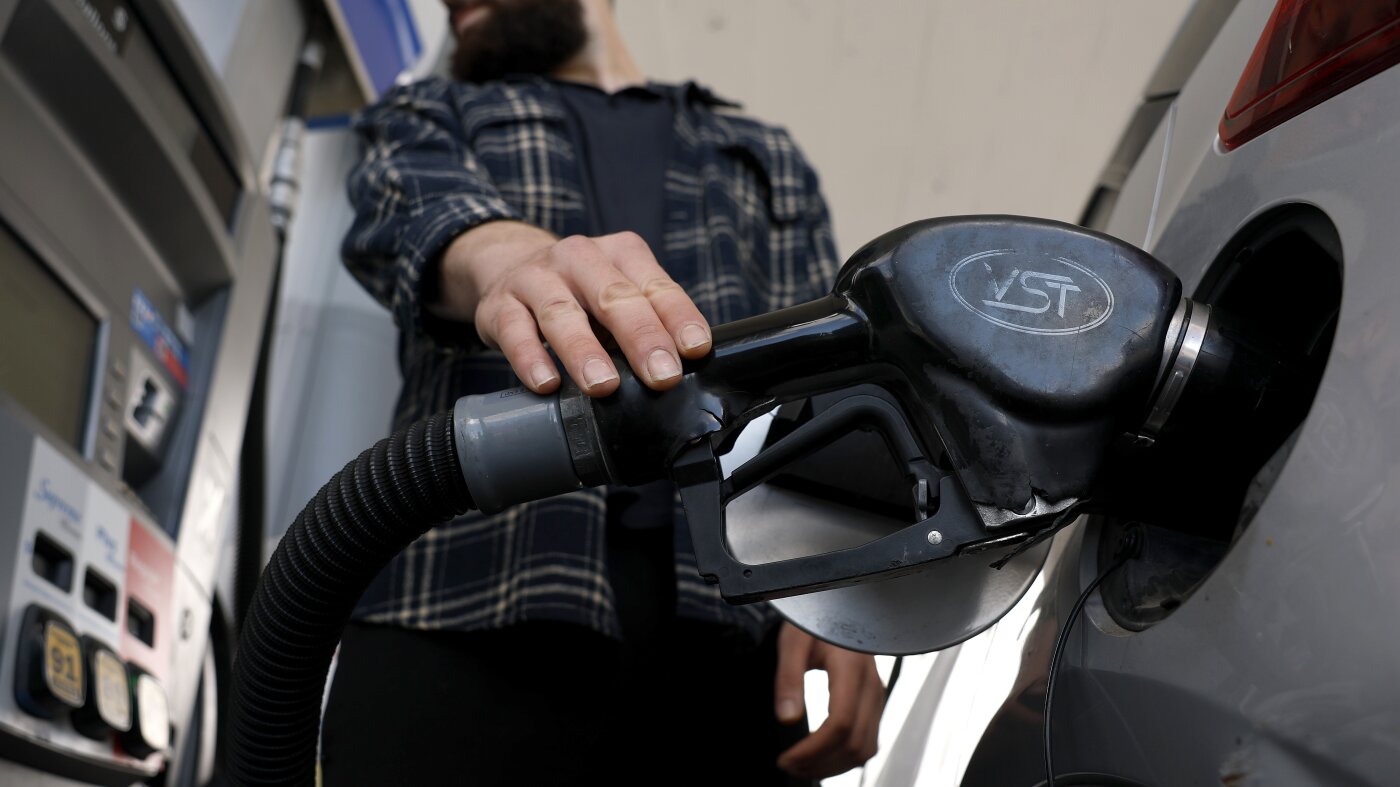
A customer pumps gas into his car at a Chevron station on May 4 in Los Angeles, Calif. Gas prices have surged to a 4-year high, as tensions in the Middle East continue. Gasoline in California is over $6 a gallon.
Justin Sullivan/Getty Images North America
hide caption
toggle caption
Justin Sullivan/Getty Images North America
The national average for a gallon of gasoline is $4.55, according to AAA; that’s a four-year high, unwelcome news for drivers as the U.S. heads into one of the busiest travel weekends of the year.
AAA estimates a record 45 million Americans will travel this weekend, despite high prices for gasoline, diesel and jet fuel.
Gasoline prices have been elevated since the start of the war in Iran, and there’s no sign of relief on the horizon. High prices are angering voters and straining household budgets.
In California, which has the highest gasoline prices in the nation, Gov. Gavin Newsom is openly feuding with the oil giant Chevron, discouraging Californians from filling up at its stations.
Chevron and the state have been in a tense relationship for years; Chevron moved its headquarters out of California in 2024 after complaining about state and local regulations, and is currently buying oil shipped through an offshore pipeline that California has attempted to keep shut down. In the latest salvos, Chevron has posted placards at California gas stations blaming state policies for the high prices, while Newsom’s office is telling Californians they can get cheaper gas at unbranded stations.
Californians, if you’re hitting the road this holiday weekend, be sure to AVOID Chevron.
Pro tip: unbranded gas comes from the same refineries, storage tanks, and pipelines, and it meets the same state standards to keep your engine running clean, even if it doesn’t have a fancy… pic.twitter.com/FMTnNHE0Bn
— Governor Newsom Press Office (@GovPressOffice) May 21, 2026
But where does all this leave drivers? Despite high prices, most Americans are unwilling, or unable, to give up on driving. Americans have been logging more miles since the war with Iran started, according to the analytics company Arity, which tracks driving habits.
What can you do to cut costs? We asked the experts for ideas.
Drive smoothly. Pay less
The key to getting the most miles out of each gallon is driving efficiently. That means smooth acceleration, soft braking and slowing down.

Underinflated tires, heavy boxes in the back seat and an unused ski or luggage rack on the top of the vehicle can also make it less fuel efficient.
Some high-performance vehicles require premium gasoline. But if it’s only recommended, you can skip it without damaging the car, according to Consumer Reports’ deputy auto editor, Jonathan Linkov. “All cars, except the most esoteric supercars or older cars, can run fine on regular,” said Linkov.
Are you considering going electric?
Data suggests that higher gasoline prices have many drivers at least thinking about giving up gas-powered cars altogether.


But the data on sales isn’t so clear-cut. New-EV sales are still depressed following the abrupt end of a $7,500 federal consumer tax credit last fall. It’s also tax refund season, which can push up car sales of all types, compared with the previous month. CarGurus reports that used-EV sales did seem to accelerate in the month of March, and Cox Automotive reports strong prices for used EVs at wholesale auction, noting that rising gas prices “may have positively influenced demand.” On the other hand, data from the sites iSeeCars.com showed no appreciable shift in used-EV sales.
It’s not surprising to see a rise in shoppers’ interest before a rise in actual sales, especially for a purchase as significant as a vehicle. “What consumers are viewing on the site tends to be an earlier indicator than sales,” says Kevin Roberts, the director of economic and market intelligence with CarGurus.
But analysts note that high gasoline prices do motivate shoppers to select for more fuel-efficient or entirely electric vehicles — if prices stay elevated for a long time.
An average driver can save $1,800 a year
The more you drive, the more you stand to save from switching to a battery-powered car, says Janelle London, the co-executive director of a nonprofit called Coltura, which advocates against gasoline. “Across the entire U.S., an average driver doing, say, 15,000 miles a year already is going to save $1,800 a year by switching to an electric car,” London says. “But if you’re talking about a big driver, somebody who does maybe 25,000 miles a year, they’re going to be saving on average $3,000 a year by making the switch.”
And as the cost of gas keeps rising, she says, “we’re seeing the savings just skyrocket up.”
Coltura has an online tool that car shoppers can use to estimate potential savings from going electric.


Those savings vary based not just on how much you drive but also on where you live, thanks to differences in the local prices of gasoline and electricity. Yale Climate Connections recently published a map comparing the price of charging with the price of gasoline, by looking at the cost of enough electricity to take you as far as 1 gallon goes in a similar gas car: In North Dakota, driving an EV is like paying less than a dollar a gallon, but in California it’s more like $2.70 a gallon.
Or you can crunch your personal numbers more precisely by comparing the cost per mile using your own electricity rates, local gasoline prices and the efficiency of the gas and electric vehicles you’re comparing. (The extremely lazy route? Multiply your home’s cost per kilowatt-hour for electricity by 10. That’s very roughly comparable to how many dollars per gallon you’d pay to fuel your car. The national average cost for home electricity is $0.17 right now, so, ballpark, that’s like paying $1.70 for gasoline.)
Consider factors beyond gasoline
If you’re thinking of switching to an EV to save money, there are other factors to weigh as well. Maintenance savings can also be substantial — electric vehicles need new tires and not much else. On the other hand, insurance can be pricey. You might also weigh nonfinancial factors, like how much you value the environmental benefits of an EV or the merits of a quiet ride.

Charging is also crucial. Can you charge at home, which is far more convenient and affordable than charging at stations? If so, will you need to install a dedicated, higher-speed charger, which comes with an installation cost, or can you get by with a standard outlet?
The more you drive and the larger your vehicle is, the more likely it is you’ll need to add a charger. The Environmental Protection Agency has a calculator that can help with that decision.
Could you get by without driving at all?
Another option, of course, is to pursue alternatives to driving.


But data compiled by the app Transit shows that ridership was steady for most of March and actually dropped slightly in the week ending April 4.
That’s no surprise, says Stephen Miller, the policy lead at Transit; the Easter holiday may have pulled ridership down, and gas prices have been elevated only for a few weeks. “Historically, people only make larger changes that show up as a significant shift from driving to public transit if the price of gas goes up — and stays up,” he says. Year over year, transit ridership continues to increase overall, although it has yet to fully recover from the collapse in public transit use at the start of the COVID-19 pandemic.
Jerick White, who lives in Houston, bought his first e-bike in March. There were several reasons explaining why he switched from a car to two wheels, but saving on gasoline was one of them. Between the cost of the car, maintenance and gas, he says, “it just became too unbearable, unmanageable and expensive.”
He hasn’t calculated exactly how much money he’s saving, but, he says, it’s “a lot of money for sure.” One important factor in his decision: White works from home now and lives close to a grocery store and other places where he needs to run errands. Biking around “is very, very reliable if you stay in a neighborhood and you work close by,” he says.
If getting an EV makes the most sense for people with the longest commutes, trading out of a car entirely is for the other end of the spectrum: people who don’t drive much or take a lot of short trips. Veo, the bike and scooter app, reports that its average trip length is 1.9 miles.
If it works for your lifestyle, White says, biking has benefits in addition to savings on gas. “I feel like a kid again when I’m riding it,” he says. “It’s very enjoyable.” And: “Oh, my goodness, I can avoid the traffic.”
Spend more on fuel by cutting more elsewhere
Finally, some folks are willing to spend more at the pump — but cut back elsewhere. High fuel prices were not enough to stop Julie and Vince Rossi from taking their first cross-country road trip in their new recreational vehicle. They sold their house to live in a 22,000-pound RV full time and went on their longest road trip yet, driving from Arizona to Virginia.
Diesel costs even more than gasoline — and its price has gone up faster since the war started — so to afford their now-doubled fuel budget, they’re skipping the museums and amusement parks for free attractions. “If we want to continue on this lifestyle, we either look for the lowest prices or we need to cut spending somewhere else,” Julie Rossi says.
A previous version of this story ran on April 7, 2026.


A person views the Guadalupe River after flash flooding occurred along its banks on July 16, 2026 in Center Point, Texas. Flash floods swept across parts of Central Texas, prompting evacuations and triggering multiple water rescues.
Brandon Bell/Getty Images
hide caption
toggle caption
Brandon Bell/Getty Images
Dangerous floods are hitting South Central Texas — a region that just marked one year since more than 130 people died in catastrophic flooding. Gov. Greg Abbott says at least two people have died in the current emergency.
More than 230 rescues have been made, the governor said Thursday evening, adding that more than 2,350 responders and 1,400 vehicles have been deployed.
A wide swath of Texas is under flood alerts, from the Kerrville area south to Uvalde and beyond to Laredo. In parts of Uvalde County, muddy floodwaters covered roads and fields and rose nearly as high as houses’ rooftops, according to a video posted by Texas Department of Public Safety.
With heavy rains expected to continue into Friday, Abbott said Uvalde and Johnson City are at the greatest risk of life-threatening floods overnight.
“The people in that area need to be very cautious,” Abbott said.
In some cases, communities that endured flooding on Wednesday are being deluged once again.
“Showers and thunderstorms continue developing and moving into areas that are currently experiencing dangerous flooding conditions,” the National Weather Service office in San Antonio and Austin said.
NPR member stations in Texas are covering the floods. In some cases, residents tell reporters that flooding exceeds levels they saw in 2025.
In Kerrville, the city police department said in a noon update that while high water had mostly receded, the emergency is ongoing, with numerous road and bridge closures. The agency urged residents not to venture out.
“There is a lot of people driving around to take a look and that is not helpful,” the police said.
At least one summer camp has evacuated, according to the Texas Newsroom, and state lawmakers say they’re seeing an improved safety response to the floods, thanks to an increase in disaster resources such as funding for warning systems and flood mitigation.
The Guadalupe River rose at terrifying speed near Comfort, Texas, Thursday morning — from 5.46 feet at 5 a.m. CT to 37.05 feet at 8:05 a.m. — according to the U.S. Geological Survey.
Flood sirens blared Thursday morning in the town, northwest of San Antonio that’s some 35 miles east of Camp Mystic.
“We have already had several vehicles swept away,” the Comfort Volunteer Fire Department said on social media, urging people to stay off the roads. It posted a video of fast-moving high water moving through a neighborhood.
“Even if the rain has stopped where you are, water levels are likely to continue surging throughout the day as runoff from upstream moves through our creeks and rivers,” the department said.
Gov. Greg Abbott warned that the flood will likely break records, in an area that’s historically prone to flooding.
“I want to give you a comparison: The Fourth of July floods last year had rainfall of 20.29 inches,” Abbott said, according to the Texas Newsroom. “The expected rainfall during this rainstorm is expected to be more than 30 inches.”
Camp Mystic, a Christian summer camp, remains shut down after 25 campers and two counselors died last year — the result of a wall of water rushing down the Guadalupe River. They were among the more than 130 people who died across the Hill Country region.
More excessive rainfall is forecast across the Texas Hill Country Thursday, with the storm moving westward toward the Big Bend region on Friday, according to the National Weather Service.
News
Trump’s ‘American Flag Blue’ in the Lincoln Memorial pool is already gray — and the Olympic canoer ‘vandal’ is fighting his arrest | Fortune

The newly drained Lincoln Memorial Reflecting Pool’s bottom surface has noticeably faded since it was lined with a protective coating in a color President Donald Trump called “American flag blue” this spring.
An Associated Press reporter and photographer viewed the fenced-off Reflecting Pool on Wednesday from the top of the Washington Monument. The new liner appears grayer than when the pool was repainted and refilled with water in early June. Debris that had been visible earlier this week after the pool was drained is now largely gone, after work crews removed it.
Trump’s problem-plagued effort to revamp the landmark has stretched well past his initial goal of having the Reflecting Pool ready by July 4 for the nation’s 250th birthday.
The president at first suggested his renovations would cost $1.5 million, but the bill ballooned to more than $16 million by June.
Trump had said the repairs would last a century, but within days of the project’s initial completion last month, the water was beset by an algae bloom and pieces of the new coating appeared to be peeling off the bottom.
Ohio-based Green Water Solutions, also known as Greenwater Services, was given a $1.7 million contract to install a water-purification system in the Reflecting Pool, while Virginia-based Atlantic Industrial Coatings was awarded $14.7 million to repaint and waterproof the pool’s concrete floor.
Vandalism charges were levied against a former Olympic canoeist
Trump has repeatedly blamed vandals for the peeling paint, though critics allege it’s from shoddy repair work.
Trump has said, without citing evidence, that vandals made a “350-foot gash” in the liner and caused other problems. No large slash marks were immediately visible Wednesday from the Washington Monument view. It was not possible to do a more up-close inspection of the entire pool due to a dark fence surrounding the perimeter.
Interior Secretary Doug Burgum, whose agency oversees the National Park Service, said that after the water is drained and debris is cleaned from Independence Day fireworks, the plan for the pool is straightforward: “Repair the vandalism that was done. Fill it back up again.” He was speaking with conservative podcaster Katie Miller.
Court documents show that the National Park Service reported to the U.S. Park Police a June 9 incident in which a sharp knife or razor was said to have cut the pool’s new liner.
Former Olympic canoe racer David Hearn pleaded not guilty last week in D.C. Superior Court to deliberately damaging the Reflecting Pool. Hearn has said he reached inside the pool to examine the peeled sealant and let go of a chunk when he was told to by a park worker.
His attorneys and other Trump administration critics have derided the case as an abuse of prosecutorial power and maintain he is being scapegoated for the poor job done fixing up the Reflecting Pool.
At least three other people have been charged in the same court with misdemeanors for allegedly removing pieces of paint from the pool, court records show. All three pleaded not guilty during initial court appearances.
The work on the Reflecting Pool is just one of a number of projects Trump has spearheaded across the nation’s capital. Most prominently, he demolished the White House’s East Wing to build a $400 million ballroom and plans to build a towering arch. between the Lincoln Memorial and Arlington National Cemetery.

Argentina’s Lionel Messi celebrates the team’s second goal by Lautaro Martínez during their World Cup semifinal against England on Wednesday in Atlanta. Argentina defeated the English 2-1 to advance to Sunday’s final against Spain.
Shaun Botterill/Getty Images
hide caption
toggle caption
Shaun Botterill/Getty Images
ATLANTA — Argentina, the death-defying defending World Cup champion, will play for a second consecutive title after scoring two late goals to beat England in the semifinal, 2-1.

For a fourth straight knockout game, Argentina survived a heart-stoppingly close call. First was Cape Verde, the African island nation underdog, who took the champions to extra time. Then was the furious miracle comeback after Egypt took a 2-0 lead. Then, in the quarterfinal, a shorthanded Switzerland squad forced extra time despite a 72nd-minute red card.
This gutsy Argentina squad prevailed in all three games, and Wednesday, they pulled it off yet again. In the 55th minute, England took a 1-0 lead when forward Anthony Gordon tapped in a cross.
But, as the clock ticked up, Argentina turned up the intensity. A relentless onslaught yielded near miss after near miss before finally midfielder Enzo Fernández scored off a rocket from outside the penalty area to equalize the game at 1-1 in the 85th minute.
Then, in stoppage time, forward Lautaro Martínez sent the Argentina crowd into delirium with a header off a cross from 39-year-old superstar Lionel Messi, who assisted on both goals.
“I think that this team plays the best when we are facing a difficult situation, with adversity, ” said Argentina coach Lionel Scaloni afterward. “We had a challenging game, a challenging situation. There was blood in the water, and we went for it.”
In Sunday’s final they will face Spain, which defeated France on Tuesday 2-0 to contend for their second-ever title.

England’s Anthony Gordon celebrates scoring his team’s first goal during the World Cup semifinal against Argentina on Wednesday in Atlanta.
Justin Setterfield/Getty Images
hide caption
toggle caption
Justin Setterfield/Getty Images
Wednesday’s game, the sixth meeting between these two teams at the men’s World Cup, was the newest chapter in their storied rivalry. That history includes the infamous “Hand of God” goal scored by Diego Maradona in the 1986 World Cup, four years after a war between the two countries over the Falkland Islands. The British won the war, but the sovereignty of the territory is still under dispute.
(Asked Tuesday about the “Hand of God,” which was the first of two goals scored by Maradona, coach Scaloni slyly deflected. “I think all of the world remembers that game, remembers Diego’s performance, remembers above all the second goal,” he said.)
To hear England’s coach, none of that mattered on Wednesday. “We respect our opponent, but we don’t dip in historic events, and we don’t make it bigger than it is,” Thomas Tuchel told reporters the day before the match.
Yet from the opening kick, both teams eagerly played a physical game: Collisions, jersey tugs, tough tackles, bodies flying to the ground. Referee Ismail Elfath, the first American man to work a World Cup semifinal, awarded a yellow card to each team before halftime.

And after the game, as Argentina’s players celebrated on the field, midfielder Giovani Lo Celso, who did not play in the match, unfurled a white banner bearing the words “Las Malvinas son Argentinas,” or “the Malvinas are Argentine,” a reference to the Argentine name for the Falkland Islands. The banner appeared to have been first held by Argentina fans in the stands.
For England fans, the pain is a familiar one as they watched the team fall short in yet another major tournament knockout game. England lost in the Euros final in both 2024 and 2020, and the last time they reached the World Cup semifinal in 2018, they lost by the same score as Wednesday’s match, 2-1, despite scoring first.

England’s forward Harry Kane (#9) and teammates react after losing their World Cup semifinal match 2-1 against Argentina.
Odd Andersen/AFP via Getty Images
hide caption
toggle caption
Odd Andersen/AFP via Getty Images
“It’s a similar story to what’s happened in previous tournaments,” England Captain Harry Kane conceded afterward. “We’d done so well for that 60 minutes. We scored. We deserved to be ahead. And then, for one reason or another, we struggled to keep the ball. We struggled to put pressure on the ball and it just allowed them to create more momentum.”
The atmosphere inside Mercedes-Benz Stadium in Atlanta was raucous and ear-splitting. Argentine fans by the thousands wore the white and sky blue striped jerseys bearing the name of their star Messi. The English celebrated their team wearing all-white or all-red jerseys of their scoring sensations: Kane and Jude Bellingham.
But neither star could save England from another defeat, extending what has already been an agonizing 60-year wait to return to the final.
NPR’s Russell Lewis contributed reporting from Atlanta
-

 Ohio3 minutes ago
Canadian wildfire smoke forces cancellation of several events in northwest Ohio
-

 Oklahoma9 minutes ago
Oklahoma first responders join rescue efforts as deadly Texas floods claim more lives
-
Oregon15 minutes ago
Oregon Lottery Pick 4 results for July 16
-

 Pennsylvania21 minutes ago
Continued Legacy: Central Pennsylvania Auto Auction gears up for 25th anniversary of Classic Car Auction
-

 Rhode Island27 minutes ago
Would You Dare Step Inside the Scariest Porta Potty in Rhode Island?
-

 South-Carolina33 minutes ago
South Carolina Lottery Pick 3, Pick 4 results for July 16, 2026
-
 South Dakota39 minutes ago
South Dakota opera ‘Giants in the Earth’ finds new audience
-

 Tennessee45 minutes ago
State encouraging Paramount to come to Tennessee

